
Review · POMPEII TOURS
2-Hour Private Walking Tour of Pompeii
Pompeii feels close enough to touch. I love the private guide who turns ruins into real daily life, and I love the skip-the-line tickets that help you use your short time well. In just two hours, you get a guided sweep that hits the Forum, temples, bakeries, theaters, and even the area known for erotic frescoes.
Its only real drawback is effort. The tour is heavy walking on stone paths, and it’s not listed as suitable for wheelchair users or people with mobility impairments. If you need special handling, ask early and be honest about what you can manage, and plan on wearing very comfortable shoes.
In This Review
- Key things that make this Pompeii tour worth your time
- Why this 2-hour private Pompeii plan works
- Meeting at Café Hortus Pompeii: how to start without stress
- The first big wow: walking Pompeii’s basalt road
- Forum stops: where religion, power, and business intersect
- Bakeries and the Roman fast-food feeling
- Human casts: why the story hits harder in person
- Red-light district frescoes and the art people made for fun
- Theaters: one visit, three possibilities
- How the rest of the city fills in the gaps
- Price and value: what you’re really paying for
- Who this tour is best for (and who should skip it)
- Book it or skip it: my call
- FAQ
- How long is the Pompeii private walking tour?
- Where do I meet the guide?
- Does this tour include skip-the-line tickets?
- How big is the group?
- What languages are available for the live tour guide?
- What will I see during the 2 hours?
- Is the tour wheelchair accessible?
- Do I need to provide full names for the tickets?
- Is there free entry on the first Sunday of each month?
Key things that make this Pompeii tour worth your time
- Private guide focus: you can steer the pace and what you prioritize, instead of being stuck with a loud group script
- Skip-the-line access: Pompeii Express tickets help you get through faster and cover areas within the city walls
- Basalt road details: you walk on the original volcanic basalt street, with the little travertine spots used to reflect torch light
- Forum + major temples: you’ll see the Temple of Apollo, Capitolium, Temple of the Emperor, and the Basilica area
- Real everyday food stops: bakeries show how Romans handled fast food long before phones
- One theater, three styles: you visit one of Pompeii’s three theaters, depending on the day and your route
Which Pompeii ticket and guide? Compare a few more.
- Pompeii: Entry Ticket with Audio Guide★ 4.1 · 13,491 reviews
- Pompeii: Group Tour with an Archeologist Guide★ 4.4 · 2,361 reviews
- Pompeii Ruins Private Tour with Optional Skip-the-Line Entry★ 4.9 · 732 reviews
- Pompeii: All-Inclusive Group Tour with an Archeologist Guide★ 4.4 · 617 reviews
Why this 2-hour private Pompeii plan works
Pompeii can feel huge. If you try to do it on your own, you end up bouncing between highlights, losing time to lines, and missing the simple stuff that makes the place click. This tour keeps it tight: a 2-hour private walking route inside the city walls, with skip-the-line entry so you can spend your energy on what you came for.
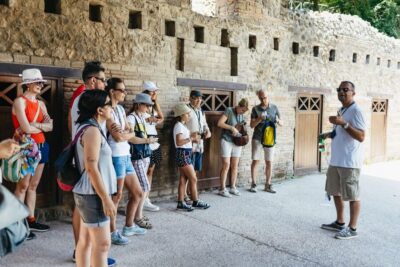
I like that the guide doesn’t treat Pompeii like a museum of random rocks. The goal is to give you one clear example from each type of building, so you leave with a mental map of how a Roman city worked: public life, religion, markets, food, and entertainment. You also get a small group cap (limited to 10 participants), which makes it easier to ask questions when something doesn’t look like the postcard.
The price is not cheap at $175.22 per person, but private guidance plus skip-the-line tickets plus time-smart access is where the value is. If you’re only in Pompeii for a few hours or you want context instead of just photos, this format often makes more sense than trying to “DIY fast.”
Meeting at Café Hortus Pompeii: how to start without stress
You meet your guide at Café Hortus Pompeii, right in front of the entrance at Via Villa dei Misteri 2, Pompeii Archeological Park. Ending back at the same spot is a simple win: you don’t have to think about a separate pickup or where the group disperses.
Two practical tips help this start feel smooth. First: bring your full names exactly as they’ll appear on the tickets, since full names are compulsory for ticketing. Second: plan your shoes like you’re walking for real, not sightseeing lightly. You’ll be on uneven surfaces and stone steps, and you’ll want grip.
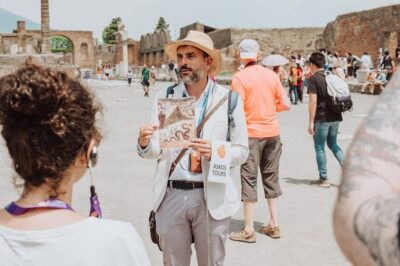
This is also one of those tours where you can set expectations early. The itinerary is flexible based on your interests and your physical abilities, so if you care more about daily life (shops, bakeries, baths) than about temples, you should say so. The guide is there for you, not for a generic script.
The first big wow: walking Pompeii’s basalt road
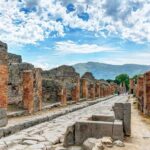
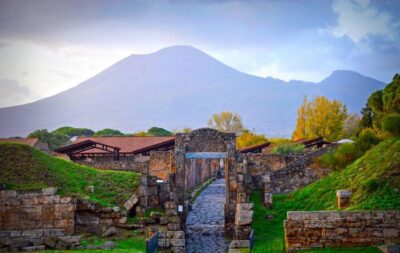
One of my favorite details in Pompeii is the street itself. On this tour, you walk along the original basalt road made of volcanic rocks. That matters because Pompeii isn’t just “old stuff.” It’s a functioning grid of streets and sidewalks, with engineering choices that worked for its weather, its traffic, and its nights.
Here’s what makes the walk special: you’ll see the little white travertine spots used to reflect torch light. So when people walked here after dark, those pale points helped guide footsteps through low, smoky light. It’s a small design choice, but it makes the whole city feel less dead and more lived-in.
You’ll also notice big basalt blocks along the road. They were used by pedestrians to avoid getting wet when it rained. That’s a very human detail. Nobody wants soggy shoes, even 2,000 years ago. And once you notice those choices, you start reading Pompeii differently: as a place with habits, workarounds, and daily routines.
Forum stops: where religion, power, and business intersect
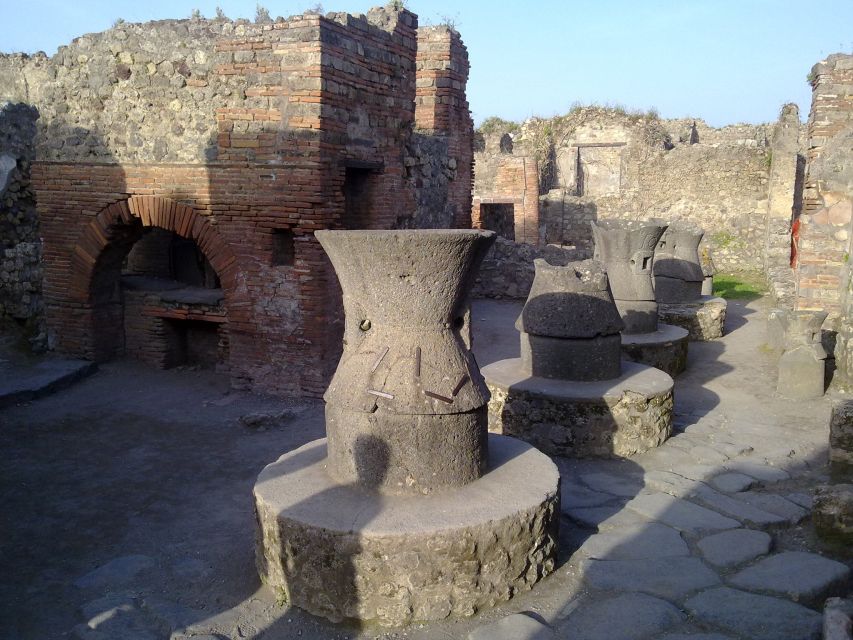
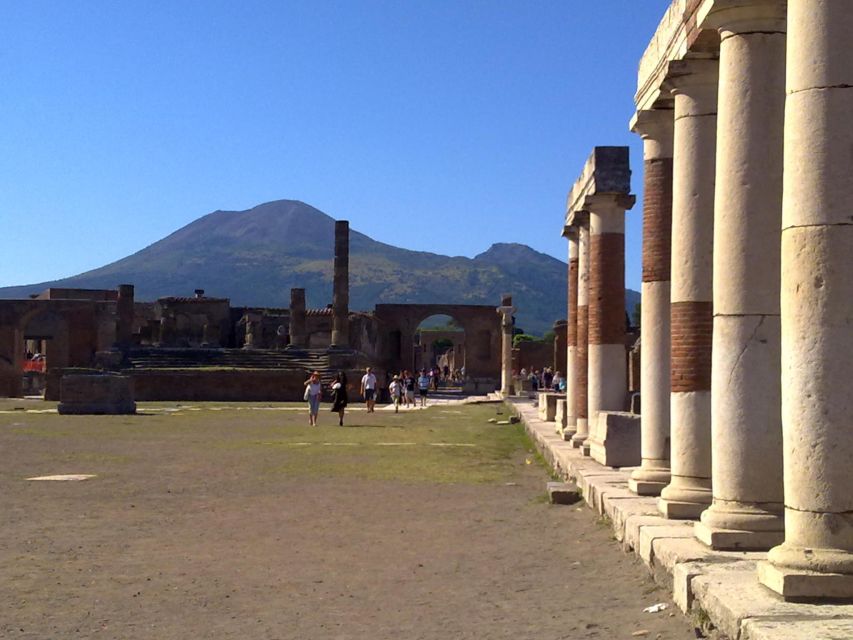
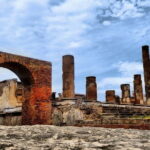
The heart of the city’s public life is the Forum. On your walk, you’ll see it as the center for religion, trade, administration, and politics. This is where Pompeii becomes more than ruins, because the buildings show how Romans organized daily power and community.
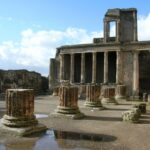
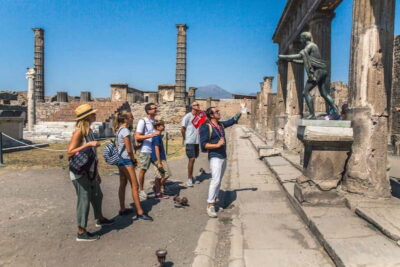
Expect stops around major landmarks, including the Temple of Apollo, the Capitolium, and the Temple of the Emperor area. You’ll also see the Basilica—an important civic building tied to public activities and legal or business life. If you’ve ever wondered how “government” actually worked in Roman cities, this cluster is where the answer lives.
One benefit of having a private guide here: you can slow down at the details that would normally look confusing. On a self-guided visit, it’s easy to see columns and assume that’s all there is. With a guide, you’re more likely to understand which structures were for which kind of public gathering. That turns your photos into something you can explain later.
There’s also the Macellum market area mentioned as part of the Forum zone. That’s the transition from power and ceremony into commerce and everyday shopping. Markets are where you get a feel for what people bought, how they ate, and how busy public life really was.
More of Pompeii Archaeological Site at street pace
Bakeries and the Roman fast-food feeling
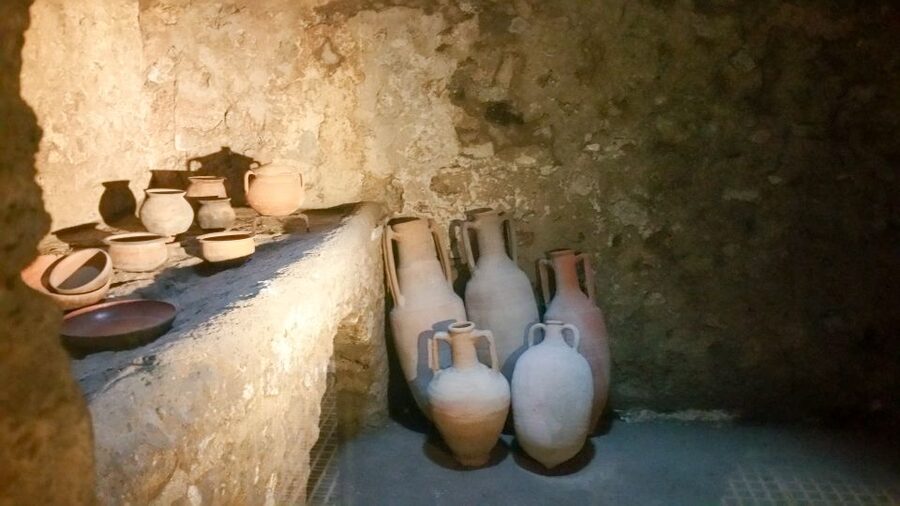
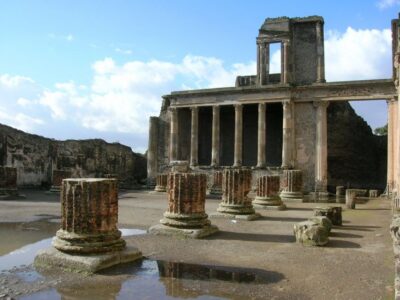
Pompeii does food better than most cities do. One of the tour’s standouts is the visit to a Pompeii bakery, where you can see evidence of carbonized loaves of bread found during excavation. That’s not abstract. It’s a physical reminder that people cooked and sold real bread on a normal day.
The tour even frames it as the Roman equivalent of fast food. That framing is useful. It helps you imagine the practical side: quick meals, grab-and-go habits, and the kind of routine food vendors served to keep people fed during work and errands.
Why I think this matters: when you learn about architecture, you often get stuck at the “wow” level. Food grounds you. You start thinking about smells, timing, and the everyday movement of people through streets. In a short two-hour tour, the bakery stop helps Pompeii feel personal instead of distant.
Human casts: why the story hits harder in person
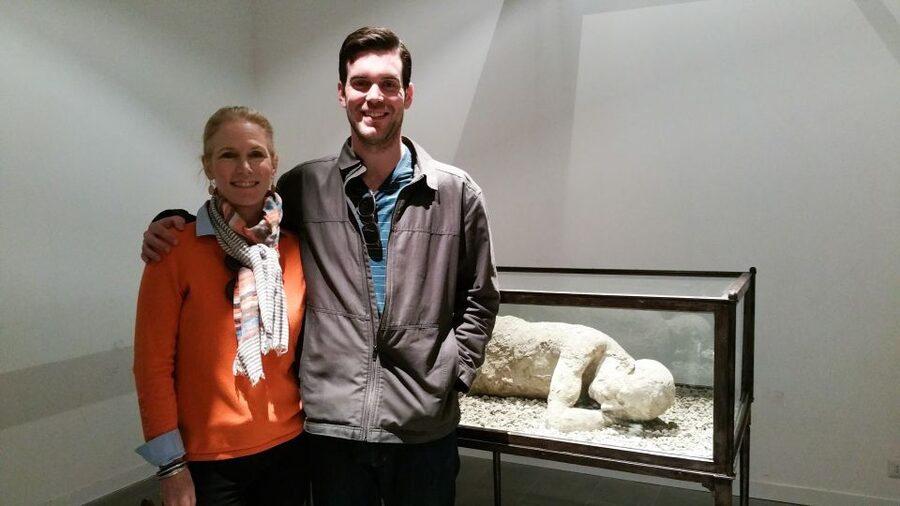
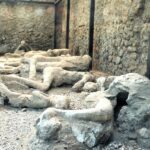
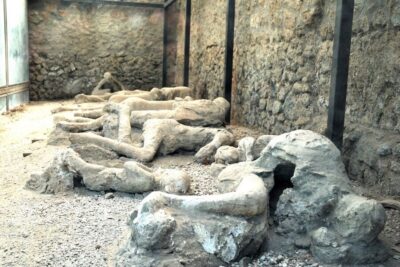
Pompeii’s impact is inseparable from its tragedy. On this tour, you’ll see a display of human casts of Pompeii residents caught by the eruption in the exact poses they died. It’s the kind of stop that changes your pace. You stop rushing. You look longer.
This is also where a guide earns their pay. A good explanation helps you understand what you’re seeing without turning it into a sensational moment. The goal isn’t shock. It’s scale and context—how an entire community met the same disaster, while the city around them still shows daily-life patterns in stone.
Even if you’ve read about Pompeii before, seeing the casts during a guided route tends to make the story land in a different way. It interrupts the sightseeing mode, which is exactly what Pompeii needs. Otherwise, it’s too easy to treat everything like a set.
Red-light district frescoes and the art people made for fun
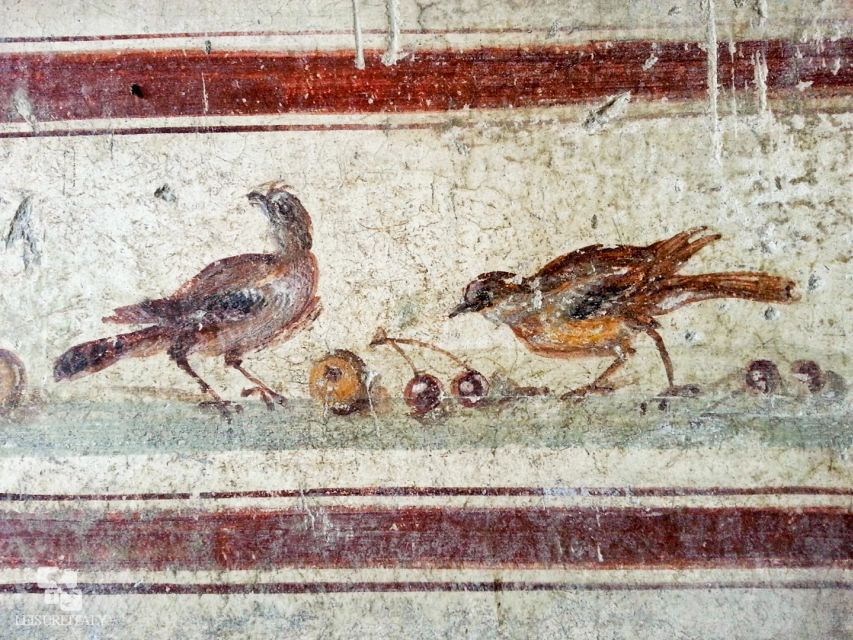
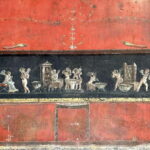
Your walk also includes the former Red Light District area. You’ll see Roman frescoes of erotic images. This stop can surprise people, because Pompeii is often packaged as purely educational. Here, you’re reminded that ancient life included humor, desire, and art meant for private spaces.
A guide’s role here is important for keeping it grounded. You’ll likely hear how these images fit into the kinds of rooms and daily rhythms you’re passing through. Without that context, it’s just images. With context, it becomes another window into how people used their homes and how art functioned socially.
If you’re traveling with teens or prefer more restrained content, it’s smart to think ahead and decide if this stop works for your group. The tour includes it as part of the route, so you won’t accidentally stumble into it like a surprise scene in a movie.
Theaters: one visit, three possibilities
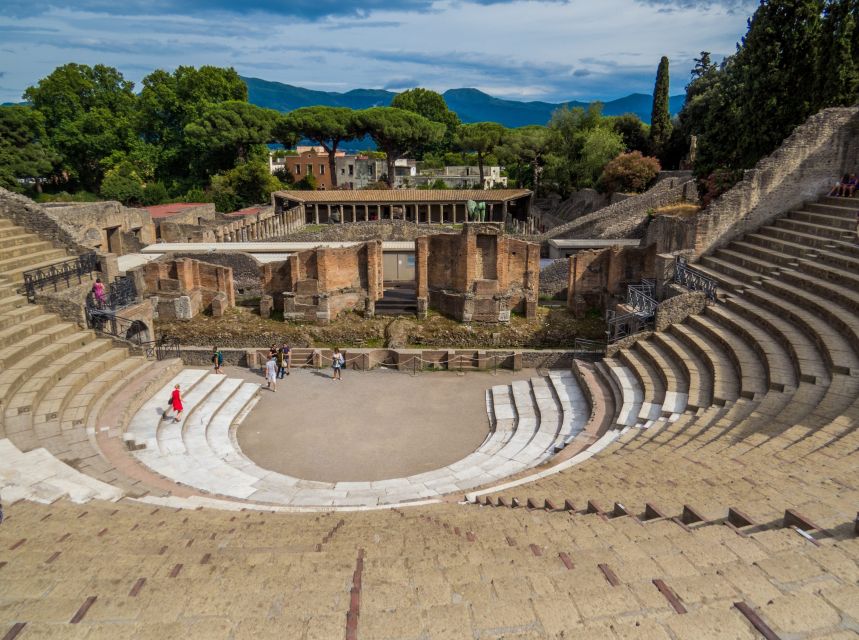
Pompeii has three theaters, and your tour will visit one of them: the outdoor arena for public performances, the indoor theater for mime and poetry, or the outdoor theater used for tragedies and comedies. Which one you see can depend on the day and the route choices.
Here’s the value of including theaters on a short, guided walk. Entertainment reveals a lot about a city. Romans didn’t just live and work; they staged stories, performed poetry, and gathered to watch plays. When you stand in a theater space and hear what it was used for, you start picturing the crowd energy and the kind of public events that filled the calendar.
The guide can help connect theater architecture to what happened there. That connection is hard to make alone unless you already know the vocabulary of the buildings.
How the rest of the city fills in the gaps
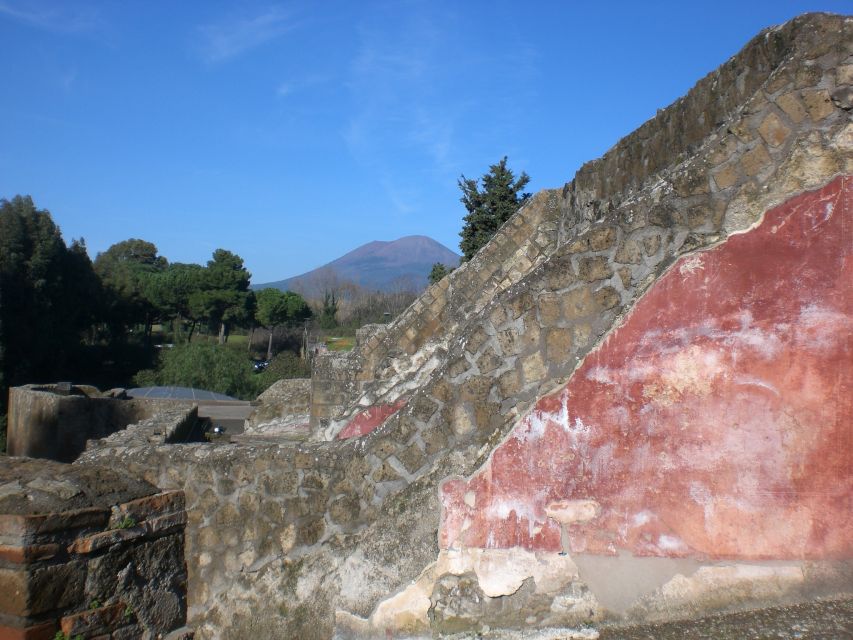
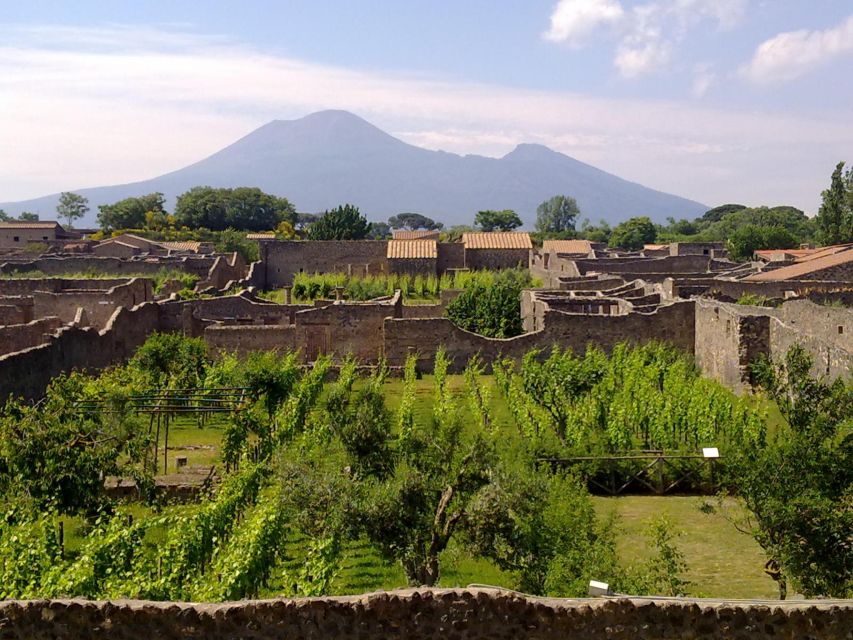
Besides the major stops, the tour is built to give you a sense of Pompeii as a full town, not just a few big-name monuments. The experience highlights public baths, villas, taverns, and shops. You’ll also encounter everyday urban texture—places where people ate, socialized, shopped, and did routine tasks.
That matters because Pompeii’s power is how well the city layout survives. When you pair those smaller “life” stops with the Forum’s big civic buildings, you get balance. Pompeii starts to look like a real place where different types of spaces served different needs.
And since the itinerary is described as flexible for interests and physical abilities, the guide can likely adjust how much time you spend on categories like food, public buildings, or entertainment. For many people, that customization is the difference between “I saw Pompeii” and “I understood Pompeii.”
Price and value: what you’re really paying for
At $175.22 per person, this tour costs more than buying an entry ticket and walking around independently. But value is about what you get for that spend.
You’re paying for:
- a private guide (so you get context and a pace matched to your group)
- Pompeii Express skip-the-line tickets
- access that allows you to visit all areas within the city walls
- enough structure to cover big categories of buildings within two hours
That last point is underrated. Pompeii can swallow time. If you’re trying to cover too much, you end up moving fast but learning little. This tour keeps your learning curve steep by choosing the most meaningful stops for a first-time visit.
If you’re going with someone who gets easily overwhelmed by crowds or details, private guiding helps a lot. You can ask questions when they come up, instead of saving them for a later guess.
If you’re the type who loves wandering with zero plan, you might still enjoy Pompeii on your own. But if you want the “what am I looking at and why does it matter?” answer, this is where that cost starts to feel justified.
Who this tour is best for (and who should skip it)
This tour is a great fit if you:
- want Pompeii in about two hours without losing time to confusion or lines
- like the idea of seeing one example of each type of building, so your mental map forms quickly
- prefer a guided explanation over walking between signs
- enjoy food stops and everyday-life details, not just monumental temples
It may be less ideal if you:
- can’t manage lots of walking on uneven stone
- need a fully wheelchair-accessible route (it’s not listed as suitable for wheelchair users or people with mobility impairments)
- are strongly uncomfortable with the erotic frescoes stop, since it’s part of the route
That said, one of the notes tied to the experience describes adaptation for someone using a wheelchair over longer stretches. The tour is still not listed as fully suitable, so don’t assume. Do ask directly about your specific needs before you book.
Book it or skip it: my call
I’d book this private tour if Pompeii is on your “must see” list and you want the ruins explained in a way that makes sense in real time. The combination of private guidance, skip-the-line access, and a route that covers Forum life, bakeries, theaters, and key everyday spaces is exactly what makes a short visit meaningful.
I’d skip it if you have plenty of time to explore on your own, or if your mobility needs require a fully accessible plan. Pompeii is demanding even on good days, and this experience is designed around walking.
If you’re in-between, choose this if you can handle the walking and you want context. Choose something else if your priority is a slow, stop-anywhere wander.
FAQ
How long is the Pompeii private walking tour?
The tour lasts 2 hours.
Where do I meet the guide?
Meet your guide at Café Hortus Pompeii, in front of the entrance at Via Villa dei Misteri 2, Pompeii Archeological Park. The tour ends back at the meeting point.
Does this tour include skip-the-line tickets?
Yes. It includes Pompeii Express skip-the-line tickets that allow you to visit all the areas within the city walls.
How big is the group?
The group is small and limited to 10 participants.
What languages are available for the live tour guide?
The live guide is available in Spanish, English, French, and Italian.
What will I see during the 2 hours?
You’ll see key parts of Pompeii’s public and everyday life, including buildings in the Forum area (such as the Temple of Apollo, the Capitolium, the Temple of the Emperor, and the Basilica), a bakery (including evidence of carbonized bread loaves), human casts display, the former Red Light District with erotic frescoes, and one of Pompeii’s three theaters. The route also aims to include examples across different building types.
Is the tour wheelchair accessible?
It is not suitable for wheelchair users and is not suitable for people with mobility impairments.
Do I need to provide full names for the tickets?
Yes. You must provide the full names of all participants because they are required for the tickets.
Is there free entry on the first Sunday of each month?
On the first Sunday of each month, entrance is free of charge, but tickets cannot be reserved ahead of time, so entry is not guaranteed.
More Tours in Pompeii Archaeological Site


More Tour Reviews in Pompeii Archaeological Site
More Pompeii Tours to Compare
More Pompeii Archaeological Site tours, freshly reviewed

Pompeii Tours, compared.
 ★ 4.8Pompeii: Entry Ticket and Guided Tour with an ArchaeologistFrom $3519,459 reviews
 ★ 4.1Pompeii: Entry Ticket with Audio GuideFrom $4013,491 reviews
 ★ 4.8Pompeii: Small Group Tour with an ArchaeologistFrom $4012,264 reviews
 ★ 4.3Pompeii Ruins & Mount Vesuvius Day TourFrom $12011,459 reviews
★ 5.0Pompeii Small Group Tour with an ArchaeologistFrom $356,593 reviews
★ 4.3Pompeii Ruins & Mount Vesuvius Day TourFrom $12011,459 reviews
★ 5.0Pompeii Small Group Tour with an ArchaeologistFrom $356,593 reviews
 ★ 4.5Skip-the-line Pompeii – Small Group TourFrom $544,401 reviews
 ★ 4.6Naples or Sorrento: Full-Day Pompeii and Mount Vesuvius TourFrom $1044,235 reviews
 ★ 3.9Pompeii: Skip-the-line Entry Ticket with Audio Guide & MapFrom $433,153 reviews
Browse the lists this tour appears in