

Review · POMPEII TOURS
Pompeii Small Group Tour with an Archaeologist
Pompeii hits fast when you’re not wandering blind. This small-group archaeologist tour helps you read the site instead of just taking photos, with stops at the Basilica, Forum, thermal baths, brothel, and theaters. I love the way the guide ties buildings to daily life, and I love the pacing that keeps the story moving. One thing to watch: you cover a lot in about 2 hours, so you’ll want steady feet on uneven ground.
You’ll start at Porta Marina Superiore with a sign and head straight into Pompeii with skip-the-line tickets (the Pompei Express entry). Then you’ll walk key streets and squares, stopping long enough to make sense of what you’re looking at—especially the famous plaster casts and the city’s major public spaces.
If you want the easy win—an efficient Pompeii overview with real context—this is a strong choice. If you’re expecting a slow, sit-down museum-style tour, plan for more movement and occasional waiting as the group stays together.
In This Review
- Key things that make this Pompeii archaeologist tour work
- Entering Pompeii at Porta Marina Superiore, without the line drag
- Basilica and Forum: how Pompeii’s civic center comes alive
- Granaries of the Forum and the plaster casts that stop you cold
- Houses, frescoes, and Stabian Baths: everyday luxury and daily routines
- Lupanar, House of Faun, and Pompeii’s main street effect
- Odeon and Teatro Piccolo to Teatro Grande: Roman entertainment at scale
- Pacing, group size, and what to expect from a 2-hour format
- What to wear, bring, and watch for on uneven Pompeii paths
- Quick verdict: should you book the Pompeii archaeologist small-group tour?
- FAQ
- Where do I meet the guide for this Pompeii small-group tour?
- Is the skip-the-line entrance ticket included?
- How long is the tour and is it offered in English?
- Are headsets provided?
- Is the tour wheelchair or scooter friendly?
- What should I bring or wear, and does it run in bad weather?
- FAQ
- Where do I meet the guide for this Pompeii small-group tour?
- Is the skip-the-line entrance ticket included?
- How long is the tour and is it offered in English?
- Are headsets provided?
- Is the tour wheelchair or scooter friendly?
- What should I bring or wear, and does it run in bad weather?
- Can I cancel for a full refund?
Key things that make this Pompeii archaeologist tour work
- Porta Marina Superiore start with Pompei Express skip-the-line entry so you waste less time at the gate
- Licensed archaeologist guide who explains what you’re seeing, not just where to look
- A tight loop of the highlights: Basilica, Forum, Granaries, House of Menander, Stabian Baths, Lupanar, theaters
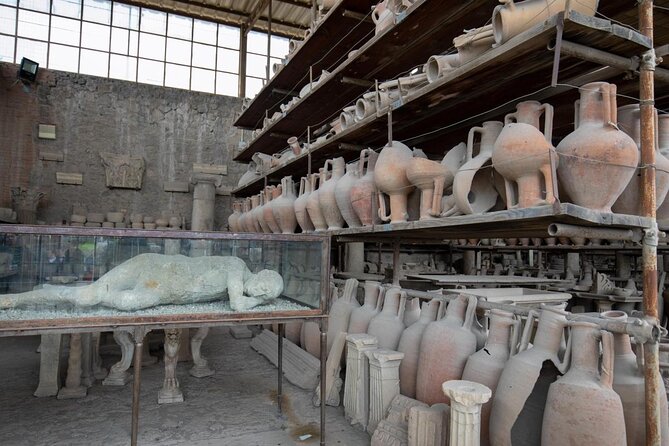
- Plaster casts at the Granaries of the Forum including victims plus casts of a dog and a tree
- Small group size (max 20) with headsets if your group is 16+
- Guided route ends inside the ruins so you can keep exploring afterward at your own speed
Which Pompeii ticket and guide? Compare a few more.
- Pompeii Small Group Tour with an Archaeologist★ 5.0 · 6,593 reviews
- Discover the Ancient Ruins of Pompeii: Day Trip from Rome★ 3.5 · 2,247 reviews
- Pompeii and Herculaneum Small Group Tour with an Archaeologist★ 5.0 · 1,350 reviews
- Skip the Line Guided Tour of Pompeii led by an Archaeologist★ 5.0 · 703 reviews
Entering Pompeii at Porta Marina Superiore, without the line drag
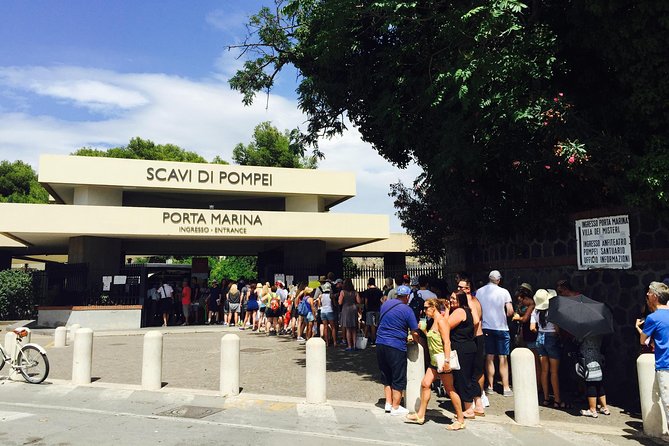
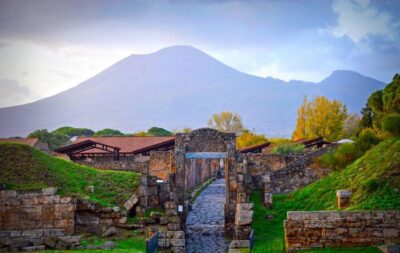
The biggest practical win here is where and how you enter. You meet your archaeologist guide at Porta Marina Superiore and go straight into the ruins with a skip-the-line ticket, the Pompei Express entry. That matters in Pompeii because queues and wandering can steal the best part of your day.
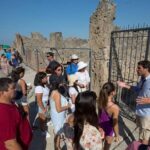
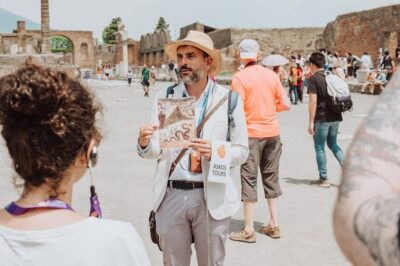
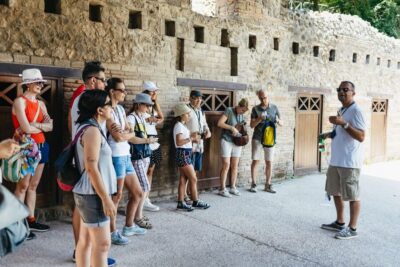
I like that the start is clear and human. The guide holds a sign with the company name, so you can get your bearings fast. And because this is capped at 20 people per guide, you’re less likely to feel like you’re herding cats through ancient streets.
There’s also a comfort upgrade if your group is larger. If you’re in the 16-plus range, you’ll get headsets, which helps a lot when you’re moving along windy streets or the guide is talking over foot traffic. Even when headsets aren’t mentioned for your group size, the small-group setup usually makes questions easier.
One more thing: the tour finishes inside the archaeological park. That’s helpful. You don’t have to retrace your steps immediately to get your bearings again.
Basilica and Forum: how Pompeii’s civic center comes alive
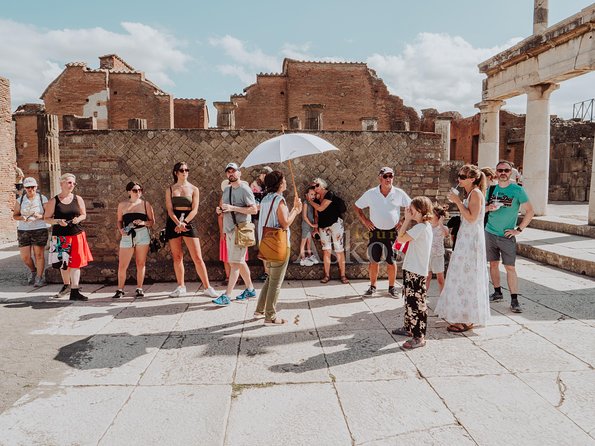
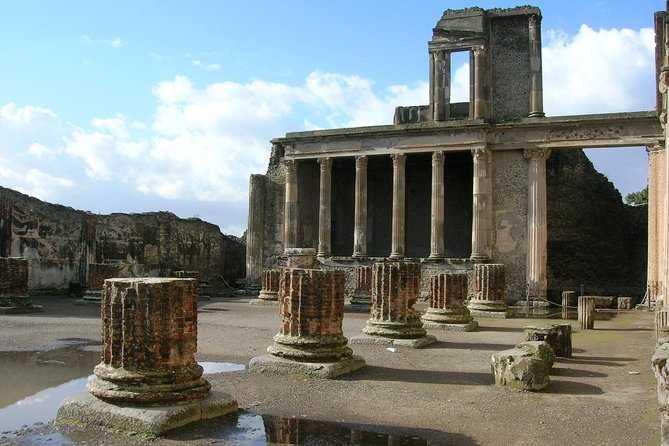
The first major stop is the Basilica, described as an open portico where merchants and other activities took place. It’s not a temple vibe. It’s a public-work vibe. As you look at the space, your guide’s job is to help you imagine the rhythm: people waiting, bargaining, chatting, and handling business in a covered-open area.
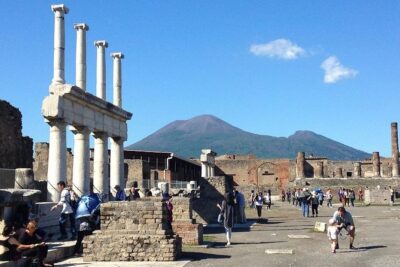
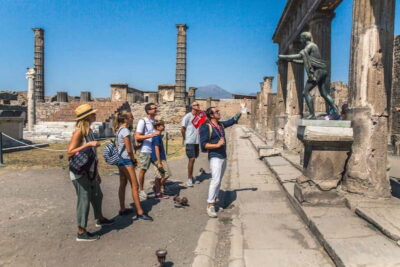
Then you move into the heart of civic life with the Forum (Foro de Pompeya). The Forum is Pompeii’s main square, and this is where the site starts to feel like a real town. You’re not just looking at stone walls. You’re mapping power, commerce, and public ritual onto the layout.
Why this matters for you: if you tour Pompeii solo, the buildings can feel like a jumble. With a guide starting at these central public areas, your brain has a framework. You can later connect other places—houses, baths, theaters—back to how people organized their day.
A small caution: you’ll be outdoors and walking between points. The Forum and central streets can feel hot in summer, and the paths can be uneven. If you’re the type who needs frequent sitting breaks, this tour might feel brisk.
Granaries of the Forum and the plaster casts that stop you cold
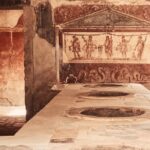
Next comes one of the most emotionally heavy parts of Pompeii: the Granaries of the Forum. In this stop, you see marble tables and features connected to baths and fountains that once adorned house entrances. It’s a reminder that Pompeii wasn’t only tragedy and ruins—it had style, public water, and everyday detail.
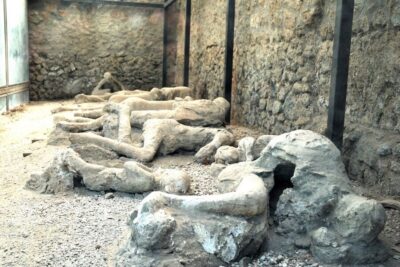
And then you reach the plaster casts of victims from the eruption, including casts of a dog and a tree. Even if you’ve seen photos before, seeing casts in the context of this specific area hits differently. It’s not just a graphic exhibit. It’s a spatial story—where people were when disaster struck, and how the city’s final moments unfolded in particular corners of the town.
For many people, this is the moment when Pompeii stops being a history lesson and becomes human. Guides often handle this part with careful storytelling, and the best ones make you think about what was lost beyond the obvious.
The drawback here is pacing. The tour stays moving, so you may not have endless time to linger. If you want long, quiet study time at the casts, you’ll likely need to plan extra self-guided hours after the tour finishes.
Houses, frescoes, and Stabian Baths: everyday luxury and daily routines
After the civic core and the eruption aftermath, the tour shifts toward private life and public leisure.
You’ll visit the House of Menander, one of the richest houses in Pompeii for architecture and decoration. The name matters because it signals status. This is where you start noticing how wealth showed up in the details: room layouts, ornamental choices, and the kind of decoration that wasn’t for one ceremonial moment, but for living.
Then you’ll get to the Stabian Baths (Terme Stabiane), which occupy a vast area and are described as the oldest thermal complex in the city. Baths are a great Pompeii lesson tool because they explain social behavior. People didn’t just wash. They met. They relaxed. They talked. And they used spaces in rhythms you can still recognize.
This stop is also a good place to spot how Pompeii’s design changes from house privacy to public community. The baths sit between big crossroads and major streets, so your guide can help you connect why they mattered to everyone, not just the wealthy.
And yes, there are visually rewarding moments along the way. You’ll pause to admire frescoes and mosaics inside key areas. That’s not fluff. Those decorations teach you what residents valued—visual storytelling, status display, and craftsmanship.
One consideration: you’re indoors and outdoors across uneven paths. In summer, shade can be limited. Bring water and plan to slow your step on climbs.

Lupanar, House of Faun, and Pompeii’s main street effect
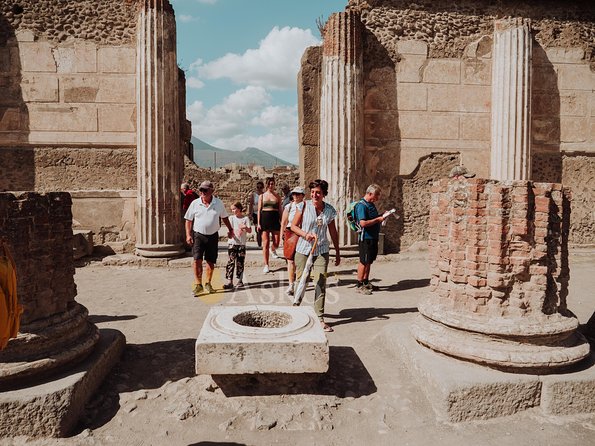
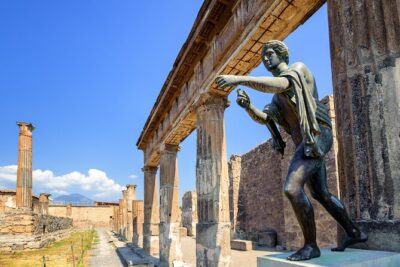
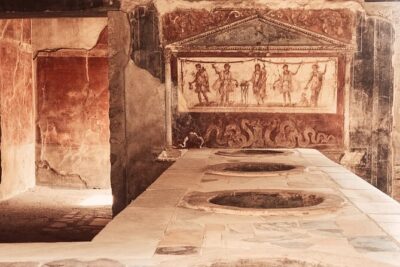
Pompeii has a reputation partly because of the Lupanar, the most famous brothel in the ruined city. This stop can feel provocative, but it’s also useful. It’s part of how the ancient city handled commerce, desire, and social realities. A good archaeologist guide doesn’t sensationalize. They connect the site to street life and the practical workings of an urban economy.
From there, the tour continues with time in the House of the Faun, one of the largest and most impressive private residences in Pompeii. This is a strong contrast to the civic spaces. You see how wealth shaped domestic architecture and how big wealthy homes were designed to handle visitors, family life, and display.
You’ll also walk along the main street during the route. That’s a smart move. Street-level walking helps you understand scale. You start guessing distances, noticing how buildings face the road, and realizing how the city’s layout shaped daily movement.
Why I think this works for you: Pompeii can overwhelm your eyes. A route that moves from forum life to houses to entertainment and then back to street context makes the town feel connected instead of scattered.
Potential downside: because the brothel and house interiors are set into a walking schedule, you may not get a deep, slow reading of every room. If that’s what you want, treat this as your orientation day, then spend more time later on the areas that grabbed you.
Odeon and Teatro Piccolo to Teatro Grande: Roman entertainment at scale
The tour finishes with Pompeii’s theater story, and it’s a good ending theme. Rome loved public entertainment, and theaters were built to make crowds part of the show.
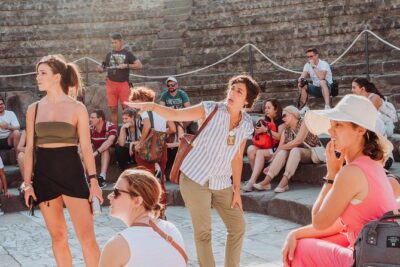
You’ll have a brief stop at the Odeon, plus a look at the Teatro Piccolo, and then visit the city’s largest theater, Teatro Grande. That sequence helps you grasp how the city supported different audience sizes and event types.
Teatro Grande is the big one. Standing in or near a major theater space, even in ruins, helps you picture how sound carried, how people found their places, and how performances became community rituals. It’s also a helpful counterpoint to the tragedy sites. Pompeii wasn’t only fear. It was also laughter, music, and spectacle.
If you’re a first-timer, theaters are a great “wow” payoff. Even if you don’t know Roman performance history, the layout tells you what you need to know. And if you do care, your archaeologist guide should connect architecture to Roman civic culture.
One small practical note: you’ll still be walking during this portion. Set expectations that the last stop is also your final stretch of the walk.
Pacing, group size, and what to expect from a 2-hour format
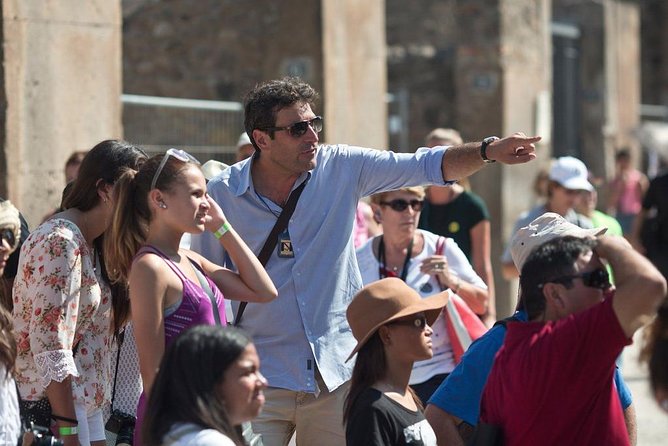
This tour is designed to pack major stops into about 2 hours. That’s both the strength and the trade-off.
The strength is clarity. You get a curated, guided route through the places that actually help you understand Pompeii’s layout. Guides also tend to tell stories that go beyond the stonework. In past tours, I’ve seen different archaeologist guides bring a strong narrative style—Teresa, Alessandra, Paolo, Alfredo, Antonio, Vincenzo, Jolanta, Rafaela, Amadeo, and Julia have all been mentioned by name for making Pompeii feel human and understandable.
The trade-off is time at each stop. If your ideal Pompeii day includes long reads of inscriptions, extra photos in every corner, and extended time in the deepest interiors, you’ll likely want a follow-up self-guided visit after the tour ends.
I also suggest you arrive early. The tour has a fixed start, and Pompeii’s site size makes it hard to catch up once you’re behind the group. One delayed start or headset hiccup can happen anywhere, but you can reduce your risk by being on time and ready to walk.
What to wear, bring, and watch for on uneven Pompeii paths
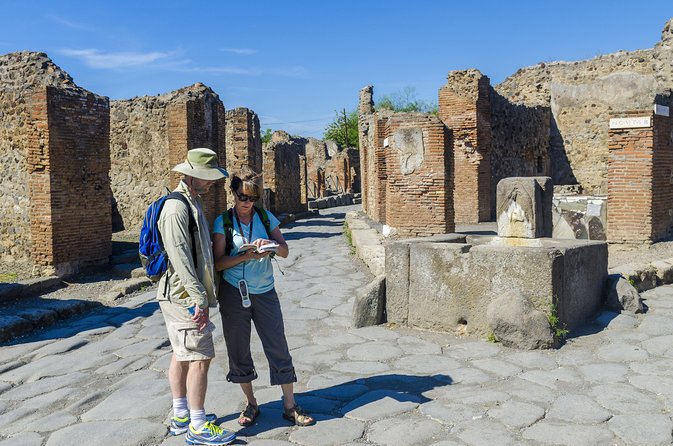
Pompeii is not flat. Even when the route is “just walking,” you’ll deal with uneven ground, steps, and ramps.
For comfort, wear comfortable shoes with good grip. Sunglasses and sunscreen matter in summer because shade can be limited. Bring a small bottle of water. It’s a small request that turns into a big quality-of-life upgrade.
For most people, this tour is described as possible. But it’s not set up for everyone. Mobility scooters aren’t allowed. And the tour is not recommended if you have mobility issues or impairments due to steps and ramps. If you fall into that category, you should ask about a suitable private tour option.
Also worth knowing: the tour is available year-round with rain or shine. That means you should pack for wet stone as well as sun.
If you travel with a small dog, there are strict rules. Only dogs that don’t exceed 10 kg and 40 cm height are permitted, and they must be on a leash and held in the arms inside buildings, with cleanup required. Service animals are allowed.
Quick verdict: should you book the Pompeii archaeologist small-group tour?
If you want a smart first look at Pompeii—guided by someone with an archaeology background—this is a good value. The price is low for what you get in a short window: small group size, headsets when needed, and a skip-the-line entry ticket included.
Book it if:
- you want to understand what you’re seeing, not just where to stand
- you like story-driven stops at the Forum, baths, houses, and theaters
- you plan to keep exploring after the tour ends
Skip it or consider a different format if:
- you need a slower pace with lots of sitting time
- you have mobility limitations that make steps and ramps difficult
- you want maximum time inside one or two sites rather than a broad overview
FAQ
Where do I meet the guide for this Pompeii small-group tour?
You meet your archaeologist guide at the Pompeii archaeological park entrance called Porta Marina Superiore. The guide holds a sign with the company name Askos Tours.
Is the skip-the-line entrance ticket included?
Yes. The tour includes a Pompei Express entrance ticket, and the plan is to head directly inside Pompeii after meeting the guide.
How long is the tour and is it offered in English?
The tour runs about 2 hours. It is offered in English.
Are headsets provided?
Headsets are provided for groups of 16 or more people.
Is the tour wheelchair or scooter friendly?
Mobility scooters are not allowed. The tour is also noted as not recommended for travelers with mobility issues or impairments due to steps and ramps.
What should I bring or wear, and does it run in bad weather?
Wear comfortable shoes. In summer, use sunglasses and sunscreen, and bring a small bottle of water. The tour runs rain or shine.
FAQ
Where do I meet the guide for this Pompeii small-group tour?
You meet your archaeologist guide at the Pompeii archaeological park entrance called Porta Marina Superiore. The guide holds a sign with the company name Askos Tours.
Is the skip-the-line entrance ticket included?
Yes. The tour includes a Pompei Express entrance ticket, and the plan is to head directly inside Pompeii after meeting the guide.
How long is the tour and is it offered in English?
The tour runs about 2 hours. It is offered in English.
Are headsets provided?
Headsets are provided for groups of 16 or more people.
Is the tour wheelchair or scooter friendly?
Mobility scooters are not allowed. The tour is also noted as not recommended for travelers with mobility issues or impairments due to steps and ramps.
What should I bring or wear, and does it run in bad weather?
Wear comfortable shoes. In summer, use sunglasses and sunscreen, and bring a small bottle of water. The tour runs rain or shine.
Can I cancel for a full refund?
Free cancellation is available up to 24 hours in advance for a full refund. Canceling less than 24 hours before the experience start time is not refundable.
More Tours in Pompeii

More Tour Reviews in Pompeii

More Pompeii Tours to Compare
More Pompeii tours, freshly reviewed



Pompeii Tours, compared.
 ★ 4.8Pompeii: Entry Ticket and Guided Tour with an ArchaeologistFrom $3519,459 reviews
 ★ 4.1Pompeii: Entry Ticket with Audio GuideFrom $4013,491 reviews
 ★ 4.8Pompeii: Small Group Tour with an ArchaeologistFrom $4012,264 reviews
 ★ 4.3Pompeii Ruins & Mount Vesuvius Day TourFrom $12011,459 reviews
 ★ 4.5Skip-the-line Pompeii – Small Group TourFrom $544,401 reviews
 ★ 4.6Naples or Sorrento: Full-Day Pompeii and Mount Vesuvius TourFrom $1044,235 reviews
 ★ 3.9Pompeii: Skip-the-line Entry Ticket with Audio Guide & MapFrom $433,153 reviews
 ★ 4.0Pompeii & Mt.Vesuvius Day Tour from Naples with Pizza LunchFrom $1492,901 reviews