
Review · POMPEII TOURS
Pompeii: Tour with Archaeologist Guide & Skip-the-Line Entry
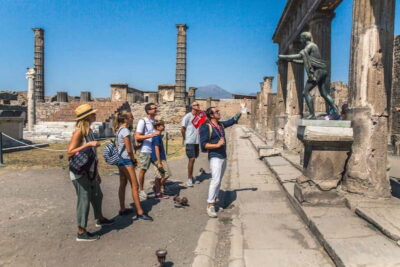
Pompeii hits different when a pro steers you. With skip-the-line entry and an archaeologist guide, this 2-hour walk turns a huge UNESCO site into something you can actually understand. You’ll meet at the Welcome box, get access quickly, and follow a route designed to show how Romans lived before Vesuvius changed everything.
What I like most is the focus on interpretation: you’re not just staring at stones. You’re hearing why places mattered—art, daily customs, and even plaster casts that help bring the city into focus. I also appreciate that the tour is paced for questions, not speed-walking through the highlights.
The main thing to consider is timing. It’s only two hours, and if you arrive late after the group has departed, your group ticket can be lost, so plan to be there early and ready.
In This Review
- Key highlights you’ll feel during the walk
- Why this Pompeii tour makes sense for first-timers
- Entering Pompeii: priority access and the Welcome box check-in
- Porta Marina and Teatro Piccolo: the route that gets you oriented fast
- Casa degli Amanti: homes, wall art, and reading everyday Roman life
- Thermopolium and the city of quick meals
- A short free moment, then Terme Stabiane for the social side of bathing
- Lupanare: a frank look at Roman nightlife and sexuality
- The Foro Civile di Pompei and Basilica: places built for civic power
- What the best guides do with crowded Pompeii
- Price check: is $32 worth it for skip-the-line and archaeologist guidance?
- Practical tips so the experience feels smooth, not stressful
- Who should book this tour (and who should choose something else)
- Should you book Pompeii: Tour with Archaeologist Guide and Skip-the-Line Entry?
Key highlights you’ll feel during the walk
- Skip-the-line priority access: fewer delays at the entrance means more time inside the excavations.
- Archaeologist-led explanations: you get context for buildings, art, and everyday life, not just dates.
- Radio guidance when groups get larger: you may be given a radioguide if the group size requires it.
- A route through Pompeii’s most readable places: Porta Marina, forums, baths, and more, in a logical flow.
- Stop-by-stop structure with short breaks: quick pauses and small free-time windows to catch your breath and photos.
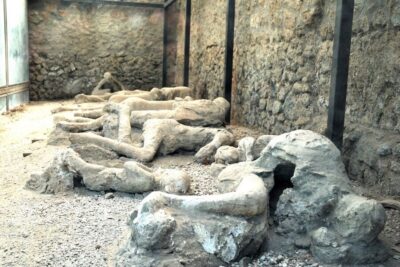
- Plaster casts and artifacts focus: you see more than walls—your guide helps you connect what you’re seeing to real people.
Which Pompeii ticket and guide? Compare a few more.
- Pompeii: Entry Ticket and Guided Tour with an Archaeologist★ 4.8 · 19,459 reviews
- Pompeii: Small Group Tour with an Archaeologist★ 4.8 · 12,264 reviews
- Pompeii: Skip-the-line Entry Ticket with Audio Guide & Map★ 3.9 · 3,153 reviews
- Naples: Pompeii and Mt. Vesuvius with Lunch and Wine Tasting★ 4.5 · 2,454 reviews
Why this Pompeii tour makes sense for first-timers
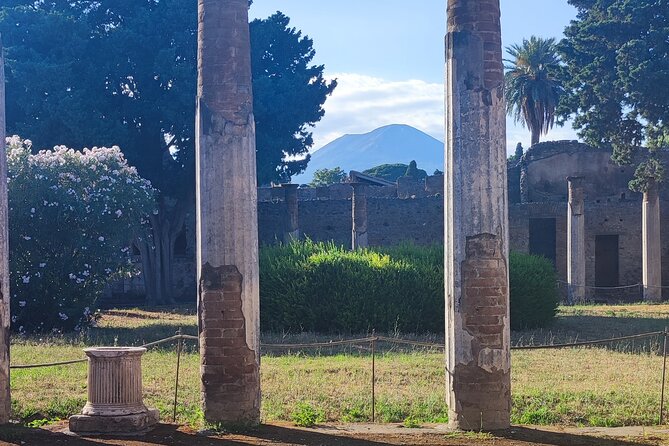
Pompeii is one of those rare places where the past looks uncannily close. The city was founded as far back as the 7th century BC, and in 79 AD Vesuvius buried it under ash and debris, preserving homes, streets, workshops, and public buildings. That preservation is what makes Pompeii so special: you’re not reconstructing everything from fragments—you’re walking through an almost intact Roman city.
The big win of a guided format is meaning. A self-guided stroll can feel impressive, but it’s easy to miss the point of each building—what it was used for, how people moved through space, and what the details were telling you. This tour is built to give you that translation layer, which matters because Pompeii is enormous.
Also, the site can be crowded and slow at entrances. Getting skip-the-line entry is not just convenience; it’s value. If you lose your morning waiting in queue lines, you’re trading one of the few calm hours for another half-hour of standing around.
Entering Pompeii: priority access and the Welcome box check-in
The practical part starts before you ever step into the ruins. You meet at the Welcome box, and from there you’re guided into Pompeii with priority entry that helps you avoid long ticket lines. The goal is simple: you start faster, so the guide can spend the 2 hours where it counts.
Bring what you’re told to bring: a passport or ID card (copies are accepted). For what you carry, plan light. Bags aren’t allowed, and bikes and alcohol/drugs are also not permitted, so don’t count on packing your day like a museum visit.
One small but important heads-up: if you arrive late and the tour has already left, you won’t be able to join, and your tickets can be lost since they’re group tickets. That’s not meant to scare you—it’s meant to keep you from losing money and momentum. Build in buffer time so you can meet your guide calmly.
Porta Marina and Teatro Piccolo: the route that gets you oriented fast
Your tour begins at Porta Marina, one of the city’s key gateways. In about 10 minutes, you get the first mental map: how people entered, how streets connected, and how this city functioned as a system rather than scattered ruins. For first-time visitors, that orientation is gold. Without it, Pompeii can feel like a lot of impressive architecture with no clear order.
Next comes Teatro Piccolo, also visited for roughly 10 minutes. Even if you don’t consider yourself a theater person, this stop helps you see Pompeii’s social rhythm. Romans didn’t only work and shop; they gathered, watched, and talked. A small theater like this gives you a more human sense of daily life—less spectacle, more community.
What I like about starting here is that your brain gets trained early. After Porta Marina and Teatro Piccolo, later stops like the forums and bath areas start making more sense because you already have a sense of where people were moving and why.
Casa degli Amanti: homes, wall art, and reading everyday Roman life

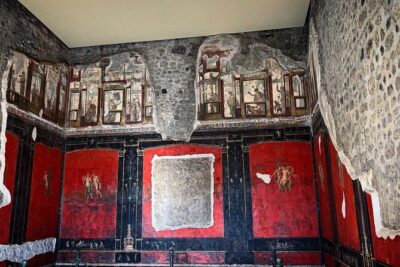
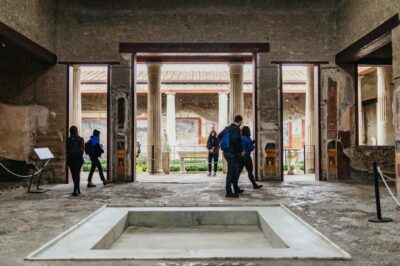
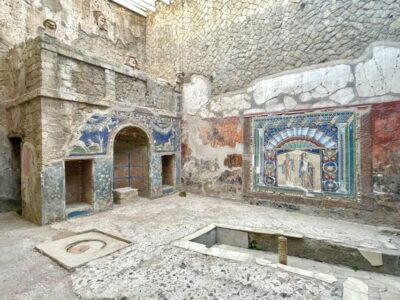
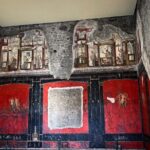
Then you head to Casa degli Amanti for about 15 minutes. This is one of those places where Pompeii shines. A preserved home shows more than rooms—it shows taste, routines, and the kind of visual messaging people lived with.
The house stop matters because it gives you a contrast to the public spaces. At a forum or theater, you’re watching social life from a distance. In a home, you get closer to private habits—how rooms were organized, how art and decoration worked as status and storytelling, and what daily life may have looked like.
And this is where the guide’s expertise really pays off. When you hear how a guide connects details to everyday customs, you stop treating Pompeii like a set of attractions and start treating it like a lived-in city.
More guided runs around Pompei Campania


Thermopolium and the city of quick meals

Next up is the Thermopolium, another 15-minute stop. A thermopolium was basically a public food stop—think of it as something like a fast-eat place in a Roman neighborhood. Even the term sounds unfamiliar until you see the setup and understand how people grabbed hot drinks or prepared food without cooking at home.
This stop is valuable because it breaks the Pompeii story out of the big monuments mode. You’re learning about habits: what people ate, where they did it, and how commerce worked at street level. It’s a reminder that Rome wasn’t only marble and myths; it was routine and transactions.
There’s also a wider point here for your visit: Pompeii is full of small details that become meaningful once someone explains the function. The thermopolium is exactly that kind of place.
A short free moment, then Terme Stabiane for the social side of bathing
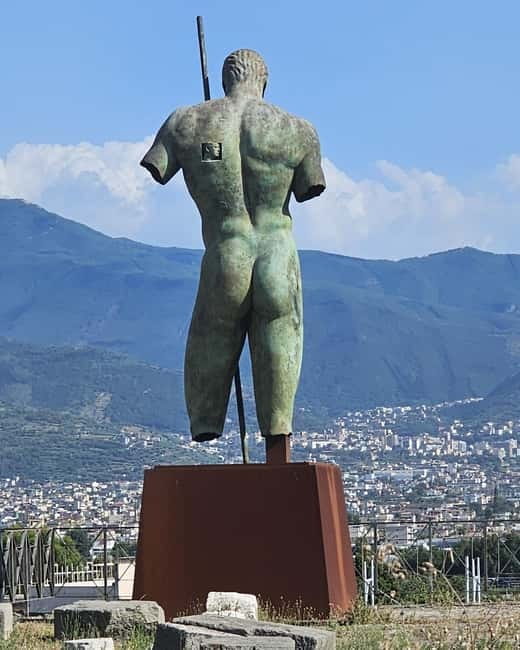
Between scheduled stops, you get a brief free time window (about 5 minutes). It’s short on purpose. Use it to refocus, grab water if you need it, and keep your energy for what comes next.
Then you’ll visit Terme Stabiane for around 15 minutes. Bathing in Pompeii wasn’t just hygiene; it was social time. The baths are also a great setting to understand how Roman buildings used water, circulation, and room layout. If you like architecture that has a job to do, this is a strong stop.
One more practical note from the general experience of Pompeii: it can get hot and the walking can add up. The fact that the tour alternates public sites, home life, and food/bath stops helps keep you from feeling like you’re stuck in one kind of ruin the whole time.
Lupanare: a frank look at Roman nightlife and sexuality
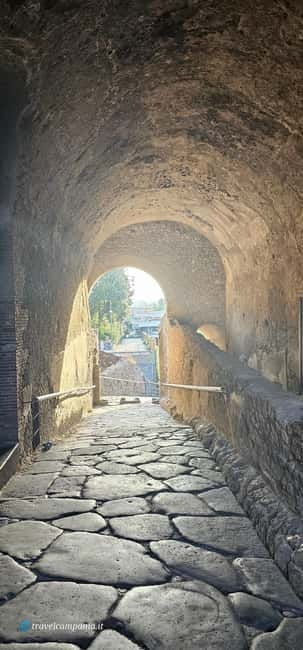
Your next main stop is the Lupanare (around 20 minutes). This is one of the city’s more direct reminders that Roman life included sexual commerce and organized adult entertainment. The building type is specific, and it’s also one of the places where having a guide makes a huge difference. Without context, it can feel sensational rather than historical. With context, it becomes a window into how society worked, what norms existed, and how spaces were designed for particular uses.
A stop like this can be uncomfortable for some people. If you’re visiting with kids, you might want to think about what you’re comfortable answering. But from a learning standpoint, it’s also one of the best examples of Pompeii documenting everyday behavior and built form at the same time.
If you’re the type who enjoys learning how societies really functioned, this is where the tour earns its keep.
The Foro Civile di Pompei and Basilica: places built for civic power
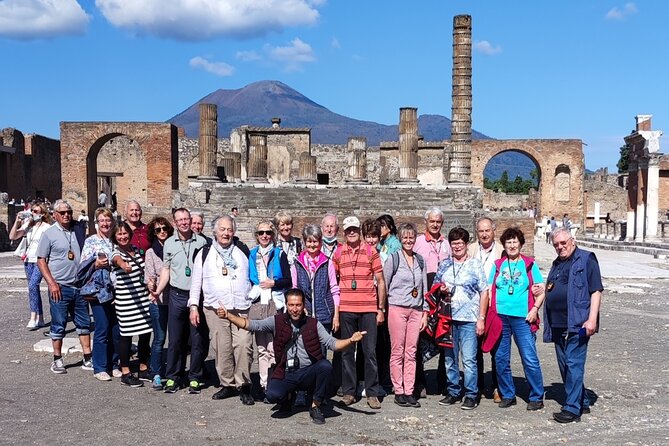
Next you’ll visit the Foro Civile di Pompei for about 15 minutes. The forum is where civic life shows up in stone: laws, announcements, business, social status, and public gatherings. When the guide explains how the forum worked, you start seeing it as a set of roles and routines, not just a big open area.
After that, there’s another free time stretch of about 10 minutes, and then the tour ends at the Basilica with time for a self-guided visit. That setup is smart. The guide gives you enough civic context at the forum that when you walk around the Basilica on your own, you’ll notice details instead of just admiring scale.
The self-guided piece at the end also helps you match your own pace. If you want extra photos or a slower read of the space, you can do it without holding up the whole group. And if you’re ready to keep exploring, you’re positioned well to do it.
What the best guides do with crowded Pompeii
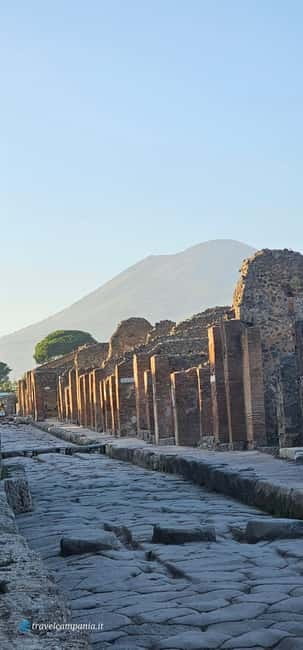
This tour’s success is heavily about the guide. The operator listed for this experience is Angelo (Travelcampania), and many guides who lead this style of tour show a similar strength: keeping the group moving while still giving clear explanations and time for questions.
In the real world, Pompeii is crowded, and the earpiece system can be the difference between hearing clearly and feeling lost. If your group is large enough, you may receive a radioguide—some visitors find the audio helpful for understanding through crowds. On a busy day, that means you can stay with the story instead of standing at the edge, straining to hear.
You’ll also want to watch the tour pace. People who enjoy this tour tend to like an efficient route, short stops with focused context, and then the option to wander afterward. If you hate structured tours, this might feel a bit tight. But if you want a guided framework you can build on, it’s a solid fit.
Price check: is $32 worth it for skip-the-line and archaeologist guidance?
At $32 per person for a 2-hour experience, the value isn’t only the ticket. You’re paying for three things that are hard to get on your own on a crowded day: priority entry, an archaeologist-style expert guide, and a route that targets key buildings and everyday life stops.
If you’ve ever tried to plan Pompeii by yourself, you know the problem: there’s so much to see that you can’t easily decide what to prioritize. This tour solves that decision fatigue for you. And if you do it early in your visit, you can use what you learned to guide your later self-exploration.
One more practical value point: entry includes the Pompeii Express ticket as part of the tour package. So you’re not piecing together multiple steps while trying to find your way in a busy site.
That said, two hours is not a full Pompeii day. It’s a smart introduction, not a complete cover-all. If you want to see every major site in detail, plan to stay after the tour ends and pick a few extra targets.
Practical tips so the experience feels smooth, not stressful
Pompeii is famous, which means queues, crowds, and tight meeting spots are part of the reality. Here’s how I’d set yourself up based on what’s supported for this tour:
- Be at the Welcome box early, not right on time, because late arrivals can mean missing the departure with group tickets.
- Travel light: no bags are allowed.
- Bring your ID/passport (copies are accepted).
- Expect walking over uneven outdoor excavations. Comfortable shoes matter more than fashion.
- If you need storage, there are free lockers at the gates for backpacks, and there may be water fountains on-site even if they’re not clearly marked.
Language is another practical piece. The live guide operates in English, Italian, French, Spanish, and German. If you’re in a smaller language group, there’s a possibility the format shifts to audio support with an Italian-speaking guide. Either way, the priority is that you understand what you’re seeing.
Also note the tour is not suitable for people with mobility impairments, wheelchair users, or people over 95 years. Pompeii’s surfaces and the site layout make this a hard match for full accessibility.
Who should book this tour (and who should choose something else)
I’d recommend this tour if you want a strong first pass through Pompeii, especially if it’s your first time and you’d rather learn what you’re seeing than guess. It’s also a good choice if you hate wasting time in line and prefer your day inside the excavations.
You might choose a different option if you already know Pompeii well, or if you want a longer deep session where you can linger at each stop without the pressure of a guided schedule. This one is designed to cover key places efficiently, then leave you room to continue on your own.
It’s also a reasonable pick for families depending on the group and comfort level. The route includes a stop like the Lupanare, so it’s worth thinking through what questions you’ll be comfortable answering.
Should you book Pompeii: Tour with Archaeologist Guide and Skip-the-Line Entry?
Book it if your goal is clarity fast: skip the entrance wait, get an archaeologist-led route, and walk away understanding what Pompeii’s buildings were for. At $32 and 2 hours, it’s a strong way to avoid the common first-timer problem of seeing everything and learning almost nothing.
Skip it or consider another format if you need long, slow pacing or full coverage. With limited time and a fixed route, you may want more than this tour offers. If you do book it, plan to add extra time afterward—Pompeii rewards curiosity once you have a basic map in your head.
More Tours in Pompei Campania




More Tour Reviews in Pompei Campania



More Pompeii Tours to Compare
More Pompei Campania tours, freshly reviewed



Pompeii Tours, compared.
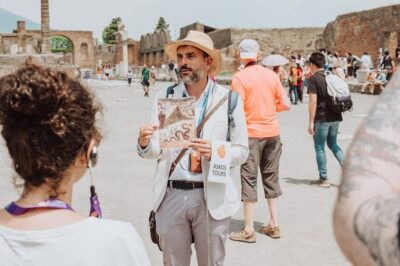 ★ 4.8Pompeii: Entry Ticket and Guided Tour with an ArchaeologistFrom $3519,459 reviews
 ★ 4.1Pompeii: Entry Ticket with Audio GuideFrom $4013,491 reviews
 ★ 4.8Pompeii: Small Group Tour with an ArchaeologistFrom $4012,264 reviews
 ★ 4.3Pompeii Ruins & Mount Vesuvius Day TourFrom $12011,459 reviews
★ 5.0Pompeii Small Group Tour with an ArchaeologistFrom $356,593 reviews
★ 4.3Pompeii Ruins & Mount Vesuvius Day TourFrom $12011,459 reviews
★ 5.0Pompeii Small Group Tour with an ArchaeologistFrom $356,593 reviews
 ★ 4.5Skip-the-line Pompeii – Small Group TourFrom $544,401 reviews
 ★ 4.6Naples or Sorrento: Full-Day Pompeii and Mount Vesuvius TourFrom $1044,235 reviews
 ★ 3.9Pompeii: Skip-the-line Entry Ticket with Audio Guide & MapFrom $433,153 reviews