
Pompeii feels real when you can roll through it. This wheelchair-accessible, skip-the-line tour brings you along a special route so you can see major Pompeii highlights without the usual chaos. I like that it focuses on how people actually lived, not just stone piles, and I also love the way the guide turns each stop into a story you can follow.
Two things stood out for me right away: the guided highlights (thermal baths, forum, theater, domus, and more) and the fact that admission is handled for you with skip-the-line access. You’re not stuck waiting, and you’re not guessing what you’re looking at.
One drawback to keep in mind: the meeting point is the Amphitheatre area (Piazza Immacolata, Pompei), and a wheelchair user in one review said they couldn’t even reach the start because the approach required a long, multi-train route. Plan your route in advance and give yourself extra time before the tour begins.
In This Review
- Key reasons this tour is worth your attention
- Pompeii, but paced for mobility needs
- Skip-the-line tickets that protect your time
- Starting at the Amphitheatre: where the day gets organized
- The 2 km route through Pompeii’s main streets
- Thermal baths: more than just a stop
- Domus, daily spaces, and the feeling of a lived-in city
- Gladiators’ Gym and mills: work, training, and motion
- Lupanare and the erotic frescoes: honest, but be ready
- Forum and Theater: the big public spaces
- Pleasure houses and the Roman contrast effect
- Guides who actively help you see everything
- Price and value: is $254.67 fair?
- Who this Pompeii wheelchair-friendly tour suits best
- When to book and how to set expectations
- Should you book this wheelchair-accessible skip-the-line Pompeii tour?
- FAQ
- How long is the Pompeii tour?
- Does the tour include tickets and skip-the-line entry?
- Where does the tour start and end?
- Is the tour wheelchair accessible?
- Is the tour private?
- What costs extra besides the tour price?
Key reasons this tour is worth your attention
- A special wheelchair-friendly Pompeii path of about 2 km helps you stay on track
- Skip-the-line admission included, so you lose less time in queues
- A guide-led route through top highlights, from baths and domus to the forum and theater
- Stops that cover daily life, including mills and the Lupanare (erotic frescoes)
- Guides who actively help you see everything, including scooter and wheelchair users
- Private format for your group, so your pace and needs matter more
Which Pompeii ticket and guide? Compare a few more.
- Pompeii Small Group Tour with an Archaeologist★ 5.0 · 6,593 reviews
- Discover the Ancient Ruins of Pompeii: Day Trip from Rome★ 3.5 · 2,247 reviews
- Pompeii and Herculaneum Small Group Tour with an Archaeologist★ 5.0 · 1,350 reviews
- Skip the Line Guided Tour of Pompeii led by an Archaeologist★ 5.0 · 703 reviews
Pompeii, but paced for mobility needs
If you’ve ever felt “Pompeii isn’t for me” in a planning moment, this tour is the answer. The big idea is simple: instead of forcing you through every uneven corner of the site, you follow a special path about 2 kilometers long designed to make Pompeii accessible to everyone.
I like that the tour is built around the experience, not just access paperwork. You’re not watching from the edge while others wander. You’re walking, rolling, and stopping long enough to understand what you’re seeing. That matters in Pompeii, because the ruins can look like disconnected fragments until someone connects them with real stories.
You also get a clear time box: around 2 hours. Pompeii is huge, and in two hours you won’t see everything. Still, this tour is honest about the trade-off. You’re aiming for the best highlights plus the “how life worked” context, which is exactly what many people want from Pompeii anyway.
Skip-the-line tickets that protect your time
Let’s talk about the practical win first: skip the line ticket is included. In a place like Pompeii, that can mean the difference between “we started late and felt rushed” and “we’re settled and ready.”
Admission is part of your tour plan, and you get a guided tour at the same time. That’s one less thing you have to manage at the site when you’re trying to move with a wheelchair or scooter. You also get a mobile ticket, which reduces the last-minute fuss of finding and printing things.
Now, the tour is rated 3.8 based on 6 reviews, so this isn’t a perfect score. The good news is that the most praised parts are strongly tied to what you actually care about: help from the guide, smooth access, and seeing the key areas without wasting time.
Starting at the Amphitheatre: where the day gets organized
Your tour starts back at the Amphitheatre of Pompeii in Piazza Immacolata, Pompei. The end goes back to that same meeting point. I like the structure. When a tour loops back to the start, it reduces stress for accessibility needs, because you’re not dealing with a complicated finish point.
Getting to the Amphitheatre area is also where you should pay attention. One review included a tough reminder: a wheelchair user said they couldn’t even reach the beginning of the accessible tour, because getting there required a three-train trip. That doesn’t mean you’ll have the same problem. It does mean you shouldn’t wing it.
Here’s what you can do: check your route to Piazza Immacolata ahead of time and give yourself cushion time. If you’re coordinating with a scooter chair, caregiver timing, or any transfer steps, that extra buffer is worth more than you think.
The 2 km route through Pompeii’s main streets
The itinerary is designed around a special route that runs roughly 2 kilometers through the most important highlights. The goal is to let you “follow the city” the way it would’ve been experienced on foot—without making the day feel like an endurance test.
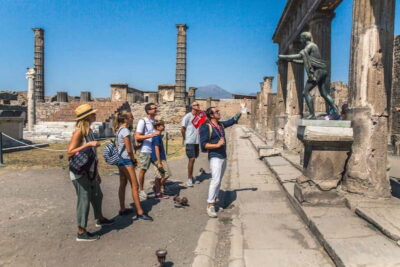
The guide brings the ruins to life by linking stops to everyday routines. You’ll hear anecdotes and secrets, and you’ll learn how life worked in Roman times. That “how people lived” focus is what turns Pompeii from impressive ruins into something you can actually picture.
You’ll move through main streets and then into big anchor areas like the thermal baths, the domus, and other recognizable sites. Even if you’ve seen photos of Pompeii, don’t underestimate how different it feels when you’re guided to the right places in the right order.


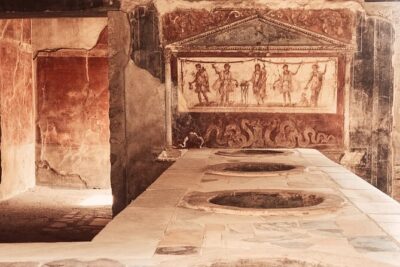
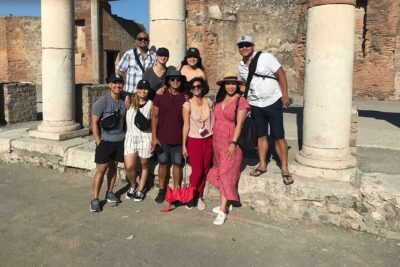
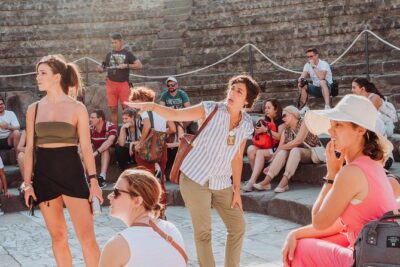

Thermal baths: more than just a stop
One of the big highlights on the route is the thermal baths. You’ll visit them as part of the main highlights tour pacing, and they’re repeated within the broader set of stops. That repetition isn’t a mistake—it signals that the baths are a centerpiece of the Roman daily-life story you’re being guided through.
What I like about a baths stop on a guided accessible route is that it gives you an anchor. You’re not just collecting random ruins. You’re spending time in a place that helps you understand how Romans organized routine, social life, and comfort.
For accessibility: baths areas can be visually and spatially spread out. This tour’s value is that the guide keeps you on the special route so you’re not trying to negotiate the site alone.
Domus, daily spaces, and the feeling of a lived-in city
You’ll also visit the domus—which is exactly the kind of stop that helps you connect ruins to real people. A domus is where the story shifts from city-scale landmarks into the “what life looked like inside” kind of detail.
The guide doesn’t just name the places. The idea is that you get context: what you’re seeing, why it mattered, and how daily life would’ve played out in that kind of setting. This is where guided tours can make or break your day, because Pompeii can become overwhelming fast when there’s no narrative thread.
If your mobility is limited, the domus and similar stops are also helpful because they’re not just “walk past and look.” You’re guided through enough of Pompeii’s key spaces that the day feels coherent.
Gladiators’ Gym and mills: work, training, and motion
Two stops that add a lot of realism are the Gladiators’ Gym and the mills. They’re not just iconic names; they’re the kind of places that help you understand what was happening in the city day to day.
When a tour includes mills, it signals that you’re getting beyond the big “wow” buildings and into functional spaces. That’s one reason I think this tour is good value for people who want more than a photo checklist.
You don’t have to be a Roman-history expert to appreciate it either. If you care about how cities actually run—training, work, movement—these stops support that interest.
Lupanare and the erotic frescoes: honest, but be ready
One of the more distinctive Pompeii stops on this tour is the Lupanare, famous here for its erotic frescoes. This is one of those moments where Pompeii stops being polite museum material and becomes frank about real life in the Roman world.
I appreciate that the tour includes it as a “highlight” rather than ignoring the most talked-about corners of Pompeii. It’s part of what makes the city’s story complete. Just keep in mind: if erotic imagery would make you uncomfortable, consider whether you want this included in your day.
Since this is a guided tour, you’ll also have a human explaining context. That helps you decide what you want to look at and how long you want to stay.
Forum and Theater: the big public spaces
The route also includes the Forum and the Theater, two stops that push Pompeii’s story back toward public life. When you reach spaces like these, the tour’s pacing helps you connect civic space to the daily-life spaces you’ve already seen.
I like that the tour doesn’t treat Pompeii as one big exhibit. Instead, it groups your experience: everyday places first, then the major public landmarks. That structure makes the ruins easier to understand while you’re moving.
And because this is a special access route, you’re not forced to decide between “skip the highlights” or “go too far and get stuck.” The goal is to let you see the centerpieces without turning the day into a struggle.
Pleasure houses and the Roman contrast effect
You’ll also visit Pleasure Houses as part of the major highlights. Paired with the Lupanare stop, this is where the Roman world feels most distinctly different from the modern one.
I find this contrast effect useful. It’s a reminder that Pompeii isn’t just ruins from a distant time. It’s a snapshot of everyday desires, entertainment, and public-private life—presented right inside the stone remains.
Again, the guide matters here. If you’re unsure what you’re looking at, a guide can help you understand what the spaces were for and how they fit into the broader story of the city.
Guides who actively help you see everything
The biggest theme in the strong reviews is the guide approach. A standout name that came up is Mariano, described as fabulous for a scooter user—someone who made sure the person could see everything possible. That’s exactly the kind of detail that matters for accessible travel.
Another name that appeared is Momma, who was praised for being fun, knowing Pompeii history, and making the experience feel like more than a transaction. One review even said the guide walked with the group and time flew—worth every penny.
Here’s what you should take from that: a wheelchair-accessible tour only works if the guide is hands-on with the pacing and the stops. You’re not just receiving narration; you’re receiving real-time help to keep the day comfortable and meaningful.
Price and value: is $254.67 fair?
At $254.67 per person for a roughly 2-hour experience, this is not a bargain-basement tour. But it also isn’t “just a guide telling you stuff.”
You’re paying for a few concrete value drivers based on the info you have:
- Skip-the-line admission included
- A guided route built around an accessibility plan (about 2 km)
- A private setup for your group
- A human-led experience that targets major highlights like baths, forum, theater, domus, and more
If you’re going to Pompeii anyway, paying for access and guidance can be worth it—especially when you factor in how stressful queues and self-navigation can be. The price is higher than standard group tours, but the trade-off is the structure and support that help you actually enjoy the site.
If budget is tight, you might compare against other Pompeii tours that are cheaper, but this one clearly aims at a specific need: accessibility plus major highlights without wasted time.
Also, plan ahead. The tour is commonly booked about 76 days in advance on average, so getting your spot sooner can help.
Who this Pompeii wheelchair-friendly tour suits best
This tour is a strong fit if you:
- want top Pompeii highlights in a short time window
- prefer a guided story that explains Roman daily life
- need a route designed around wheelchair or scooter accessibility
- appreciate skip-the-line convenience
It may be less ideal if you:
- want a longer “wander at your own speed” Pompeii day
- dislike stops that include the Lupanare’s erotic frescoes
- can’t commit to planning your approach to the meeting point carefully (given the reported access difficulty for one wheelchair visitor)
The tour’s accessibility focus makes it particularly meaningful for people traveling with mobility tools. And it’s also worthwhile for anyone who likes a guided, structured visit through the most important parts of Pompeii.
When to book and how to set expectations
Book soon rather than last minute. With the average booking window around 76 days, this tour likely has demand from travelers who need the specific accessibility setup.
Also set expectations for what 2 hours can realistically cover. You’ll hit major highlights and key everyday-life spaces, but you won’t see every corner of Pompeii. The tour’s strength is quality and flow on the special route—not trying to cram the whole archaeological park into a short visit.
If you’re nervous about getting there, do what I always suggest for accessibility trips: map the route, check the timing, and show up early enough to handle any last-minute issues. That’s how you prevent the kind of start trouble one wheelchair user described.
Should you book this wheelchair-accessible skip-the-line Pompeii tour?
Yes, if you want Pompeii in a way that feels manageable and guided. The combination of skip-the-line access, a wheelchair-friendly 2 km route, and major stops like thermal baths, domus, gladiators’ gym, mills, the Lupanare, forum, theater, and pleasure houses adds up to a focused Pompeii day.
I’d especially recommend it if mobility tools are part of your travel reality, and if you value guides who actively help you keep seeing everything. Names like Mariano and Momma were specifically praised for that kind of attention.
Just don’t ignore the planning lesson. Confirm your route to the Amphitheatre meeting point in Piazza Immacolata, and build in buffer time. If you do that, this tour can turn Pompeii from a daunting site into a clear, story-driven experience you’ll remember.
FAQ
How long is the Pompeii tour?
The tour runs about 2 hours.
Does the tour include tickets and skip-the-line entry?
Yes. Skip-the-line admission is included, along with the guided tour.
Where does the tour start and end?
It starts at the Amphitheatre of Pompeii, Piazza Immacolata, 80045 Pompei NA, Italy, and ends back at the same meeting point.
Is the tour wheelchair accessible?
The tour is designed along a special path of about 2 kilometers to make Pompeii accessible to everyone. Service animals are allowed.
Is the tour private?
Yes. Only your group will participate.
What costs extra besides the tour price?
Tips are not included.
More Tours in Pompeii


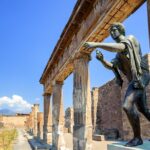

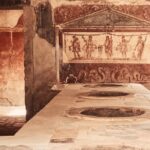
More Tour Reviews in Pompeii

More Pompeii Tours to Compare
More Pompeii tours, freshly reviewed



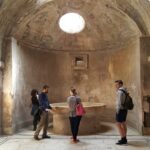

Pompeii Tours, compared.
 ★ 4.8Pompeii: Entry Ticket and Guided Tour with an ArchaeologistFrom $3519,459 reviews
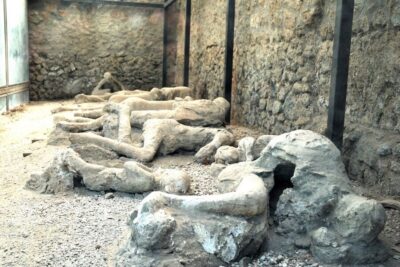 ★ 4.1Pompeii: Entry Ticket with Audio GuideFrom $4013,491 reviews
 ★ 4.8Pompeii: Small Group Tour with an ArchaeologistFrom $4012,264 reviews
 ★ 4.3Pompeii Ruins & Mount Vesuvius Day TourFrom $12011,459 reviews
★ 5.0Pompeii Small Group Tour with an ArchaeologistFrom $356,593 reviews
★ 4.3Pompeii Ruins & Mount Vesuvius Day TourFrom $12011,459 reviews
★ 5.0Pompeii Small Group Tour with an ArchaeologistFrom $356,593 reviews
 ★ 4.5Skip-the-line Pompeii – Small Group TourFrom $544,401 reviews
 ★ 4.6Naples or Sorrento: Full-Day Pompeii and Mount Vesuvius TourFrom $1044,235 reviews
 ★ 3.9Pompeii: Skip-the-line Entry Ticket with Audio Guide & MapFrom $433,153 reviews