
Review · POMPEII TOURS
Explore Pompeii with an Archaeologist
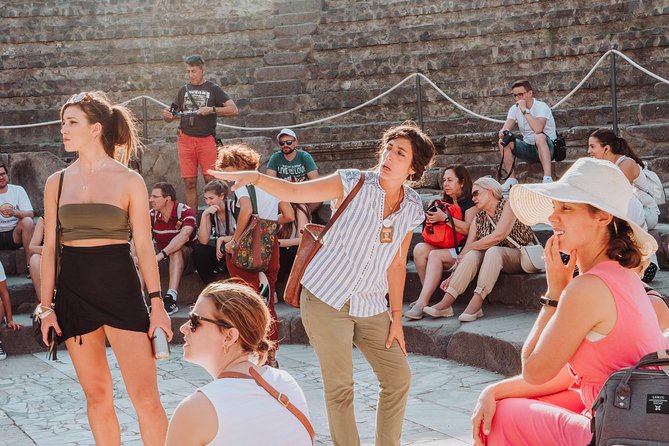
Pompeii is a time machine. This guided route with skip-the-line admission and an archaeologist at your side helps you translate the ruins into a lived-in city fast. I love how much you cover in just about 2 hours and how easy it is to ask questions in a group capped at 20. One watch-out: even with headsets, inside the park it can still get crowded, and hearing can be harder when the crowd swells.
You’ll meet your guide at the main entrance area (Porta Marina Superiore), then work through a smart hit list of places: the forum, houses, baths, a brothel area, a theater, and more. Several guides get praised for keeping a steady pace and answering questions like Mario Celentano, Alexandra, Diego, Rosanna, Teresa, and Antonio. If you want Pompeii as more than photos, this kind of guided structure is a strong way to do it.
In This Review
- Key highlights to look forward to
- Skip-the-line Tickets and an Archaeologist in About 2 Hours
- Price and what you actually get for $35.67
- Meeting at Via Villa dei Misteri, ending near Piazza Esedra
- Stop-by-stop: the Pompeii route you’ll walk (and what to expect)
- Stop 1: Archaeological Park of Pompeii (Porta Marina Superiore)
- Stop 2: Foro de Pompeya (the main square)
- Stop 3: Basilica (the courthouse)
- Stop 4: Lupanar (the brothel)
- Stop 5: Granaries of the Forum
- Stop 6: House of Menander
- Stop 7: House of the Faun
- Stop 8: Stabian Baths (Terme Stabiane)
- Stop 9: Via dell’Abbondanza (street stroll, ticket-free)
- Stop 10: Thermopolium VI
- Stop 11: Teatro Grande (the theatre)
- Stop 12: Casa dei Vettii (House of Vettii)
- The small group + headsets combo (and the one possible downside)
- Pace, walking, and comfort tips that actually help
- Guides you might meet: what different names have in common
- Who this tour is best for (and who should consider a different format)
- Should you book Askos Tours’ Archaeologist Pompeii experience?
- FAQ
- How long is the Pompeii with an Archaeologist tour?
- Is Pompeii admission included?
- What language is the tour offered in?
- Is this a small group tour?
- Where do I meet the guide, and where does the tour end?
- Are food and drinks included?
- Can I bring a service animal or a pet?
Key highlights to look forward to
- Skip-the-line admission to help you get moving sooner once you arrive
- Archaeologist-led explanations at every major stop, not just a quick walkthrough
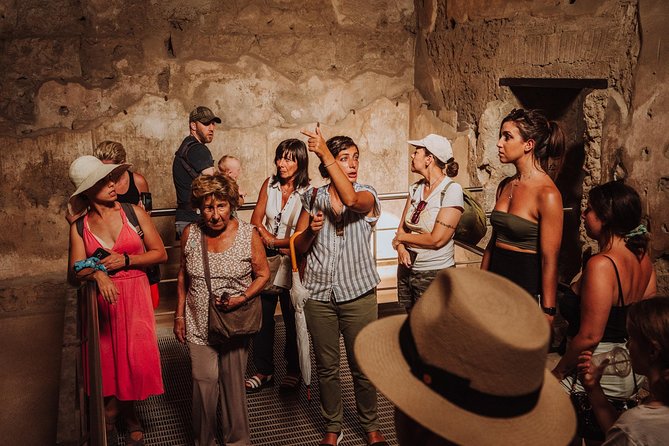
- Small group (max 20) so your questions don’t get lost in the shuffle
- Headsets for groups of 16+ to improve clarity in busy areas
- A focused 2-hour route that hits forum life, homes, baths, and entertainment
- Free stop along Via dell’Abbondanza to balance ticketed sights with a street stroll
Which Pompeii ticket and guide? Compare a few more.
- Pompeii Small Group Tour with an Archaeologist★ 5.0 · 6,593 reviews
- Discover the Ancient Ruins of Pompeii: Day Trip from Rome★ 3.5 · 2,247 reviews
- Pompeii and Herculaneum Small Group Tour with an Archaeologist★ 5.0 · 1,350 reviews
- Skip the Line Guided Tour of Pompeii led by an Archaeologist★ 5.0 · 703 reviews
Skip-the-line Tickets and an Archaeologist in About 2 Hours
Pompeii is big, and your time is never unlimited. This tour is built around a practical goal: see many of the best-known areas, but do it with context so the place doesn’t feel like a pile of walls.
The skip-the-line admission matters more than it sounds. Even when you manage your schedule, Pompeii can have slowdowns right at the start, and that’s wasted time when you only have a couple of hours. With this format, you’re spending your energy where it counts: inside the archaeological park.
Then there’s the archaeologist angle. You’re not just getting names and dates. You’re getting explanations that help you understand what you’re looking at, and you get chances to ask follow-up questions as you go. In the feedback, guides are frequently praised for being patient, staying on topic, and keeping the pace smooth (with examples like Julia, Ilaria, and Rafaela standing out for clarity and engagement).
Price and what you actually get for $35.67
At $35.67 per person for roughly 2 hours, the value is strongest if you care about two things: admission included and a real guide.
Here’s what your ticket covers:
- Pompeii admission fee
- A dedicated expert archaeologist guide
- Headsets when the group is 16 or larger
- A small-group format (maximum 20)
The big practical win: you’re not paying extra on top for entry, and you’re getting help navigating a complex site in a short time window.
What’s not included is also clear: transportation, plus food and drinks. So I’d plan on budgeting only for getting to Pompeii and keeping yourself comfortable while you’re walking.
Meeting at Via Villa dei Misteri, ending near Piazza Esedra
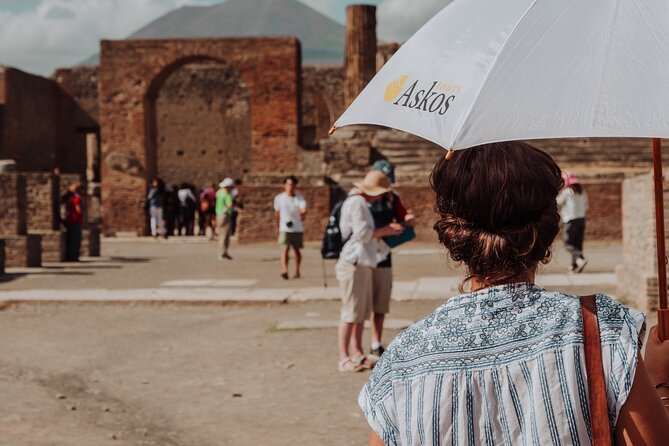
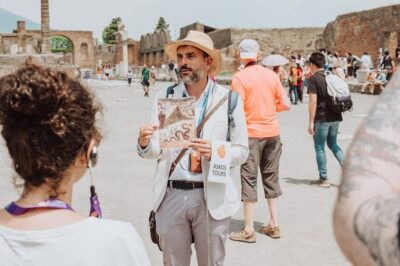
You start at Via Villa dei Misteri, 2, 80045 Pompei NA, Italy. The guide meets you holding a sign with Askos Tours at the entrance called Porta Marina Superiore.
You finish at Piazza Esedra, also in Pompei. That end point is handy because it gives you a natural place to keep exploring on your own after the guided portion. A few people specifically noted they stayed longer after the tour ended, so think of this as a strong starter course rather than a full-day takeover.
Stop-by-stop: the Pompeii route you’ll walk (and what to expect)
This tour moves at a steady rhythm, with short time blocks at each major highlight. Expect a lot of walking on uneven surfaces—one review called it out as a workout—so comfortable shoes are not optional.

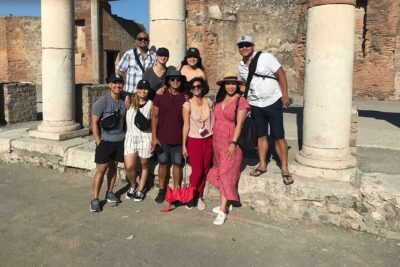
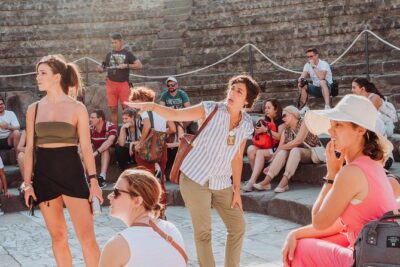

Stop 1: Archaeological Park of Pompeii (Porta Marina Superiore)
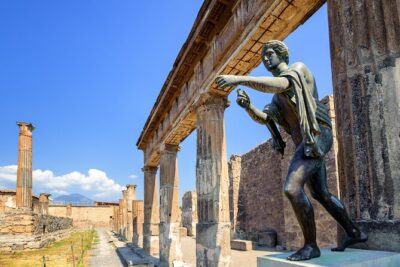
You begin at the main entrance area, Porta Marina Superiore. Your guide sets the tone here: what you’ll see, how to look at what’s left, and how to make sense of the layout.
Why it helps you: getting oriented early in Pompeii makes every later stop feel less random. You’ll also be positioned to start efficiently rather than wandering.
Potential drawback: Pompeii crowds can build quickly near key entry points, so it’s smart to arrive a bit early.
Stop 2: Foro de Pompeya (the main square)
Next is the forum, the city square where public life likely revolved. Your archaeologist will explain how this kind of space fit into everyday civic routines and what the ruins suggest about public behavior.
What to focus on: don’t just glance. Look for how the buildings frame the square, because the edges tell you how people moved and gathered.
Stop 3: Basilica (the courthouse)
The basilica is the courthouse setting. You’re in a zone that helps you understand law and administration in a Roman city.
What makes this stop click: hearing the explanation from a guide turns the space into a story about roles and routines, not just stone columns. People praised guides for clarity and for answering questions thoroughly here and throughout the walk.
Stop 4: Lupanar (the brothel)
Then you hit the Lupanar. It’s one of Pompeii’s most talked-about sites, and it’s also the kind of place where context matters. The archaeologist guide’s job is to help you interpret what you’re seeing without turning it into a spectacle.
What to expect: a straightforward, guided explanation of what this area was for, and how Pompeii’s street life included businesses like this.
Consideration: if you feel uncomfortable with adult-themed sites, this is still part of Pompeii’s record. The tour doesn’t shy away from it.
Stop 5: Granaries of the Forum
Now you move from public buildings to the working infrastructure that supported daily survival: granaries. This stop is a reminder that cities run on systems, not just monuments.
Why this is valuable: it widens your view beyond the flashy highlights. Even in a short tour, you’re getting a slice of how food supply and storage likely shaped life.
Stop 6: House of Menander
The House of Menander is one of the residential stops. You’ll get guidance to help you read a home as a living environment, not just an exterior shell.
What to focus on: the contrast between houses and public spaces. Your guide will help you see what changes from one area of the city to another.
Stop 7: House of the Faun
Another house, with a different layout and feel. This is where the tour helps you understand domestic design at a glance.
Why it works in 2 hours: houses can be confusing on your own because you don’t know what to look for. With an archaeologist speaking as you move, you get a fast framework for interpreting rooms and circulation.
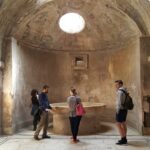
Stop 8: Stabian Baths (Terme Stabiane)
Next come the ancient baths. Baths are one of those Pompeii categories that feel instantly relatable: people gathered, washed, and socialized in an organized setting.
What makes this stop worthwhile: a guide’s explanations help you picture how a complex facility functioned as a daily routine, not just a ruined building.
Stop 9: Via dell’Abbondanza (street stroll, ticket-free)
This is your street moment. Via dell’Abbondanza is listed as free, and it’s a chance to connect the dots between major stops.
What to notice: how the street helps you understand where the city’s energy likely flowed. It’s also a natural break from entering and exiting more structured sites.
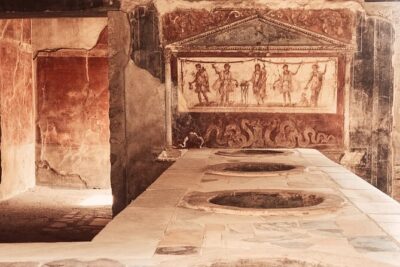
Stop 10: Thermopolium VI
Now you’re at Thermopolium VI, a sort of counter-service stop. This adds a different angle to the tour: everyday consumption and business.
Why you’ll appreciate it: it’s an easy way to see Pompeii as a functioning city with regular service points, not only formal buildings.
Stop 11: Teatro Grande (the theatre)
The theatre brings entertainment into view. Your guide will explain what you’re looking at and how this kind of venue fit into city life.
What to focus on: the role of performance spaces and why cities build them. In a guided format, this doesn’t stay vague—you get direction on what matters.
Stop 12: Casa dei Vettii (House of Vettii)
The House of Vettii closes out the classic highlights. Residential architecture returns, and you’ll end with a strong final impression.
Why it’s a good closer: by the time you reach a house at the end, you’ve already seen public life, services, and leisure. The whole city picture clicks more clearly.
The small group + headsets combo (and the one possible downside)
The group is capped at 20 travelers per guide, and headsets are provided for groups of 16 or more. That’s a practical setup for a site like Pompeii where crowd noise can spike.
In the positive feedback, people called the earphone amplifiers a big help, especially when pacing moves fast. Another benefit: with fewer people, guides are more likely to actually address your question instead of speed-walking past it.
The drawback to keep in mind: on very busy days, even headsets may not fully solve the sound problem. If you’re sensitive to noise, consider bringing a bit of patience and staying flexible about where you position yourself during explanations.
Pace, walking, and comfort tips that actually help
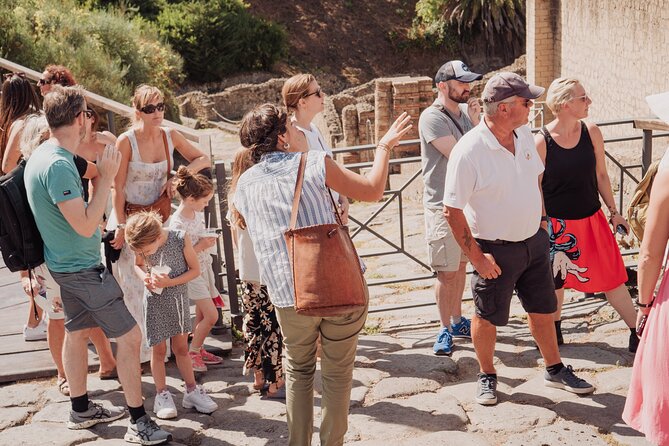
This is a fast, focused walking tour. Multiple people noted that it’s an active visit with uneven surfaces, so plan accordingly.
Bring:
- Comfortable shoes for uneven ground
- A fan or something to cool down in warmer months (one review specifically recommended a fan)
- A refillable water bottle, because water is available from fountains
Also consider:
- Umbrella or hat for sun protection. One comment directly advised sun gear.
And if you’re the type who asks a lot of questions, good news: several guides are praised for being patient and for adjusting pacing when asked.
Guides you might meet: what different names have in common
Askos Tours uses multiple guides, and the feedback consistently points to a shared style: clear explanations, strong pacing control, and real patience with questions.
A few names that came up often include:
- Mario Celentano, praised as fun, informative, and great with questions
- Alexandra, singled out as making the ruins feel meaningful
- Diego, noted for being informational and helpful
- Rosanna, described as bringing history to life with humor
- Teresa and Antonio, highlighted for passion and clarity
Even if you don’t get one of these exact guides, you’re booking a tour built around the same promise: an archaeology-focused walkthrough rather than a generic sightseeing march.
Who this tour is best for (and who should consider a different format)
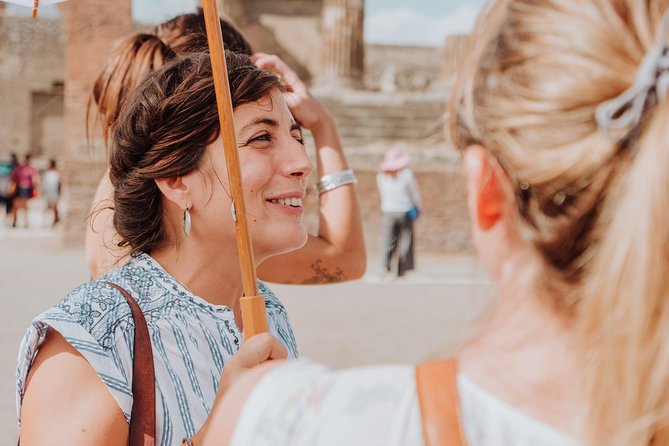
This tour is a great fit if you:
- Want a guided Pompeii overview in about 2 hours
- Prefer a small group where questions are welcome
- Like seeing a mix of forum life, baths, houses, and theatre instead of only one theme
- Want skip-the-line admission to reduce idle time
You might consider a different setup if you:
- Want very slow, in-depth time in fewer rooms
- Struggle with crowds and loud environments even with headsets
- Are hoping to focus on areas currently under excavation (this specific route doesn’t list digging zones as a highlight)
Should you book Askos Tours’ Archaeologist Pompeii experience?
I’d book it if your goal is simple: get a smart Pompeii overview with context, not just photos, and do it in a manageable chunk of time.
The key reason is the mix of skip-the-line access, an archaeologist guide, and a tight route that covers major highlights without turning the whole day into logistics. The small group size also makes it feel more like a conversation than a lecture.
If you’re chasing a full-day, super-slow, ultra-detailed experience, you may want to pair Pompeii with additional independent time after the tour. But for a first, time-efficient visit, this is a solid choice.
FAQ
How long is the Pompeii with an Archaeologist tour?
It lasts about 2 hours.
Is Pompeii admission included?
Yes. Pompeii admission fee is included with the tour.
What language is the tour offered in?
The tour is offered in English.
Is this a small group tour?
Yes. The group is maximum 20 travelers per guide, and headsets are provided for groups of 16 or more.
Where do I meet the guide, and where does the tour end?
You meet at Via Villa dei Misteri, 2, 80045 Pompei NA, Italy (near the Porta Marina Superiore entrance). The tour ends at Piazza Esedra, 80045 Pompei NA, Italy.
Are food and drinks included?
No. Food and drinks are not included.
Can I bring a service animal or a pet?
Service animals are allowed. Dogs are permitted only if they do not exceed 10 kg in weight and a maximum height of 40 cm, and they must be on a leash and held in the arms inside buildings; you must also collect their excrement.
More Tour Reviews in Pompeii




More Pompeii Tours to Compare
More Pompeii tours, freshly reviewed



Pompeii Tours, compared.
 ★ 4.8Pompeii: Entry Ticket and Guided Tour with an ArchaeologistFrom $3519,459 reviews
 ★ 4.1Pompeii: Entry Ticket with Audio GuideFrom $4013,491 reviews
 ★ 4.8Pompeii: Small Group Tour with an ArchaeologistFrom $4012,264 reviews
 ★ 4.3Pompeii Ruins & Mount Vesuvius Day TourFrom $12011,459 reviews
★ 5.0Pompeii Small Group Tour with an ArchaeologistFrom $356,593 reviews
★ 4.3Pompeii Ruins & Mount Vesuvius Day TourFrom $12011,459 reviews
★ 5.0Pompeii Small Group Tour with an ArchaeologistFrom $356,593 reviews
 ★ 4.5Skip-the-line Pompeii – Small Group TourFrom $544,401 reviews
 ★ 4.6Naples or Sorrento: Full-Day Pompeii and Mount Vesuvius TourFrom $1044,235 reviews
 ★ 3.9Pompeii: Skip-the-line Entry Ticket with Audio Guide & MapFrom $433,153 reviews