
Review · POMPEII TOURS
Pompeii Tour & Admission included in a Small Group
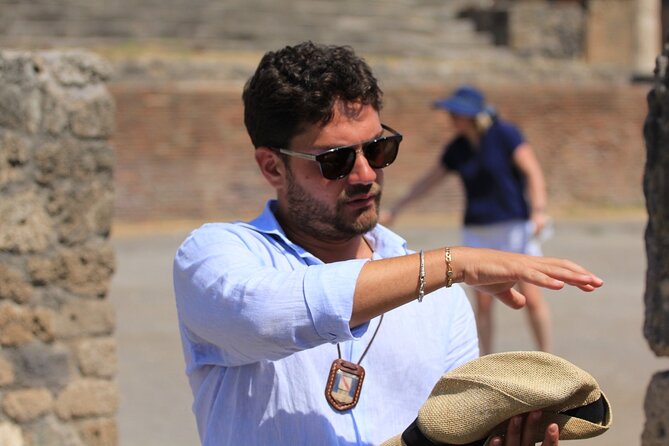
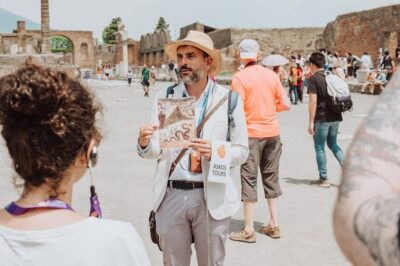
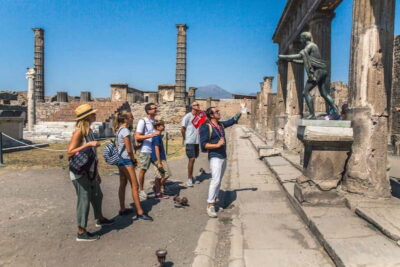
Pompeii changes fast when you walk it with a guide. This small-group tour (up to 15 people) gets you into the Archaeological Park with admission included, then stitches the site together so it feels like a real place, not just rocks. I like two big things right away: included entrance so you avoid hassle, and the way the guide keeps the pace moving while explaining the story of 79 AD. One consideration: the ground can be uneven, and some areas have steps/curbs, so comfortable shoes matter.
What makes this plan feel especially good is the format: short stops, clear directions, and a headset option if it’s busy. You’ll hit the “greatest hits” around the forum, baths, shops, and theaters without spending your whole day hunting for the right street. I also love the practical extras—mobile ticket plus a paper map—so you’re not scrambling at the entrance.
Finally, I’d frame it as a highlights tour. You’ll learn a lot, but it’s not built to explain every excavation detail or keep you parked in one room for ages.
In This Review
- Key highlights you should notice right away
- Pompeii in Two Hours: what this small-group plan does best
- Before you go: meeting at the Villa of the Mysteries, plus what to bring
- Entering the Archaeological Park from Porta Marina
- Forum stops: Venus, Apollo, the Basilica, and the main square feeling like a civic hub
- Temple of Venus (Tempio di Venere)
- Basilica
- Sanctuary of Apollo (Sanctuary of Apollo)
- Forum – Main Square (Foro di Pompeya)
- Temple of Jupiter (Tempio di Giove Capitolino)
- Roman baths, thermopolia, and shops where daily life actually happened
- Macellum (market hall) and the plaster casts
- Forum Baths (Terme del Foro)
- Thermopolium (Termopolio di Vetuzio Placido)
- Shops and the “how people spent money” vibe
- Houses and theaters: House of the Faun, Vettii, Via dell’Abbondanza, and Teatro Grande
- Houses (Casa del Fauno + House of the Vettii)
- Via dell’Abbondanza (the main street)
- Teatro Grande (Large Theater)
- Guides that make Pompeii feel personal: Livio, Antonio, Riccardo, Ornella, and others
- Price and value: is $66.01 worth the walk?
- Who this tour is best for (and who should plan differently)
- Should you book this Pompeii small-group tour?
- FAQ
- What’s included in the Pompeii admission and tour price?
- How long is the tour?
- Where does the tour start and end?
- What language is the tour offered in?
- How many people are in the group?
- Is bottled water included?
Key highlights you should notice right away
- Admission included: you enter the Pompeii Archaeological Park without buying a separate ticket.
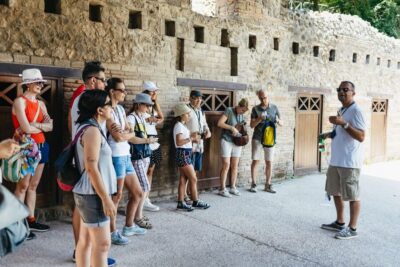
- Small-group experience: maximum 15 travelers, with headsets offered if crowds make hearing hard.
- Porta Marina start: the route begins at the main entrance, with Vesuvius in your visual mix early.
- Forum-centered storytelling: you see temples, the main square, and daily-life settings in a logical flow.
- Real everyday Pompeii stops: baths, thermopolia (street food counters), bakeries/shops, and the main street.
- Domus and theaters: you’ll get key houses and end with Teatro Grande.
Which Pompeii ticket and guide? Compare a few more.
- Pompeii Small Group Tour with an Archaeologist★ 5.0 · 6,593 reviews
- Discover the Ancient Ruins of Pompeii: Day Trip from Rome★ 3.5 · 2,247 reviews
- Pompeii and Herculaneum Small Group Tour with an Archaeologist★ 5.0 · 1,350 reviews
- Skip the Line Guided Tour of Pompeii led by an Archaeologist★ 5.0 · 703 reviews
Pompeii in Two Hours: what this small-group plan does best
If Pompeii is on your “must see” list, this kind of tour is a smart way to make it make sense fast. Pompeii isn’t one straight path. It’s a whole city spread out, and the details matter. With a guide, you stop seeing isolated ruins and start seeing a working layout: where people shopped, where they ate, where decisions were made, where entertainment happened.
This tour is designed for exactly that “first-time clarity” feeling. You spend about two hours walking, with a series of short stops that keep things moving. Each stop is built around a place with a job in the city—forum buildings, temples, baths, markets, theaters—so your brain gets an organized map of daily life.
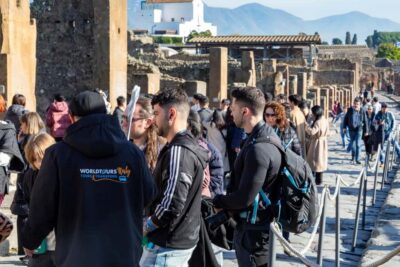
The other big advantage is scale. Pompeii is huge. Even on a highlights tour, you’ll walk. But compared with trying to DIY it (where you can miss the story), this structure helps you cover ground with confidence. One review even called out that Pompeii is larger than it looks, and that the pace + headset made the experience easier to follow.
Before you go: meeting at the Villa of the Mysteries, plus what to bring
The meeting point is at the Villa of the Mysteries, Villa dei Misteri, 2, 80045 Pompei NA, Italy. The good news: it’s near public transportation, so you’re not stuck figuring out a complicated transfer.
Here’s what you’ll want to bring for comfort and speed:
- Comfortable shoes with grip. The site includes curbs, stepping stones, and uneven terrain.
- A light layer. Pompeii is outdoors, and conditions can shift.
- Your best attention span. This is a highlights walk, so you’ll get more out of it if you listen through the stops rather than saving all questions for the end.
A small note: bottled water isn’t included. It’s not a dealbreaker, but plan to buy water nearby or bring your own if you can.
Entering the Archaeological Park from Porta Marina
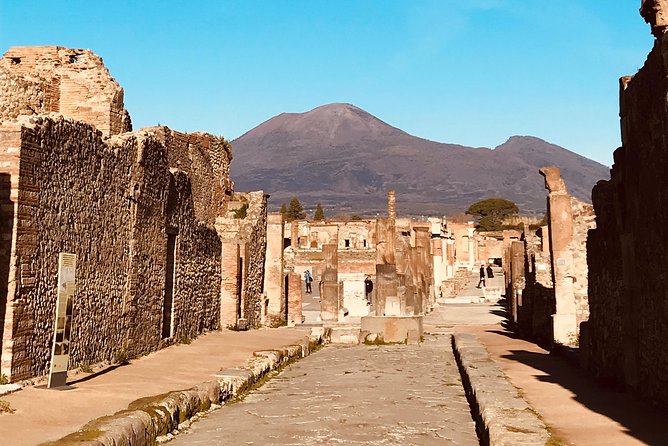
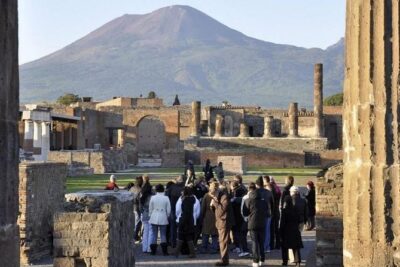
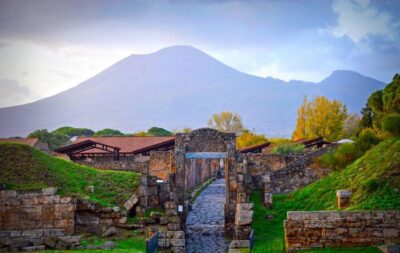
The tour includes your entrance ticket to the Pompeii Archaeological Park, and you join at the main entrance area of Porta Marina. That matters because it sets the tone right away. Mt Vesuvius rises in the background, and the guide frames Pompeii’s final moments—the eruption of 79 AD—and how the excavations changed what we know today.
This is where a guide earns their fee. Pompeii can feel chaotic if you’re only reading signs. With a good archaeologist-style explanation, the streets turn into routes, and the buildings turn into social spaces.
You also get a “big picture to details” flow early on. You’ll walk past recognizable civic anchors like:
- the Roman Forum and major forum buildings (including the Basilica)
- the market area
- standout religious spaces and city highlights along the route
One specific piece you’ll appreciate is that the tour is built to show the city’s daily rhythm: not only where important people met, but also where people ate, bought supplies, and relaxed.
Forum stops: Venus, Apollo, the Basilica, and the main square feeling like a civic hub
After you get into the park and oriented, the tour shifts into the civic heart. You’ll make several short “pulse checks” through key religious and administrative spaces.
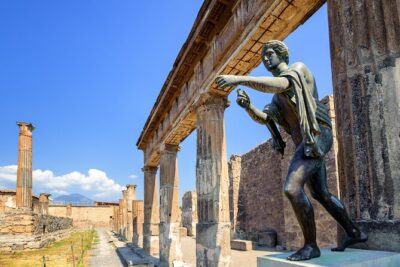

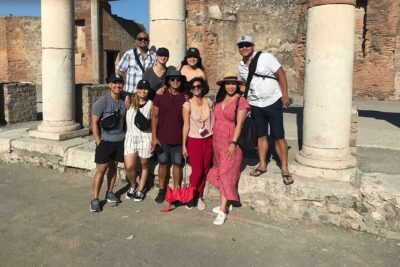
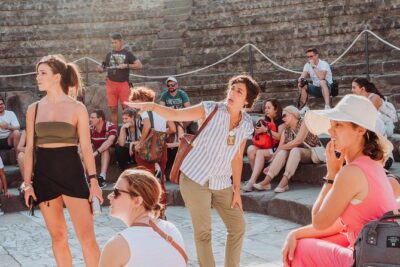
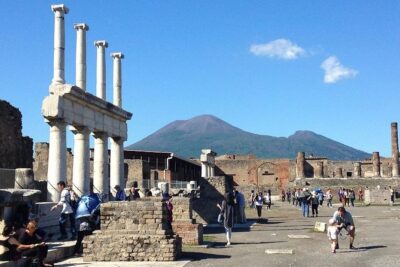
Temple of Venus (Tempio di Venere)
This stop spotlights the Temple of Venus, a goddess closely tied to Pompeii’s identity. Even if you don’t know Roman religion, the guide’s context helps you understand why a temple would sit where it does and how it fits the city’s self-image.
Basilica
Next is the Basilica, described as the main business and justice space in the forum. This is a great stop because it flips your perspective: you start to see the forum as a place of transactions and decisions, not just a monument zone.
Sanctuary of Apollo (Sanctuary of Apollo)
Apollo’s sanctuary is another strategic marker along the main approach into the city. The important idea here is placement: it was built where people would naturally travel between Porta Marina and the public heart of Pompeii.
Forum – Main Square (Foro di Pompeya)
This is the moment where Pompeii feels most like a living city. The main square represents daily civic life, and you’ll likely notice how many important sights cluster around it.
Temple of Jupiter (Tempio di Giove Capitolino)
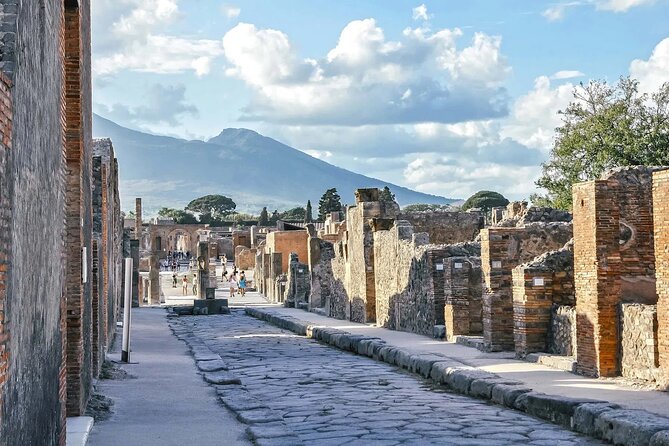
The Temple of Jupiter dominates one side of the forum, and the view behind it connects the city and Vesuvius visually. That pairing—religious power plus the looming landscape—hits hard, especially once you’ve heard the eruption story earlier.
Roman baths, thermopolia, and shops where daily life actually happened
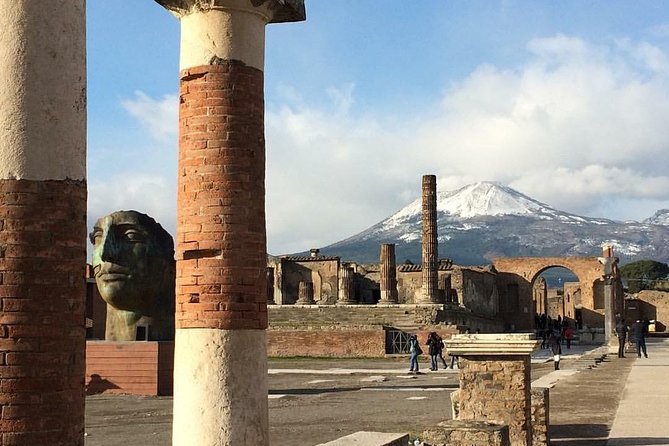
Pompeii isn’t only about big monuments. The most fun part for many people is watching the city’s everyday functions show up in stone.
Macellum (market hall) and the plaster casts
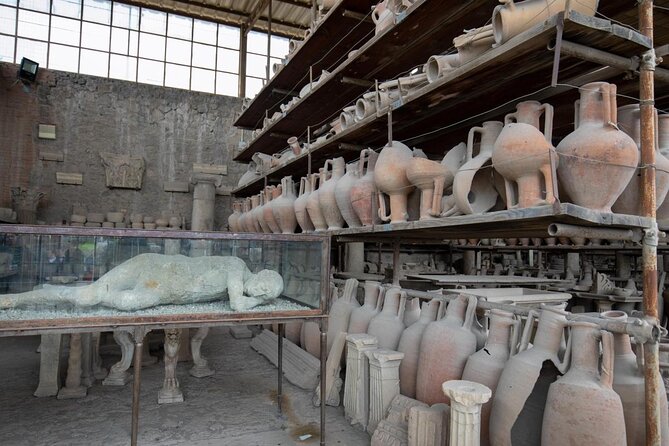
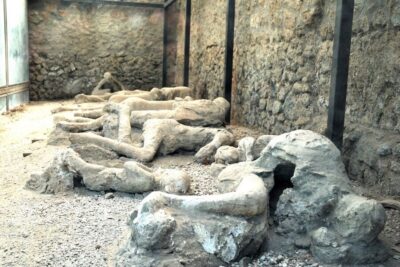
The Macellum was a monumental building for food and consumer goods. The standout detail here is the mention of plaster casts (bodies)—the archaeological method used to show what people looked like at the moment of the eruption. If you want one stop that feels emotionally powerful and historically specific, this is often it.
Forum Baths (Terme del Foro)
Next comes the Forum Baths, and this stop is practical as well as interesting. The tour points out that male and female areas had separate entrances. That single detail makes the site feel more real: you’re not just looking at architecture; you’re picturing routine, privacy, and how public spaces worked.
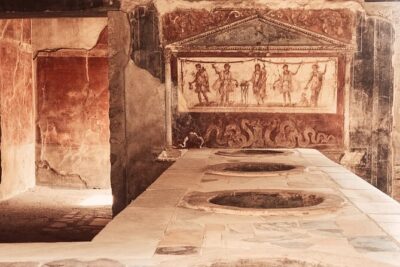
Thermopolium (Termopolio di Vetuzio Placido)
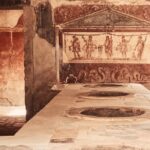
A thermopolium was basically an ancient street-food counter. The guide frames it as refreshment for the inhabitants. Even if you can’t taste anything (tragically), you can still understand how quickly people ate and drank during a normal day.
Shops and the “how people spent money” vibe
Along the route through the main streets, you’ll also see Roman shop types like thermopolia and bakeries. The reason I like this part is that it breaks the common museum habit of only thinking about elites and temples. Pompeii gives you the in-between places too.
Houses and theaters: House of the Faun, Vettii, Via dell’Abbondanza, and Teatro Grande
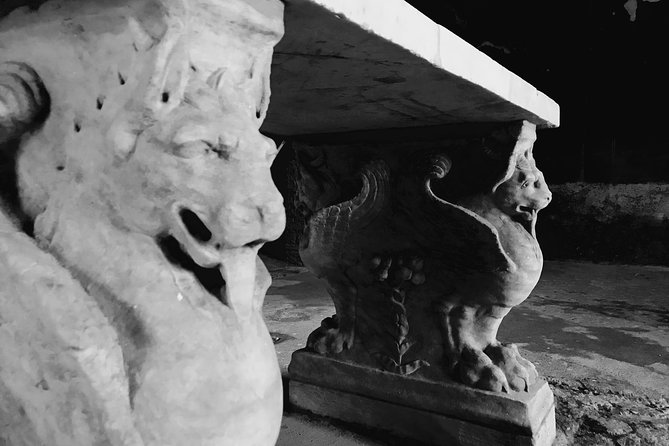
The tour finishes with the parts that make you go quiet for a minute: homes and performance spaces.
Houses (Casa del Fauno + House of the Vettii)
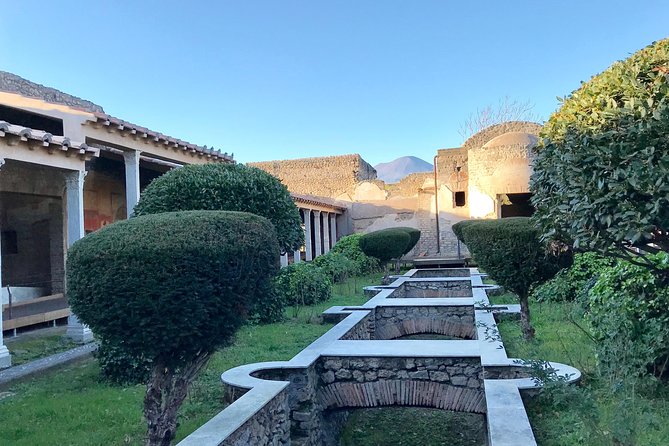
You’ll visit the House of the Faun—one of the largest houses in Pompeii. The route also mentions a welcome inscription on the sidewalk in Latin (HAVE). You’ll also see the House of the Vettii, known for wealth and its connection to Priapus, tied to prosperity.
There’s one useful consideration: these houses can be subject to seasonal openings and closings. So if you’re traveling in a period where something is shut, it’s not the end of the world—but it can slightly change what you see inside.
Via dell’Abbondanza (the main street)
Then you walk along Via dell’Abbondanza, Pompeii’s ancient main street (the decumanus maximus). This is more than a “pretty street” stop. It helps you connect everything else you’ve seen—shops, houses, public spaces—into one coherent city corridor.
Teatro Grande (Large Theater)
Finally, you reach Teatro Grande, where comedies and tragedies in the Greco-Roman tradition were performed. The theater stop is a great closer because by this point you’ve already learned how the city worked day to day, so entertainment feels less like an add-on and more like part of how people lived.
Guides that make Pompeii feel personal: Livio, Antonio, Riccardo, Ornella, and others
The guide quality is a major reason this tour is rated so high (4.8 overall with most recommendations). Names that show up with strong praise include Livio, Antonio, Riccardo, Ornella, and Annalisa.
What stands out in those comments is not just facts—it’s the ability to link details to how Romans lived. One review credited a guide with making the eruption and the changed landscape feel powerful. Another noted a guide’s passion and how it kept kids engaged. And at least one highlight: Riccardo was singled out for connecting Pompeii to modern terminology and for explaining architectural details in a way that clicks.
I’d treat this as a teachable tour. If you want Pompeii to feel like a story—with names, roles, and routines—this is the style that tends to work.
Price and value: is $66.01 worth the walk?
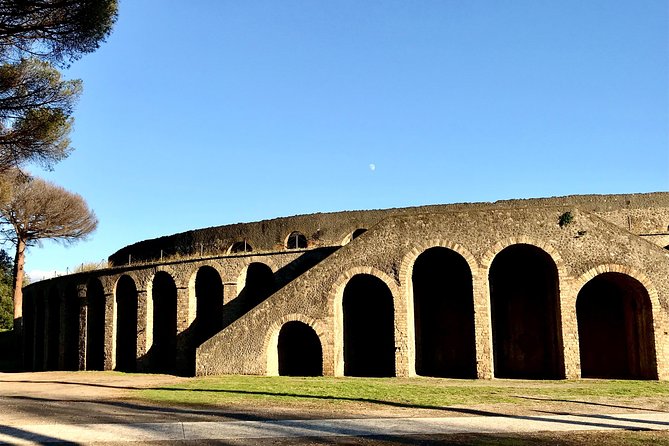
At $66.01 per person for about two hours, the value comes from what’s included, not just the tour length. Here’s the math that matters to me:
- You get admission to the Pompeii site included, which is the biggest single cost.
- You get an authorized guide/archaeologist style of interpretation.
- You get a headset if it’s crowded, which makes a real difference in outdoor ruins where sound can bounce around.
- You get a mobile ticket and a paper map, which helps you keep moving without confusion.
Could you do Pompeii on your own? Sure. But you’ll spend more time figuring out where things fit together. This tour buys you clarity: where you are, what you’re looking at, and why that building mattered.
So if your time in the area is limited, or you want to avoid turning your day into a scavenger hunt, this price looks reasonable.
Who this tour is best for (and who should plan differently)
This tour fits best if:
- you’re visiting Pompeii for the first time and want high-impact highlights
- you like short, structured stops rather than wandering for hours
- you care about understanding daily life in Pompeii, not only the big monuments
- you want a small-group setting that’s easier to manage than huge crowds
You might want a different format if:
- you want a slower pace and deeper excavation process explanations
- you’re hoping for long inside-the-house time at every domus
- you have trouble with uneven outdoor ground and frequent stops
Should you book this Pompeii small-group tour?
I’d book it if you want Pompeii to feel understandable within a couple hours. The included admission, headset support, and small-group size do the heavy lifting. You’ll leave with a coherent view of the forum, baths, markets, main street, and major houses—plus a guided explanation of the eruption story that makes the site hit harder in the best way.
If you’re worried about walking on uneven terrain, go in expecting steps and curbs, wear grippy shoes, and plan your time for a few extra minutes between stops. And if you’re visiting during a period when specific houses are closed seasonally, don’t cancel the whole trip—aim to enjoy the city-wide story you still get.
FAQ
What’s included in the Pompeii admission and tour price?
Admission ticket to the Pompeii site is included, along with an authorized guide/archaeologist, headset support if the site is crowded, and a Pompeii paper map.
How long is the tour?
The duration is about 2 hours.
Where does the tour start and end?
It starts at the Villa of the Mysteries (Villa dei Misteri, 2, 80045 Pompei NA, Italy) and ends back at the meeting point.
What language is the tour offered in?
The tour is offered in English and uses a mobile ticket.
How many people are in the group?
The tour has a maximum of 15 travelers.
Is bottled water included?
No. Bottled water is not included.
More Tours in Pompeii


More Tour Reviews in Pompeii

More Pompeii Tours to Compare
More Pompeii tours, freshly reviewed



Pompeii Tours, compared.
 ★ 4.8Pompeii: Entry Ticket and Guided Tour with an ArchaeologistFrom $3519,459 reviews
 ★ 4.1Pompeii: Entry Ticket with Audio GuideFrom $4013,491 reviews
 ★ 4.8Pompeii: Small Group Tour with an ArchaeologistFrom $4012,264 reviews
 ★ 4.3Pompeii Ruins & Mount Vesuvius Day TourFrom $12011,459 reviews
★ 5.0Pompeii Small Group Tour with an ArchaeologistFrom $356,593 reviews
★ 4.3Pompeii Ruins & Mount Vesuvius Day TourFrom $12011,459 reviews
★ 5.0Pompeii Small Group Tour with an ArchaeologistFrom $356,593 reviews
 ★ 4.5Skip-the-line Pompeii – Small Group TourFrom $544,401 reviews
 ★ 4.6Naples or Sorrento: Full-Day Pompeii and Mount Vesuvius TourFrom $1044,235 reviews
 ★ 3.9Pompeii: Skip-the-line Entry Ticket with Audio Guide & MapFrom $433,153 reviews