
Review · POMPEII TOURS
Pompeii Small Group with an Archaeologist and Skip The Line
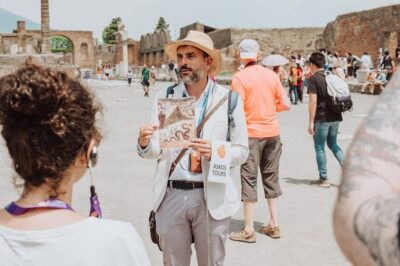
Pompeii makes sense in two guided hours. This tour is built for fast entry (skip-the-line with your ticket ready) and a real archaeologist-led walkthrough, so you spend your time actually seeing the city instead of waiting outside the gates.
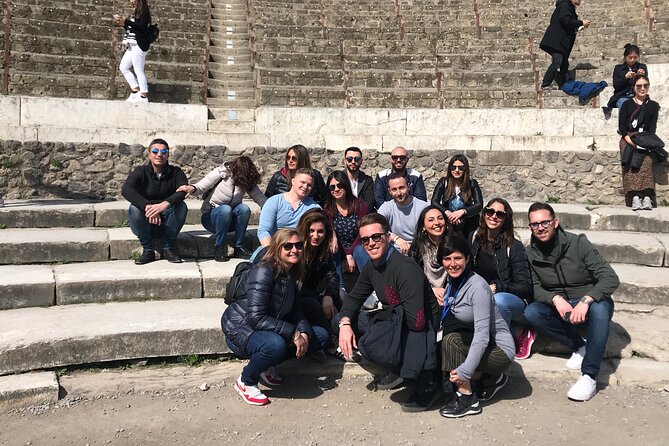
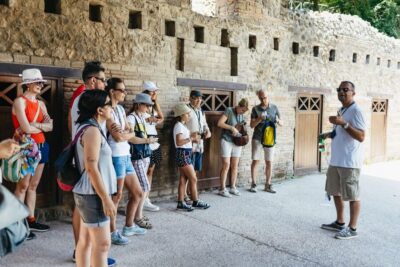
I especially like the small-group size (up to 10), which keeps the pace relaxed and makes it easier to ask questions. And I like that the tour is anchored by archaeologist Eliana Sandretti, not a script-read lecture.
The main consideration: the whole experience is designed as a highlights run in about two hours, so you won’t linger long in every corner (and noise can make certain bits harder to catch in busier spots).
In This Review
- Key things to know before you go
- Skip-the-line in Pompeii: how this tour saves the day
- Meet at Ristorante Suisse: a simple start you can actually find
- The 2-hour flow: what you’ll see and why it works
- Teatro Grande and the small theatre: where performances shaped daily life
- Granai del Foro and the casts: the tragedy you’ll never forget
- Stabian Baths (Terme Stabiane): frescoes and everyday luxury
- Foro di Pompei and La Basilica: the city’s public center and courtroom
- Temples with Vesuvius behind them: Jupiter and Venus
- Quadriporticus of the theatres, Gladiator Barracks, and training life
- Lupanar: the old red-light district and how to read it respectfully
- Casa del Fauno: seeing wealth up close without the guesswork
- Price and value: is $217.69 worth it?
- Guide quality and the human side of the experience
- Who this tour is best for
- Should you book this Pompeii small-group archaeologist tour?
- FAQ
- How long is the Pompeii small-group tour?
- What’s included in the ticket price?
- Is skip-the-line entry included?
- How large is the group?
- Where do I meet the guide?
- Is the tour offered in English?
- Do I get a mobile ticket?
- What’s not included?
Key things to know before you go
- Skip-the-line entry: your ticket is handled so you can get inside and start walking quickly
- Archaeologist storytelling: Pompeii becomes understandable, not just scenic ruins
- A smart highlights route: theatres, baths, forum sites, temples, and major houses in one loop
- The human scale of Pompeii: victim casts and everyday details give context fast
- Question-friendly pacing: small group size helps you get answers instead of just listening
Which Pompeii ticket and guide? Compare a few more.
- Pompeii Small Group Tour with an Archaeologist★ 5.0 · 6,593 reviews
- Discover the Ancient Ruins of Pompeii: Day Trip from Rome★ 3.5 · 2,247 reviews
- Pompeii and Herculaneum Small Group Tour with an Archaeologist★ 5.0 · 1,350 reviews
- Skip the Line Guided Tour of Pompeii led by an Archaeologist★ 5.0 · 703 reviews
Skip-the-line in Pompeii: how this tour saves the day
Pompeii is one of those places where your time matters. The site is huge, the walkways add up, and the best photo spots aren’t close to each other. So I like a tour that treats logistics as part of the experience, not an annoying extra.
This one includes fast-track skip-the-line tickets, meaning you’re already set when you arrive. That matters because Pompeii’s crowds can build, and waiting in line is the easiest way to lose the momentum of a short trip. If you have only a day (or only a couple of hours) here, arriving ready to move is a big deal.
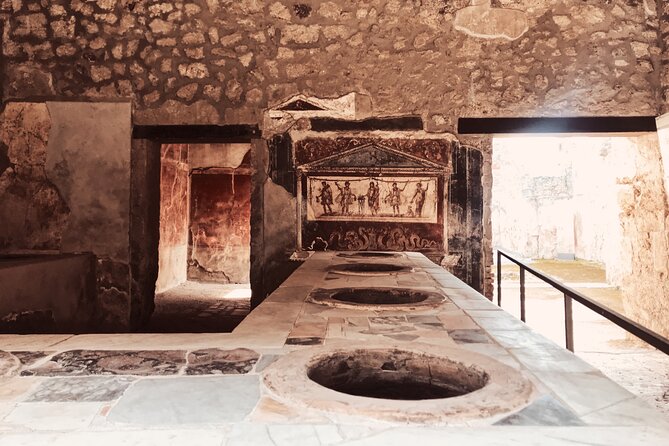
You’re also not just “admitted.” The tour is built around a guided sequence that helps you connect what you’re seeing—where people performed, shopped, ate, went to court, relaxed in baths, and lived in houses that ranged from modest to wildly impressive.
Meet at Ristorante Suisse: a simple start you can actually find
The meeting point is Ristorante Suisse, Piazza Esedra, 10/13, 80045 Pompei NA, Italy. It’s listed as the place where the experience starts and ends, so you’re not juggling transfers or figuring out where you’ll end up.
A practical tip: if you’re arriving from Naples or another nearby town, give yourself a little cushion before the start time. Even with a guided route, you don’t want to be the person sprinting in with 30 seconds to spare.
The tour also uses a mobile ticket, and it’s offered in English. If you’re thinking about accessibility, the tour notes that most travelers can participate, and service animals are allowed—so it’s fairly straightforward for many visitors.
The 2-hour flow: what you’ll see and why it works
The tour is designed for a concentrated overview. In about two hours, you’ll cover key zones across the city: the performance spaces, public forum areas, baths, temples, and then over to homes and the district associated with nightlife and sex work.
That route is the big value. Pompeii is famous, but it’s also easy to get lost in the details if you walk it solo. A good guide helps you read the ruins like a city plan, not like random walls.
The schedule has short stops (some around 10–15 minutes), which sounds brief—until you realize it’s what makes it doable. You get a clear sense of the layout, plus context for the big sights, without spending your whole day standing still.
Teatro Grande and the small theatre: where performances shaped daily life
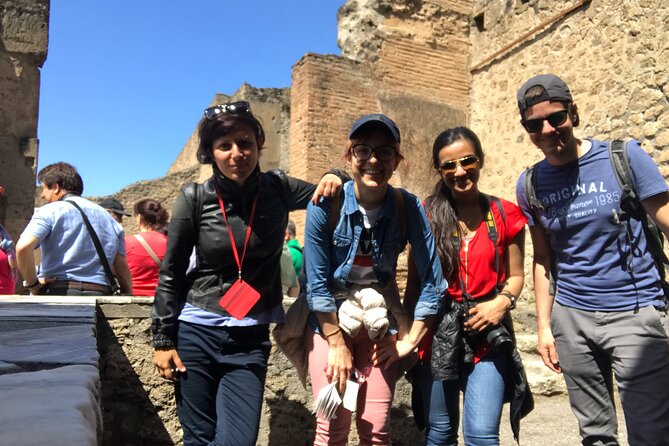
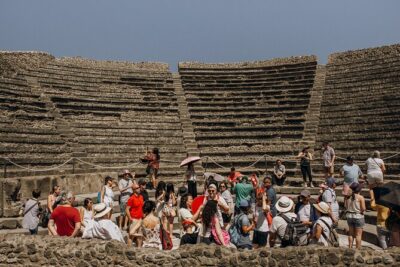
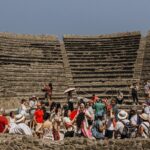
You start in the Pompeii Archaeological Park and then move into the entertainment side of town. The route includes the small theatre (the designated spot for musical and singing performances) and then the Teatro Grande, where Greek-Roman comedies and tragedies were performed.
Here’s what this stop does for you: it gives a sense of rhythm. Pompeii wasn’t just a quiet neighborhood frozen in time. People gathered. They listened. They watched stories unfold in a shared public space.
Also, theatre spaces help you understand architecture fast. Once you see how the seating and stage areas worked, you start noticing similar design choices elsewhere. It becomes easier to spot purpose, even when the building is partly damaged.
If you’re the type who likes “what was happening here” more than “what it looks like,” this section is a strong start.
More skip-the-line entries around Pompeii
Granai del Foro and the casts: the tragedy you’ll never forget
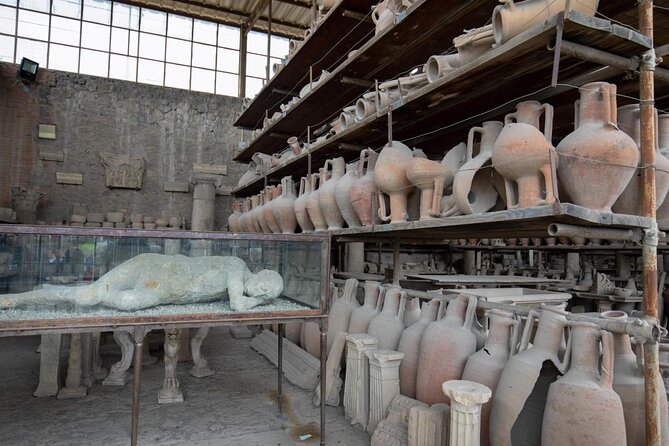
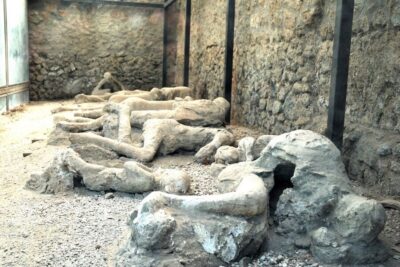
Next up: Granai del Foro, the barns of the forum area, where casts of victims who died during the eruption of 79 AD are displayed.
This is the emotionally heavy part of the route, and it’s also one of the reasons I think an archaeologist-led guide is worth it. Without context, you can feel like you’re just looking at figures in a room. With context, you understand why the site is preserved and what it represents in terms of the eruption’s impact.
This stop also reminds you that Pompeii’s fame isn’t only about art and clever buildings. It’s about real lives. Even if you’ve read about the eruption before, the physicality of the space makes the story hit differently.
Stabian Baths (Terme Stabiane): frescoes and everyday luxury
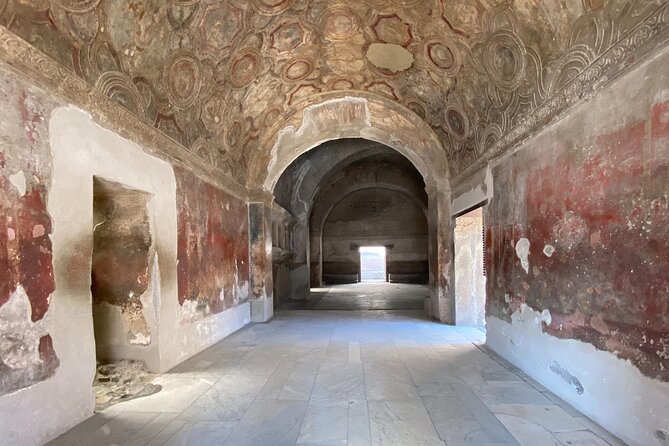
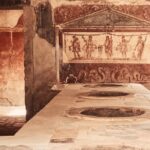
Then you move to the Stabian Baths, with time set aside to admire the colorful frescoes.
Baths in Roman towns were not just about washing. They were social spaces—places to chat, relax, and spend time. So when you’re standing in the remains of the Stabian Baths, the guide’s job is to help you picture the daily routine behind the décor.
The frescoes do the heavy lifting visually, but the tour makes them meaningful by tying decoration to how people used these spaces. You start noticing that these weren’t empty rooms; they were lived-in environments.
If you’re worried about getting burned by the sun, baths are also a good reminder to pace yourself. You’ll be outside between stops, but this one is built around a specific “payoff” attraction once you arrive.
Foro di Pompei and La Basilica: the city’s public center and courtroom
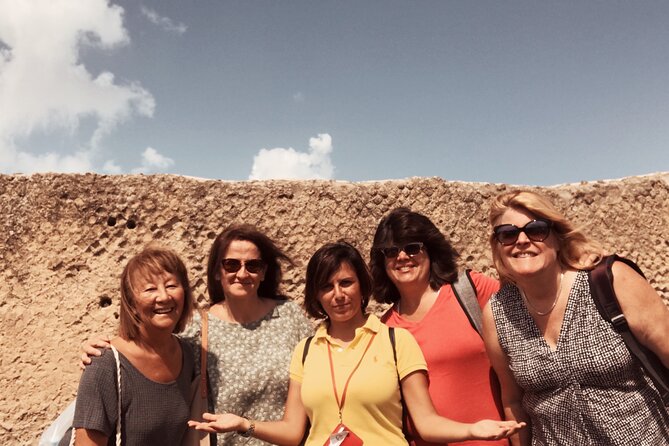
From the baths, you head to the core civic area: Foro di Pompei (the main square) and then Pompei La Basilica, where justice was administered.
This pair is valuable because it shows two sides of public life:
- the forum as a hub for movement and gatherings
- the basilica as the place where order and decisions happened
Even with short time here, the guide’s explanation matters. The ruins can look like “big old stone rooms” if you don’t know what happened there. But once you understand the function, the forum stops feeling random. It starts feeling like a system.
Temples with Vesuvius behind them: Jupiter and Venus
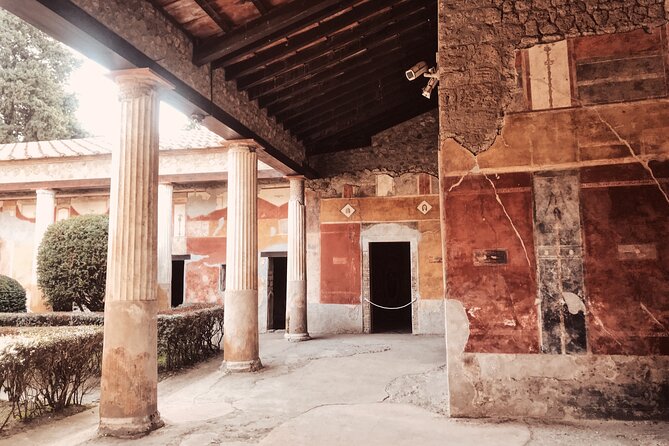
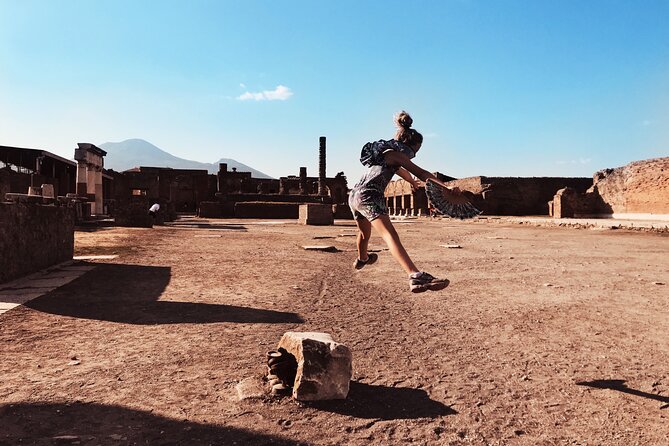
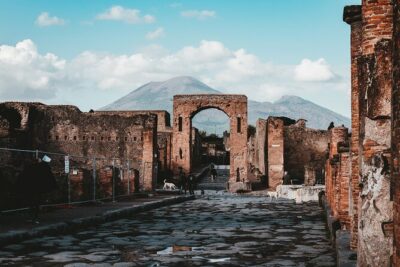
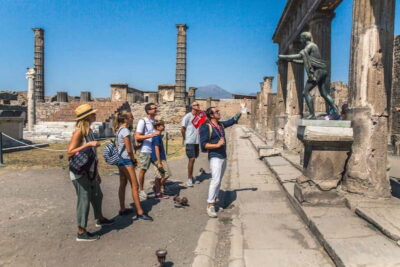
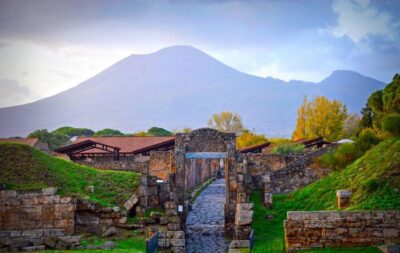
The tour includes a temple stop where you’ll see the imposing presence of Vesuvius in the backdrop—specifically the Temple of Jupiter. And you’ll also visit the Temple of Venus, tied to veneration of the city’s divinity.
This is one of those places where location is part of the story. Pompeii’s relationship with Vesuvius is unavoidable, and the way the views frame the temples makes the city feel less like a museum and more like a real place where people believed, feared, and planned life around forces they couldn’t control.
If you want your tour to include at least a couple “wow” perspective moments—not only close-up ruins—this is where you tend to get them.
Quadriporticus of the theatres, Gladiator Barracks, and training life
Next, you’ll cover the area related to the theatres and then move into Gladiator Barracks—including where gladiators trained, plus the apartments connected to their lives.
It helps to think of this stop as “work-life Pompeii.” We often picture ancient cities as temples and wealthy houses. But gladiators were workers in a system that was part sport, part entertainment, and part survival.
The tour’s format here matters because it links training spaces to how the city used performers and public spectacle to attract crowds. Once you understand that, the barracks don’t feel like an odd side attraction. They feel like another key chapter in the story.
Lupanar: the old red-light district and how to read it respectfully
You’ll also visit the Lupanar, often described as the old red-light district. Time is set aside to see the space and understand what it was for.
This is one of the stops that can feel awkward if you’re expecting it to be played like a novelty. A good guide helps you treat it as history instead of gossip. You learn what it tells you about social life, commerce, and what people sought in a city with strict hierarchies.
I also like that this stop is placed in the middle of the route, not tacked on at the end. It lands while you still have context for how people used Pompeii’s public spaces.
Casa del Fauno: seeing wealth up close without the guesswork
Finally, you’ll visit the Casa del Fauno, one of the richest and most luxurious residences in Pompeii.
This is a strong closing move. A great house stop doesn’t just show you pretty stones. It shows you how status worked—where people gathered, how the home functioned, and what wealth looked like in everyday architecture.
If you’ve ever visited ruins alone and felt like you were staring at rooms with no clue where to begin, this is the opposite. The guide helps you interpret features so you can imagine how the place ran.
And yes, this kind of home is where the scale hits. Even in ruins, you get a sense that some families lived with comfort and resources that were worlds away from the city’s more modest living.
Price and value: is $217.69 worth it?
At $217.69 per person for a tour that runs about two hours, value comes down to what you’re buying:
You’re paying for:
- skip-the-line entry
- an archaeologist-led guide (in many cases, Eliana Sandretti)
- included admission tickets
- a small group (up to 10)
- a guided route that hits major sites without you having to plan an entire walking day
If you’ve only got limited time and you want the biggest sights plus real context, this price can feel fair. You’re not trying to DIY Pompeii and figure out what matters as you go. You’re using your time in the park the way the tour is designed: focused, efficient, and guided.
Where it might feel pricey is if you’re the kind of traveler who prefers to wander slowly, linger for a long time, and read everything on your own. But for most people who want a clear Pompeii “greatest hits” route with meaning, this format hits the sweet spot.
Guide quality and the human side of the experience
One of the most praised parts of this tour is the guide experience—especially the archaeologist angle. Eliana Sandretti is described as communicating in a way that feels fresh, not like recycled lines. That matters because Pompeii is repetitive if you’re not careful. The stones look similar; the story is what keeps you engaged.
There’s also strong evidence of good communication ahead of time. The tour is confirmed at booking, and the guides have been described as texting to confirm reservations.
Another practical plus: if things shift, the tour isn’t a dead end. Guides such as Dario and Francesco/Francisco have been reported stepping in while keeping the route coherent. The best kind of flexibility is the kind that protects your day.
Who this tour is best for
This tour is a good match if you:
- want the most important Pompeii sites in a short visit
- care about context (why things exist, how people lived, what the eruption changed)
- prefer a small group so you can ask questions
- want to avoid lining up and spending your prime time waiting outside
- like architecture plus human stories, not just scenery
It’s also a solid option for families who need a manageable pace. The tour has been described as patient, including with a young child and stroller, which can be a real deciding factor in Pompeii.
Should you book this Pompeii small-group archaeologist tour?
I’d book this if your goal is to leave Pompeii feeling like you understood it, not just like you survived it. The skip-the-line entry saves time, the route hits the big named areas, and the archaeologist-led approach helps the ruins make sense.
Two quick cautions before you click confirm:
- If you dream of slow wandering and long stays in one spot, the highlights pace might not feel like enough.
- Pompeii is outdoors, and this experience requires good weather, so plan your day with that in mind.
If you’re flexible on timing, that helps too—because schedules can change and the provider has shown they’ll work with you.
Bottom line: this is one of the more time-efficient ways to see Pompeii, and it’s also one of the more meaningful ones.
FAQ
How long is the Pompeii small-group tour?
It’s about 2 hours.
What’s included in the ticket price?
Admission tickets for the included stops, an authorized guide with archaeologist & tour guide, and fees and taxes for purchasing the entrance ticket.
Is skip-the-line entry included?
Yes. It includes fast-track skip-the-line tickets.
How large is the group?
The tour is for up to 10 people.
Where do I meet the guide?
At Ristorante Suisse, Piazza Esedra, 10/13, 80045 Pompei NA, Italy.
Is the tour offered in English?
Yes, it’s offered in English.
Do I get a mobile ticket?
Yes, it includes a mobile ticket.
What’s not included?
Food and drinks, tips, and transport are not included.
More Skip-the-Line Tickets in Pompeii

More Tour Reviews in Pompeii



More Pompeii Tours to Compare
More Pompeii tours, freshly reviewed



Pompeii Tours, compared.
 ★ 4.8Pompeii: Entry Ticket and Guided Tour with an ArchaeologistFrom $3519,459 reviews
 ★ 4.1Pompeii: Entry Ticket with Audio GuideFrom $4013,491 reviews
 ★ 4.8Pompeii: Small Group Tour with an ArchaeologistFrom $4012,264 reviews
 ★ 4.3Pompeii Ruins & Mount Vesuvius Day TourFrom $12011,459 reviews
★ 5.0Pompeii Small Group Tour with an ArchaeologistFrom $356,593 reviews
★ 4.3Pompeii Ruins & Mount Vesuvius Day TourFrom $12011,459 reviews
★ 5.0Pompeii Small Group Tour with an ArchaeologistFrom $356,593 reviews
 ★ 4.5Skip-the-line Pompeii – Small Group TourFrom $544,401 reviews
 ★ 4.6Naples or Sorrento: Full-Day Pompeii and Mount Vesuvius TourFrom $1044,235 reviews
 ★ 3.9Pompeii: Skip-the-line Entry Ticket with Audio Guide & MapFrom $433,153 reviews