
Review · POMPEII TOURS
Pompeii Archaeological Small-Group tour for 15 people
Pompeii works best when someone keeps the story moving. This Askos Tours small-group walk (max 15) strings together the Forum, major houses, the baths, and the city theater with an archaeologist-style guide. You get a tight route that helps you understand what you’re seeing instead of just wandering lost among arches and stones.
I love the pacing and the audio help. With headsets available for groups of 10+, you’re not forced to strain your ears in the narrow lanes. I also love the value of the included entry: you don’t have to keep stopping to figure out ticket coverage while you’re staring at famous spaces like the Forum granaries and the House of Menander.
One thing to consider: 2 hours is not a full Pompeii day. If the site is packed (like it sometimes gets on big holidays), the tour may be adjusted to fit the flow, and some younger kids can find the context a bit heavy compared with what they’d rather do on vacation.
In This Review
- What Makes This Pompeii Tour Work So Well
- Two Hours at Pompeii: The Small-Group Advantage
- Where You Meet (and Where You End Up)
- Getting Oriented at Porta Marina Superiore
- Vicolo delle Terme, 2: Merchants, Porticoes, and Street Life
- The Forum: Pompeii’s Main Square Moment
- Granaries of the Forum: Casts, Fountains, and Details That Matter
- Walking Pompeii’s Main Street: Connecting the Dots
- House of Menander: A Rich Interior Story Without the Guesswork
- Stabian Baths: The Oldest Thermal Complex Angle
- Lupanar: The Famous Brothel Stop (Brief, Focused, Not Sensational)
- House of the Faun: Size, Splendor, and Layout
- Teatro Grande: Ending With Pompeii’s Big Public Stage
- Guides Make the Difference: Names to Remember
- Price and Ticket Value: Is $77.06 Worth It?
- Who This Tour Suits Best (and Who Might Want Something Else)
- Final Take: Should You Book This Pompeii Small-Group?
- FAQ
- How long is the Pompeii Archaeological small-group tour?
- How big is the group?
- Is the tour in English?
- What’s included in the price?
- Which entrance sites are included versus free during the tour?
- Where do I meet the guide, and where does the tour end?
- Are food and drinks included?
- Can I cancel for a refund?
What Makes This Pompeii Tour Work So Well
- Up to 15 people keeps the guide from turning into a megaphone with a job
- Headsets for groups of 10+ make the narration clearer, especially around busy corners
- Key entry tickets included helps you spend time looking, not calculating
- A structured “see it in order” route ties Forum life to houses, baths, and public space
- English-only guidance makes it straightforward for international visitors
Which Pompeii ticket and guide? Compare a few more.
- Pompeii Small Group Tour with an Archaeologist★ 5.0 · 6,593 reviews
- Discover the Ancient Ruins of Pompeii: Day Trip from Rome★ 3.5 · 2,247 reviews
- Pompeii and Herculaneum Small Group Tour with an Archaeologist★ 5.0 · 1,350 reviews
- Skip the Line Guided Tour of Pompeii led by an Archaeologist★ 5.0 · 703 reviews
Two Hours at Pompeii: The Small-Group Advantage
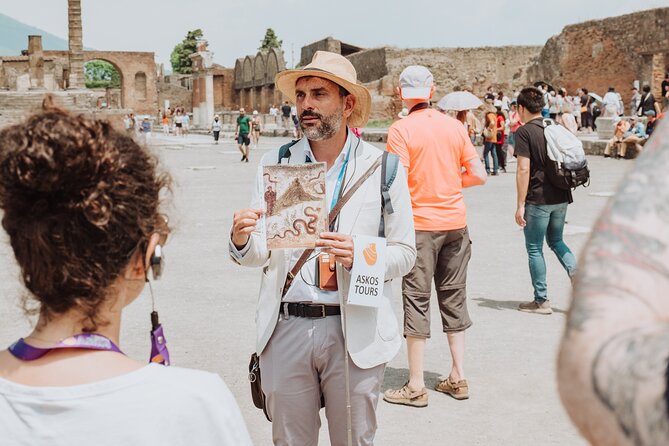
Pompeii can overwhelm fast. The ruins cover a lot of ground, and once you’re inside, it’s easy to lose the thread. This tour is designed to prevent that. In about 2 hours, you follow a logical sequence through the city’s most recognizable areas, so your brain keeps connecting the dots.
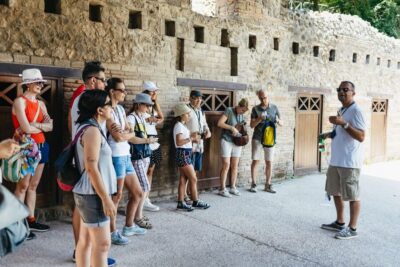
The small group size matters. When the group is under 15, you get enough attention to ask questions without waiting in a human traffic jam. It also helps the guide keep everyone moving at a steady pace, which is huge when you’re dealing with uneven surfaces and tightly packed streets.
And yes, the “small group” promise is real here. You’re capped at 15, and headsets kick in for groups of 10 or more—so you can actually hear details while walking.
Where You Meet (and Where You End Up)
You start at Via Villa dei Misteri, 2, 80045 Pompei. Your guide meets you at the main entrance of the archaeological site at Porta Marina Superiore, standing in front of Hortus bar & Restaurant with an Askos Tours sign.
This is one of those practical touches that saves time and stress. Pompeii is busy and easy to mix up, especially if you arrive a few minutes late. Having a visible meeting point and a clearly marked guide reduces the scramble.
You finish inside the ruins in Piazza Esedra. That’s a smart ending: you’re in the middle of things, not pushed back toward the exit. Afterward, you’re free to keep wandering on your own.
Getting Oriented at Porta Marina Superiore
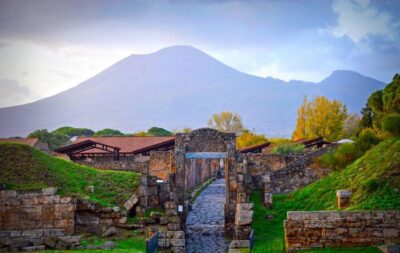
The first stop is Piazza Porta Marina, right at Porta Marina Superiore. It’s a good “start here” moment because it frames Pompeii as a city you move through—not just a collection of buildings.
From there, the guide keeps you walking into smaller streets. This is where the tour’s structure really helps: instead of hopping randomly, you’re led from a main access point into quieter, more specific areas where the ruins start to feel lived-in.
Admission at this first stop is listed as free, so you’re not immediately thinking about tickets. The focus stays on orientation and understanding the city layout.
Vicolo delle Terme, 2: Merchants, Porticoes, and Street Life
Next comes Vicolo delle Terme, 2. You’re shown a basilica-style open portico, a kind of sheltered space that supported merchants and other activity. This is a useful early stop because it shifts you away from “tourist sightseeing mode” into “how did people move and work here?” mode.
A sheltered portico sounds small, but Pompeii is full of spaces like this that explain daily rhythms. When you see the structure of an open covered area, you start to picture conversation, trading, and foot traffic.
Time here is short—around 10 minutes—so the guide’s job is to point you toward the most meaningful visual cues rather than let everyone drift.

The Forum: Pompeii’s Main Square Moment
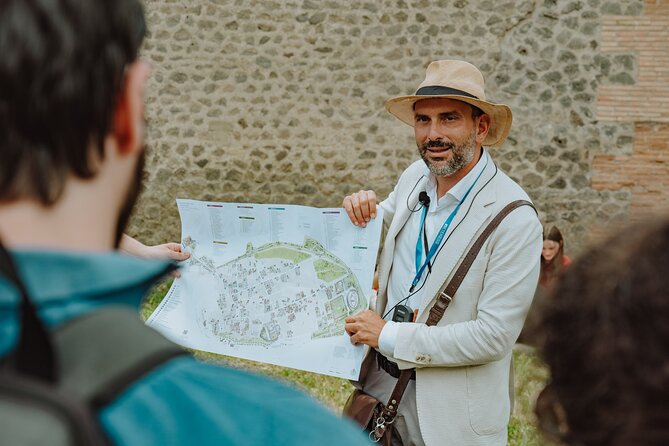
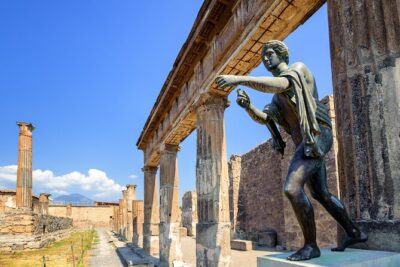
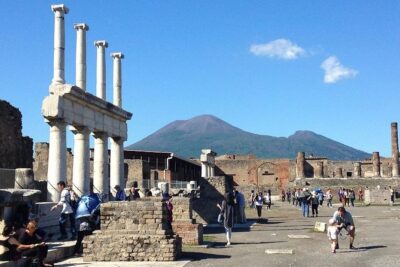
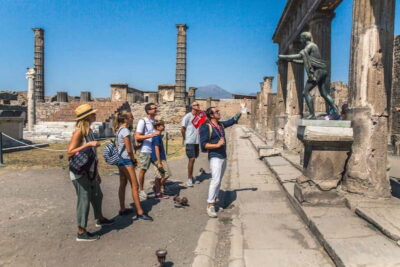
Then you step into the Foro de Pompeya, the ancient main square. This is the place to expect the biggest “oh wow” effect because it’s central, open, and instantly legible compared with the smaller lanes.
Admission here is included, which means you’re paying attention to a core space right away without needing to manage ticket logistics. The guide helps you look at the Forum as an engine of civic life, not just stonework.
For me, the best Forum visits do two things: they show you what mattered politically and socially, and they explain how the space shaped movement. This tour’s short stop format works for that. You get a snapshot without feeling like you’re stuck for hours.
Granaries of the Forum: Casts, Fountains, and Details That Matter
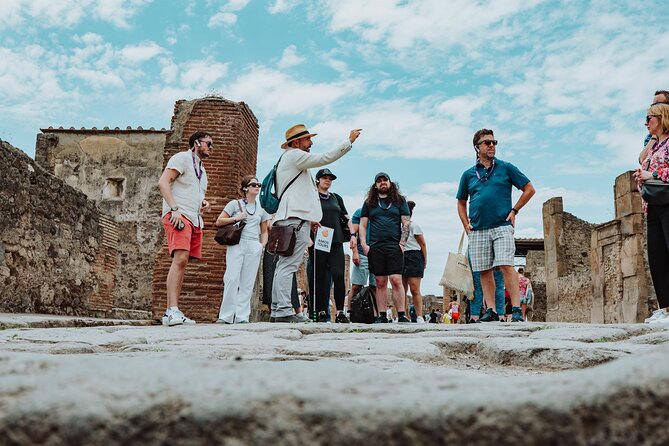
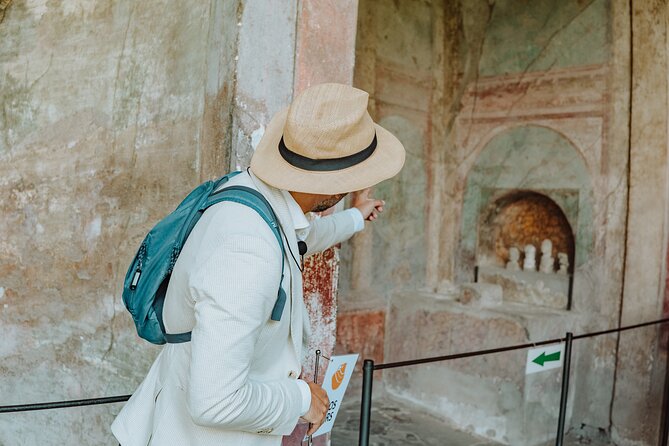
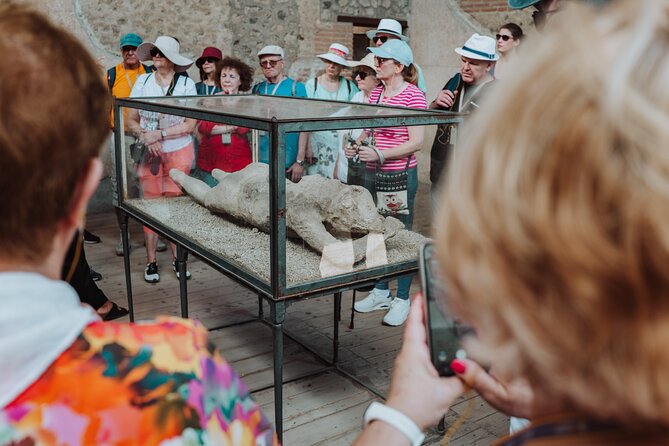
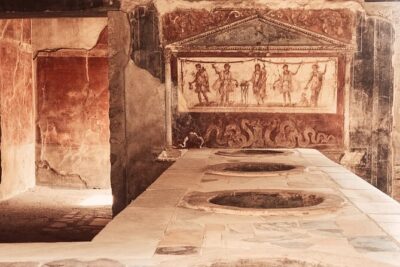
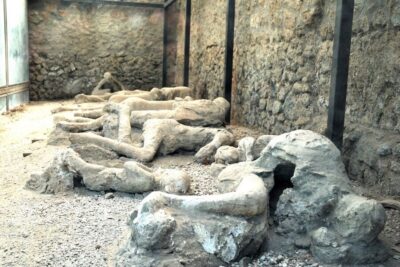
In the Granaries of the Forum, you see marble tables and baths for fountains that adorned entrances of houses. The stop also includes casts linked to the eruption: victims, plus a dog and a tree.
This is one of the tour’s most emotionally loaded areas, and it’s also where the guide’s approach matters most. You’re not just looking at artifacts—you’re being guided to notice what these installations say about everyday life and public ornament.
A practical note: this stop is listed as 10 minutes, so don’t expect a museum-style pace. If you’re the kind of person who loves stopping for 10 photos of one niche corner, this is where you might wish the time were longer. Still, in a 2-hour overall tour, the trade-off is that you cover several top sites instead of lingering too long in one room.
Walking Pompeii’s Main Street: Connecting the Dots
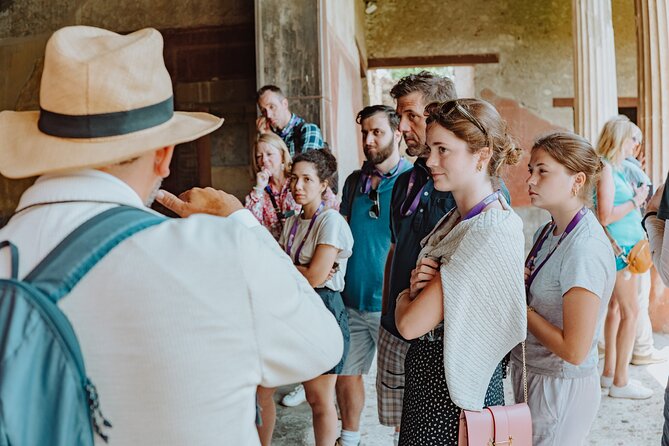
Between major interiors and landmarks, you walk the main street of Pompeii. This matters because it bridges the city’s “rooms” and “public spaces.”
It’s also a chance to reset your brain. After looking at architecture and specific rooms, walking gives you the bigger picture: streets, approach routes, and how people would have encountered each place in sequence.
House of Menander: A Rich Interior Story Without the Guesswork
The House of Menander is one of Pompeii’s richest and most magnificent houses in terms of architecture, decoration, and contents. You get about 15 minutes here, and the guide’s job is to turn what looks like “a lot of old walls” into something you can actually read.
This kind of stop is valuable because Pompeii’s houses aren’t just about wealth. They show how people organized space—how they displayed taste, how they structured daily movement, and what they used for entertaining. The name Menander also signals that you’re in a well-known, high-impact house, so you’ll likely feel the excitement of seeing a star location.
If you’re visiting with teenagers and adults, this stop tends to land well because the explanation can connect art and everyday behavior. For younger kids, the context can be more demanding than the visuals alone.
Stabian Baths: The Oldest Thermal Complex Angle
Next up: the Stabian Baths (Terme Stabiane), occupying a vast area between key crossroads and lanes. The tour frames them as the oldest thermal complex in the city.
This is a strong “daily life” stop. Baths in Roman towns weren’t just about washing. They were social space—places where people met, talked, and spent time. Seeing a large thermal complex helps you understand why Pompeii’s urban design mattered. It wasn’t all temples and houses. It was also routines and public comfort.
You get about 15 minutes here, and admission is included, which keeps the rhythm smooth. The only drawback is that baths are big and easy to mentally wander from. That’s where a good guide helps you focus on the most significant features.
Lupanar: The Famous Brothel Stop (Brief, Focused, Not Sensational)
Then you visit the Lupanar, the most famous brothel in Pompeii. Admission is included here too, and you spend about 10 minutes.
This stop can feel intense because it’s tied to sex work and private life. The benefit of having a guided visit is that you aren’t left to guess what you’re looking at. You get explanation that keeps it grounded in how the site functioned.
One consideration: if you’re uncomfortable with this subject, you should know the tour includes it and it’s not optional once you’re inside. The pacing is brief, but it’s still a major stop in the route.
House of the Faun: Size, Splendor, and Layout
The House of the Faun is another headline residence—one of the largest and most impressive private homes in Pompeii. You get about 15 minutes and included admission.
This is the kind of house that rewards attention. Even when you can’t read every detail, you can feel the differences in scale. That scale is the point: you’re not just seeing a room, you’re seeing how wealth organized domestic life.
If you loved the House of Menander stop, the House of the Faun typically gives you a satisfying “second angle.” One house shows one kind of greatness; the other helps you compare.
Teatro Grande: Ending With Pompeii’s Big Public Stage
The tour finishes with Teatro Grande, the most important theater in Pompeii. You get about 10 minutes and included admission.
This ending makes sense. After houses and baths, you return to a major public gathering place. The theater ties together the idea of community spaces—performances, crowds, shared time.
If you want a mental image to carry with you after the tour, the theater is a strong final anchor. It helps you picture Pompeii as a place where people came together, not only to live and work, but also to watch, react, and belong.
Guides Make the Difference: Names to Remember
The quality of this tour often comes down to the person leading it. In English-language tours with Askos, you may be guided by professionals like Mario Celebtano, Rafaelle, Antonella, Camillo Sorrentino, Nicoletta, Hugo, or Teresa—each praised for preparation, clear explanations, and the ability to connect Pompeii’s spaces to what people did there.
One theme that shows up across strong reviews is how guides handle crowds without losing the thread. On a busy holiday day (like April 25), the route was adjusted earlier to keep the group moving. That kind of flexibility is exactly what you want from a guide when Pompeii is packed.
Price and Ticket Value: Is $77.06 Worth It?
At $77.06 per person for an ~2-hour tour, this is a mid-range ticket for a guided Pompeii experience. Here’s why the value can make sense.
First, the tour includes a Pompei Express entrance ticket, and specific stops list admission included. That means you’re paying for guided time plus access to key sites rather than just a walking lecture outside.
Second, the small group cap of 15 plus headsets for larger groups reduce the usual pain point of Pompeii tours: you get both access and communication. If you’ve ever been in a big group where you can’t hear a word, you already know why this matters.
Third, the route hits major Pompeii highlights without trying to cover every corner. If you’re short on time, $77.06 can feel like buying focus. If you already know Pompeii well and want total freedom, you might decide to go independent. But if you want structure and interpretation, this tour is priced like a practical helper, not a splurge.
Who This Tour Suits Best (and Who Might Want Something Else)
This tour fits well if you’re visiting Pompeii for the first time and want a guided route that makes the city feel understandable. It’s also a good pick for teenagers and adults who enjoy context—architecture, daily life, and what specific spaces were used for.
It may be less ideal for very young children who need long play breaks or who struggle with explanations at this level. The tour’s 2-hour length is friendly for many families, but the subject matter and historical framing can be more engaging for older visitors.
If you’re a history buff, you’ll likely appreciate the way the route mixes public square (Forum), private wealth (houses), social routine (baths), and entertainment (the theater). If you prefer quiet wandering, you could feel rushed, because the emphasis is on covering the highlights in sequence.
Final Take: Should You Book This Pompeii Small-Group?
I’d book this if you want Pompeii to make sense fast. The small group size, headsets, and ticket coverage at major stops help you get value out of limited time. It’s a smart choice when you want a guide who can explain what you’re seeing in concrete terms, including strong stops like the Forum granaries with casts and the headline residences like Menander and the Faun.
I’d think twice if you want a long, unstructured day or if you dislike tours that include the Lupanar. Also consider that busy days can tighten the schedule. If you’re planning around a major holiday or peak crowds, build in extra flexibility.
If you book, take advantage of the fact that you finish in Piazza Esedra and can keep going afterward. After the tour, ask your guide for one or two logical next areas to explore, then follow that thread while you’re still in Pompeii mode.
FAQ
How long is the Pompeii Archaeological small-group tour?
The tour lasts about 2 hours.
How big is the group?
The group is capped at a maximum of 15 people.
Is the tour in English?
Yes, the tour is offered in English.
What’s included in the price?
The tour includes guidance for the entire duration, the Pompei Express entrance ticket, small-group access, headsets for groups of 10 or more, and a licensed guide with an archaeological background.
Which entrance sites are included versus free during the tour?
The first two stops are listed with free admission, while key later stops include admission (including the Foro de Pompeya, the Granaries of the Forum, the House of Menander, the Stabian Baths, the Lupanar, the House of the Faun, and Teatro Grande).
Where do I meet the guide, and where does the tour end?
You meet at Porta Marina Superiore, in front of Hortus bar & Restaurant, with an Askos Tours sign. The tour ends inside the ruins in Piazza Esedra.
Are food and drinks included?
No. Food and drinks are not included.
Can I cancel for a refund?
Yes. Free cancellation is available up to 24 hours in advance for a full refund. If you cancel less than 24 hours before the start time, the amount paid is not refunded.
More Tours in Pompeii



More Tour Reviews in Pompeii

More Pompeii Tours to Compare
More Pompeii tours, freshly reviewed



Pompeii Tours, compared.
 ★ 4.8Pompeii: Entry Ticket and Guided Tour with an ArchaeologistFrom $3519,459 reviews
 ★ 4.1Pompeii: Entry Ticket with Audio GuideFrom $4013,491 reviews
 ★ 4.8Pompeii: Small Group Tour with an ArchaeologistFrom $4012,264 reviews
 ★ 4.3Pompeii Ruins & Mount Vesuvius Day TourFrom $12011,459 reviews
★ 5.0Pompeii Small Group Tour with an ArchaeologistFrom $356,593 reviews
★ 4.3Pompeii Ruins & Mount Vesuvius Day TourFrom $12011,459 reviews
★ 5.0Pompeii Small Group Tour with an ArchaeologistFrom $356,593 reviews
 ★ 4.5Skip-the-line Pompeii – Small Group TourFrom $544,401 reviews
 ★ 4.6Naples or Sorrento: Full-Day Pompeii and Mount Vesuvius TourFrom $1044,235 reviews
 ★ 3.9Pompeii: Skip-the-line Entry Ticket with Audio Guide & MapFrom $433,153 reviews