
Review · POMPEII TOURS
Small-Group Tour in Pompeii with a Real Archeologist, ticket included
Pompeii hits different when someone explains it. This small-group walk through the ruins pairs a real archaeologist guide with priority access, so you spend less time guessing and more time understanding daily Roman life.
I love the priority ticket entrance setup and the fact that you get headsets, which makes the tour feel clear even when you’re packed near crowds and stone walls. I also like that the pace stays manageable for a hot day, with short, focused stops that keep the story moving.
One consideration: many stops are brief, so if you want long pauses in front of mosaics and frescoes, you’ll need to plan a little extra time after the guided portion.
In This Review
- Key highlights to look for
- Priority park access and an archaeologist at your side
- Price and value: what you’re paying for at $66.23
- Meeting at Hotel Vittoria in Piazza Esedra: the logistics that matter
- Stop 1: Casa del Poeta Tragico and the Cave Canem floor mosaic
- Stop 2: Casa dei Vettii and the luxury of elite myth-making
- Stop 3: The Lupanar—business, rooms, and Roman realism
- Stop 4: Foro di Pompei—public space without carts
- Stop 5: Suburban Baths—relaxation outside city walls
- Stop 6: Casa del Fauno and the bronze faun statue
- Stop 7: Casa del Menandro—silver objects and Trojan War frescoes
- Stop 8: The Archaeological Park area, amphitheatre, and the question of tickets
- Stop 9: Temple of Apollo and the cult’s shifting power
- After the tour: use your day ticket like a pro
- How to handle Pompeii’s heat (without losing your mind)
- Who this tour suits best
- Should you book this Pompeii small-group tour?
- FAQ
- How long is the Pompeii small-group tour?
- What language is the tour offered in?
- How big is the group?
- Where is the meeting point?
- Does the tour start and end at the same place?
- Are tickets included?
- Is private transportation included?
- What’s included besides the guide?
- Are service animals allowed?
- Can I cancel for a full refund?
- Is the tour dependent on weather?
Key highlights to look for
- Archaeologist-led explanations tied to what you’re seeing, not just general facts
- Priority entry to the archaeological park to help you get started sooner
- Max group size of 15 with headsets so you can actually hear details
- A smart mix of sites: elite houses, the forum, baths, brothel, amphitheatre, and Apollo
- A day ticket means follow-up wandering after the tour, if you want more time in a favorite spot
Which Pompeii ticket and guide? Compare a few more.
- Pompeii Small Group Tour with an Archaeologist★ 5.0 · 6,593 reviews
- Discover the Ancient Ruins of Pompeii: Day Trip from Rome★ 3.5 · 2,247 reviews
- Pompeii and Herculaneum Small Group Tour with an Archaeologist★ 5.0 · 1,350 reviews
- Skip the Line Guided Tour of Pompeii led by an Archaeologist★ 5.0 · 703 reviews
Priority park access and an archaeologist at your side
Pompeii is big, and it’s easy to get lost in fragments. This tour is built to keep you oriented with a guide who can explain what’s in front of you—why a room was shaped a certain way, what a decoration signaled, and how the city functioned right before the eruption.
The archaeologist angle matters because it changes the tone. You’re not just looking at ruins. You’re learning how historians and archaeologists read them—sometimes with more than one interpretation—so the place starts to feel like a working city, not just a photo backdrop.
You’ll also get headsets, which is a big deal at Pompeii. Even with a small group, you’ll hear better and miss fewer details as you move between rooms and courtyards.
Price and value: what you’re paying for at $66.23
At $66.23 per person for about 2 hours 30 minutes, the value is mainly in the guide + time savings. Priority entry helps you avoid some of the worst start-of-day delays, and the guided route keeps you from wasting your precious hours figuring out what’s worth your attention.
Most stops include admission ticket access, which is helpful because Pompeii can turn into an “extra charge” puzzle if you’re not careful. One note: the amphitheatre stop lists admission ticket not included, so if that’s a must-see for you, confirm what your priority park entry covers for that specific segment before you go.
The price also makes sense if you’re short on time. In a single afternoon, you get a guided cross-section of Pompeii’s everyday life—from fancy houses to public spaces to the entertainment and worship sites.
Meeting at Hotel Vittoria in Piazza Esedra: the logistics that matter
This tour starts and ends at the meeting point near Hotel Vittoria, Piazza Esedra, 80045 Pompei. That round-trip pattern is convenient because you’re not scrambling to re-find transportation afterward.
Use the address above as your anchor. One guide experience flagged that the meet-up can be confused by app locations, so I strongly recommend you navigate to the Piazza Esedra area and be ready to show up at the correct spot.
With a maximum of 15 people, the group size stays small enough for conversation. That matters when your guide is pointing out specific clues in mosaics, wall paintings, and layout details.
Stop 1: Casa del Poeta Tragico and the Cave Canem floor mosaic
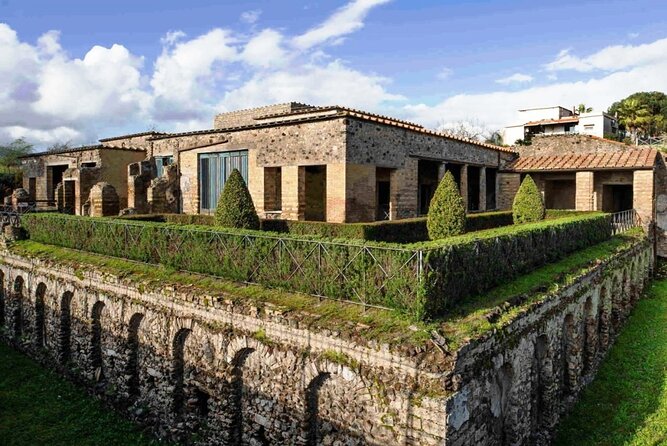
The tour begins in an elite house of the imperial age: Casa del Poeta Tragico. One highlight here is the floor mosaic famously labeled Cave Canem—a vivid reminder that even in a city of art and status, humor and warning signs were part of daily space.
What I like about starting here is the contrast it gives you. You see a home with real status signals early on, so later stops like the forum or the Lupanar make more sense. You can compare what elite households valued versus what public life looked like.
A drawback? The stop is short, about 15 minutes. You’ll get the big picture and the key objects explained, but you won’t have endless time to study every tile pattern or wall surface.
Other tickets and entries for Pompeii


Stop 2: Casa dei Vettii and the luxury of elite myth-making
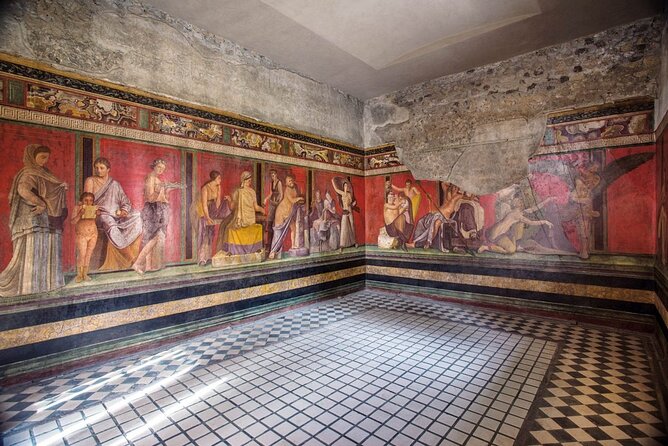
Next is Casa dei Vettii, known from its owners, Aulo Vettio Restituto and Aulo Vettio Conviva. This is one of Pompeii’s most celebrated luxurious houses, and it’s a strong choice because it shows how elite Romans used wall art and architecture to project taste and identity.
In a place like Pompeii, the buildings aren’t just pretty. They tell you how power and wealth were displayed. In Casa dei Vettii, you’re likely to notice how the home’s design channels attention toward decoration—especially myth-themed painting.
Again, expect a brisk pace. If you tend to linger, remember you have the day access after the tour to revisit the rooms that grab you.
Stop 3: The Lupanar—business, rooms, and Roman realism
Then comes the stop many people remember: the Lupanar, the two-storey building associated with prostitution and commercial activity. This isn’t presented as a sensational detour. It’s used as a lens on how the city worked—where commerce happened and how buildings were adapted for it.
The building layout is especially striking: five rooms on the ground floor and five upstairs, each with a concrete bed and, if you were lucky, a mattress or mat. That detail grounds the place in physical reality. It’s not an abstract concept; it’s a set of rooms built for repeat business.
A consideration: this stop can feel jarring if you’re expecting only “classic ruins.” I think it’s valuable, though, because it keeps the story honest. Pompeii wasn’t only art and temples. It was also ordinary, transactional life.
Stop 4: Foro di Pompei—public space without carts
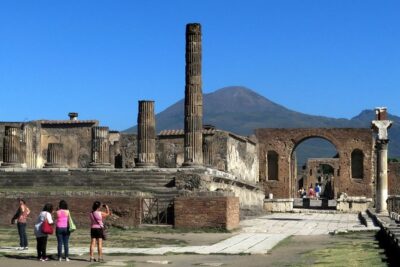
The route moves to the civic heart: the Foro di Pompei, measuring about 142 metres long and 38 metres wide. What stood out is the design rule—pedestrians and carts were separated, with the forum reserved for pedestrians and carts not allowed.
Today, the forum reads differently than in its prime: statues are gone, and much of the ornate flooring and marble work isn’t fully present. Still, the layout teaches you something important—public buildings face the forum, making it the stage for civic life.
A good mental trick here: don’t judge what’s missing. Look at what remains—alignment, open areas, and where buildings would frame people’s daily movement.
Stop 5: Suburban Baths—relaxation outside city walls
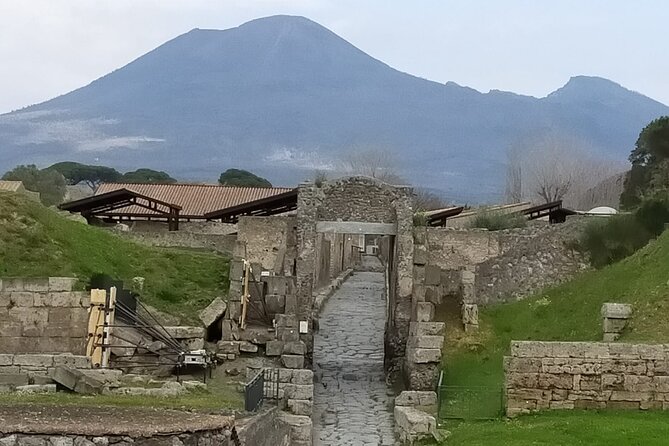
Next you’ll reach Suburban Baths, located outside the city walls. Even the positioning matters. These were likely used by travelers, with a nearby port area featuring rocks where boats could moor.
So the baths aren’t just a “pretty ruin.” They suggest a city that hosted visitors and movement, not just residents. When you compare this to elite household spaces, you start to see the different roles of water and relaxation in Pompeii’s social life.
The stop is short, but the context is useful. Baths tied together comfort, routine, and the flow of people in and out of the city.
Stop 6: Casa del Fauno and the bronze faun statue
Then it’s Casa del Fauno, one of Pompeii’s most famous homes. It’s named after a bronze statue of a faun located in the impluvium. That placement is a clue in itself: the interior water feature and the statue are part of how the house creates meaning in everyday movement.
What I like about this stop is that it connects art to function. The impluvium wasn’t only a decorative basin—it was part of a household system for handling water and shaping how you experience the center of the home.
You’ll get the key story quickly, then move on. If the bronze faun becomes your favorite detail, plan to return after the tour with more time to look.
Stop 7: Casa del Menandro—silver objects and Trojan War frescoes
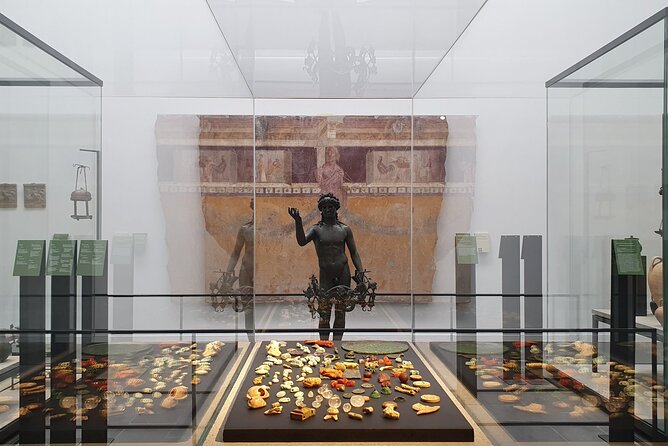
Casa del Menandro is the kind of stop that makes Pompeii feel bigger than your first impression. The house is around 2,000 square metres, and it’s named for a fresco depicting the poet Menandro.
The details here are eye-catching. The site produced 118 silver objects, described as tableware of great interest, and the walls feature frescoes from the Trojan War—including the death of Laocoonte, Cassandra, and Ulysses.
This is one of the stops where an archaeologist guide can really help you see beyond the surface. Myth scenes can look like decoration until someone explains why these stories mattered culturally and how they fit into Roman taste.
Short time can be a trade-off. The good news: if you’re the type who likes visual stories, this is the house where I’d prioritize extra time after the guided route.
Stop 8: The Archaeological Park area, amphitheatre, and the question of tickets
The tour then reaches the Archaeological Park of Pompeii focus area, including the amphitheatre and nearby gymnasium. The amphitheatre could hold up to 20,000 people across three levels, and during hot summer months spectators were protected by a type of dark linen covering.
Adjacent to the arena, you can see the gymnasium, tied to training and youth activity. So this stop isn’t only about spectacle. It also hints at how public games sat beside education and physical culture.
Ticket note: this specific amphitheatre stop lists admission ticket not included. Because the tour advertises priority park entry, the practical question is what part of the amphitheatre area you can access with what’s included. If amphitheatre access is essential for you, verify coverage before you arrive so you aren’t stuck outside the exact section you care about.
Stop 9: Temple of Apollo and the cult’s shifting power
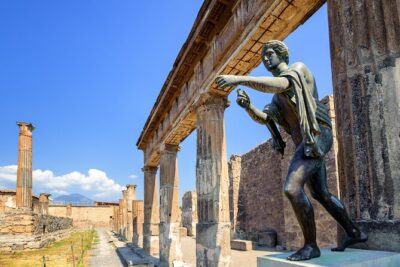
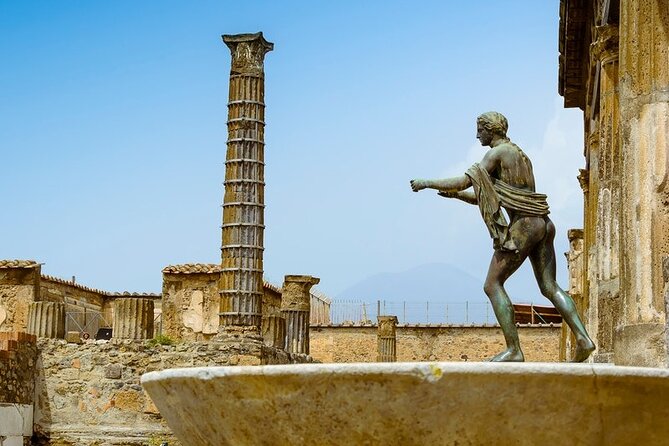
The final major temple stop is the Temple of Apollo. The worship of Apollo arrived before the eruption of 79 A.C., and the tour context explains that the cult later lost followers because Jupiter became a stronger God.
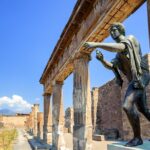
Two sculpture details are highlighted: a bronze statue of Apollo shown with a bow and arrow, plus a statue of Diana. That pairing helps you think beyond one single deity and instead imagine a religious landscape where choices changed over time.
Even if temples aren’t your top interest, Apollo is a strong closer because it ties belief to political and cultural shifts, not just myth and marble.
After the tour: use your day ticket like a pro
A key practical benefit is that your admission access is valid for the day, so after the guided part ends, you can keep exploring at your own speed.
Here’s how to use that wisely:
- Revisit the one or two stops that you couldn’t fully study in 15 minutes.
- If you felt rushed at the houses, prioritize the decorated interior spaces where you want time to compare layouts and wall art.
- If you loved public life, spend extra time around open areas like the forum zone to see how buildings face the civic space.
Also, take your time with the “in-between” details. Pompeii rewards slow looking—doorways, thresholds, and the way courtyards channel movement.
How to handle Pompeii’s heat (without losing your mind)
The ruins get hot fast, and one review note summed it up: it’s hot but worth it. My advice is simple: bring water and plan for sun exposure, especially if your tour runs in summer.
The tour itself helps a bit because the route moves stop-to-stop with short guided segments, so you’re not stuck staring at one stone wall for too long. Still, you’ll be outside much of the time, and Pompeii doesn’t negotiate with the weather.
Wear good walking shoes. Pompeii’s surfaces can be uneven, and your feet will be what decides how much you can enjoy afterward.
Who this tour suits best
This is a great pick if:
- You’re visiting Pompeii for the first time and want structure fast.
- You care about what buildings reveal about people—home life, civic life, entertainment, worship.
- You like having a guide who can explain competing interpretations, not only one memorized storyline.
It might be less ideal if:
- You want long, independent time in only a couple of houses.
- You’re trying to see every possible site in one shot without any pace adjustments.
- You’re extremely sensitive to “brief stops,” since many are about 15 minutes each.
Should you book this Pompeii small-group tour?
Yes, if you want a smart first pass that turns ruins into a city story. The combination of small group size, headsets, and a guide with real archaeological perspective makes the experience feel organized and easier to understand.
Book it especially if Pompeii is on your short list of “must-see” places and you want to return later with a better sense of what you’re looking at. If amphitheatre access is critical for you, double-check the ticket coverage for that specific segment so you aren’t surprised on the day.
FAQ
How long is the Pompeii small-group tour?
The tour lasts about 2 hours 30 minutes.
What language is the tour offered in?
It’s offered in English.
How big is the group?
The tour has a maximum of 15 travelers.
Where is the meeting point?
The meeting point is Hotel Vittoria, Piazza Esedra, 80045 Pompei NA, Italy.
Does the tour start and end at the same place?
Yes, it ends back at the meeting point.
Are tickets included?
The tour includes priority ticket entrance for the Archeological Park of Pompeii, and admission ticket access is included for most stops listed.
Is private transportation included?
No, private transportation is not included.
What’s included besides the guide?
Headsets are included, along with the priority ticket entrance.
Are service animals allowed?
Yes, service animals are allowed.
Can I cancel for a full refund?
Yes. You can cancel for a full refund if you cancel up to 24 hours in advance. If you cancel less than 24 hours before the start time, the amount paid isn’t refunded.
Is the tour dependent on weather?
Yes. It requires good weather, and if it’s canceled due to poor weather, you’ll be offered another date or a full refund.
More Tours in Pompeii


More Tour Reviews in Pompeii

More Pompeii Tours to Compare
More Pompeii tours, freshly reviewed

Pompeii Tours, compared.
 ★ 4.8Pompeii: Entry Ticket and Guided Tour with an ArchaeologistFrom $3519,459 reviews
 ★ 4.1Pompeii: Entry Ticket with Audio GuideFrom $4013,491 reviews
 ★ 4.8Pompeii: Small Group Tour with an ArchaeologistFrom $4012,264 reviews
 ★ 4.3Pompeii Ruins & Mount Vesuvius Day TourFrom $12011,459 reviews
★ 5.0Pompeii Small Group Tour with an ArchaeologistFrom $356,593 reviews
★ 4.3Pompeii Ruins & Mount Vesuvius Day TourFrom $12011,459 reviews
★ 5.0Pompeii Small Group Tour with an ArchaeologistFrom $356,593 reviews
 ★ 4.5Skip-the-line Pompeii – Small Group TourFrom $544,401 reviews
 ★ 4.6Naples or Sorrento: Full-Day Pompeii and Mount Vesuvius TourFrom $1044,235 reviews
 ★ 3.9Pompeii: Skip-the-line Entry Ticket with Audio Guide & MapFrom $433,153 reviews