
Review · POMPEII TOURS
Pompeii 2-hour Private Tour with an Archaeologist-Ticket included
Pompeii feels personal when you go private. This 2-hour Pompeii walk with an archaeologist lets you trade the big-group shuffle for your own pace and expert context at the sites you stop at. You start at Porta Marina Superiore and end up still close to the action, with your guide giving a hand on how to get back afterward.
I like two things right away: first, the tour is structured around Pompeii’s most important street-and-building moments, so your time does not evaporate. Second, the guides put real work into explaining what you’re seeing, and some of the archaeologist guides have serious credentials, like Silvia (PhD archaeologist) and Alessandra (also described as a PhD archaeologist who has worked on excavation). The main consideration is simple: 2 hours is short, so this is a highlights route, not every corner of Pompeii.
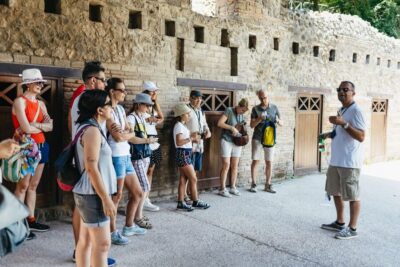
If you want Pompeii that feels human-sized instead of overwhelming, this is a strong fit. You’ll still cover a lot of ground on foot, but you’ll get pauses for questions and photo moments, which matters on a site this massive. Just come with comfortable shoes and a moderate willingness to walk and handle uneven surfaces.
In This Review
- Quick hits before you go
- A 2-hour Pompeii sprint with your own archaeologist
- Where you meet, where you end, and how to not get lost
- The walk starts at Porta Marina: seeing Pompeii’s street life early
- Basilica and the Forum area: merchants, civic space, and what to look for
- Granaries of the Forum: the small details that hit hard
- Houses that show wealth: Menander and the Faun in one route
- Stabian Baths and the Lupanar: the city runs on routine
- Teatro Piccolo and Teatro Grande: entertainment at street level
- Price and value: is $214.75 per person worth it?
- Who should book this private Pompeii tour
- Should you book Askos Tours’ 2-hour Pompeii private tour?
- FAQ
- How long is the Pompeii 2-hour private tour?
- What’s included in the price?
- Is the tour offered in English?
- Where do I meet the guide, and where does the tour end?
- Is this a private tour?
- Do I need to arrange my own transportation to Pompeii?
- What should I wear?
- FAQ
- What is the cancellation policy?
Quick hits before you go
- Private, archaeologist-led pacing: you are not stuck matching a loud group rhythm.
- Ticket included for Pompeii: less time worrying about admissions.
- Stop-to-stop context: merchants, daily routines, and the eruption’s aftermath come up as you walk.
- A route built around big landmarks: Forum, baths, houses, brothel, and theaters in one session.
- English-speaking guidance with a meeting sign at Porta Marina Superiore (Askos Tours).
Which Pompeii ticket and guide? Compare a few more.
- Pompeii Small Group Tour with an Archaeologist★ 5.0 · 6,593 reviews
- Discover the Ancient Ruins of Pompeii: Day Trip from Rome★ 3.5 · 2,247 reviews
- Pompeii and Herculaneum Small Group Tour with an Archaeologist★ 5.0 · 1,350 reviews
- Skip the Line Guided Tour of Pompeii led by an Archaeologist★ 5.0 · 703 reviews
A 2-hour Pompeii sprint with your own archaeologist
Pompeii is not a museum you can casually stroll through. Even with good map skills, it can feel like you are just walking between piles of stone unless someone connects the dots. That is where a private archaeologist guide earns their keep.
With this tour, your time window is around 2 hours, so the experience is focused. You get to see major spaces like the Forum area, household power centers like the House of Menander and House of the Faun, and city infrastructure like the Stabian Baths, without turning the day into a leg workout that never ends. If you are traveling with limited time in the region, that matters.
You’ll also notice the guide’s style. Past guides named in this operator’s tours, such as Amedeo and Giovanni, were praised for being passionate and patient, even if someone arrived late. Luca and Mena were called out for attention to the small details, including the daily-life stuff that helps ruined rooms stop feeling like random ruins and start feeling like actual places where people lived, worked, shopped, and worried.
Where you meet, where you end, and how to not get lost
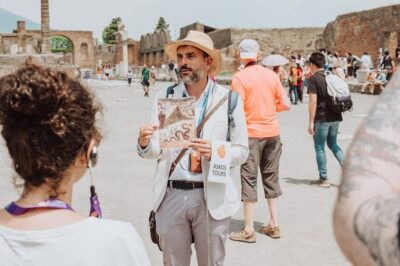
Logistics can make or break Pompeii days. This tour gives you a clear starting point at Via Villa dei Misteri, 2, 80045 Pompei NA, Italy. The meeting at the archaeological site is at Porta Marina Superiore, where the guide holds a sign with the company name Askos Tours at the top.
The tour ends at Piazza Esedra, still within the Pompeii area. That matters because you do not have to solve a complicated puzzle afterward. The guide can help you with directions for getting back to your accommodation or to the closest train station.
One practical tip: wear shoes you trust on uneven ground and plan for a walking route inside the park. This tour operates in all weather, and the operator recommends dressing appropriately. If rain makes the ground slick, your comfortable shoes matter even more than usual.
The walk starts at Porta Marina: seeing Pompeii’s street life early
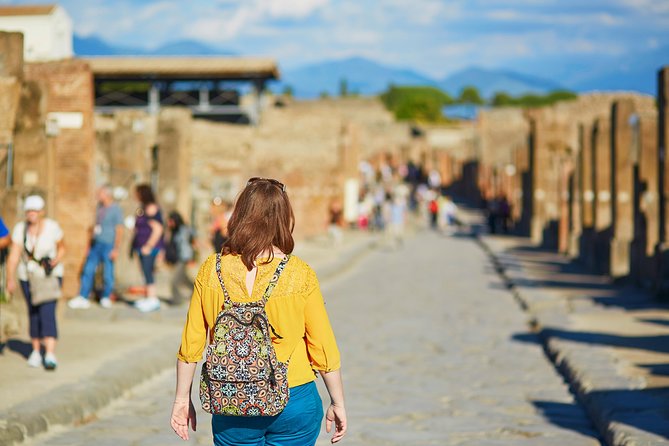
You begin at the Archaeological Park of Pompeii at Porta Marina Superiore, and the first moments set the tone. Starting at a real entrance you can recognize helps you orient fast, so you are not spending your energy trying to decode the site layout.
From there, the route quickly moves into spaces tied to public life and commerce. The first notable stop is the Basilica, described as an open portico where merchants and other activities could take shelter. That detail changes how you read it. Instead of thinking only in terms of dramatic ruins, you start thinking in terms of shade, foot traffic, and business rhythms.
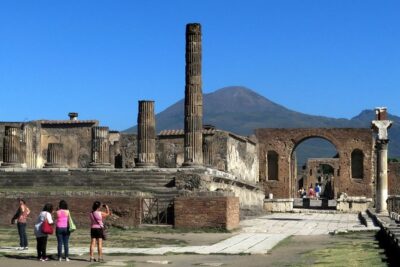
Then you reach the Foro de Pompeya, the ancient main square. A “main square” sounds obvious until you see what people actually did there: civic life, movement, and the kind of public visibility that made staying informed and showing up part of the job. Even on a short tour, this stop anchors your understanding of what Pompeii’s center looked and felt like.
Basilica and the Forum area: merchants, civic space, and what to look for
This portion is where many first-time Pompeii visitors either get lucky or get bored. The difference is whether you understand the purpose of each space you’re standing in.
At the Basilica, remember it was an open portico, not a closed hall. You’re basically looking at a sheltered commercial corridor. The guide’s job is to help you picture the flow: people passing through, stalls and sales energy, and the way daily commerce shaped how the city worked.
The Forum area adds civic texture. The main square is where you expect attention, announcements, gatherings, and the kind of visibility that would make even ordinary disputes feel public. Your guide’s explanations help you see why this mattered, instead of treating the stones like a static backdrop.
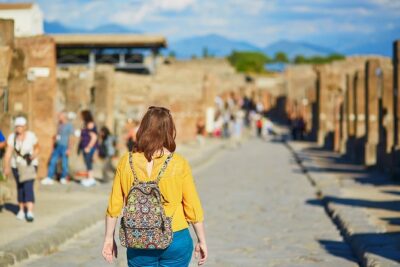
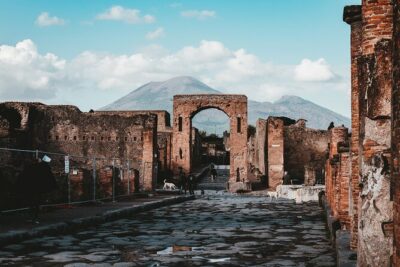
As you walk along the main street of Pompeii after these stops, you’ll get the real benefit of a private format: if something catches your eye, you can slow down. That’s also where photo pauses can happen without breaking the tour’s structure.
Other tickets and entries for Pompeii

Granaries of the Forum: the small details that hit hard
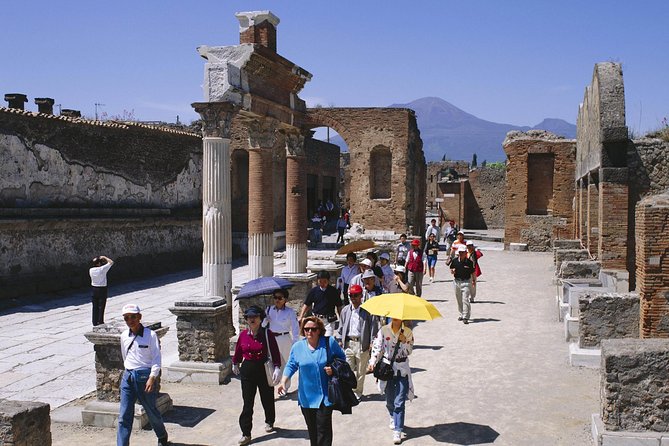
Next comes one of the more striking stops: the Granaries of the Forum. This stop is special not because it is large, but because it’s packed with tangible reminders of daily function and the eruption’s human toll.
You’ll see marble tables and baths for fountains that adorned the entrances of houses. That’s a good reminder that Pompeii was not only entertainment and status displays. People also cared about thresholds, water features, and the feel of getting in and out of a home.
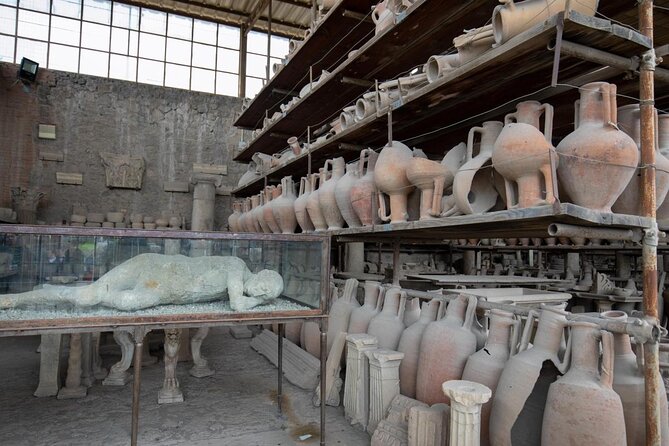
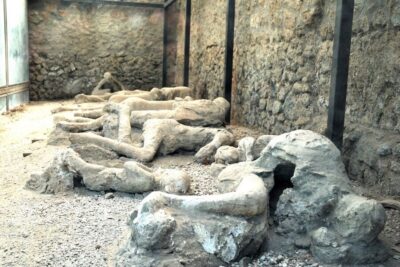
The granary area also includes casts of victims of the eruption, along with references to a dog and a tree. That combination can feel emotionally heavy, so if you want a guide for this part, now is the time. A good archaeologist guide helps you process it without turning it into shock tourism. You also benefit from knowing what these casts represent as evidence, not just as dramatic scenery.
The drawback here is the stop length. You only have about 15 minutes, so if you are someone who wants to linger and read every label, you may feel a bit rushed. In a private tour, though, you can ask for a little extra focus where you care most.
Houses that show wealth: Menander and the Faun in one route
Pompeii’s households are where the site becomes more than history. The tour includes two of the best-known residential stops: the House of Menander and the House of the Faun.
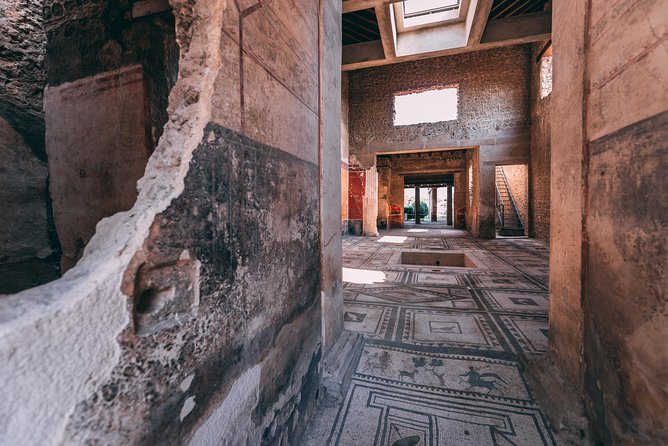
The House of Menander is described as one of the richest and most magnificent houses in Pompeii, with standout architecture, decoration, and contents. When a guide explains what you’re looking at, it becomes clear that the house is a message. It signals status, taste, and the owner’s ability to shape the experience of visitors and neighbors.
Next, the House of the Faun gets your attention for scale. It’s described as one of the largest and most impressive private residences in Pompeii. Even when you see only part of the space in a short tour, scale matters. It helps you understand how daily routines played out across multiple rooms and how a large residence organized movement and privacy.
If you enjoy photos, this is where a guide’s patience helps. One guide, Mena, was praised for being patient with photo-focused interests and still keeping the explanation clear.
Stabian Baths and the Lupanar: the city runs on routine
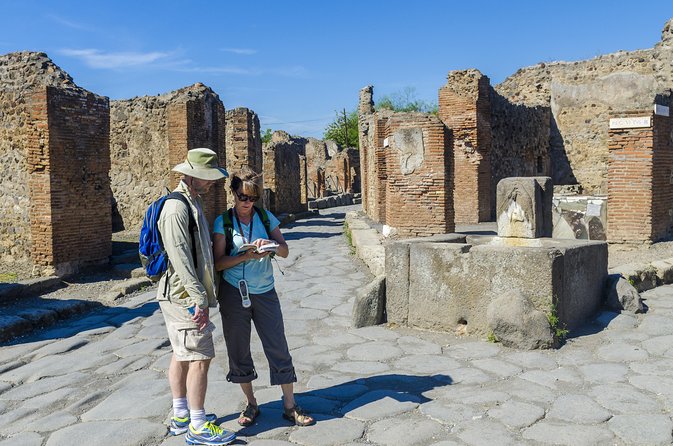
Pompeii isn’t only about grand architecture. It’s also about routine—bathing, socializing, and the spaces people used to be together.
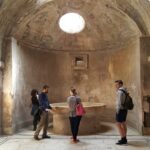
The tour stops at the Stabian Baths (Terme Stabiane), described as occupying a vast area and representing the oldest thermal complex in the city. The location is mapped between landmarks like the Brothel lane, the Holconius crossroads, and the Via Stabiana. That kind of directional description is useful because it ties the baths to the street grid around them. You’re not just looking at a room. You’re reading a neighborhood.
Then you visit the Lupanar, described as the most famous brothel in the ruined Roman city of Pompeii. This is the kind of stop where context matters. A good guide doesn’t just throw facts at you. They help you understand why this business existed in this place, and how it fit into the city’s everyday life. In a short tour, you want clarity more than volume, and that’s what these stops are built to deliver.
Teatro Piccolo and Teatro Grande: entertainment at street level
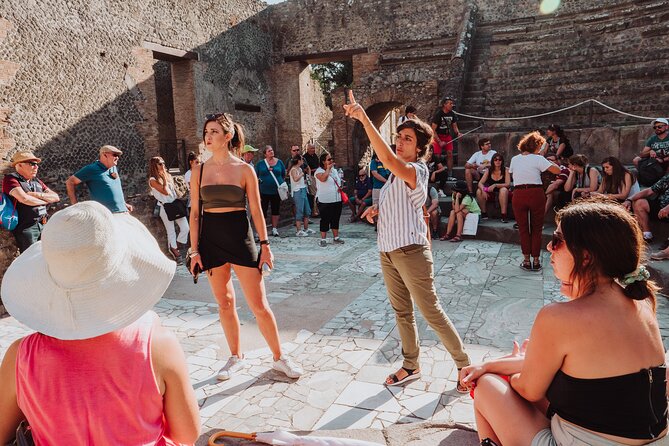
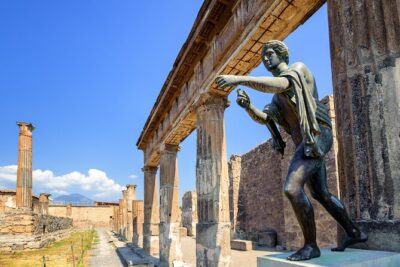
At Pompeii, theaters are not just buildings. They’re part of how the city staged public life and shared entertainment. This tour includes a look at the Teatro Piccolo and then visits the Teatro Grande, described as the most important theater in Pompeii.
The Teatro Grande stop is about 10 minutes. It’s enough time to appreciate the scale and the idea of what would have happened there, especially if your guide points out key structural elements and explains the theater’s role in public culture.
The Teatro Piccolo is often a good “breather” on a walking route. It gives your brain a change of pace from houses and lanes and helps you see the city’s entertainment ecosystem as a system, not just one famous room.
Price and value: is $214.75 per person worth it?
At $214.75 per person for a roughly 2-hour private tour, you’re paying for two things: time and expertise.
Time, because Pompeii can waste hours if you wander without a plan. This route hits major spaces in a tight sequence: Basilica, Forum area, granaries, two prominent houses, baths, the brothel, and theaters. You’re less likely to miss the parts that help you understand the city as a whole.
Expertise, because Pompeii’s details often look obvious only after someone explains them. That’s why the guide’s role matters so much. This operator’s guides have been described as archaeologists with deep credentials, including PhD archaeologists like Alessandra and Silvia. Even when your interests are specific, the tour can flex enough to keep you engaged, like the photo-focused focus described with Mena.
Also, this is offered in English and uses a mobile ticket, which saves you from extra hassle. There are also group discounts, which can lower the per-person cost if you’re traveling as a small group.
One thing to keep in mind: the short duration means you’ll see the highlights, not everything. If your goal is to spend hours in one house or one museum-like building, you may want a longer or different tour style.
Who should book this private Pompeii tour
This tour makes sense for you if you want Pompeii without the stress of managing a huge site on your own. It’s also a good match if you like learning from a guide who can answer questions and slow down where needed.
It’s especially well-suited to:
- First-time Pompeii visitors who want an orientation plus key stops fast
- History-lovers who prefer interpretation over just walking
- Families with kids who need stories and engagement (this operator’s tours mention children being kept interested)
- Photography-focused travelers who still want accurate context, not random snapshots
It might not be your best fit if you want to read every sign and linger for long stretches. With about 2 hours, you’ll need to let the guide steer your pace.
Should you book Askos Tours’ 2-hour Pompeii private tour?
My call: yes, if you want a high-value Pompeii experience built for real understanding. The biggest strength is the private archaeologist format: you get expert explanations, you can move at a human pace, and you’re guided through the parts that connect into a coherent picture of the city.
I’d skip it only if you’re chasing a slow, do-it-all, multi-hour Pompeii marathon. This is a focused highlights route. Done well, it makes Pompeii feel like a place. And based on guide feedback like Ivan’s ability to bring the site to life, Luca’s attention to small details, and Silvia’s PhD-level excavation experience, the learning side is a core part of the value.
FAQ
How long is the Pompeii 2-hour private tour?
The tour lasts about 2 hours.
What’s included in the price?
The price includes a private tour with a professional archaeological guide and admission fees to Pompeii.
Is the tour offered in English?
Yes, the tour is offered in English.
Where do I meet the guide, and where does the tour end?
You meet at Via Villa dei Misteri, 2, 80045 Pompei NA, Italy, and you start inside the archaeological site at Porta Marina Superiore. The tour ends at Piazza Esedra, 80045 Pompei NA, Italy.
Is this a private tour?
Yes. It is a private tour/activity, and only your group participates.
Do I need to arrange my own transportation to Pompeii?
Hotel pickup and drop-off and transportation to or from the ruins are not included.
What should I wear?
Comfortable shoes are recommended, and the tour runs in all weather conditions, so dress appropriately.
FAQ
What is the cancellation policy?
You can cancel for a full refund if you cancel up to 24 hours in advance.
More Tours in Pompeii


More Tour Reviews in Pompeii

More Pompeii Tours to Compare
More Pompeii tours, freshly reviewed



Pompeii Tours, compared.
 ★ 4.8Pompeii: Entry Ticket and Guided Tour with an ArchaeologistFrom $3519,459 reviews
 ★ 4.1Pompeii: Entry Ticket with Audio GuideFrom $4013,491 reviews
 ★ 4.8Pompeii: Small Group Tour with an ArchaeologistFrom $4012,264 reviews
 ★ 4.3Pompeii Ruins & Mount Vesuvius Day TourFrom $12011,459 reviews
★ 5.0Pompeii Small Group Tour with an ArchaeologistFrom $356,593 reviews
★ 4.3Pompeii Ruins & Mount Vesuvius Day TourFrom $12011,459 reviews
★ 5.0Pompeii Small Group Tour with an ArchaeologistFrom $356,593 reviews
 ★ 4.5Skip-the-line Pompeii – Small Group TourFrom $544,401 reviews
 ★ 4.6Naples or Sorrento: Full-Day Pompeii and Mount Vesuvius TourFrom $1044,235 reviews
 ★ 3.9Pompeii: Skip-the-line Entry Ticket with Audio Guide & MapFrom $433,153 reviews
Browse the lists this tour appears in