

Review · POMPEII TOURS
Pompeii Guided Group Tour with Entry Ticket and Archaeologist
Pompeii starts feeling personal quickly. This guided Pompeii walk is a smart way to cover the site’s most meaningful corners in about two hours, with a guide explaining how Romans actually lived (not just what’s broken). I especially liked the express entry included and the fact that you get headsets in larger groups, so you’re not constantly craning your neck to hear the story.
One thing to watch: the tour can be a little fussy on logistics. The meeting point can be confusing if your maps app insists on the wrong spot, and a few people reported that the headset audio can echo or be harder to catch.
Top take: If you want a guided route with entry sorted for you, this works well. If you hate last-mile “where exactly do I go” moments, do a quick check of the meeting address before you arrive.
In This Review
- Key highlights worth your time
- Pompeii, but with a plan: why this 2-hour format works
- Meeting at Porta Marina Superiore: the part that can make or break your start
- Express entry and your first steps into the Archaeological Park
- The Forum (Foro de Pompeya): the political center you can actually picture
- Macellum: the market for meat and fish—and the wall art you’ll remember
- Terme del Foro: baths for men and women, water systems, and original surfaces
- Casa del Fauno: wealth, status, and a famous mosaic (with a twist)
- Casa dei Vettii: art, erotic paintings, and who lived there
- Via dell’Abbondanza: why the route matters between major zones
- Thermopolium: the ancient fast-food stop for take-away culture
- How the guide changes your experience (and who you might hear)
- Comfort and pacing: what to wear, how to plan your day
- Price and value: what $59.13 buys you here
- Should you book this Pompeii guided group tour?
- FAQ
- How long is the Pompeii guided group tour?
- What’s included in the ticket price?
- Is the Villa of Mysteries included?
- Where do we meet for the tour?
- What time should I arrive?
- What language is the tour offered in?
- Is the tour group small?
- Is there a weather requirement?
Key highlights worth your time
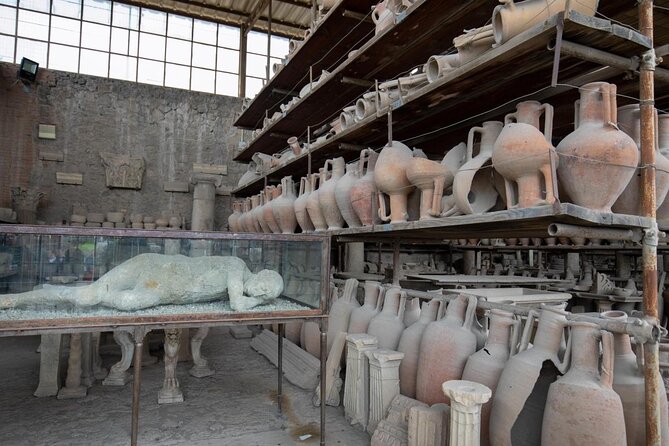
- Guided route that hits the Forum and daily-life stops without you guessing where to go
- Admission included with express entry to the Pompeii Archaeological Site
- Headsets for bigger groups (over 15 people), which helps you keep pace
- Stop-by-stop look at Roman routines: politics, baths, markets, and home life
- Easy expansion after the tour since you finish back at the meeting area
Which Pompeii ticket and guide? Compare a few more.
- Pompeii Small Group Tour with an Archaeologist★ 5.0 · 6,593 reviews
- Discover the Ancient Ruins of Pompeii: Day Trip from Rome★ 3.5 · 2,247 reviews
- Pompeii and Herculaneum Small Group Tour with an Archaeologist★ 5.0 · 1,350 reviews
- Skip the Line Guided Tour of Pompeii led by an Archaeologist★ 5.0 · 703 reviews
Pompeii, but with a plan: why this 2-hour format works
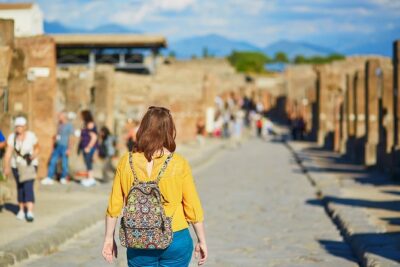
Pompeii is huge. That’s the whole problem. If you show up with only a map and good intentions, you can end up walking in circles—or spending your best energy on the wrong blocks.
This tour’s value is that it gives you a tight route with stops that explain the city’s core systems: public life in the Forum, food culture in the market area, leisure and hygiene in the baths, and then the contrast of wealthy homes and everyday takeaway food. Two hours isn’t enough to see everything, but it’s enough to understand the logic of the place.
At $59.13 per person for a guided group with express entry, it’s not “cheap,” but it’s also not pricing you like a private driver. You’re paying for direction, context, and a guide who can turn ruins into a believable daily routine.
Meeting at Porta Marina Superiore: the part that can make or break your start

The tour begins near Porta Marina Superiore and uses a very specific meeting location: Via Villa dei Misteri, 1, at the Circumvesuviana stop called Pompei Scavi villa dei Misteri. Your agency office is on the first floor of the station building, called Tempio Travel / Pompeii Tickets, and it’s about 100 meters from the entry of Porta Marina Superiore.
A couple practical tips I’d follow:
- arrive 15 minutes early so you’re not hunting while the group leaves
- don’t rely only on Google/Apple maps—one issue that shows up is that apps may point you to the wrong spot inside the station area
- take a screenshot of the address and check it before you walk up
Once you’re correctly at the office, the start is straightforward. When it’s wrong, it gets stressful fast—so plan for that and you’ll have a smoother day.
Express entry and your first steps into the Archaeological Park
Stop 1 is the Pompeii Archaeological Park entrance area, right as you start the walking portion. You get the admission ticket included, and the wording points to an express-style entry setup.
Why that matters: Pompeii can be chaotic at entry, especially at peak hours. Even a small delay can steal the best part of your visit. This is one of those tours where you’re not just buying “a guide.” You’re buying time and reduced friction at the gate.
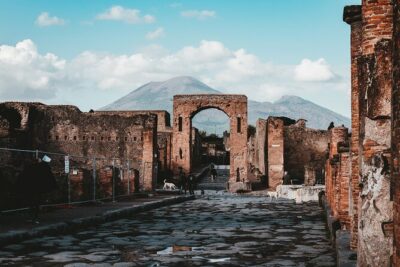
Also, starting the tour at Porta Marina Superiore helps you orient quickly. It gives you a baseline—then the route carries you into the city’s center.
The Forum (Foro de Pompeya): the political center you can actually picture
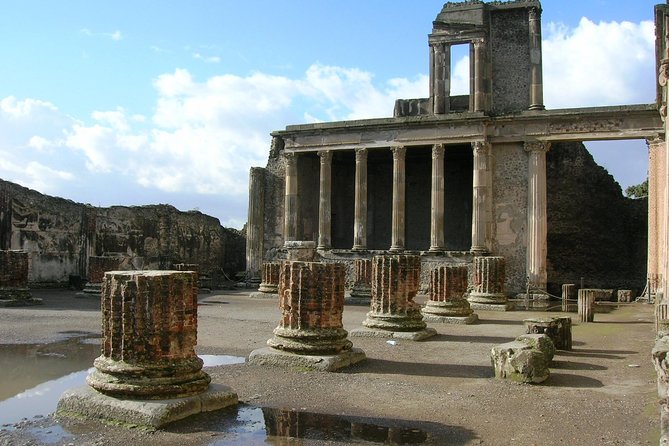
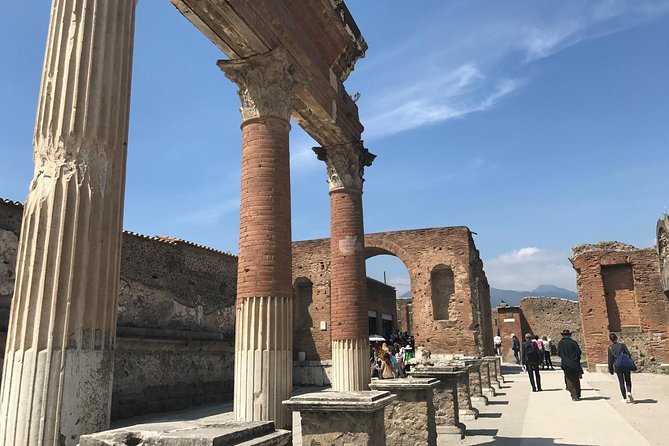
Stop 2 is the Foro de Pompeya, and it’s the right anchor stop. The Forum was the main square and the place where political, economic, and religious life overlapped.
You’ll spend about 30 minutes here. That’s enough time to do more than “look around.” With a guide, you can start reading what you’re seeing: where people would have gathered, how the city organized itself, and why this space mattered beyond being a pretty ruin.
If you only do one “big area” in Pompeii, make it the Forum—and having it explained early in your visit helps the rest of the walk make sense.
Other tickets and entries for Pompeii

Macellum: the market for meat and fish—and the wall art you’ll remember
Next is the Macellum, the market area on the Forum. It’s described as a market for meat or fish, and it includes paintings on the walls showing foods that Romans ate in the first century CE.
This is one of those stops where the guide’s voice really pays off. Markets can feel like “just shops” until you understand what people were buying, how spaces were laid out, and why the artwork was there in the first place. Even if you’re not a “food history” person, you’ll probably find it surprisingly tangible.
It’s also a good photo stop, because the market setting is visually clear and you can connect it to your earlier Forum orientation.
Terme del Foro: baths for men and women, water systems, and original surfaces
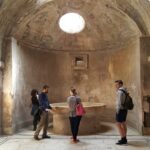
Stop 4 is the Terme del Foro, and it’s a high-impact stop because baths show everyday life so clearly. You’ll get about 15 minutes here.
A few specific details make this more than a generic “Roman baths” stop:
- the bath sector covered around 410 square meters
- it had separate areas for men and women, with independent entrances
- water came from the Serino aqueduct, though there was also a well for shortages
- ceilings are original and preserve stucco from the period
- the calidarium tub is marble, with mosaic flooring
That kind of detail is what helps you visualize the rhythm of the day. Baths were social spaces as much as they were practical ones. When you understand the layout and the water system, the building stops feeling like a pile of stones and starts feeling like infrastructure.
If you’re the type who likes “how did they manage this?” questions, this stop will be your favorite.
Casa del Fauno: wealth, status, and a famous mosaic (with a twist)
Stop 5 is the Casa del Fauno, one of the larger, more luxurious aristocratic homes from the Roman Republic period. You’ll spend about 10 minutes here.
The highlight is the famous Alexander mosaic. The version you’ll see in the house is a copy, while the original is preserved at the MANN museum.
That’s a useful detail to know before you look, because you might otherwise assume everything on site is the original artifact. The guide’s mention of the copy vs. original helps you appreciate what you’re seeing without turning it into a scavenger hunt.
This home is also a great stop for reading scale. Even in a short time, you can grasp how wealth shaped architecture and movement through the space.
Casa dei Vettii: art, erotic paintings, and who lived there
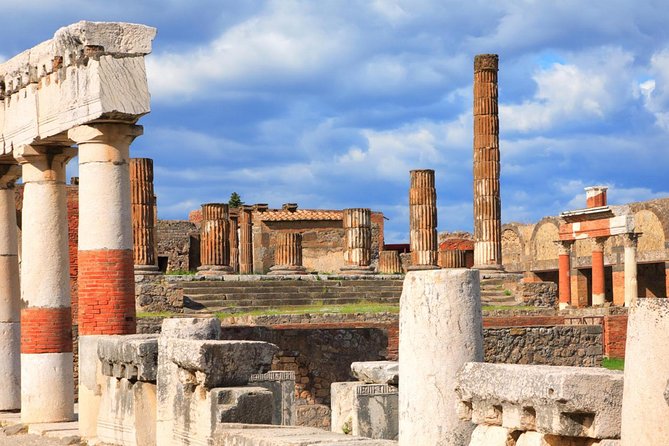
Stop 6 is the Casa dei Vettii. It’s a Roman domus that was buried during the 79 CE eruption and then uncovered by archaeological work.
It’s named after its owners: Aulo Vettio Restituto and Aulo Vettio Conviva. You’ll also see a room with erotic paintings, described as tied to a setup where sexual imagery connected to a prostitute who lived with the owner.
This stop is often where Pompeii stops being “ancient history” and starts being uncomfortable—in a human way. It’s not only about what Romans believed or built. It’s about how private life could be very direct, very visual, and very different from what modern visitors expect.
It can feel like an odd topic for a guided walk, but a good guide frames it as part of the full picture of Roman society. If you want a tour that treats Pompeii as lived-in life, not just polite architecture, this is a key stop.
Via dell’Abbondanza: why the route matters between major zones
After the Vettii home, the walk continues along Via dell’Abbondanza. This street connects major parts of the city between the Forum and Porta Sarno, passing by other important areas like the Stabian Baths, theaters, the Temple of Iside, and the amphitheater.
You’re not stopping at every one of those here, but walking the corridor matters. You start to feel the city as a connected system rather than a list of separate ruins. It also helps you keep your bearings so that, after the tour, wandering feels less random.
This is the “in-between” portion, but it’s the part where the guided route earns its keep.
Thermopolium: the ancient fast-food stop for take-away culture
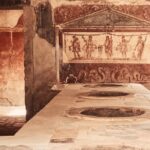
Stop 7 is the Thermopolium Regio VI, Insula VIII, 8. A thermopolium is literally a place where hot food was sold—think take-away in the Roman world. You’ll spend around 10 minutes here.
This is a fun, practical contrast after homes and baths. You get a sense of who visited places like this and how meals fit into everyday movement through the city.
And because it’s tied to food sold ready-to-go, it often lands well for families and first-time visitors. It gives Pompeii a pulse: people didn’t live only in palaces and public buildings. They ate, grabbed food, and kept going.
How the guide changes your experience (and who you might hear)
The tour is offered in English, and it’s led by an archaeologist or archaeologist-style guide. In the real world, the tour quality depends on the guide’s pacing and ability to explain without turning Pompeii into a textbook reading.
The best moments from the high-rated experiences mention guides who were engaging, patient with questions, and able to connect facts to real-life scenarios. Names that come up include Laura, Alessandra, Eraldo, and Rita. Some guides also used humor to make the walk lighter—useful when you’re surrounded by stone that never “moves.”
That said, one recurring caution: the audio headset quality can vary. If you’re sensitive to echo or low clarity, arrive with the attitude that you may have to reposition your body slightly or turn toward the guide.
Comfort and pacing: what to wear, how to plan your day
You’re walking between major zones with multiple stops, and Pompeii’s surfaces are uneven in places. Wear comfortable, sturdy shoes. Plan for a few photos, but also plan to keep moving—part of the value is hitting the highlights without burning your whole day.
The tour runs about 2 hours. After that, you’ll likely want to stay. Several people recommend using the tour as a launchpad, then wandering on your own with a better sense of where you are.
Timing matters too. During peak periods, entry can feel chaotic. If you can choose a morning slot, I’d lean that way for a calmer start.
Price and value: what $59.13 buys you here
For $59.13, you’re getting:
- a 2-hour guided group walk
- express entry to the Pompeii Archaeological Site
- headsets for groups over 15
That’s the “value core.” If you were to visit on your own, you’d still need to figure out what’s worth seeing, what you’re looking at, and how to avoid wandering through the wrong areas. Here, you pay for the ability to connect the dots.
Is it the cheapest way into Pompeii? Not really. Some alternative tours may cost less. But they also may not provide the same focused route, headset setup, or stop-by-stop explanation that turns the ruins into a coherent story.
If you care about getting the maximum understanding from a limited amount of time, this price starts to feel fair.
Should you book this Pompeii guided group tour?
Book it if:
- you want a guided route that covers the Forum and key daily-life stops in about two hours
- you’d like entry handled without extra planning at the gate
- you prefer structure and explanation over aimless wandering
Skip it or be extra careful if:
- you hate dealing with meeting-point details and you’re arriving last minute
- you’re worried about hearing clarity from headsets (audio can be hit or miss)
- you’re the type who wants to see everything—because Pompeii cannot be fully “done” in two hours
My take: if you show up prepared—early, with the right meeting address in hand, wearing good shoes—you’ll come away with a real sense of how Pompeii worked day to day, not just what it looked like from a distance.
FAQ
How long is the Pompeii guided group tour?
The tour lasts about 2 hours.
What’s included in the ticket price?
The price includes a 2-hour guided tour, an express entrance ticket to the Pompeii Archaeological site, and headsets for groups larger than 15 people.
Is the Villa of Mysteries included?
No. The Villa of Mysteries entry ticket plus is not included.
Where do we meet for the tour?
Meet at Via Villa dei Misteri, 1, 80045 Pompei NA, Italy. The office is called Tempio Travel / Pompeii Tickets, on the first floor of the Circumvesuviana station building.
What time should I arrive?
You should be at the meeting spot about 15 minutes before the indicated voucher time.
What language is the tour offered in?
The tour is offered in English.
Is the tour group small?
The maximum group size is 35 travelers.
Is there a weather requirement?
Yes. This experience requires good weather, and if it’s canceled due to poor weather you’ll be offered a different date or a full refund.
More Tours in Pompeii


More Tour Reviews in Pompeii

More Pompeii Tours to Compare
More Pompeii tours, freshly reviewed



Pompeii Tours, compared.
 ★ 4.8Pompeii: Entry Ticket and Guided Tour with an ArchaeologistFrom $3519,459 reviews
 ★ 4.1Pompeii: Entry Ticket with Audio GuideFrom $4013,491 reviews
 ★ 4.8Pompeii: Small Group Tour with an ArchaeologistFrom $4012,264 reviews
 ★ 4.3Pompeii Ruins & Mount Vesuvius Day TourFrom $12011,459 reviews
★ 5.0Pompeii Small Group Tour with an ArchaeologistFrom $356,593 reviews
★ 4.3Pompeii Ruins & Mount Vesuvius Day TourFrom $12011,459 reviews
★ 5.0Pompeii Small Group Tour with an ArchaeologistFrom $356,593 reviews
 ★ 4.5Skip-the-line Pompeii – Small Group TourFrom $544,401 reviews
 ★ 4.6Naples or Sorrento: Full-Day Pompeii and Mount Vesuvius TourFrom $1044,235 reviews
 ★ 3.9Pompeii: Skip-the-line Entry Ticket with Audio Guide & MapFrom $433,153 reviews