
Review · POMPEII TOURS
Small Group Guided Walking Tour of Ancient Pompeii Highlights
Pompeii makes sense fast with the right guide. This small-group walking tour hits the key sights quickly, with skip-the-line entry and a real guide who puts the city’s layout and daily life into context. I especially liked the skip-the-line advantage and the way the group stays small enough for questions. One catch: the schedule is strict, and the guide won’t wait if you’re late since entrance times are booked.
You’ll spend about 2 hours on foot with guided stops at major ruins (theatres, baths, and even the Lupanar) and the entrance tickets are included. The tour is offered in English, max 18 travelers, and it’s smart casual with comfortable shoes—because you will be walking on the original ancient streets.
In This Review
- Key things I’d plan around before you go
- A small-group Pompeii walk, with skip-the-line tickets
- Starting at Coffee Shop Vittoria and the 10-minute rule
- How the 2-hour route hits Pompeii’s big stories
- Stop 1: UNESCO Pompeii orientation with guided entrance
- Teatro Grande: the 5,000-seat open-air theatre
- Odeon and Teatro Piccolo: the 800-seat theatre experience
- Terme del Foro: Roman baths buried by 79 A.D.
- Lupanar: the brothel quarter and the fresco clues
- Guides who turn ruins into living context (Lello, Italo, Susanna)
- What the $107.23 price buys you (and what you should compare)
- Practical tips for doing Pompeii highlights without burning out
- Should you book this Pompeii small-group guided walking tour?
- FAQ
- How long is the Small Group Guided Walking Tour of Ancient Pompeii Highlights?
- What does the tour cost?
- Is skip-the-line access included?
- Are entrance tickets included?
- What stops will we visit?
- What should I bring and what isn’t included?
- Where is the meeting point?
- What is the cancellation policy?
Key things I’d plan around before you go
- Skip-the-line entry means less time stuck and more time learning.
- Max 18 people helps the walk feel like a conversation, not a lecture.
- Two open-air theatres (Teatro Grande and Odeon) show how Pompeii handled entertainment and public life.
- Terme del Foro gives you daily-life context beyond streets and shop fronts.
- Lupanar fresco details help explain social life in a way you can actually visualize.
Which Pompeii ticket and guide? Compare a few more.
- Pompeii Small Group Tour with an Archaeologist★ 5.0 · 6,593 reviews
- Discover the Ancient Ruins of Pompeii: Day Trip from Rome★ 3.5 · 2,247 reviews
- Pompeii and Herculaneum Small Group Tour with an Archaeologist★ 5.0 · 1,350 reviews
- Skip the Line Guided Tour of Pompeii led by an Archaeologist★ 5.0 · 703 reviews
A small-group Pompeii walk, with skip-the-line tickets
Pompeii can feel like a million stone fragments until someone helps you see the patterns. What I like here is that you’re not just “looking.” You’re being guided through what mattered to people—where they gathered, how they relaxed, and what their society looked like.
The skip-the-line piece is a big practical value. When you’re visiting a site that draws huge crowds, the time you save can turn a stressful visit into a relaxed one. And because this is a guided experience with entrance tickets included, you’re not juggling extra paperwork while trying to stay oriented.
Starting at Coffee Shop Vittoria and the 10-minute rule
You meet at Coffee Shop Vittoria, Via Mare, 80045 Pompei NA, Italy. The tour ends back at the same meeting point, so it’s a clean loop—no complicated end-of-day navigation.
Do arrive 10 minutes early, because if there’s a delay, the guide will not wait. Entrance tickets are booked for a specific time slot, so the entire group moves as one. Also keep in mind this is a guided tour confirmation, not a standalone ticket to the ruins; you use it with the guide.
If you’re traveling by public transit, you’re close enough to make it workable. And if you’re coming as a family, children can participate as long as they’re with an adult.
How the 2-hour route hits Pompeii’s big stories
This walk is built to give you quick clarity. In roughly two hours, you’ll cover a blend of public entertainment, civic life, daily routines, and social culture. It’s not trying to cover everything. It’s trying to cover what helps the whole city click.
Expect a steady pace with short stops. You’ll be walking on uneven, ancient surfaces, so comfortable shoes matter. In warm months (and especially around peak summer), this format can be a relief because you get key sights without getting lost in heat and crowd fatigue.
Stop 1: UNESCO Pompeii orientation with guided entrance
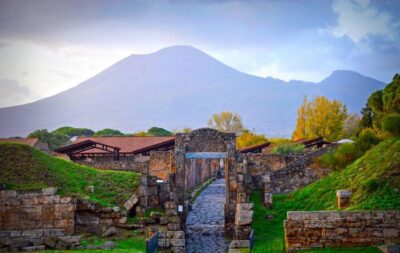
Your first stop is at a UNESCO World Heritage Site area with about 30 minutes on location (entrance ticket included). This is where the guide helps you make sense of what you’re about to see.
Why this matters: Pompeii isn’t laid out like a museum with neat labels. Streets, building shapes, and entrances can look similar until someone explains the city’s logic. If you get your bearings early, every later stop feels more specific—less guesswork, more “oh, that’s why this is here.”
More of Pompeii at street pace
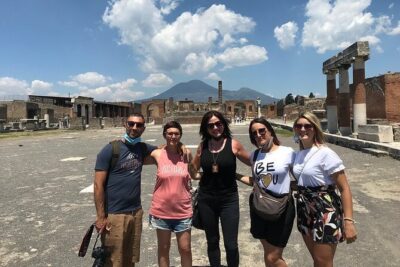

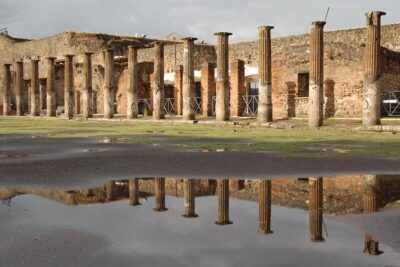
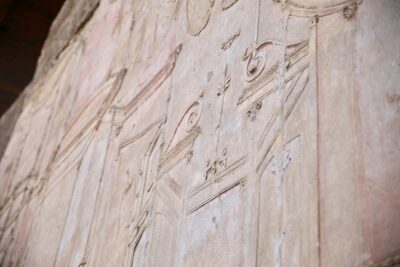
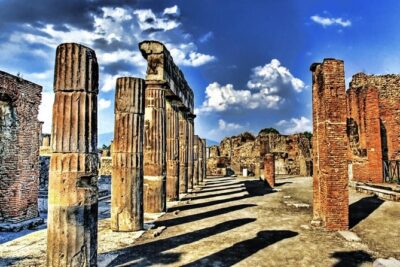
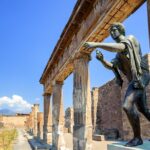
Teatro Grande: the 5,000-seat open-air theatre
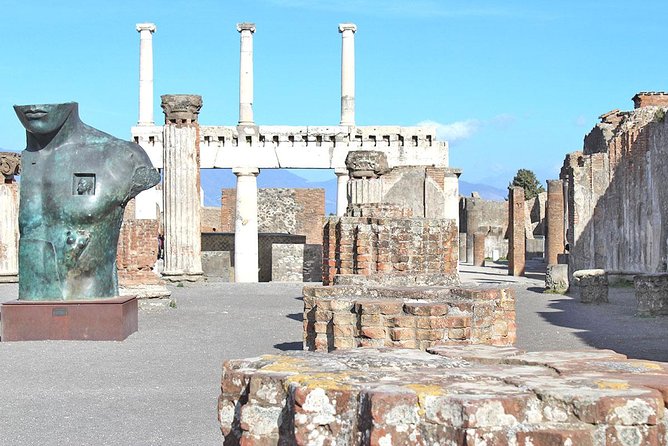
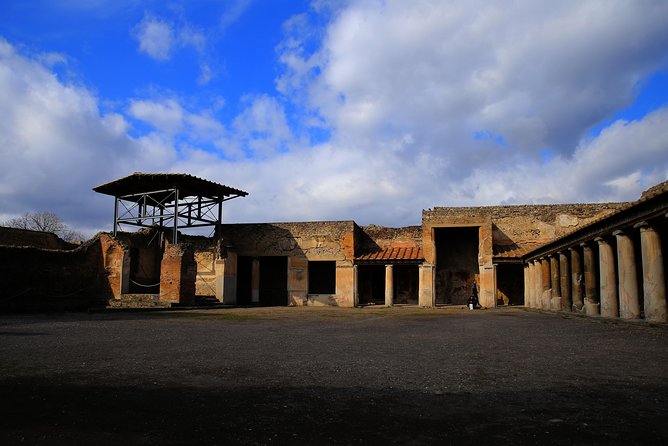
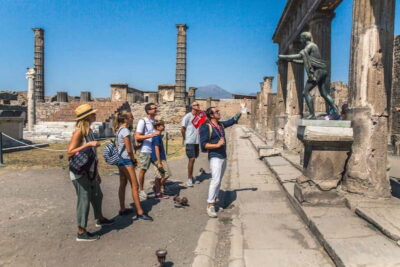
Next up is Teatro Grande, the large open-air theatre with about 5,000 seats, with roughly 20 minutes here.
This stop is more than a history photo-op. A theatre like this tells you how public life worked. Who went? What kinds of events would draw crowds? How did people move through the space? The guide’s job is to connect the stone geometry to real human behavior.
One practical benefit: theatres are built for viewing and acoustics, so they’re excellent places to understand scale. Even if you only have a short time, you can quickly grasp how much attention Pompeii put into entertainment and community gatherings.
Odeon and Teatro Piccolo: the 800-seat theatre experience
After the big stage, you’ll step into the smaller performance venue: Odeon / Teatro Piccolo, about 800 seats, again with around 20 minutes.
This contrast is useful. Pompeii didn’t just have one “show space.” It had options—different sizes, different vibes, and different crowd needs. A good guide will point out the architectural differences that change how the space functions, so you don’t just memorize two names.
If you want an easy way to remember the city, think of this pair as the “big event” and the “smaller, more intimate” end of Pompeii’s performance world.
Terme del Foro: Roman baths buried by 79 A.D.
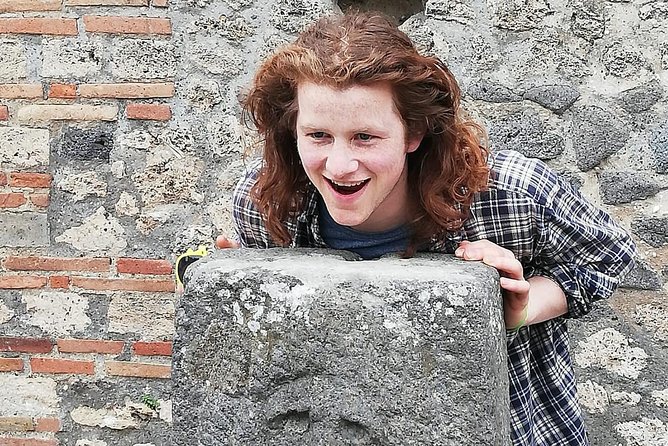
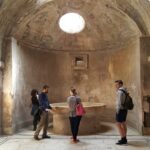
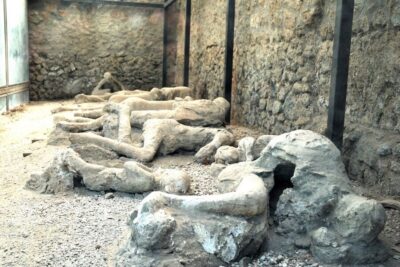
Then comes Terme del Foro, the Roman bath complex, with about 20 minutes. These baths were buried by the eruption of Vesuvius in 79 A.D., and seeing them with context helps you understand what daily life meant there.
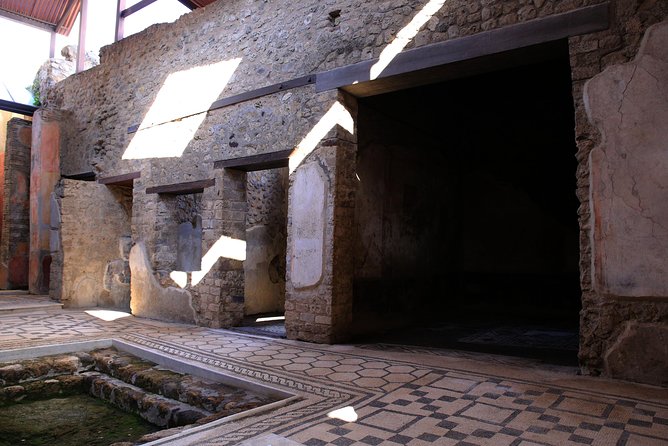
Baths are a shortcut to understanding culture because they combine routines, social contact, and body care. Instead of only focusing on what happened in public squares or theatres, you’re learning what people did regularly. And when you notice how spaces might have been arranged for changing, bathing, and moving, the site stops being static.
A drawback to be aware of: bath areas can feel like a lot of stone walls and floors if you don’t have guidance. That’s exactly why a professional guide matters here.
Lupanar: the brothel quarter and the fresco clues
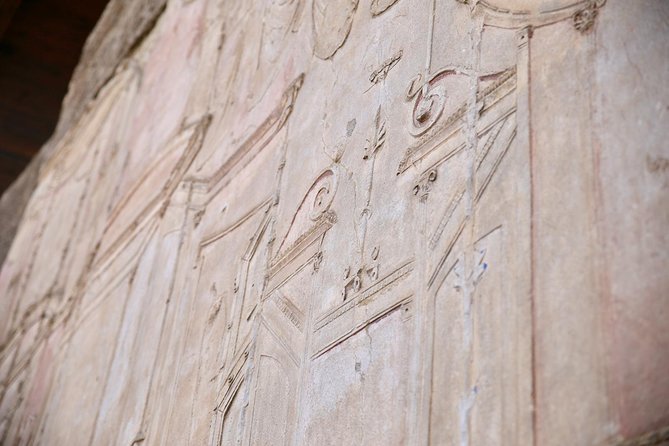
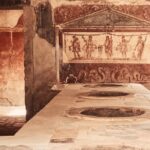
The final major theme stop is the Lupanar, the appointment houses/brothels area, with about 30 minutes. Some frescoes are still visible, and they’re tied to the speciality of the women working—details that help explain the intended use of the spaces.
This is the stop that many people remember because it’s specific. Not every “social” site can be described in clear terms from ruins alone, but fresco remnants and room layouts make it easier to understand what the Lupanar was for.
It’s also a reminder to plan mentally. If you’re visiting with younger teens, it can be worth asking your guide how they handle sensitive explanations at a level your group is comfortable with. (In the past, kids have found the tour’s framing interesting when the guide keeps it informative and not sensational.)
Guides who turn ruins into living context (Lello, Italo, Susanna)
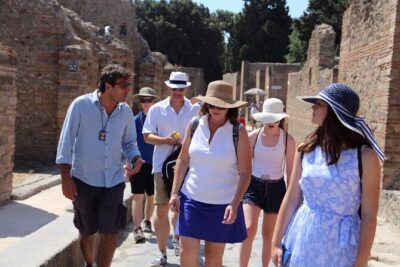
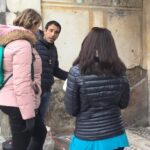
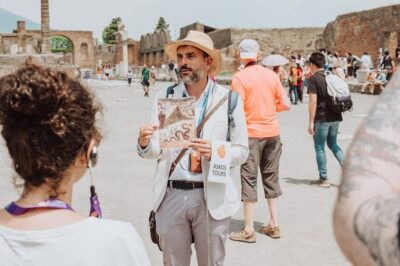
The best part of this experience is the guide. Multiple guides in this program are described as archaeologists or as having strong archaeological backgrounds, with storytelling that feels animated and clear instead of dry.
Names you might encounter include Lello, Italo, and Susanna. The big pattern across them: they bring energy, use humour, and share just the right level of detail so you don’t lose your attention.
One practical enhancement that can help a lot: a radio system with a small ear piece. That means you can hear instructions and explanations even while the group shifts between different parts of the site. It stays low-key, and it reduces the frustration of missing key points.
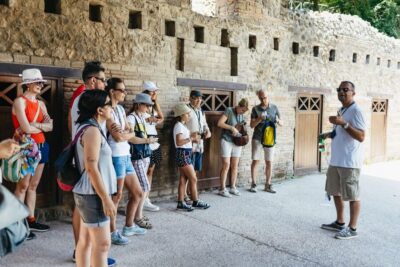
You’re also more likely to get real answers in a smaller group. When you’re not buried behind a crowd, you can ask the question you’re actually thinking.
What the $107.23 price buys you (and what you should compare)
At $107.23 per person for about 2 hours, the value comes from a few specific inclusions:
- Professional guide
- Guaranteed skip the long lines
- Entrance tickets included
Where this price makes sense: if you want to see the highlights efficiently without spending your limited time hunting down info on your own. Pompeii rewards understanding the “why,” not just the “where.” A guide compresses that learning into a short visit.
Where you might reconsider: if you already have a strong self-guided plan, you might enjoy spending longer wandering independently. But for most people, the combination of guide + time savings is what turns the day from chaotic into satisfying.
Also, this tour has a strong reputation score (rating 4.9 with 27 reviews, and 100% recommendation). I treat that as a helpful sign, not a guarantee—but it does match what tends to matter most in Pompeii: group size and explanation quality.
Practical tips for doing Pompeii highlights without burning out
Here’s how I’d set you up for a smoother visit:
- Wear comfortable shoes with grip. The ground is uneven and old.
- Dress smart casual, but think heat and sun. Bring a hat and water if you can (drinks aren’t included).
- Show up early. The 10-minute timing rule is real.
- Keep your expectations realistic: this is a highlights walk, not a full Pompeii day.
- After the guided portion, you can keep exploring on your own if you want extra time. The guided stops help you know what to look for next.
If you’re coming as a couple, solo, or family, this format works well because it’s structured but not rushed beyond the fixed timing. And if you’re a teen or a history-curious kid, the guided approach can turn “ruins” into a story you can follow.
Should you book this Pompeii small-group guided walking tour?
I’d book it if you want Pompeii’s highlights with less waiting and more meaning. The strong selling points for me are skip-the-line access, a small group size (max 18), and the fact that you’re guided by people with serious archaeological grounding—often with names like Lello, Italo, or Susanna depending on the date.
I’d think twice if you hate structured pacing or if you’re hoping for a fully independent wander. This tour moves as a group, and the schedule is strict. Also, if you’re looking for a deep, site-wide tour of everything in Pompeii, this will feel like a focused sampler rather than the whole meal.
FAQ
How long is the Small Group Guided Walking Tour of Ancient Pompeii Highlights?
It lasts about 2 hours.
What does the tour cost?
The price is $107.23 per person.
Is skip-the-line access included?
Yes. The tour includes guaranteed skip-the-long-lines entry.
Are entrance tickets included?
Yes. Entrance tickets are included for the stops listed on the tour.
What stops will we visit?
You’ll see major Pompeii highlights including a UNESCO World Heritage Site orientation area, Teatro Grande, Odeon / Teatro Piccolo, Terme del Foro, and the Lupanar.
What should I bring and what isn’t included?
Drinks and lunch are not included, and there’s no hotel pickup or drop-off. Wear comfortable shoes because the walking is on original ancient streets.
Where is the meeting point?
The tour starts at Coffee Shop Vittoria, Via Mare, 80045 Pompei NA, Italy and ends back at the same meeting point.
What is the cancellation policy?
You can cancel for a full refund up to 24 hours before the start time. If you cancel less than 24 hours before, the amount paid is not refunded.
If you want, tell me your travel month and your group ages. I can help you decide whether this 2-hour highlights format is the best match—or how to pair it with extra time for independent exploring.
More Tours in Pompeii


More Tour Reviews in Pompeii

More Pompeii Tours to Compare
More Pompeii tours, freshly reviewed



Pompeii Tours, compared.
 ★ 4.8Pompeii: Entry Ticket and Guided Tour with an ArchaeologistFrom $3519,459 reviews
 ★ 4.1Pompeii: Entry Ticket with Audio GuideFrom $4013,491 reviews
 ★ 4.8Pompeii: Small Group Tour with an ArchaeologistFrom $4012,264 reviews
 ★ 4.3Pompeii Ruins & Mount Vesuvius Day TourFrom $12011,459 reviews
★ 5.0Pompeii Small Group Tour with an ArchaeologistFrom $356,593 reviews
★ 4.3Pompeii Ruins & Mount Vesuvius Day TourFrom $12011,459 reviews
★ 5.0Pompeii Small Group Tour with an ArchaeologistFrom $356,593 reviews
 ★ 4.5Skip-the-line Pompeii – Small Group TourFrom $544,401 reviews
 ★ 4.6Naples or Sorrento: Full-Day Pompeii and Mount Vesuvius TourFrom $1044,235 reviews
 ★ 3.9Pompeii: Skip-the-line Entry Ticket with Audio Guide & MapFrom $433,153 reviews
Browse the lists this tour appears in