
Review · POMPEII TOURS
Pompeii 3 Hours Walking Tour Led by an Archaeologist
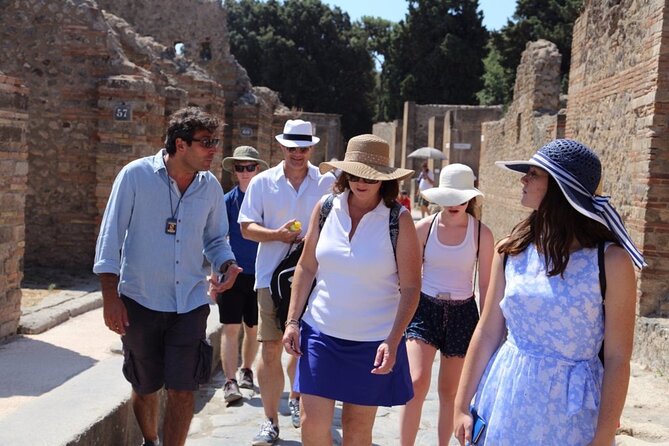
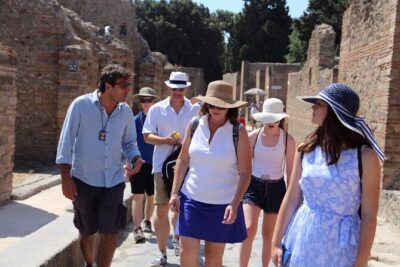
Pompeii clicks faster with an archaeologist. This is a private 3-hour walking tour through the Pompeii Archaeological Park with a guide who can explain what you’re actually looking at, from public life to private rooms. You get a route that hits the city’s big set pieces without the usual scramble.
I especially like two things: admission ticket fees are included, so you’re not doing awkward add-on math mid-visit, and the pacing stays human for a place that’s otherwise overwhelming. You’ll move through standout stops such as the Basilica area, the Foro (main square), and the thermal baths zone, plus major houses and theaters.
One consideration: Pompeii is very exposed with minimal shade, so this will feel like an active outdoor day. Bring protection for sun and heat, and expect to walk a good stretch rather than drift through slowly.
In This Review
- Key highlights worth planning for
- Where you meet and how you get started
- Step into Pompeii with the right orientation
- Stop 1: Pompeii Archaeological Park entry (Porta Marina Superiore)
- Basilica area: the portico where commerce and shelter met
- The Foro square: where Pompeii’s main civic rhythm played out
- Main street walking: connecting the city’s spine
- Granaries of the Forum: marble details plus the human cost
- House of Menander: wealth you can read in layout and decoration
- Stabian Baths (Terme Stabiane): the oldest thermal complex in town
- Lupanar: the famous brothel in the ruined city
- House of the Faun: big-scale domestic life and impressive presence
- Odeon and Teatro Piccolo: smaller theater, big purpose
- Teatro Grande: Pompeii’s most important theater
- How the 3-hour format feels on your feet
- Price and value: what $256.99 buys you
- Best guide fit: who tends to enjoy this tour most
- Practical tips so you don’t get cooked by the sun
- Should you book Pompeii 3 Hours Walking Tour Led by an Archaeologist?
- FAQ
- How long is the Pompeii walking tour?
- Is admission included?
- Where do we meet the guide?
- Does the tour run in bad weather?
- Is transportation included?
- What should I know about sun and comfort?
Key highlights worth planning for
- Archaeologist-led explanations for both everyday Roman life and the city’s details
- Private group setup so you can ask questions and keep the pace
- Admissions included for key parts of the Pompeii visit
- Major sites in 3 hours: Forum, baths, Lupanar, and Teatro Grande
- Free luggage storage at the meeting area before you start walking
- Multiple guide options you might meet, including archaeologists and art historians such as Daniela Mantice, Monica, Antonella, Anna Sorrento, and Lia
Which Pompeii ticket and guide? Compare a few more.
- Pompeii Small Group Tour with an Archaeologist★ 5.0 · 6,593 reviews
- Discover the Ancient Ruins of Pompeii: Day Trip from Rome★ 3.5 · 2,247 reviews
- Pompeii and Herculaneum Small Group Tour with an Archaeologist★ 5.0 · 1,350 reviews
- Skip the Line Guided Tour of Pompeii led by an Archaeologist★ 5.0 · 703 reviews
Where you meet and how you get started
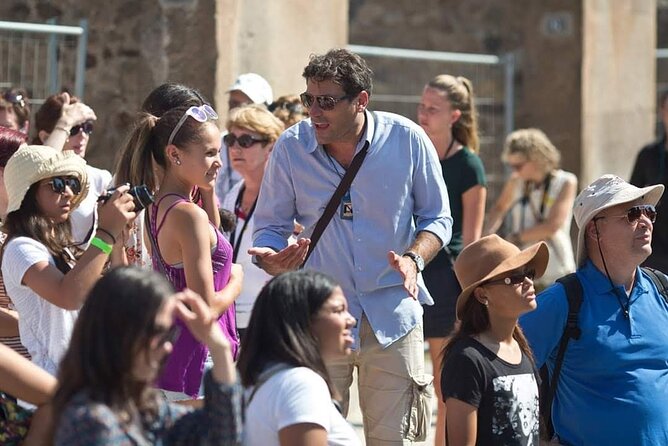
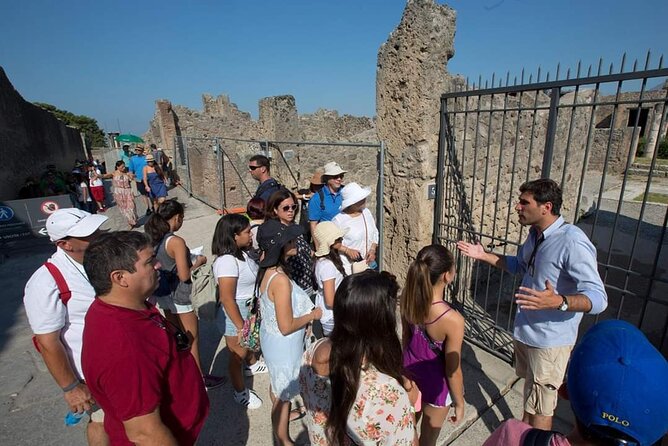
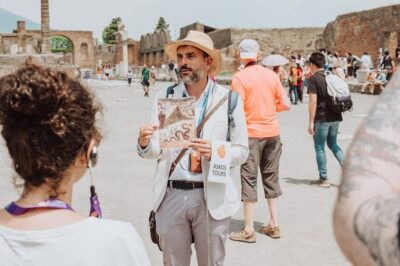
Your tour starts at Via Villa dei Misteri, 1, 80045 Pompei NA, Italy, at the main entrance area of the archaeological site (Porta Marina Superiore). The guide holds a sign for Askos Tours, so you should be able to spot them quickly and avoid the classic Pompeii meet-up chaos.
This is also where the helpful touches matter: there’s a safe luggage store for free, and that alone can make the first ten minutes much less stressful. If you’ve got bags or you’re meeting after arriving in town, you can leave it behind and focus on the ruins.
And since this tour runs rain or shine, don’t count on weather to slow things down. If drizzle happens, you’ll still be moving—so a light rain layer can be useful.
Step into Pompeii with the right orientation
Pompeii is vast, and first-time visits can feel like you’re seeing a lot of stone without a map for the meaning. That’s where an archaeologist guide earns their keep: instead of listing features, they frame how the city worked—public space, commerce, homes, baths, and entertainment—so each stop feels like a piece of a single story.
You’ll begin with the park entry and then head into the urban core. The route is designed so you don’t just wander; you get a guided line that helps you connect buildings that are separated by distance but linked by daily life.
Also, because it’s a private tour, you’re not stuck waiting for the slowest member of the group at every fork in the path. That matters in a place where shade is limited and the walking is constant.
Stop 1: Pompeii Archaeological Park entry (Porta Marina Superiore)
At the first stop, you meet at Porta Marina Superiore and the admission ticket part is covered. Think of this as your launch point: you’re not simply buying into the site; you’re entering with context for what you’re about to see.
This is a good moment to ask a quick question before the route gets deep—things like what themes you want emphasized (art and decor, daily life, architecture, or the eruption aftermath). A private guide can tailor the flow more than a large group can.
Basilica area: the portico where commerce and shelter met
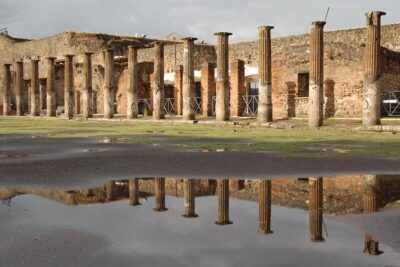
Next you’ll spend time at the Basilica area. In simple terms, this was an open portico that gave merchants and other activities a covered place to work and gather.
What I like about starting here is that it sets expectations: Roman “public life” wasn’t just politics and speeches. It was trade, meeting points, and practical shelter. You’re learning the mechanics of the city while you’re still fresh and oriented.
You’ll have enough time to look closely rather than rush past big shapes. And because the guide can explain the function of a space like this, the Basilica stops being abstract.
More of Pompeii at street pace

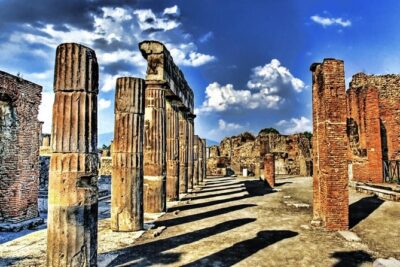
The Foro square: where Pompeii’s main civic rhythm played out
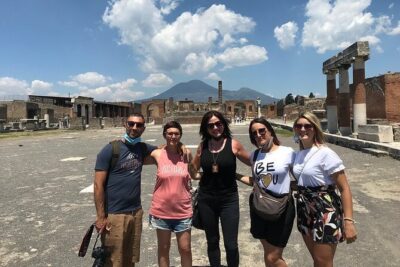
From the Basilica, you move to the Foro de Pompeya, the ancient main square. This is the kind of space where you can almost picture movement: people crossing paths, announcements happening, and everyday life orbiting around the center.
In Pompeii, the Forum areas help you understand hierarchy and social structure. If you’ve ever wondered what a Roman city felt like at street level, this is one of the best places to get that sensation—because the square is designed for visible public interaction.
Short stops are still time well spent here, because the guide can point out what to look for instead of making you guess.
Main street walking: connecting the city’s spine
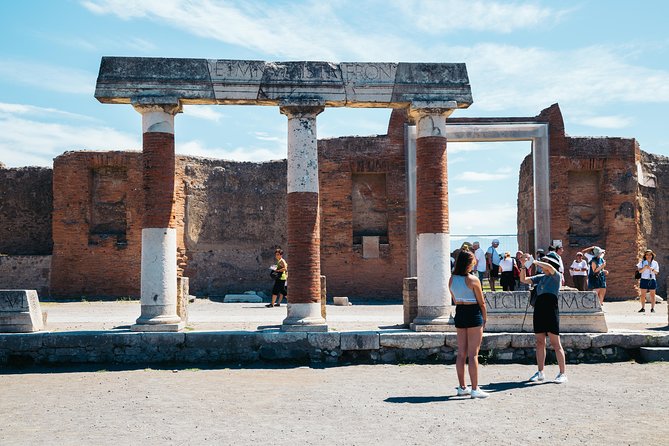
Between major stops, you’ll walk through the main street. That’s not “dead time.” It’s where you start to feel the layout: how the city stretches, how buildings face the flow of pedestrians, and how you move between public nodes.
I like this part because it helps you connect the big landmarks. The ruins don’t exist as isolated monuments; they’re stitched together by streets and routines.
Granaries of the Forum: marble details plus the human cost
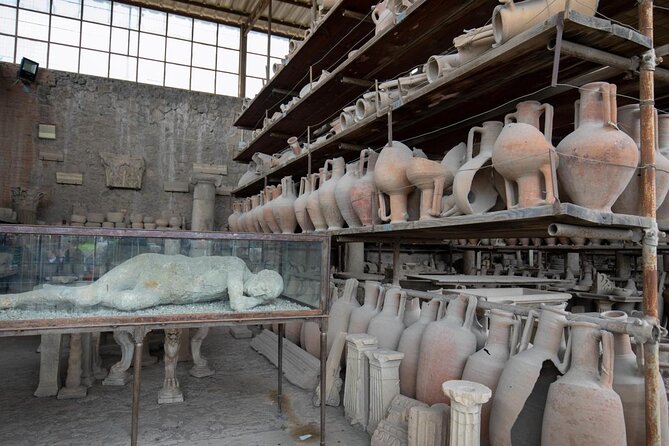
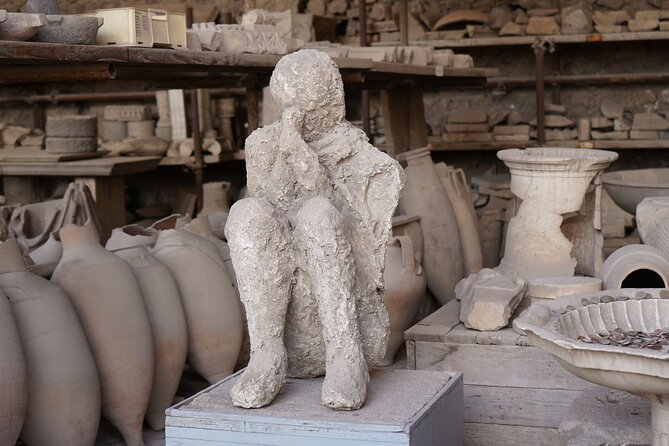
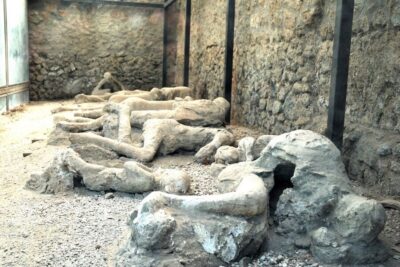
The Granaries of the Forum is a standout stop because it mixes aesthetics and evidence of catastrophe. You’ll look at marble tables and structures connected to fountains at entrances of houses. Then the site adds a darker layer with casts of victims from the eruption—and even casts of a dog and a tree.
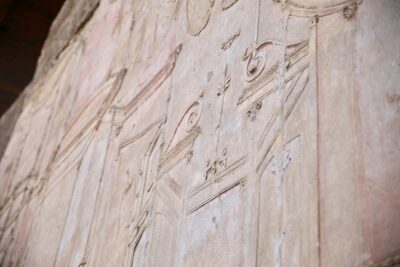
This is one of those places where your guide’s job is crucial. Without interpretation, you might just see shapes and signs. With an archaeologist’s framing, the casts become part of the story: what people tried to protect, what happened, and what survived long enough to record the end of a day in Pompeii.
It’s also a moment where the pace matters. You’re not racing; you’re taking in details while staying respectful.
House of Menander: wealth you can read in layout and decoration
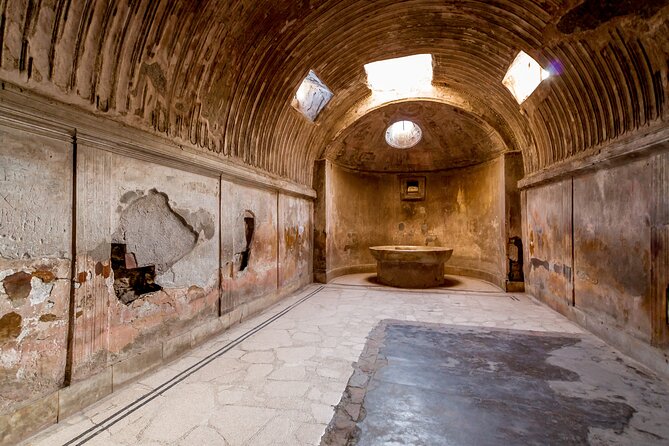
Next is the House of Menander, one of the richest homes in Pompeii in terms of architecture, decoration, and contents. This is where the tour shifts from public life into private status.
What I like about including a “big house” stop is that it teaches you what prosperity meant on the ground. You’re not just viewing ruins—you’re reading social signals through space: how rooms relate to each other, what kind of decoration a wealthy household invested in, and what the home says about daily rhythms.
If you’re the kind of traveler who enjoys art and material culture, this stop usually lands well. Even if you don’t get lost in art details, your guide can explain what matters and why.
Stabian Baths (Terme Stabiane): the oldest thermal complex in town
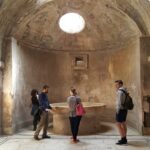
Then it’s the Stabian Baths, also called Terme Stabiane. These occupy a vast area between major cross streets and are described as the oldest thermal complex in the city.
Baths were more than hygiene. They were social centers, relaxation spots, and a way for Romans to spend time. In Pompeii, the ruins help you understand the scale of bathing culture—this wasn’t a quick wash-and-go.
Because the baths cover a large area, you’ll appreciate having a guide who can direct your attention. Otherwise, you risk getting lost in the “big building” effect. With the explanation, it starts to make functional sense.
Lupanar: the famous brothel in the ruined city
After the baths, you’ll visit the Lupanar, the most famous brothel in Pompeii. This stop can feel like a tonal shift, but it’s important. Roman cities weren’t polite museum pieces; they included adult spaces too.
The value here is understanding how the Lupanar fit into the urban environment—how it was accessed, where it sits in the broader city grid, and how everyday people would have encountered it.
If you’re touring with kids, you’ll want to judge the appropriateness for your group, since this site is openly an adult venue.
House of the Faun: big-scale domestic life and impressive presence
The House of the Faun is described as one of the largest and most impressive private residences in Pompeii. This is another key wealth marker, but the focus feels different from Menander: scale and presence are part of the message.
When you walk through spaces like this, you start to see how wealth worked as a physical statement. The home design isn’t random—it’s arranged around how people lived, hosted, and moved.
Your guide’s explanations help you notice things you’d probably miss on your own, especially when multiple houses feel similar at first glance.
Odeon and Teatro Piccolo: smaller theater, big purpose
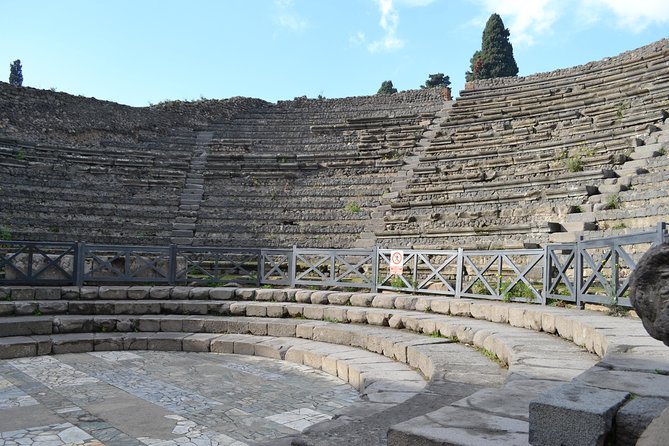
You’ll also have a look at the Odeon, often associated with the Teatro Piccolo. It’s a compact stop, but it helps you round out the entertainment map.
Even when you only get a short look, it’s useful because theaters in Roman cities weren’t decoration. They were a key outlet for public gathering and spectacle. Seeing the smaller venue helps you understand the range of entertainment spaces.
Teatro Grande: Pompeii’s most important theater
The route ends with Teatro Grande, described as the most important theater in Pompeii. This is the big stage in the city’s performance world.
What’s great about finishing here is that theater ties together themes you’ve already seen: public life, civic identity, and the way Romans used shared spaces for community energy. If you’ve been enjoying architecture and layout, this is also one of the more visually satisfying stops.
Even a 3-hour tour can only cover so much ground in a huge site. Ending at Teatro Grande leaves you with a memorable “anchor” before you head back on your own.
How the 3-hour format feels on your feet
Three hours in Pompeii is a smart sweet spot. Long enough that you get real context and multiple major stops, short enough that you’re still mentally fresh.
But you should plan for active walking. The site is vast and very exposed with minimal shade, so the experience depends on your comfort with outdoor heat. This is why the guide’s pacing matters: it should keep you moving without making you feel rushed.
The tour also includes admission ticket fees, which means less time at entrances and more time actually learning while you’re inside the spaces.
Price and value: what $256.99 buys you
At $256.99 per person, this isn’t a budget “drop in and wander” Pompeii option. The value comes from three main places:
First, you’re paying for a professional archaeologist guide. That’s the difference between seeing ruins and understanding them—especially in places where function isn’t obvious (baths, porticoes, and domestic architecture).
Second, admission ticket fees are included, and that reduces the hidden costs that can creep into self-guided visits.
Third, it’s a private tour for only your group. That often means better use of time. Instead of losing minutes to crowds, you’re spending them on explanations and questions. For couples and small families, the math can start to make sense.
There’s also mention of group discounts, and this tour is often booked about 50 days in advance, so if you want a specific schedule, you’ll be wise to reserve early.
Best guide fit: who tends to enjoy this tour most
This tour makes the most sense if you want structure and interpretation. I think it’s a strong match for:
- People who care about how Romans lived, not just what the ruins look like
- Travelers who like architecture and material details (houses, porticoes, baths, and theaters)
- Couples and small groups who want flexibility and quieter pacing
- Anyone who wants a guide who can explain technical and historical points in a way you can follow
From the range of names associated with this experience—people like archaeologist Monica, art historian Daniela Mantice, and guides including Antonella, Anna Sorrento, and Lia—you can also tell it’s not one-note lecturing. Many guides lean into clear teaching and human storytelling.
Practical tips so you don’t get cooked by the sun
Because Pompeii is exposed and shaded areas are limited, plan your day around comfort. Use sunscreen and wear a hat, since those are directly recommended for the site conditions here.
Also, take advantage of the free luggage store at the meeting point. It helps you travel lighter and reduces stress before the walking starts.
Finally, remember the guide will help you with practical info on how to get back to your accommodation or the nearest train station after the tour ends. That’s handy when the route finishes at the ruins rather than at a quick stop nearby.
Should you book Pompeii 3 Hours Walking Tour Led by an Archaeologist?
I’d book this if you want Pompeii to feel understandable, not just dramatic. For the money, the standout value is the archaeologist-led interpretation plus admission included, all delivered in a private format that keeps you from getting swallowed by crowds and rushing.
Pass or rethink it if you’re hoping for an ultra-low-cost self-guided stroll. And if you know you struggle with sun exposure or long outdoor walking, you’ll need to plan carefully—because Pompeii is exposed, and this tour doesn’t try to hide that fact.
If you’re serious about seeing the key bones of Pompeii—Forum life, baths, the Lupanar, major houses, and Teatro Grande—this is a smart way to do it in a single focused session.
FAQ
How long is the Pompeii walking tour?
The tour lasts about 3 hours.
Is admission included?
Yes. Admission ticket fees are included as part of the experience.
Where do we meet the guide?
You meet at Via Villa dei Misteri, 1, 80045 Pompei NA, Italy, at the main entrance area of the archaeological site (Porta Marina Superiore). The guide holds an Askos Tours sign.
Does the tour run in bad weather?
Yes. The tour takes place rain or shine.
Is transportation included?
No. Transportation to and from the attractions is not included.
What should I know about sun and comfort?
Pompeii is vast and very exposed with minimal shade, so the tour advises using sunscreen and wearing a hat.
More Tours in Pompeii


More Tour Reviews in Pompeii

More Pompeii Tours to Compare
More Pompeii tours, freshly reviewed



Pompeii Tours, compared.
 ★ 4.8Pompeii: Entry Ticket and Guided Tour with an ArchaeologistFrom $3519,459 reviews
 ★ 4.1Pompeii: Entry Ticket with Audio GuideFrom $4013,491 reviews
 ★ 4.8Pompeii: Small Group Tour with an ArchaeologistFrom $4012,264 reviews
 ★ 4.3Pompeii Ruins & Mount Vesuvius Day TourFrom $12011,459 reviews
★ 5.0Pompeii Small Group Tour with an ArchaeologistFrom $356,593 reviews
★ 4.3Pompeii Ruins & Mount Vesuvius Day TourFrom $12011,459 reviews
★ 5.0Pompeii Small Group Tour with an ArchaeologistFrom $356,593 reviews
 ★ 4.5Skip-the-line Pompeii – Small Group TourFrom $544,401 reviews
 ★ 4.6Naples or Sorrento: Full-Day Pompeii and Mount Vesuvius TourFrom $1044,235 reviews
 ★ 3.9Pompeii: Skip-the-line Entry Ticket with Audio Guide & MapFrom $433,153 reviews
Browse the lists this tour appears in