
Review · POMPEII TOURS
Private Awesome Pompeii Family Tour + Guide, Transport & Tickets
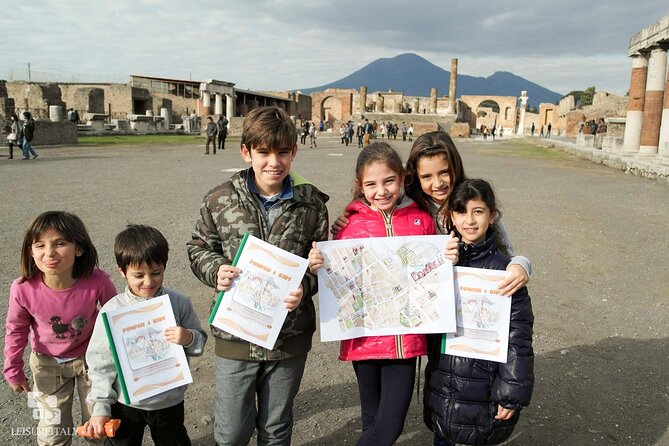
Pompeii feels personal with your own guide. This private family tour takes you through key parts of the ancient city at a pace that actually works for kids and adults—plus you get transport and tickets handled for you.
I especially like the family-friendly explanations (one guide was praised for making everything clear for grandchildren and an 8-year-old). And I like that the route mixes the headline ruins with the everyday stuff: markets, baths, homes, and the busy shopping street.
The only real consideration is the price: at $457.02 per person, it’s a splurge compared with group tours. If you’re traveling solo, it may feel steep.
In This Review
- Key things I think you’ll like
- Why a Private Pompeii Tour Works So Well for Families
- Pickup From Naples or Sorrento, and How You’ll Start the Day
- Archaeological Park of Pompeii: What You Get in the First Big Block
- The Volcano Photo Stop Without the Top Drive
- Porta Marina and the City Walls: A Smart Orientation Start
- Basilica and Forum: Where Roman Life Played Out in Public
- Inside the Basilica
- The Forum: Politics, Markets, and News All Together
- Temple of Apollo: Religion and Public Culture in One Place
- Macellum Market and Forum Baths: Everyday Life, Not Just Monuments
- Macellum: How Romans Bought Food
- Forum Baths: Socializing as Wellness
- Casa del Fauno and Via dell’Abbondanza: Luxury and Sidewalk Life
- House of the Faun (Casa del Fauno)
- Via dell’Abbondanza: The Main Shopping Street
- Insula dei Casti Amanti Viewpoints and Teatro Grande Seats
- Insula dei Casti Amanti: Seeing the Block From Above
- Teatro Grande: The Sound and Shape of the Theatre
- Antiquarium di Pompei: Artifacts and the Victims’ Casts
- Timing, Crowds, and What to Wear for Pompeii
- Price and Value: Is $457.02 Per Person Worth It?
- Who This Tour Fits Best (and Who Might Want Another Style)
- Should You Book This Pompeii Private Family Tour?
- FAQ
- How long is the Pompeii family tour?
- Where does pickup happen?
- Is the tour in English?
- Is this a private tour?
- Are admission tickets included?
- Is there a volcano stop?
- Do I get a mobile ticket?
- What fitness level is needed?
- What should I wear for the visit?
- Can I cancel for free?
- Are service animals allowed?
Key things I think you’ll like
- Private family pace with time to ask questions and slow down where your group wants
- Transport + tickets included, so you’re not managing logistics on the day
- A volcano photo stop from the bottom without the strain of driving up top
- Bags-of-everyday-life stops like the Macellum market and Forum Baths
- Big-city orientation early at Porta Marina and along the walls
- Great viewpoints from Insula dei Casti Amanti and Teatro Grande
Which Pompeii ticket and guide? Compare a few more.
- Pompeii Small Group Tour with an Archaeologist★ 5.0 · 6,593 reviews
- Discover the Ancient Ruins of Pompeii: Day Trip from Rome★ 3.5 · 2,247 reviews
- Pompeii and Herculaneum Small Group Tour with an Archaeologist★ 5.0 · 1,350 reviews
- Skip the Line Guided Tour of Pompeii led by an Archaeologist★ 5.0 · 703 reviews
Why a Private Pompeii Tour Works So Well for Families
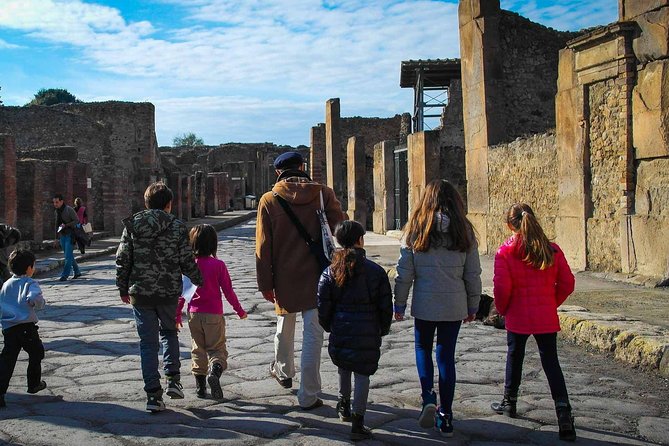
Pompeii can overwhelm you fast. It’s huge, crowded, and easy to feel like you’re just power-walking from one famous wall painting to the next. A private family guide solves that problem with one simple thing: you control the tempo.
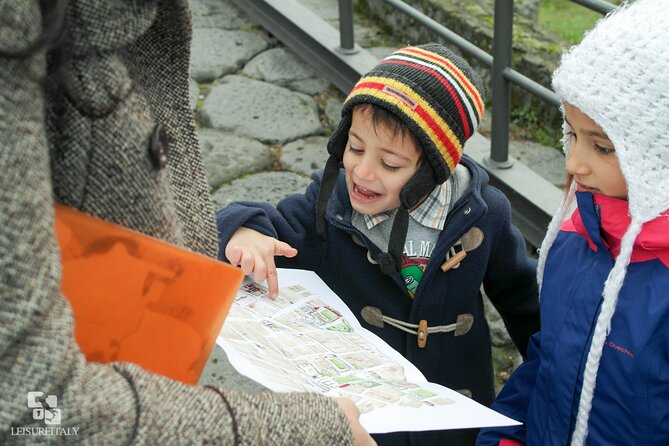
With this kind of tour, you’re not stuck following a fixed group script. You can ask questions as they come up, and you can spend extra time where your kids (or you) are actually paying attention—like the market layout, the bath rooms, or the way Roman public spaces functioned.
One detail that stands out from guide feedback: some guides (names like Fabio and Fabrizio have been reported) are praised for explaining clearly enough that kids can keep up. That matters. Pompeii gets so much more interesting when your family understands what they’re looking at, not just where it is.
Pickup From Naples or Sorrento, and How You’ll Start the Day
This tour includes pickup, with flexible meeting points anywhere within the Naples and Sorrento area. That’s a big deal in this part of Italy, where getting everyone into the right bus/train/van combo can turn into a mini project.
You’ll also get a mobile ticket, which simplifies the day-of process. The tour is private, so it’s only your group. If you’re traveling with multiple kids, grandparents, or anyone who gets tired quickly, having a dedicated guide and transport can reduce friction more than you’d expect.
Language is English, and the route is best for people with moderate physical fitness. You’re walking through outdoor archaeological areas with uneven ground, so plan on real steps, not museum-shuffle steps.
Archaeological Park of Pompeii: What You Get in the First Big Block
Most of your time is spent inside the Archaeological Park of Pompeii, with about two hours devoted to exploring its ancient streets, homes, shops, bath houses, and public squares.
Here’s the practical value: Pompeii isn’t one building. It’s a whole city plan frozen in time. A good guide helps you connect the dots between the places that look separate to most first-time visitors. Your guide will explain how Romans lived and worked—how they ate, traded, worshipped, and spent their free time.
Two hours in Pompeii is a realistic amount for a family. You’ll see a lot, but you won’t feel like you’re being dragged nonstop. And because it’s private, you can pause for a snack break, adjust for a child who needs a moment, or simply slow down where the ruins are especially interesting.
Admission is included for this main park time, so you don’t need to juggle extra ticket steps on the day.
The Volcano Photo Stop Without the Top Drive
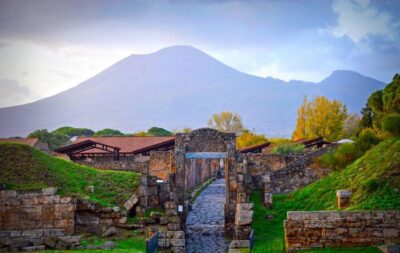
You’ll also have a quick segment designed around views of the volcano from the bottom. The promise here is clear: you’re not driving up to the top.
This matters for two reasons:
- Time and energy. You get the dramatic scenery without making the day physically harder than it needs to be.
- Photo-friendly viewpoints. If your group wants pictures with the volcanic backdrop, doing it from the lower vantage point keeps it easy and accessible.
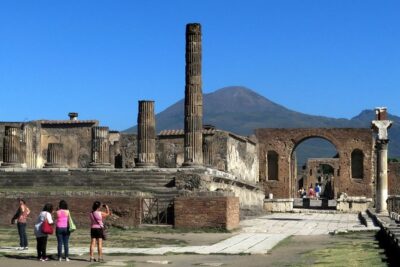
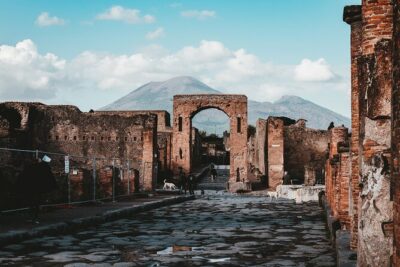
If your goal is to see the relationship between Pompeii and Mount Vesuvius without a big extra excursion, this fits well.
Other tickets and entries for Pompeii

Porta Marina and the City Walls: A Smart Orientation Start

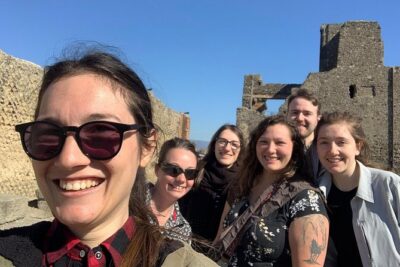
You begin with Porta Marina e cinta muraria, starting at Porta Marina, one of Pompeii’s main gates. This stop gives you the city’s “how it worked” context early.
Instead of jumping straight into ruins, your guide explains:
- how the city layout tied into entry points and movement,
- how the defensive walls shaped what the city could protect,
- and how Pompeii connected toward surrounding ports and trade routes.
It’s a quick but high-value moment. Once you understand where people entered and how the city was organized, the rest of the walking starts to feel less random.
Basilica and Forum: Where Roman Life Played Out in Public
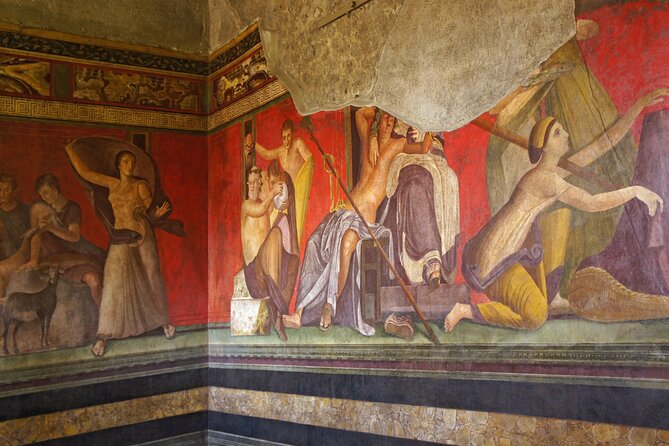
Pompeii’s power comes through its public spaces. You’ll spend time in two of the most important.
Inside the Basilica
In the Basilica, your guide explains how it functioned as the main civic center—law, business, and public affairs all in one impressive hall. Think negotiation, contracts, legal disputes, and the general mechanics of civic life.
Even if you only catch pieces of what’s being explained, the Basilica helps you understand something essential: Roman cities weren’t just temples and houses. They were systems for decision-making and commerce.
The Forum: Politics, Markets, and News All Together
Then comes the Forum of Pompeii, the heart of public life. Your guide connects the square to the full mix of activities around it—temples, administrative buildings, markets, and the covered spaces where people gathered.
From a family perspective, the Forum is where Pompeii starts to feel like a “daily life” place. You can imagine conversations, trading, announcements, and ceremonies—because the layout is designed for people to meet in the open.
Temple of Apollo: Religion and Public Culture in One Place
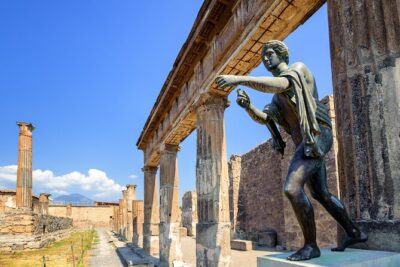
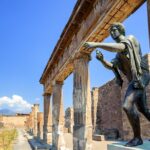
At the Temple of Apollo, you’ll learn why this sanctuary mattered so much. Your guide frames it as one of Pompeii’s most important religious spaces, dedicated to Apollo, tied to music, prophecy, and the arts.
This stop is great when you want atmosphere. Your guide points out architectural details—columns, altar, and bronze sculptures—so it feels like a sacred complex, not just a set of stones.
And it’s not only about worship. Your guide links religion and public life in Roman society, so the temple becomes part of the city’s social map, not a disconnected “religious stop.”
Macellum Market and Forum Baths: Everyday Life, Not Just Monuments

Two of the most memorable “this is what people did” stops are Macellum and the Forum Baths (Terme del Foro).
Macellum: How Romans Bought Food
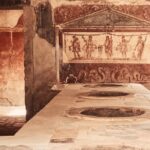
In the Macellum, Pompeii’s main indoor market, the tour turns practical. Your guide explains how ingredients and food were traded and displayed, including the kinds of goods you’d expect—fish, meat, produce, grains, and spices.
This is the kind of stop where families tend to get excited because it’s relatable. People shop, people ask prices, people store supplies. It’s Roman—but it feels human.
Forum Baths: Socializing as Wellness
Then you move to Terme del Foro, one of the best-preserved thermal bath complexes. Your guide walks you through heated rooms and points out decorations like frescoes and stucco.
The key idea: these weren’t just for cleaning. Romans met there, chatted, and handled business. If you’ve ever been in a place where a “routine” spot becomes a social hub, you’ll get the connection fast.
Casa del Fauno and Via dell’Abbondanza: Luxury and Sidewalk Life
Pompeii doesn’t only show kings and temples. You also get the everyday commercial street.
House of the Faun (Casa del Fauno)
At the House of the Faun, you’ll see one of Pompeii’s grander residences—an elite home with courtyards and fine artwork. Your guide highlights intricate mosaics, including the famous Alexander Mosaic, and explains how elite families expressed status through art and architecture.
This stop works well after the public spaces because it shows the contrast: public civic life outside, wealth and display behind private walls.
Via dell’Abbondanza: The Main Shopping Street
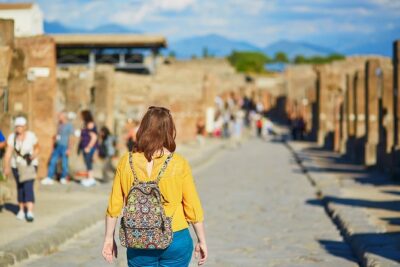
Then you walk along Via dell’Abbondanza, Pompeii’s busiest commercial street. Your guide brings the street to life with the mix of workshops, bakeries, taverns, and homes along the route.
You’ll also get an explanation of practical city infrastructure—like water fountains and raised stepping stones—that helped Pompeii function in its own time.
For kids, this is often where the ruins start to feel like a real place again: not only “ancient museum,” but daily errand routes, street noise, and storefront life.
Insula dei Casti Amanti Viewpoints and Teatro Grande Seats
Pompeii has plenty of ground-level ruins. But the best photos and biggest “wow” moments often come from seeing the city layout and performance spaces more clearly.
Insula dei Casti Amanti: Seeing the Block From Above
At the Insula of the Chaste Lovers, you’ll get an elevated viewpoint. Your guide helps you map out homes, private courtyards, bakeries, and work areas—so you can understand how dense the city felt.
This is a useful stop for families because you’re not trying to read every tiny detail. You’re seeing the overall plan, which makes the rest of the walking easier to picture later.
Teatro Grande: The Sound and Shape of the Theatre
At the Grand Theatre (Teatro Grande), you’ll enter one of Pompeii’s most atmospheric spaces. Your guide leads you to the open-air stage area and helps you imagine how comedies, tragedies, and even political performances once played to thousands.
You can sit on original stone tiers, and your guide helps connect why the theatre design mattered—how voices could carry across the bowl-shaped space.
If your family likes “story mode,” this stop tends to land. You can picture performances in a way that’s harder in ruins that don’t have a clear purpose left.
Antiquarium di Pompei: Artifacts and the Victims’ Casts
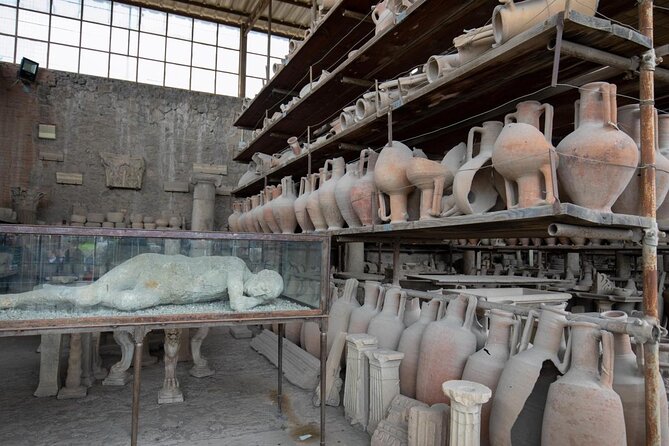
The Antiquarium di Pompei is where the ruins outside get emotional and personal. Your guide connects what you’re about to see (and what you already saw) to artifacts that once filled homes, shops, and temples.
Expect statues, frescoes, everyday objects, and importantly, casts related to the eruption’s victims. This is not just educational. It makes the site’s story feel real in a way that’s hard to achieve from walking alone.
If you like having context—why certain buildings matter, what objects people used, what life looked like day to day—this stop adds real meaning.
Timing, Crowds, and What to Wear for Pompeii
Pompeii is crowded. This tour’s structure helps you manage it with a private flow and sensible stop order. One guide story in the info you provided highlights tailoring the timing to avoid early morning crowds, which can make the whole experience feel less stressful and more family-friendly.
Practical tips you’ll actually use:
- Wear appropriate walking shoes.
- Bring sun gear for May through September (the tour explicitly calls this out).
- Keep a moderate fitness plan—there’s walking across uneven archaeological ground.
Also, because it’s private, you can make small adjustments without disrupting a large group schedule.
Price and Value: Is $457.02 Per Person Worth It?
Let’s talk straight about value. $457.02 per person is not the bargain-basement option. This tour is priced like what it is: a private family experience with guide, transport, and admission tickets included.
Where the value shows up:
- You’re not spending time figuring out routes and tickets.
- Your guide can focus on what your family wants, instead of checking boxes at a fast pace.
- The itinerary covers a wide range of Pompeii features—public spaces (Forum, Basilica), sacred areas (Apollo), markets (Macellum), daily life (Via dell’Abbondanza), and viewpoints (Insula and theatre).
Where it might feel less worth it:
- If your group doesn’t care about explanations and you’re happy walking on your own, a self-guided plan could cost far less.
- If you’re traveling very lightly and you don’t need pickup or structured time, other formats might be cheaper.
For many families, though, private time plus tickets plus transport becomes cheaper than it seems once you count the hassle you’re avoiding.
Who This Tour Fits Best (and Who Might Want Another Style)
This is a strong match if you:
- want a family-friendly pace and clear explanations,
- like seeing a mix of public life, daily life, and standout ruins,
- prefer not to battle crowds on foot as a group of multiple ages,
- want pickup from the Naples or Sorrento area.
It’s also stated that service animals are allowed, which can make the day easier for some families.
If your group has very limited walking ability, this likely won’t feel comfortable. The tour notes moderate physical fitness, so assume you’ll be on your feet for multiple stops across an outdoor site.
Should You Book This Pompeii Private Family Tour?
If you’re going to Pompeii with kids, grandparents, or anyone who needs a calmer pace, I think this one is worth serious consideration. The combination of private guide, tickets and transport included, and stops that cover both big-name ruins and everyday life gives you more understanding per hour than a typical check-the-box day.
Book it if:
- you want Pompeii explained in a way your family can follow,
- you want a plan that manages energy and crowds,
- you appreciate the mix of Forum spaces, markets, baths, homes, theatre, and a context stop at the Antiquarium.
Think twice if:
- your budget is tight,
- you’re comfortable doing Pompeii on your own and don’t need pickup or a guided flow.
FAQ
How long is the Pompeii family tour?
It runs about 4 to 5 hours.
Where does pickup happen?
Pickup is flexible within the Naples and Sorrento area. You need to specify the pickup place.
Is the tour in English?
Yes, the tour is offered in English.
Is this a private tour?
Yes. It’s private, and only your group participates.
Are admission tickets included?
Yes. Admission is included for the Pompeii Archaeological Park stop. Other listed stops are marked as admission ticket free.
Is there a volcano stop?
Yes. You’ll see the volcano from the bottom for photos, and the tour does not drive to the top.
Do I get a mobile ticket?
Yes, a mobile ticket is included.
What fitness level is needed?
The tour is listed for travelers with a moderate physical fitness level.
What should I wear for the visit?
Wear appropriate walking shoes. Bring sun gear from May to September.
Can I cancel for free?
Free cancellation is available. You can cancel up to 24 hours in advance for a full refund.
Are service animals allowed?
Yes, service animals are allowed.
More Tours in Pompeii


More Tour Reviews in Pompeii

More Pompeii Tours to Compare
More Pompeii tours, freshly reviewed


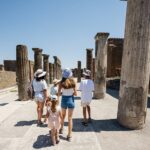
Pompeii Tours, compared.
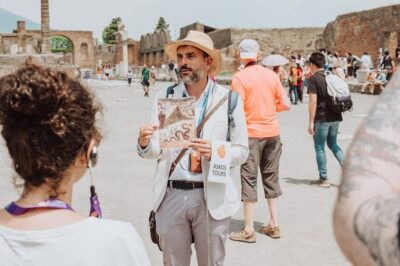 ★ 4.8Pompeii: Entry Ticket and Guided Tour with an ArchaeologistFrom $3519,459 reviews
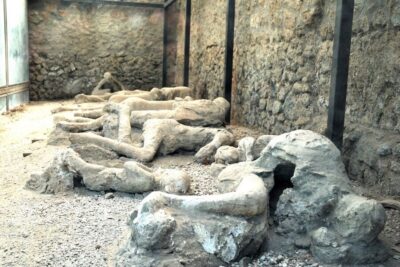 ★ 4.1Pompeii: Entry Ticket with Audio GuideFrom $4013,491 reviews
 ★ 4.8Pompeii: Small Group Tour with an ArchaeologistFrom $4012,264 reviews
 ★ 4.3Pompeii Ruins & Mount Vesuvius Day TourFrom $12011,459 reviews
★ 5.0Pompeii Small Group Tour with an ArchaeologistFrom $356,593 reviews
★ 4.3Pompeii Ruins & Mount Vesuvius Day TourFrom $12011,459 reviews
★ 5.0Pompeii Small Group Tour with an ArchaeologistFrom $356,593 reviews
 ★ 4.5Skip-the-line Pompeii – Small Group TourFrom $544,401 reviews
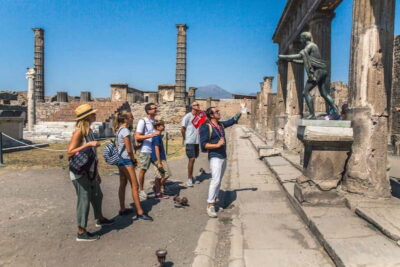 ★ 4.6Naples or Sorrento: Full-Day Pompeii and Mount Vesuvius TourFrom $1044,235 reviews
 ★ 3.9Pompeii: Skip-the-line Entry Ticket with Audio Guide & MapFrom $433,153 reviews