
Review · POMPEII TOURS
Pompeii Walking Tour: The Real History of the Ruins
One volcanic ash burial later, Pompeii still feels painfully real. This 2-hour English walking tour brings you to major stops like the Teatro Grande, the Casa del Menandro, the Stabian Baths, and the Forum area, all with an archaeology-minded guide. I like the tight route that hits both “big” monuments and everyday life, plus the English explanations with humor that make the city click fast. One possible drawback: you’re walking on uneven ancient surfaces, so comfortable shoes matter, and the pace can feel brisk if you stop often for photos.
I’m also a fan of how the guide connects what you’re seeing to Roman culture and daily routines, from public courts to bathing spaces. And if you want the standout “wow” moment, you get it early with the buried theater setting and later with the ancient cobblestone street atmosphere. With a maximum of 35 people, it still feels manageable, but this is the kind of tour where you’ll want to stay close to the group.
Below is what you can expect, how each stop lands, and whether this is the right fit for your Pompeii day.
In This Review
- Key things to know before you go
- Why Pompeii still feels different than other ruins
- Price and value: what $42.05 buys you here
- Meeting at InStazione and getting to the Pompeii entrance
- Teatro Grande and Odeon: Roman entertainment under ash
- Via Stabiana cobbles and the “street you can walk on”
- Casa del Menandro: a wealthy domus with a famous name
- Via dell’Abbondanza zone: shops, restored paintings, and daily commerce
- Stabian Baths: the oldest in Pompeii (and gendered spaces)
- The Lupanar: an adult-space stop that’s hard to forget
- Forum of Pompeii: Jupiter, the Basilica, Apollo, and granaries
- Guides that make the difference: humor, clarity, and English flow
- Who this Pompeii tour is best for
- Should you book this Pompeii walking tour?
- FAQ
- Where is the tour meeting point?
- What time does the tour start and how long does it last?
- Is the tour in English, and does the price include admission?
- Which key stops are included?
- Is lunch included in the tour price?
- How large is the group?
- What happens if weather is bad or plans change?
Key things to know before you go
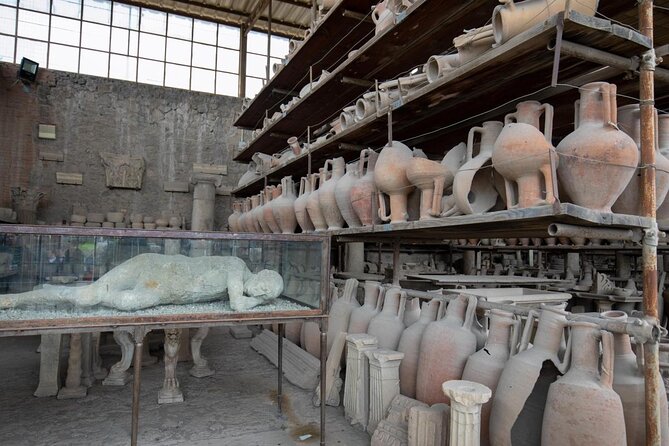
- AD 79 Pompeii highlights: You’ll focus on the ruins’ preserved layout—streets, houses, baths, and public buildings.
- Included entrance ticket: You don’t need to figure out separate entry for the main stops.
- Teatro Grande and Odeon: Roman entertainment spaces are part of the route, not optional add-ons.
- Via Stabiana and Via dell’Abbondanza area: You’ll walk the ancient street texture, shops, and restored shop painting areas.
- Stabian Baths and Lupanar: The tour covers both civic life and private, adult spaces.
- Forum area in the same loop: Temple of Jupiter, Basilica courtroom space, Apollo, and the granaries zone all fit into the 2 hours.
Which Pompeii ticket and guide? Compare a few more.
- Pompeii Small Group Tour with an Archaeologist★ 5.0 · 6,593 reviews
- Discover the Ancient Ruins of Pompeii: Day Trip from Rome★ 3.5 · 2,247 reviews
- Pompeii and Herculaneum Small Group Tour with an Archaeologist★ 5.0 · 1,350 reviews
- Skip the Line Guided Tour of Pompeii led by an Archaeologist★ 5.0 · 703 reviews
Why Pompeii still feels different than other ruins
Pompeii is the rare ruin where the city layout reads like a real place. You’re not just looking at isolated columns. You’re moving through theaters, baths, houses, brothel spaces, and the Forum in a connected way—so you can imagine how people used these places day after day.
This tour leans into that “city as a system” feeling. You start at major public architecture (like the Teatro Grande and the Odeon) and then shift to domestic wealth and neighborhood streets. Later you zoom back out to the civic center: the Temple of Jupiter area, the Basilica, and the granaries zone. It’s a smart mix for anyone who wants more than a checklist.
The big practical advantage is time. With an approximate 2-hour run, you get a concentrated Pompeii “starter map” that helps you orient before you explore further on your own.
Price and value: what $42.05 buys you here
At $42.05 per person for an approx. 2-hour English tour, you’re paying for three things at once: a guided route, included admission, and a plan that keeps you from bouncing between scattered sites on your own.
If you’re the type who likes context, the value jumps. Pompeii can look like ruins first and a living city second—unless someone connects the dots. The tour’s guide is there specifically to provide archaeology insight into Roman culture and explain what each space meant.
One note on value: admission is included, but lunch isn’t. If your day has food built around a fixed schedule, plan to eat before or after the tour rather than expecting it to cover meals.
Meeting at InStazione and getting to the Pompeii entrance
You’ll start at the InStazione help desk in the Pompeii area, then register your details and move to the entrance together with the guide at Porta Anfiteatro. The tour departs daily at 10:30 am and is offered in English.
Two practical tips make this part smoother. First, aim to arrive early enough to handle any registration moments without feeling rushed. Second, if you rely on trains, build in extra time—there has been at least one real-world case of timing confusion on the pickup side, so you’ll sleep better with a buffer.
The good news is the tour ends at Scavi di Pompei, near Viale delle Ginestre. That puts you in a location where it’s easier to keep exploring without needing to backtrack.
Teatro Grande and Odeon: Roman entertainment under ash
The tour’s first big stop pulls you into Pompeii as a theater town. You’ll visit the Teatro Grande and the Odeon. The Teatro Grande was buried by Vesuvius in 79 AD and later found through excavation. Inside, performances included comedies, mimes, pantomimes, and atellane.
The Odeon is part of the same opening cluster, and it’s tied to Pompeii’s political shift: it dates back to the period when the Samnite city’s status changed as it became a Roman colony. Even if that sounds like history homework, it matters in a hands-on way. You’re seeing architecture that reflects how power and culture were reorganized.
Why this stop works in a walking tour: theaters are built to be used by groups, and Pompeii’s preserved settings make it easier to picture how social life gathered. Where it can feel less ideal: the stop is only about 15 minutes, so if you love deep reading at each monument, you’ll want to come back later independently for longer time.
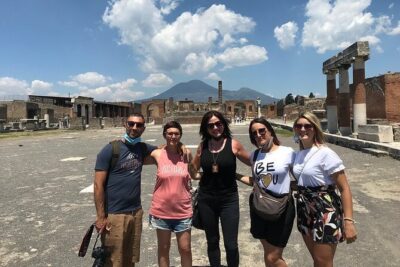
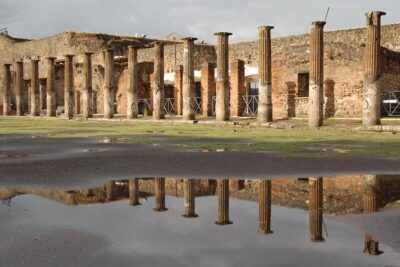
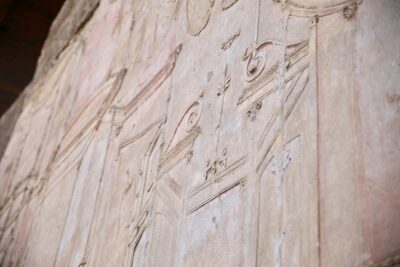
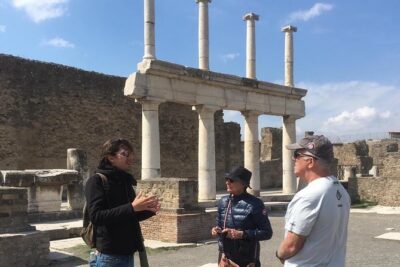
More of Pompeii at street pace

Via Stabiana cobbles and the “street you can walk on”
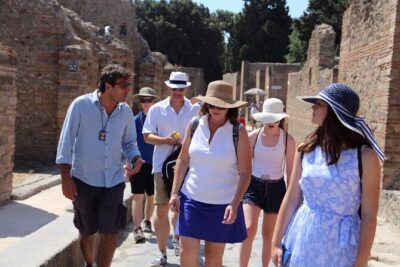
After the theater area, the tour continues along Via Stabiana, described as a perfectly preserved cobbled street with sidewalks and pedestrian walkways. Shops and houses line the route, so you’re not just looking. You’re moving through the city’s rhythm.
This is one of the stops where Pompeii stops being abstract. A cobblestone street is a physical detail you can feel under your feet, and you quickly understand how people navigated daily errands. It’s also a helpful mental bridge to later stops: the tour keeps showing you how public and private space sat side by side.
If you have mobility limitations or you’re prone to sore feet, this is where you’ll notice the “walking tour” format. The route is short overall, but Pompeii’s ground can be uneven. Plan for that, and you’ll enjoy the street more instead of rushing through it.
Casa del Menandro: a wealthy domus with a famous name
Next comes the Casa del Menandro, a large urban domus of about 1,800 m². It was excavated in 1926–1932, and it’s a standout example of a wealthy family house in Pompeii. It gets its name not from an owner’s signature, but from an image of the Greek poet Menander found there.
This stop is about understanding home life in Roman-era terms. Instead of only grand public buildings, you see how decoration, space, and social status played out inside a city block. It also gives you a contrast against what comes later—because after you picture a sophisticated household, the shift to baths and then to adult entertainment spaces lands with more meaning.
You’ll only have around 15 minutes here, so use that time to focus on what’s visually distinctive. The tour doesn’t try to turn this into a museum marathon. It’s more like a guided highlight of the house’s most telling elements.
Via dell’Abbondanza zone: shops, restored paintings, and daily commerce
From the domus area, the tour moves toward the Via dell’Abbondanza area—the “street of abundance,” where you’ll see a succession of public facilities, shops, and residences. You’ll also encounter restored shop painting areas.
A specific highlight here is the mention of the thermopolium of Asellina, described as a well-known inn, plus artisan workshops called officinae. Even if you only catch parts of the restored visuals in a short time, it’s the kind of detail that makes Pompeii feel less like a diagram and more like a working town.
Why this matters: a lot of ruins tours oversell grand monuments and leave commerce as a footnote. This tour makes commerce part of the narrative, so you get a fuller picture of what daily movement through the city looked like.
Stabian Baths: the oldest in Pompeii (and gendered spaces)
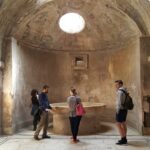
The tour then heads to the Stabian Baths (Terme Stabiane), a Roman bath complex buried in 79 AD and later excavated. This complex is described as the oldest building in the city of its kind.
You’ll see the bath setting as a preserved structure with male and female sectors described as perfectly preserved. That’s not just an architectural note—it’s a clue to how Romans organized social routines around shared public spaces, even when boundaries existed.
The time here is brief (about 15 minutes), so treat it like a guided orientation. If you’re the type who wants to understand bathing layout deeply, you may enjoy doing a second visit after your tour day—but as a primer, the Stabian Baths are a strong choice.
The Lupanar: an adult-space stop that’s hard to forget
Next is the Lupanar, Pompeii’s brothel space. The tour explains that lupanari were places dedicated to mercenary sexual pleasure—described as real houses of tolerance. Some are still visible in Pompeii’s ruins.
This is understandably a sensitive stop for some people. From a travel perspective, I treat it as an important reality check. Pompeii wasn’t only theaters and temples. It also contained spaces for work, leisure, and transactions that the city’s social structure made possible.
It’s a short stop (about 10 minutes), which helps. You get the context and a chance to see what remains, without forcing the visit to linger.
Forum of Pompeii: Jupiter, the Basilica, Apollo, and granaries
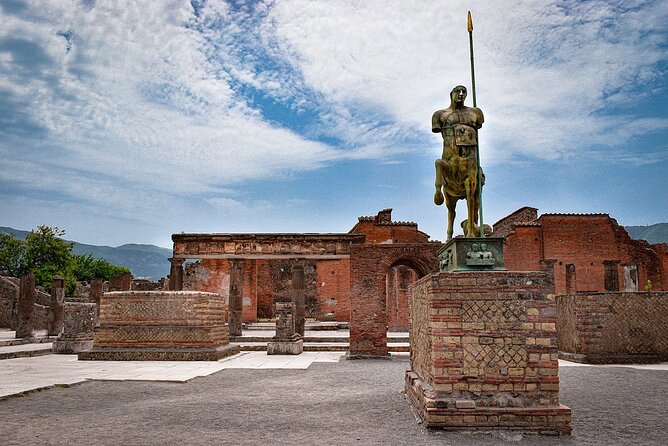
The tour’s finale phase focuses on Pompeii’s civic core. In the Forum of Pompeii, you’ll learn it was built around the 4th century BC in the Samnite era near key road junctions linking toward Neapolis, Nola, and Stabiae. Shops surrounded the open area and were built mostly in lava and tuff, with cemented clay.
After Roman conquest, the Forum was rebuilt and expanded, with many changes in the 2nd century BC. The tour then brings you to key monuments:
- Temple of Jupiter (later Capitolium), connected to the three major divinities of Rome: Jupiter, Juno, and Minerva. The stop also mentions the erarium, the public treasure stored in the basement area.
- Basilica, described as an indoor forum-like space from the 2nd century BC. It functioned as a courtroom and public activity zone when weather conditions suggested indoor use. The tribunal and the judge’s elevated position are part of the explanation, including the note that access was controlled by a wooden staircase to prevent attacks.
- Temple of Apollo, tied to the spread of Apollo worship through the Greek world, and linked to the shifting religious importance as Jupiter’s cult grew around the Capitolium era.
Finally, you’ll reach the granaries zone, where excavations left a deposit of materials. In the past, it served as a market for cereals and legumes. The tour also points out the lack of traces of plaster there, leading to the belief that the structure wasn’t finished at the time of the eruption. You’ll also hear about the ponderary table, where tools for correct exchanges helped traders convert measurement units from different parts of the empire into Pompeii’s units.
This is a lot to pack into a short window. The reason it works is that the guide keeps tying each stop back to function—religion, law, markets. If you only remember one thing from the Forum area, make it this: Pompeii’s public spaces were designed for people to do stuff.
Guides that make the difference: humor, clarity, and English flow
The biggest repeat praise here is guide delivery. Names like Grace, Frederica, Vincenzo, and Igor show up as examples of English-speaking guides who mix humor with solid explanations, and who pace the group so everyone sees what matters.
In practical terms, that means you’re less likely to feel lost. Pompeii’s layout can be confusing fast, especially if you’ve never been before. A good guide helps you read what you’re seeing: what’s public vs. private, what’s entertainment vs. administration, and what details are worth noticing.
One caution: the tour is only about 2 hours and the stops are time-boxed. If you’re the type who wants to linger at every wall painting or take multiple photos per corner, you’ll need to accept that you’ll see the highlights first and return later for depth.
Who this Pompeii tour is best for
This is a great match if you want:
- A structured first Pompeii day with a guided route.
- An English tour with explanations that link ruins to Roman daily life.
- A mix of monuments and everyday spaces, not just temples.
It may be less ideal if you’re trying to fully satisfy a “long-form museum” mood in one visit. The house, baths, brothel, and Forum areas all get their moment, but you won’t have hours inside each stop.
Should you book this Pompeii walking tour?
I’d book it if you’re short on time and you want the ruins to make sense quickly. The route hits the key categories—entertainment (Teatro Grande), elite home life (Casa del Menandro), public routine (Stabian Baths), adult spaces (Lupanar), and civic center life (Forum, Temple of Jupiter, Basilica, Apollo, granaries). With admission included and a smallish group cap of 35, it’s good value for a guided Pompeii orientation.
I’d be a little more careful if you hate tight timing or you need more flexibility on the morning. Give yourself a buffer for getting to the meeting point, especially if you’re using public transport. And if you’re traveling with mobility concerns, plan for cobblestones and walking.
If you want a clear, guided “real history of the ruins” intro without turning your day into a long slog, this is one of the smarter ways to do Pompeii.
FAQ
Where is the tour meeting point?
You start at the InStazione help desk in Pompeii (80045 Pompei). The tour route ends at Scavi di Pompei, Viale delle Ginestre, 80045 Pompei.
What time does the tour start and how long does it last?
The tour departs daily at 10:30 am and runs for about 2 hours.
Is the tour in English, and does the price include admission?
Yes. It’s offered in English, and the entrance ticket is included with the guided tour.
Which key stops are included?
You’ll visit sites including the Teatro Grande and Odeon, Casa del Menandro, Stabian Baths, the Lupanar, and the Forum area, with stops at places like the Temple of Jupiter, Basilica, Temple of Apollo, and the granaries zone.
Is lunch included in the tour price?
No. Lunch is not included.
How large is the group?
The tour has a maximum size of 35 travelers.
What happens if weather is bad or plans change?
This experience requires good weather. If it’s canceled due to poor weather, you’ll be offered a different date or a full refund. You can also cancel for a full refund up to 24 hours before the experience start time.
More Tours in Pompeii



More Tour Reviews in Pompeii

More Pompeii Tours to Compare
More Pompeii tours, freshly reviewed



Pompeii Tours, compared.
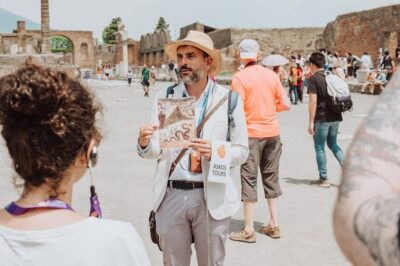 ★ 4.8Pompeii: Entry Ticket and Guided Tour with an ArchaeologistFrom $3519,459 reviews
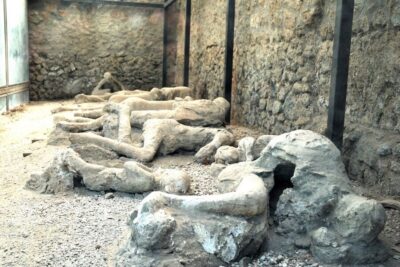 ★ 4.1Pompeii: Entry Ticket with Audio GuideFrom $4013,491 reviews
 ★ 4.8Pompeii: Small Group Tour with an ArchaeologistFrom $4012,264 reviews
 ★ 4.3Pompeii Ruins & Mount Vesuvius Day TourFrom $12011,459 reviews
★ 5.0Pompeii Small Group Tour with an ArchaeologistFrom $356,593 reviews
★ 4.3Pompeii Ruins & Mount Vesuvius Day TourFrom $12011,459 reviews
★ 5.0Pompeii Small Group Tour with an ArchaeologistFrom $356,593 reviews
 ★ 4.5Skip-the-line Pompeii – Small Group TourFrom $544,401 reviews
 ★ 4.6Naples or Sorrento: Full-Day Pompeii and Mount Vesuvius TourFrom $1044,235 reviews
 ★ 3.9Pompeii: Skip-the-line Entry Ticket with Audio Guide & MapFrom $433,153 reviews
Browse the lists this tour appears in