
Review · POMPEII TOURS
Pompeii tour with LOCAL GUIDE and SKIP THE LINE entrance
Pompeii shrinks your time in the best way. This skip-the-line Pompeii tour uses a local guide to move you through major sights while the ruins still feel shockingly alive.
Two things I really like: you get priority entry plus guided context, not just an entrance ticket. And the route hits big-name stops—like Casa del Menandro and the Forum—so your visit feels purposeful, even in a shorter window.
One thing to consider: the guided portion is about 2.5 hours, and Pompeii is huge. If you want more slow wandering and extra “wait, what is that?” moments, you may feel time pressure.
In This Review
- Key things to know before you go
- Pompeii in 2.5 hours: what this tour really does for you
- Meeting point at Via Villa dei Misteri: arrive ready to roll
- Entrance + guide: why priority entry matters in Pompeii
- Stop 1: Archaeological Park of Pompeii and the feeling of a paused city
- Casa del Menandro: a high-status home with myth-painted walls
- The Lupanar stops: Roman sex work, daily commerce, and “how the walls talked”
- Foro de Pompeya: where administration, business, and justice converged
- Stabian Baths: the oldest thermal complex feeling less strange than it sounds
- Price and value: is $66.38 a smart deal for this route?
- Who should book this Pompeii skip-the-line tour
- Guides you might meet: names and what to expect
- Should you book it?
- FAQ
- How long is the Pompeii tour?
- Is the entrance ticket included?
- Does this tour skip the line for entry?
- What language is the tour offered in?
- Where does the tour start and end?
- Which parts of Pompeii are included?
- How many people are in the group?
Key things to know before you go
- Skip-the-line entry saves your morning momentum right at the entrance.
- Local guide turns scattered ruins into a clear picture of daily Roman life.
- Mobile ticket means you can keep everything on your phone.
- The tour includes standout stops like Casa del Menandro, the Lupanar, and the Stabian Baths.
- Group size is capped at 14 travelers, which helps you keep up with the guide’s pace.
- After the tour, you may have time to stay inside the excavations on your own.
Which Pompeii ticket and guide? Compare a few more.
- Pompeii Small Group Tour with an Archaeologist★ 5.0 · 6,593 reviews
- Discover the Ancient Ruins of Pompeii: Day Trip from Rome★ 3.5 · 2,247 reviews
- Pompeii and Herculaneum Small Group Tour with an Archaeologist★ 5.0 · 1,350 reviews
- Skip the Line Guided Tour of Pompeii led by an Archaeologist★ 5.0 · 703 reviews
Pompeii in 2.5 hours: what this tour really does for you
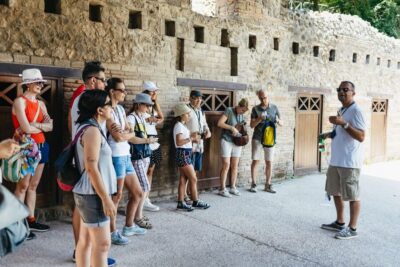
Pompeii can be overwhelming fast. The problem isn’t the site—it’s the scale and the noise of choices. This tour solves that with a clear structure and a guide who points at what matters and why it matters.
I like that you’re not paying just to walk. You’re paying to get the story stitched together while you’re standing in the places where it happened. That’s especially useful for Pompeii, where one street corner can connect to housing, commerce, social life, and public power all at once.
The other big win is that priority service helps you waste less time right at the start. Lines and delays are exactly what make short tours feel short. With this, the schedule stays tighter so you actually reach multiple key areas instead of spending most of your visit stuck at the gate.
Meeting point at Via Villa dei Misteri: arrive ready to roll
The tour starts near the Pompeii entrance area at Via Villa dei Misteri, 3, 80045 Pompei NA, Italy, and it ends back at the same meeting point. That back-to-the-start ending is practical. It means you’re not figuring out a complicated hop to a second pickup zone.
Because the meeting spot is specific, I’d plan to arrive early and double-check any messages you receive before you head over. One traveler noted confusion around meeting instructions, and that’s the kind of small problem that can turn a smooth start into a scramble.
Also, you’ll be doing a real walking circuit through the site. So bring what you need to stay comfortable for the full 2 hours 30 minutes (approx.) timeframe, from start to finish.
Entrance + guide: why priority entry matters in Pompeii
This experience includes your entrance ticket, plus skip-the-line priority service for entry. It also includes an authorized local guide, and it’s offered in English.
In a place like Pompeii, the difference between arriving at the right time and losing time to queues can be huge. With priority entry, you spend your energy on the ruins, not on waiting for the gate to open.
The guide service matters just as much. Without guidance, Pompeii can turn into a set of impressive but disconnected rooms and streets. With a local guide, you get the “how this worked” layer: how houses were laid out, what certain spaces were used for, and how public buildings shaped everyday life.
You also get the tour branded as a Time Machine, which is basically the point: you’re not just viewing objects, you’re walking through a city that was frozen in 79 AD.
Stop 1: Archaeological Park of Pompeii and the feeling of a paused city
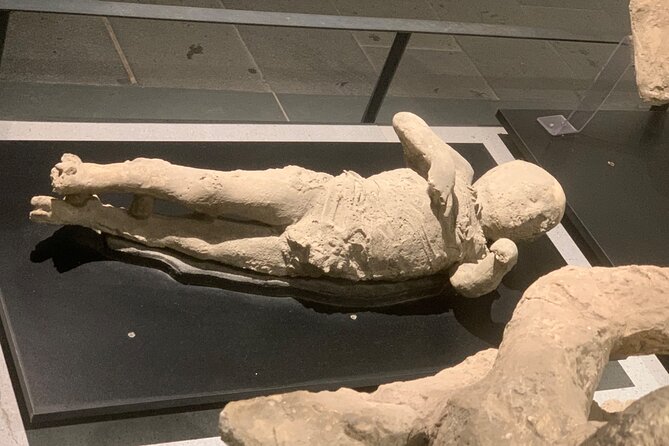
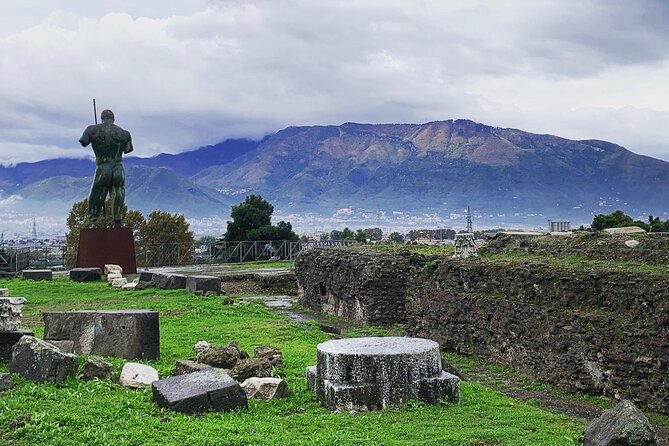
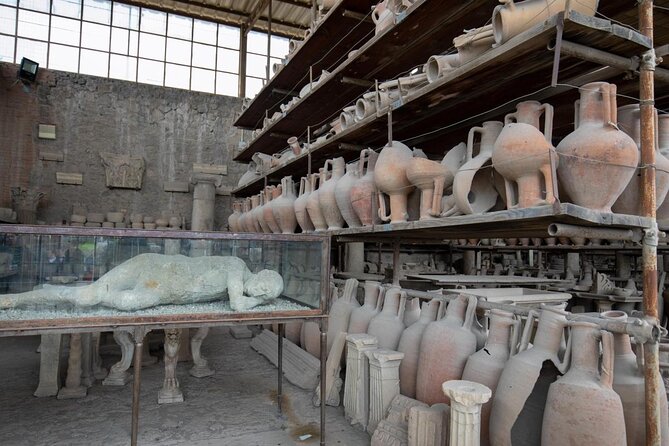
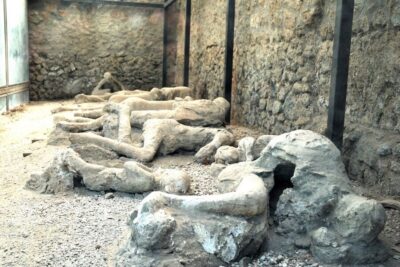
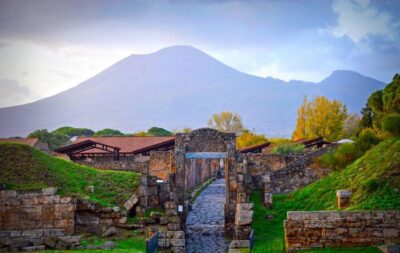
The tour begins at the Archaeological Park of Pompeii, walking from the entrance area (a few meters from the station and car parks). Pompeii’s big story is the way volcanic ash preserved buildings and even everyday traces of life. That preservation is why historians can reconstruct daily Roman life with such clarity.
What you’ll experience early on is the “you can almost sense time” effect. The streets and structures make it feel like the eruption might still be close—because the city is laid out so you can imagine movement, routine, and crowding.
The guided portion at this start is your orientation. The guide helps you understand what you’re looking at before the tour jumps into specific houses and public spaces. That order is smart. It makes later stops easier to follow because you already know the basics of the city’s layout and purpose.
A practical bonus: after the guided tour, there’s the possibility of staying inside the excavations. That gives you a chance to revisit your favorite areas once you’re not on a tight “listen and move” schedule.
More guided runs around Pompeii



Casa del Menandro: a high-status home with myth-painted walls
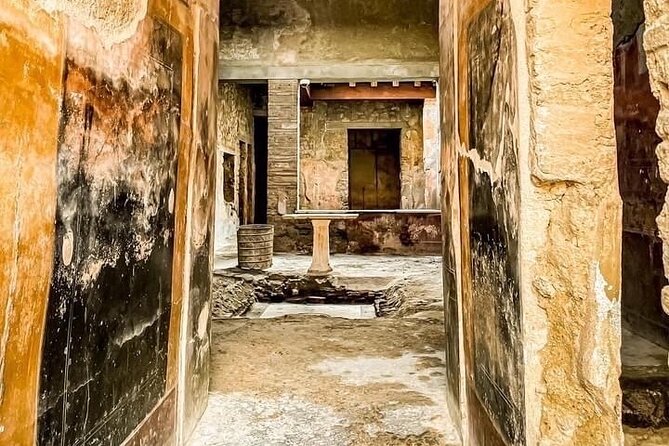
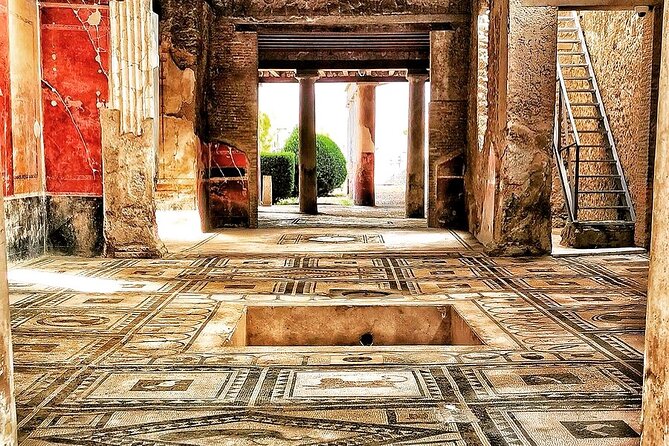
Casa del Menandro is one of the best stops for understanding how rank and daily life mixed in Pompeii. This is described as a large house shaped by complex building events, representing a typical home of a high-ranking family.
The atrium is the star. It’s frescoed with scenes from the Iliad and the Odyssey. So while Pompeii is about archaeology, this stop is about taste—what stories were admired, what imagery communicated education or status, and how art lived inside ordinary routines.
You’ll also get a look at the peristyle described as the “rhodium” type, with a higher northern side. Those details may sound technical, but the point is simple: the house’s layout wasn’t random. It reflected design choices, climate thinking, and how people moved through private space.
One of the most intriguing parts is the underground story tied to the house’s name. The home takes its name from a portrait of Menander (an Athenian playwright) placed in the porch. Beneath the house there’s a small thermal district and an underground room—perhaps a cellar. In that underground space, a chest with 118 pieces of silverware was found and is now exhibited in the National Archaeological Museum of Naples. The idea that family service items were hidden adds a very human punch to the ruins.
The Lupanar stops: Roman sex work, daily commerce, and “how the walls talked”
The Lupanar is a stop that hits hard because it’s direct. It’s described as a brothel where prostitutes—often Greek and Oriental slaves—worked for between two and eight asses. The tour also frames the cost in relation to simple daily economics, like a cup of wine costing one.
The building has two floors. You can picture a clear separation between owners and slaves’ spaces upstairs, and the lower level with five rooms arranged on either side of a corridor. Those rooms include built-in beds, with curtains that closed them. Even the corridor layout matters here: it’s a design meant for controlled access and quick flow between entrances.
What I find useful on this stop is how the description connects the architecture to the experience. The rooms weren’t just “there.” They were organized for a commercial function. And at the end of the corridor under the stairwell, you can see a latrine—another reminder that daily needs and hired spaces overlapped.
You’ll also hear about the erotic depictions painted along the walls, including small pictures in the central corridor that told customers what happened there. The term used for the place comes from Latin lupa, meaning prostitute.
One note: the tour includes a Lupanar segment more than once in the provided structure. In practice, you may see similar material reinforced in different ways, depending on pacing and how the guide frames it. Either way, it’s a stop that’s historically significant and socially revealing.
Foro de Pompeya: where administration, business, and justice converged
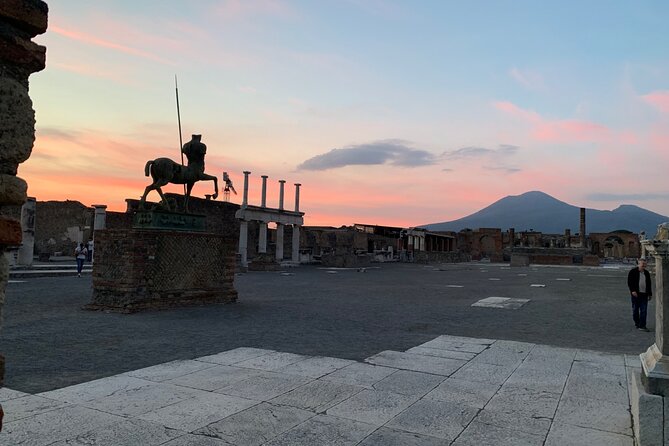
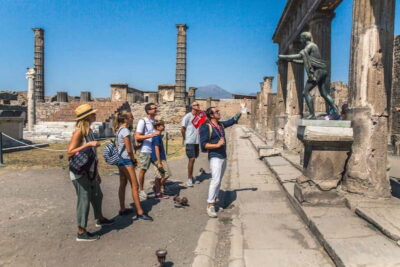
Then you move into the Foro de Pompeya, the Civil Forum and the center of daily life. This is where public buildings for city administration and justice faced the square, alongside business and commercial activity.
The Forum gives you a “big picture” moment. You’re seeing how civic power was staged in stone and space. The square originally had a simpler appearance—an open area with rammed earth, and a western Sanctuary of Apollo plus an eastern line of shops.
After that, it changes. The Forum was modified between the 3rd and 2nd centuries BC. The shape became more regular, arcades appeared, and the square was paved with tuff slabs. Later, during the imperial age, the paving shifts again to travertine slabs. You’ll also hear about bronze letters that belonged to a major inscription, including recesses in some slabs designed to hold them.
If you want one takeaway from this stop, it’s this: Pompeii wasn’t only private homes and dramatic disaster. It ran on public systems—trade, law, worship, and administration—compressed into a single central stage.
Stabian Baths: the oldest thermal complex feeling less strange than it sounds

The Stabian Baths, or Terme Stabiane, are one of the easiest ways to understand Roman comfort. These are Roman-era thermal complexes buried by the 79 eruption and rediscovered through excavations. The description also notes that they are the oldest building of their kind in the city.
This stop is short, but it works because it shifts your viewpoint. After homes and civic space, you’re back to a communal routine. Baths in the Roman world weren’t only about cleaning. They were part of social life and a place where people spent time.
Even without a long bathroom-themed tour (thankfully), the Stabian Baths help you connect Pompeii’s everyday rhythms to a broader Roman lifestyle. It makes the city feel less like a museum and more like a system where people met, talked, and repeated daily habits.
Price and value: is $66.38 a smart deal for this route?
At $66.38 per person, this is priced for efficiency. That matters here because you’re getting three big components together: an entrance ticket, a local guide, and priority entry that helps you start without losing time.
If you’re the kind of traveler who can’t stand “wasting half the trip waiting,” priority access is the value kicker. And if you want your Pompeii visit to feel coherent rather than random, the guide is the other half of that value equation.
The short duration is both a feature and a tradeoff. You’re seeing multiple highlights in one sitting, and the group size is limited (max 14 travelers), so you’re not floating in a mega-crowd. But at the end of the guided part, the site is still big. So if your ideal Pompeii day involves long pauses and extra stops, you might feel the time limits after Casa del Menandro, the Forum, and the baths.
Who should book this Pompeii skip-the-line tour
Book it if:
- You want a guided plan that hits major stops without turning the day into decision fatigue.
- You care about starting quickly via skip-the-line entry.
- You’re okay with a focused route that favors key sights over long free roaming.
Skip it (or consider a longer option) if:
- You want deep, slow time in fewer spaces.
- You’re the type who reads every inscription, circles every detail, and needs more than 2.5 hours to feel satisfied.
- You prefer tours that include extra equipment like headphones; one traveler specifically recommended using headphones, which suggests audio comfort may vary by group setup.
This also fits families and mixed ages well, since at least one guide (Antonio) was noted as kind to daughters and made the ruins easier to grasp for younger visitors.
Guides you might meet: names and what to expect
The provider for this experience is listed as Gennaro Balzano. The tour is also shown with multiple local guide names in practice, including Antonio, Anna, Sasa, and Gennaro.
What’s consistent across these names is the “human” approach: friendly pacing, patience, and time for questions (with the caveat that the overall tour still has a set length). If your priority is someone who explains what you’re seeing in plain terms, this is the right kind of format.
And if you’re worried about feeling rushed, look for the promise of a non-rushed explanation style—since that has been a clear strength for the guides associated with this experience.
Should you book it?
If you want Pompeii with structure, this is a good call. Priority entry is the practical advantage, and the local guide is what makes the ruins feel connected instead of scattered.
I’d book this if your schedule is tight and you still want the major highlights—Casa del Menandro, the Lupanar, the Forum, and the Stabian Baths—without spending your day stuck at the entrance.
I’d think twice if Pompeii is your only shot and you know you’ll want more time per stop. In that case, you may feel the limits of a 2.5-hour guided circuit, even with the freedom to stay inside afterward.
FAQ
How long is the Pompeii tour?
The tour is about 2 hours 30 minutes (approx.).
Is the entrance ticket included?
Yes. Entrance tickets are included in the tour.
Does this tour skip the line for entry?
Yes. It includes priority service to skip the line for entry.
What language is the tour offered in?
The tour is offered in English.
Where does the tour start and end?
It starts at Via Villa dei Misteri, 3, 80045 Pompei NA, Italy and ends back at the same meeting point.
Which parts of Pompeii are included?
The tour covers the Archaeological Park of Pompeii, Casa del Menandro, the Lupanar, Foro de Pompeya, and the Stabian Baths (Terme Stabiane).
How many people are in the group?
The maximum group size is 14 travelers.
More Tours in Pompeii



More Tour Reviews in Pompeii

More Pompeii Tours to Compare
More Pompeii tours, freshly reviewed



Pompeii Tours, compared.
 ★ 4.8Pompeii: Entry Ticket and Guided Tour with an ArchaeologistFrom $3519,459 reviews
 ★ 4.1Pompeii: Entry Ticket with Audio GuideFrom $4013,491 reviews
 ★ 4.8Pompeii: Small Group Tour with an ArchaeologistFrom $4012,264 reviews
 ★ 4.3Pompeii Ruins & Mount Vesuvius Day TourFrom $12011,459 reviews
★ 5.0Pompeii Small Group Tour with an ArchaeologistFrom $356,593 reviews
★ 4.3Pompeii Ruins & Mount Vesuvius Day TourFrom $12011,459 reviews
★ 5.0Pompeii Small Group Tour with an ArchaeologistFrom $356,593 reviews
 ★ 4.5Skip-the-line Pompeii – Small Group TourFrom $544,401 reviews
 ★ 4.6Naples or Sorrento: Full-Day Pompeii and Mount Vesuvius TourFrom $1044,235 reviews
 ★ 3.9Pompeii: Skip-the-line Entry Ticket with Audio Guide & MapFrom $433,153 reviews