
Review · POMPEII TOURS
Pompeii private tour with expert guide in archaeology
Pompeii makes more sense with a guide. This private archaeology tour turns scattered ruins into a clear story of daily life 2,000 years ago. I love the focus on how people actually lived, worked, and played, and I love the pace of a roughly 2-hour visit that doesn’t drag. One catch: the entry ticket to the Pompeii Archaeological Park isn’t included, so you’ll budget extra for it.
I also like that this is for a small group (up to 8), so you can ask questions and spend a bit more time on the parts you care about. You start at Coffee Shop Vittoria on Via Mare in Pompei, then you finish back at the same meeting point.
One more heads-up: the route includes the red light district and famous erotic frescoes, so if you’re traveling with teens or you just prefer a more family-friendly pace, plan accordingly.
In This Review
- Key points to know before you go
- Why an archaeologist guide matters in Pompeii
- Getting oriented: meeting at Coffee Shop Vittoria and building a good plan
- Gladiator school and training: where entertainment turned into training
- Theater time and the flow of everyday streets
- Baths and the 2,000-year-old spa culture
- The red light district and erotic frescoes: go in informed
- Domus for patricians: mosaics, frescoes, and power
- The Forum, plaster casts, temples, and the market pulse
- Price and value: what $302.34 buys you (and what it doesn’t)
- Best for whom? Who this tour suits and who might want a different pace
- Should you book this Pompeii private tour?
- FAQ
- How long is the Pompeii private tour?
- Is this a private tour?
- How many people are in a group?
- Is the tour in English?
- What’s included in the price?
- Do I need to buy the Pompeii park entrance ticket?
- Where do we meet the guide?
- Where does the tour end?
- Is pick-up and drop-off included?
- What is the cancellation policy?
Key points to know before you go

- Expert guide archaeologist who explains what you’re looking at, not just what happened long ago
- Small private group (up to 8), so the tour can fit your pace
- Full stop list for everyday Pompeii: gladiators, theater, shops, baths, the Forum, and more
- Erotic frescoes are part of the route (worth knowing up front)
- Ticket to Pompeii Archaeological Park is extra at €19 per booking
- Ends at the Forum, with the option to keep exploring or return to exits with your guide
Which Pompeii ticket and guide? Compare a few more.
- Pompeii Small Group Tour with an Archaeologist★ 5.0 · 6,593 reviews
- Discover the Ancient Ruins of Pompeii: Day Trip from Rome★ 3.5 · 2,247 reviews
- Pompeii and Herculaneum Small Group Tour with an Archaeologist★ 5.0 · 1,350 reviews
- Skip the Line Guided Tour of Pompeii led by an Archaeologist★ 5.0 · 703 reviews
Why an archaeologist guide matters in Pompeii

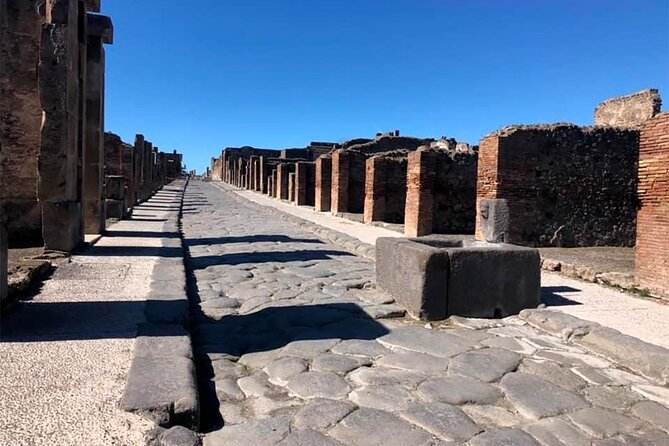
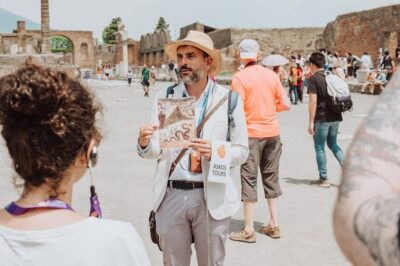
Pompeii can look like walls and floors at first glance. The big advantage of this tour is that you’re not left guessing. Your guide is an archaeology expert focused specifically on Pompeii, so you get the why behind the what—how these spaces worked, what they signaled, and what daily routines looked like before the eruption.
I also like that the tour is built around real parts of city life: training and games, theater entertainment, food and trade along main streets, bathing culture, religious areas, and the Forum as the city’s central social hub. You’re not just ticking off landmarks. You’re building a mental map of how the city functioned.
Finally, the timing is realistic. About two hours is enough to see the major highlights without turning your legs into pasta. If you want a deeper, slower day, this tour also works as a smart first pass—then you can continue on your own afterward.
Getting oriented: meeting at Coffee Shop Vittoria and building a good plan
The meeting point is Coffee Shop Vittoria, Via Mare, 80045 Pompei NA, Italy. The tour ends back at this same spot, which helps if you’re coordinating with train schedules, buses, or other plans.
Because your guided portion runs about two hours, it’s worth arriving a few minutes early to settle in and get your questions ready. This is also a good idea if you have mobility limits, because the tour is listed as requiring a moderate physical fitness level. You’ll be walking through uneven historic ground typical of Pompeii.
If you’re hoping to reduce walking time on the first leg, note that pick-up and drop-off by minivan isn’t included—but you can book that option through Pompeigrandtour. If you’re staying farther out, it can be a relief to have the logistics handled.
Gladiator school and training: where entertainment turned into training
The tour starts at Pompeii Archaeological Park, beginning with your archaeology guide and a full immersion in everyday life 2,000 years ago. One of the first stops is the school and training place of gladiators.
This isn’t just about fighting. You’ll get the context of how gladiators fit into Roman society—status, spectacle, discipline, and the business side of public entertainment. When you understand that these spaces were designed for training and performance, the layout and purpose make more sense.
Possible drawback to keep in mind: Pompeii is open-air and uncovered in places. If it’s hot or sunny, plan for sun protection and water, because your early time in the park can feel long fast.
Theater time and the flow of everyday streets

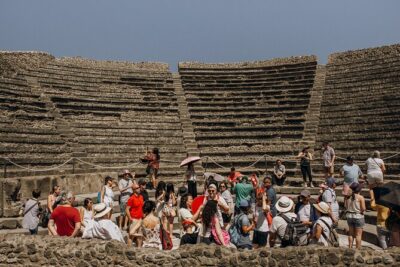
Next up is the theater. Even without getting technical, a guide helps you see how a theater functioned as a social magnet—where people gathered, how performances shaped community life, and why the Romans built spaces for mass entertainment.
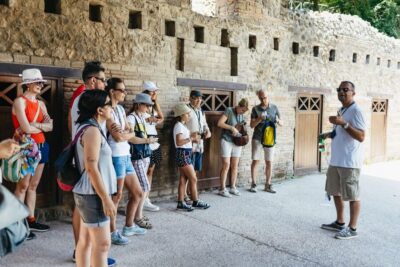
From there, you move to the main streets with ancient taverns and shops. This part is where I think the guide earns their fee. Street-level details are easy to miss when you’re just scanning ruins. With explanation, you can start noticing patterns: where commerce likely happened, how people moved through the area, and how everyday businesses shaped the rhythm of the city.
If you’re the kind of traveler who loves to picture daily routines—what people ate, where they shopped, how they spent evenings—this is one of the most satisfying segments.
More guided runs around Pompeii



Baths and the 2,000-year-old spa culture

Then come the Baths, described as a 2,000-year-old spa. This stop is valuable because bathing in Roman times wasn’t just hygiene. It was social life, relaxation, and a chance to network in a public setting.
The guide’s role here is key. Baths can feel confusing if you don’t know what the different areas were used for. When someone explains the logic of the space, you can interpret the building rather than just admire it as “old.” And you’ll get a better sense of why this was a daily routine for many residents.
Practical note: baths areas can involve more walking and sometimes uneven surfaces. Wear shoes you trust.
The red light district and erotic frescoes: go in informed

This tour includes the red light district with famous erotic frescoes. I’m glad they’re not hiding this in fine print, because it changes the vibe of the stop.
If you’re traveling as a couple, this can be a fascinating look at Roman attitudes toward sexuality and public art. If you’re traveling with kids, or if you prefer a more conservative atmosphere, you’ll want to mentally prepare. You might also choose to brief your group beforehand so everyone knows what to expect before you reach the area.
Either way, a guide matters here too. Erotic art in a ruin can feel random without context. With explanation, it becomes part of a larger picture—how Pompeii used imagery to communicate, entertain, and signal culture.
Domus for patricians: mosaics, frescoes, and power
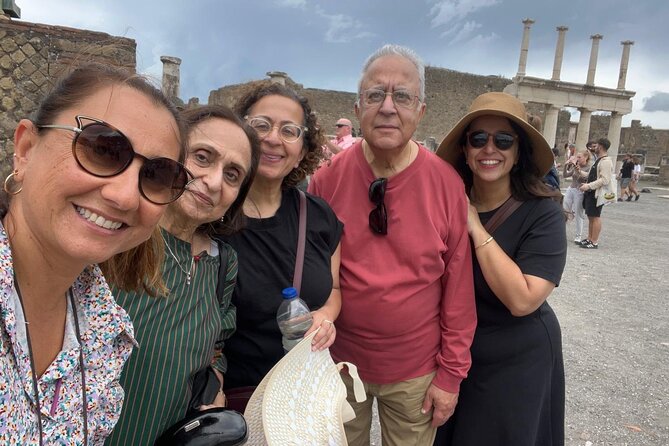
A standout segment is a house of rich Roman patricians (a Domus) with frescoes and mosaics. This is one of the clearest ways to see social inequality in physical space.
What I like about this stop is that it gives you a contrast. You’ve seen public areas and street life. Then you step into the world of wealth and taste—decor, design choices, and how elite households displayed their status.
The mosaics and frescoes aren’t just pretty. When you understand what visitors were meant to notice, you get a sharper sense of what mattered to the people inside: taste, prestige, and self-presentation.
If you love art details, take an extra moment here. Even on a tight schedule, the guide’s pointers can help you notice patterns you’d otherwise walk past.
The Forum, plaster casts, temples, and the market pulse
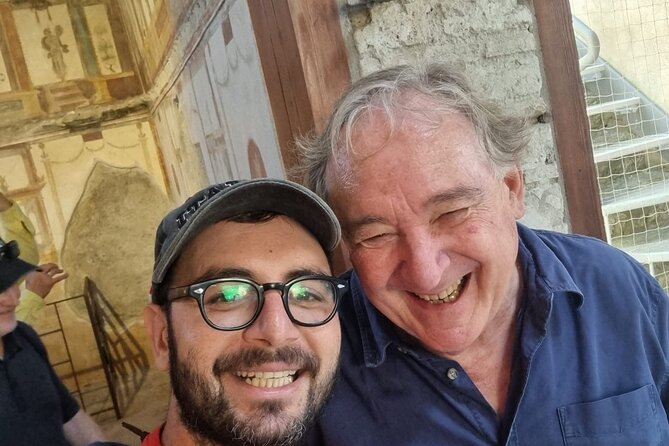
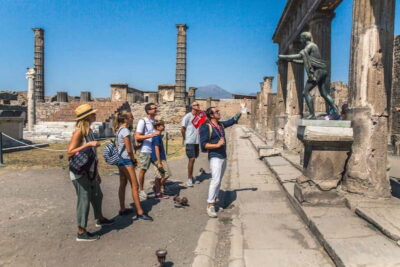
The tour ends at the Forum, the center of social life, with its buildings. This is where you’ll feel how the city organized public space.
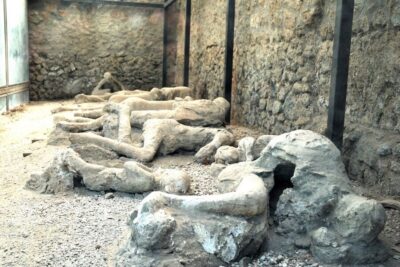
You’ll also encounter plaster casts of the victims crystallized at the time of the Vesuvius eruption. This stop can be emotionally heavy, but it’s also one of the most important parts of Pompeii because it turns disaster from an abstract story into something tangible. A good guide can help you look at it respectfully and understand why these casts matter.
The tour also includes temples places of worship and the main market of the city. That combination is smart: it shows how Pompeii’s core systems connected—faith, commerce, public decision-making, and daily interaction—all within one central hub.
After reaching the Forum, your guided portion ends. Then you can decide whether to continue the visit yourself or return to the exits with the guide. I like that flexibility. If you want more time for photos or to slow down in a specific area, you can do it without feeling like you’re abandoning a fixed script.
Price and value: what $302.34 buys you (and what it doesn’t)
The price is $302.34 per group, up to 8 people, for about 2 hours. That’s a private tour price, which means the cost can look steep until you do the math based on how many people share.
Here’s the value equation I’d use:
- You’re paying for an expert guide archaeologist, not a crowd experience.
- You’re paying to save time and reduce the frustration of reading ruins without context.
- You’re also buying flexibility. Private tours let you focus on your interests instead of rushing with strangers.
Then there’s the one extra cost you must plan for: the entrance fee to the Archaeological Park of Pompeii is €19.00 per booking, and it’s not included in the tour price. So your total spend equals tour price plus the park ticket.
If you can fill the group (near 8 people), this tends to become a very reasonable way to do Pompeii. If you’re only a couple or a small family, it’s still a good buy if you care about understanding what you’re seeing and you want a guided route tailored to you.
Best for whom? Who this tour suits and who might want a different pace
This private Pompeii archaeology tour is a great fit if you:
- Want real explanation for what you’re seeing, not just a self-guided walk
- Prefer a small group (or a full private group)
- Like seeing everyday life represented: gladiators, theater, shops, baths, and the Forum
- Are comfortable with a stop that includes erotic frescoes
It might be less ideal if you:
- Want a very long day in Pompeii (this is about two hours)
- Have strong preferences for avoiding anything adult-themed
- Are expecting transportation to be included (pickup/drop-off by minivan is not included, though you can book it separately)
Should you book this Pompeii private tour?
Book it if you want Pompeii to feel like a city, not just a site. The big reason to choose this format is that you get an archaeology expert who can connect the dots across the main parts of daily life—gladiators, street commerce, bathing, elite houses, and the Forum.
Consider booking a different option if your top priority is maximum time inside the park or you need pickup included in the base price. Also think ahead about the erotic fresco segment, so it matches your comfort level.
If you’re on a tight schedule and want the best chance of understanding what you’re walking through, this is a smart, high-value way to do Pompeii.
FAQ
How long is the Pompeii private tour?
It lasts about 2 hours.
Is this a private tour?
Yes. It’s private, and only your group participates.
How many people are in a group?
The price is per group for up to 8 people.
Is the tour in English?
Yes, it’s offered in English.
What’s included in the price?
The included part is an expert guide archaeologist.
Do I need to buy the Pompeii park entrance ticket?
Yes. The entrance fee for the Archaeological Park of Pompeii (€19.00 per booking) is not included.
Where do we meet the guide?
You meet at Coffee Shop Vittoria, Via Mare, 80045 Pompei NA, Italy.
Where does the tour end?
The guided tour ends at the Forum, and the activity ends back at the meeting point.
Is pick-up and drop-off included?
No. Pick-up and drop-off by minivan is not included, but it’s listed as a possibility to book at Pompeigrandtour.
What is the cancellation policy?
Free cancellation is allowed up to 24 hours in advance for a full refund.
More Tours in Pompeii



More Tour Reviews in Pompeii

More Pompeii Tours to Compare
More Pompeii tours, freshly reviewed


Pompeii Tours, compared.
 ★ 4.8Pompeii: Entry Ticket and Guided Tour with an ArchaeologistFrom $3519,459 reviews
 ★ 4.1Pompeii: Entry Ticket with Audio GuideFrom $4013,491 reviews
 ★ 4.8Pompeii: Small Group Tour with an ArchaeologistFrom $4012,264 reviews
 ★ 4.3Pompeii Ruins & Mount Vesuvius Day TourFrom $12011,459 reviews
★ 5.0Pompeii Small Group Tour with an ArchaeologistFrom $356,593 reviews
★ 4.3Pompeii Ruins & Mount Vesuvius Day TourFrom $12011,459 reviews
★ 5.0Pompeii Small Group Tour with an ArchaeologistFrom $356,593 reviews
 ★ 4.5Skip-the-line Pompeii – Small Group TourFrom $544,401 reviews
 ★ 4.6Naples or Sorrento: Full-Day Pompeii and Mount Vesuvius TourFrom $1044,235 reviews
 ★ 3.9Pompeii: Skip-the-line Entry Ticket with Audio Guide & MapFrom $433,153 reviews