
Review · POMPEII TOURS
Pompeii: Guided Tour with Priority Entrance
Skip the line. Then see Pompeii faster.
This guided tour gives you priority admission into Pompeii’s UNESCO ruins, plus headsets so you can actually hear your guide in a busy outdoor site. You’ll focus on the city’s big-story places, from the Forum to the Stabian Baths and the Lupanar, in about 2 hours 30 minutes.
My favorite part is how the guide turns scattered ruins into a clear picture of daily life and Roman civic power. I also love the skip-the-line entry, which matters a lot at Pompeii when queues can chew up your morning. Guides like Giulia, Vicente, Max, and Claudio show up in feedback as standout examples of how this tour becomes more than just walking and looking.
One real consideration: Pompeii is still Pompeii. You’re walking on uneven stone, often in strong sun, and the tour can feel warm and physically busy. Comfortable shoes and planning for heat make a bigger difference than people expect.
In This Review
- Key highlights worth knowing
- Priority Entry at Pompeii: Why “Skip the Line” Actually Matters
- Where You Meet at Zeus Car Park and How to Start Without Stress
- Forum Power Walk: Basilica, Civic Center, Temple of Jupiter, and Macellum
- The Civil Forum: the city’s daily command center
- The Basilica: Pompeii’s formal business and justice hall
- Temple of Jupiter: politics, religion, and a dramatic backdrop
- The Macellum: the market world and imperial influence
- Via dell’Abbondanza and the House of the Faun: from Main Street to Mosaics
- Stabian Baths and the Lupanar: Everyday Rituals and the Adult Edge
- Stabian Baths (Terme Stabiane): bathing as routine
- The Lupanar: famous brothel and erotic wall art
- How Long You’ll Spend at Each Stop (and Why That Can Feel Great or Rushed)
- Pace, Crowds, and Hot-Day Reality: Practical Tips That Make It Better
- Price and Value: Is $59.13 Worth It for Priority Access and a Guide?
- Who This Pompeii Tour Fits Best
- Final Verdict: Should You Book This Pompeii Priority Entrance Tour?
- FAQ
- What does the Pompeii priority entrance tour include?
- How long is the tour?
- Where do I meet the guide?
- Is the tour in English?
- How many people are in the group?
- Are tickets provided on a mobile device?
- What sights are covered during the visit?
- Is the Stabian Baths admission included?
- What should I wear for Pompeii?
- Is cancellation free and what weather matters?
Key highlights worth knowing
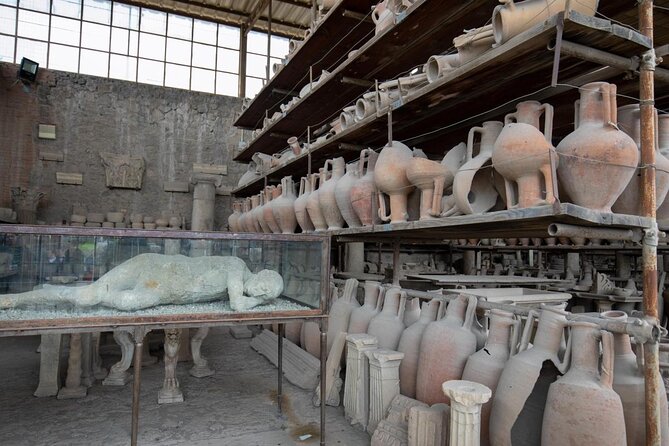
- Priority entrance helps you jump ahead of the main crowd flow at Pompeii.
- Headsets make the commentary easier to follow, even when the group clusters in key areas.
- Forum focus covers the Basilica, Civil Forum, Temple of Jupiter, and the Macellum market zone.
- Street-to-villa route connects the decumanus (main street) to the House of the Faun and its Alexander Mosaic.
- Two sharp “life and death” stops: the Stabian Baths and the Lupanar, both short but memorable.
Which Pompeii ticket and guide? Compare a few more.
- Pompeii Small Group Tour with an Archaeologist★ 5.0 · 6,593 reviews
- Discover the Ancient Ruins of Pompeii: Day Trip from Rome★ 3.5 · 2,247 reviews
- Pompeii and Herculaneum Small Group Tour with an Archaeologist★ 5.0 · 1,350 reviews
- Skip the Line Guided Tour of Pompeii led by an Archaeologist★ 5.0 · 703 reviews
Priority Entry at Pompeii: Why “Skip the Line” Actually Matters
Pompeii is one of those places where time disappears fast. The ruins are huge, the pathways are narrow in spots, and the crowds can pile up right where you’d most want to stop and read. That’s why priority entrance is more than a small perk. It helps you start your visit with momentum instead of standing around.
This tour is set up for a guided flow through the “main hits.” You get into the Archaeological Park of Pompeii with priority admission, then your guide takes you through the big civic and everyday-life spaces. With headsets included (especially helpful for groups over 10), you’re less likely to lose the thread when you’re surrounded by other tour groups.
Also, keep your expectations tuned. Priority entrance reduces waiting at the gate, but Pompeii will still be busy. Your payoff is how quickly you get into the story of the city, not a guarantee of empty streets.
Where You Meet at Zeus Car Park and How to Start Without Stress
The meeting point is Camping Zeus, at Zeus Car Park, Via Villa dei Misteri, 3, 80045 Pompei NA, Italy. The tour ends back at the same place, so you’re not hunting for your way out across the grounds.
A few practical notes that come straight from how this kind of tour works on-site:
- Arrive early enough to find the group before your start time. Even small delays can make the rest of the route feel rushed.
- Plan to walk a lot after you meet your guide. Pompeii is not a “sit and watch” experience.
- Wear shoes with grip. The ground can be uneven, and you’ll be moving between street levels and archaeological surfaces.
If you’re coming by taxi or local transit, treat the meeting point as your anchor. Once you’re inside with your guide, the route is structured around key stops.
Forum Power Walk: Basilica, Civic Center, Temple of Jupiter, and Macellum
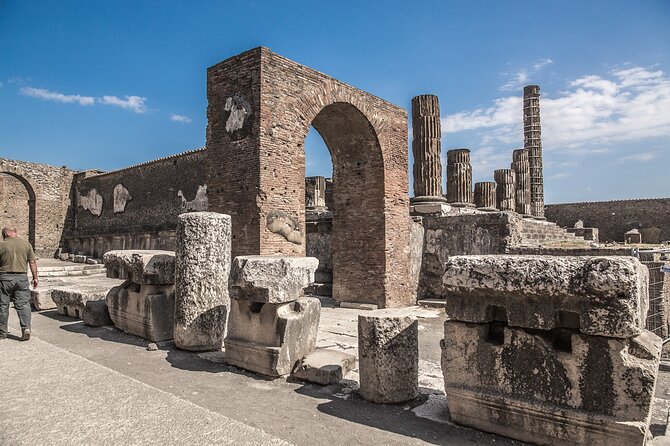
The heart of your tour is the Forum area, because it’s where Pompeii’s public life becomes easy to understand. Instead of jumping randomly from building to building, the guide leads you through places tied to administration, worship, commerce, and community routine.
Here’s what you’ll see in this core section:
The Civil Forum: the city’s daily command center
The Civil Forum is described as the focal point for public buildings tied to city administration and justice, business, trade, and markets, plus citizen worship. In other words, this is where Pompeians met their government and their neighbors in the same spaces.
The guide’s job here is huge: without context, the Forum can look like a cluster of stone fragments. With commentary, you start to see the logic—what happened where, and why it mattered.
More guided runs around Pompeii


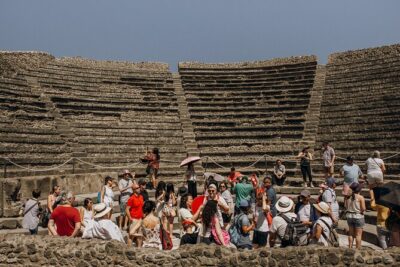

The Basilica: Pompeii’s formal business and justice hall
Next comes the Basilica, the most sumptuous Forum building, with an extension of about 1,500 square meters. It was used for business and administration of justice. You’ll pass through multiple entrances from the Forum, then see how it’s organized into three naves with brick columns and Ionic capitals.
Even when you can’t read every detail, the layout helps you understand why this mattered. It wasn’t just a big room—it was structured for flow, meetings, and formal civic activity.
Temple of Jupiter: politics, religion, and a dramatic backdrop
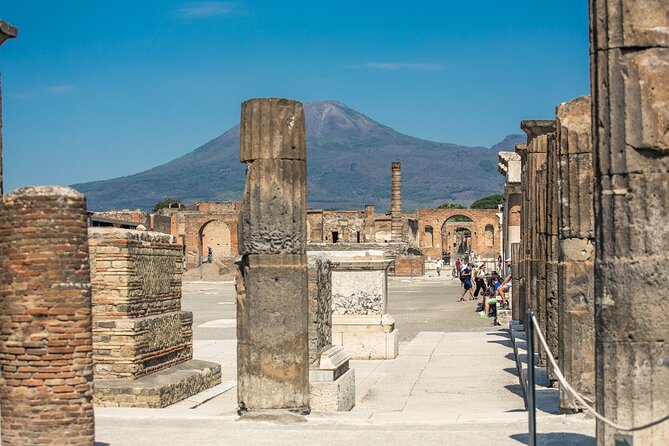
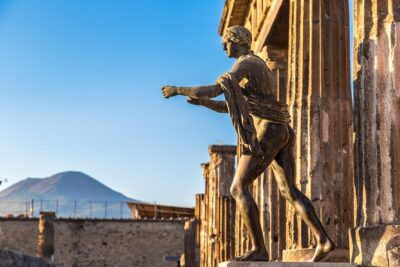
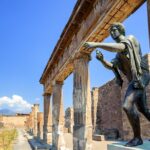
The Temple of Jupiter sits on the north side of the Forum, with Mount Vesuvius rising behind it. That Vesuvius view is not just scenic—it helps connect geography to power and identity.
When the colony was founded (80 BC), the temple was renovated into something like a Capitolium, with statues of Jupiter, Juno, and Minerva placed on a high base so they were visible to people passing through the Forum square.
If you want a “why did they build it like this” moment, this is one. Pompeii’s layout makes the city feel planned, not random.
The Macellum: the market world and imperial influence
The Macellum is the market complex, including a tuff quadriporticus and an elevated worship hall. You’ll hear how statues (including copies of a female and a male armed figure) relate to imperial cult themes, and how the layout suggests both trade and ritual.
This stop is also a reminder that Roman life blended practical business with belief systems. It wasn’t either-or.
Via dell’Abbondanza and the House of the Faun: from Main Street to Mosaics
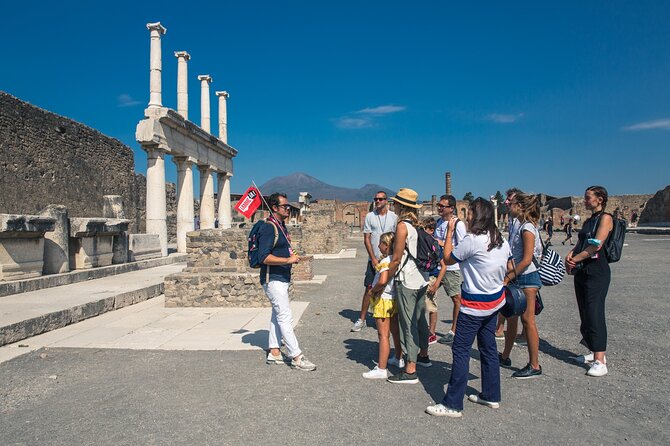
After the Forum, your route shifts into the flow of daily movement. Via dell’Abbondanza was Pompeii’s main street—called a decumanus maximus—running east/west from the Forum to Porta Sarno. In Roman times it was crowded with shops, workshops (officinae), cafés and snack-bars, and places to eat and drink.
That street segment helps you imagine noise and motion. It also gives your guide room to talk about how people actually lived, not just what temples looked like.
Then you step into the House of the Faun, a grand Roman villa known for mosaics—especially the Alexander Mosaic. Even if mosaics aren’t your thing, this one matters because it’s a storytelling masterpiece tied to how elite households displayed knowledge, culture, and status.
This is the kind of stop where a guide can make a big difference. The mosaic is famous, but the context about why Pompeians chose it makes the viewing feel intentional rather than just decorative.
Stabian Baths and the Lupanar: Everyday Rituals and the Adult Edge
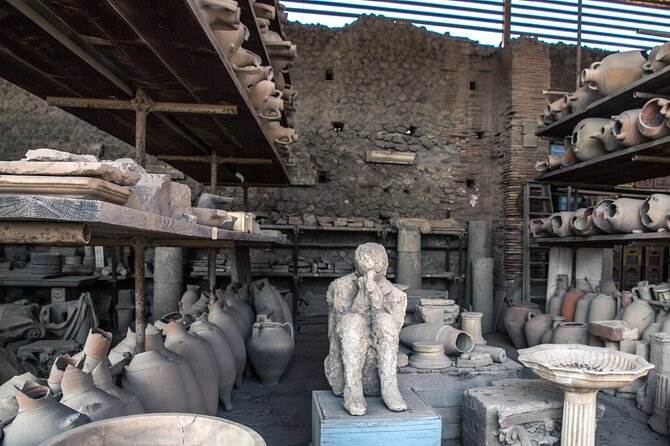
Two of the most memorable parts of Pompeii are also two of the easiest to misunderstand if you visit blindly. This tour includes both.
Stabian Baths (Terme Stabiane): bathing as routine
The Stabian Baths are behind the Temple of Jupiter and date to shortly after the colony’s founding by General Sulla (around 80 BC). You’ll learn how men’s and women’s sections had separate entrances.
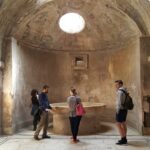
In the men’s area you see how spaces connect: dressing room (apodyterium) also used as a tepidarium, plus frigidarium for cold baths and calidarium for hot baths. The baths were heavily damaged during the earthquake of 62 AD.
This stop is short, but it’s useful because it shows Pompeii wasn’t only dramatic streets and monuments. People had routines. The baths were social and physical life.
The Lupanar: famous brothel and erotic wall art
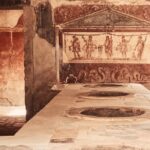
The Lupanar of Pompeii is the most famous brothel in the ruined city, also called Lupanare Grande. You’ll be guided through what makes it historically notable, including the erotic paintings on the walls.
This is Latin for brothel, and your guide will connect it to the idea that Pompeii’s everyday world included sex work and strong cultural influences from Greek and Oriental slaves, who were paid in asses. (You’ll also hear simple price context: a glass of wine cost one As.)
A quick heads-up for planning: this is an adult-themed stop. If you’re touring with younger teens, you may want to check whether this content fits your family.
How Long You’ll Spend at Each Stop (and Why That Can Feel Great or Rushed)
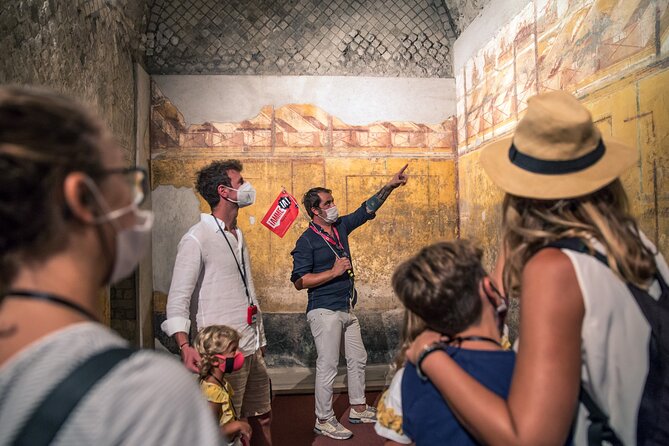
Your tour is about 2 hours 30 minutes total, with specific segments:
- The Pompeii archaeological park portion: about 2 hours.
- Stabian Baths: about 10 minutes.
- Lupanar: about 10 minutes.
That structure is ideal if you want a curated sprint through the best-known places. Many people find this length works because Pompeii is intense. You get a strong overview, then you still have time and energy to explore on your own after.
But if you’re the type who likes to linger at each wall painting or every floor detail, you’ll feel the time pressure. Some feedback also points out that you may not see everything within the allotted window, because Pompeii is too vast for any one route.
Pace, Crowds, and Hot-Day Reality: Practical Tips That Make It Better
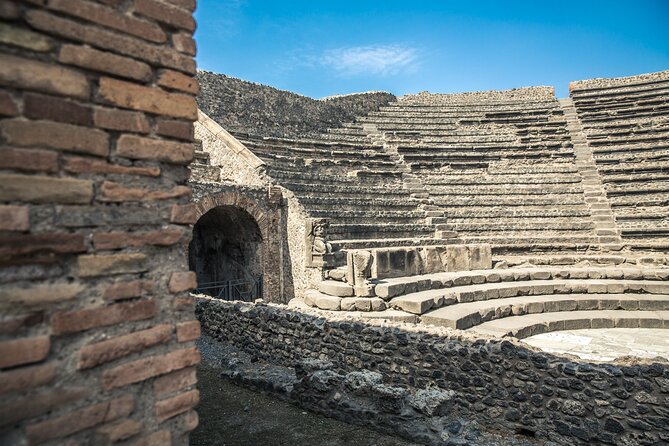
The tour is built to handle busy outdoor conditions. Headsets help a lot when groups are clustered near major sights. You’ll still be sharing space with other visitors, especially near the Forum.
Here’s what I’d do to make the day smoother:
- Start earlier when you can. There’s a common pattern that morning tours feel easier because you pass through key areas before the crowds thicken.
- Bring water. Even if the site has fountains you can use to top up, you’ll still feel better if you plan ahead.
- Don’t carry heavy bags. It’s easier when you’re free to move and stop quickly.
- Use sunscreen and consider a hat. Pompeii gets very hot in summer, and there’s not much you can do about that except prepare.
Also watch your footing. Uneven surfaces show up in ruins everywhere, but Pompeii can be extra because it’s a mix of original stones, excavated surfaces, and uneven access routes.
Price and Value: Is $59.13 Worth It for Priority Access and a Guide?
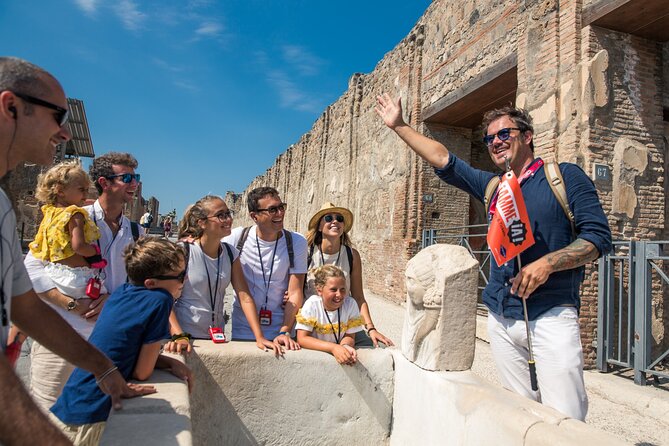
At about $59.13 per person, this tour sits in the “worth it if you’re time-limited” category.
Here’s why it can be good value:
- Priority admission can save you a big chunk of your morning when lines are long.
- A licensed guide brings structure. Instead of wandering and guessing what you’re looking at, you get history and architecture tied directly to the places you stop.
- Headsets reduce the effort of staying with the group and help you follow commentary without constantly adjusting where you’re standing.
Is it worth it for everyone? Not automatically. If you’re the kind of visitor who wants full freedom to roam at your own speed, you might prefer a self-guided approach. But if you’re visiting for a short window and want the clearest “first Pompeii” experience, the cost can feel justified.
One small note: the tour includes key highlights and multiple short stops, so the value comes from efficient coverage, not deep time in a single room.
Who This Pompeii Tour Fits Best
This is a strong match if you want:
- A guided overview of Pompeii’s most important sights in about 2.5 hours.
- Priority access that helps you beat delays.
- Headsets that make it easier to follow the story in a loud, crowded area.
It can also suit travelers who enjoy asking questions. Multiple guide names show up in feedback as approachable and responsive, including Alessio, Max, Vincenzo, Giulia, Vivianna, Anarita, and Claudio. If your guide is one of these styles—clear, organized, and willing to answer—you’ll likely enjoy how the ruins become understandable.
You might rethink the tour if:
- You’re traveling with very young kids who need space to move, because you’ll be grouped and moving through busy zones.
- You want to spend a lot of time in just one neighborhood or building. Pompeii rewards slow looking.
Final Verdict: Should You Book This Pompeii Priority Entrance Tour?
If you want the best shot at a smooth first Pompeii visit, I’d book this. Skip the line plus a structured route plus headsets is a practical combo, especially in peak heat and peak crowds.
I’d skip it if you plan to spend all day at Pompeii and you hate group pacing. In that case, self-guided time might suit you better.
FAQ
What does the Pompeii priority entrance tour include?
It includes a guided tour of about 2 hours 30 minutes, skip-the-line admission fees to the Pompeii ruins, and headphones in Pompeii to hear the guide clearly for larger groups. Admission tickets are included for the Pompeii ruins, and included stops also cover the Lupanar.
How long is the tour?
The tour runs for approximately 2 hours 30 minutes total.
Where do I meet the guide?
Meet at Camping Zeus, Zeus Car Park, Via Villa dei Misteri, 3, 80045 Pompei NA, Italy.
Is the tour in English?
Yes, it’s offered in English.
How many people are in the group?
The maximum group size is 25 travelers.
Are tickets provided on a mobile device?
Yes, the tour offers a mobile ticket.
What sights are covered during the visit?
You’ll visit the Pompeii archaeological park highlights such as the Basilica, Civil Forum, Temple of Jupiter, Macellum, Via dell’Abbondanza, the House of the Faun (including the Alexander Mosaic), the Large Theater, plus additional stops including the Stabian Baths and the Lupanar.
Is the Stabian Baths admission included?
The Stabian Baths stop lists admission ticket as free.
What should I wear for Pompeii?
Wear sunscreen and comfortable shoes. The site can be very hot in summer, and you’ll be walking on uneven surfaces.
Is cancellation free and what weather matters?
Free cancellation is available if you cancel at least 24 hours in advance for a full refund. The experience requires good weather; if canceled due to poor weather, you’ll be offered a different date or a full refund.
More Tours in Pompeii



More Tour Reviews in Pompeii

More Pompeii Tours to Compare
More Pompeii tours, freshly reviewed



Pompeii Tours, compared.
 ★ 4.8Pompeii: Entry Ticket and Guided Tour with an ArchaeologistFrom $3519,459 reviews
 ★ 4.1Pompeii: Entry Ticket with Audio GuideFrom $4013,491 reviews
 ★ 4.8Pompeii: Small Group Tour with an ArchaeologistFrom $4012,264 reviews
 ★ 4.3Pompeii Ruins & Mount Vesuvius Day TourFrom $12011,459 reviews
★ 5.0Pompeii Small Group Tour with an ArchaeologistFrom $356,593 reviews
★ 4.3Pompeii Ruins & Mount Vesuvius Day TourFrom $12011,459 reviews
★ 5.0Pompeii Small Group Tour with an ArchaeologistFrom $356,593 reviews
 ★ 4.5Skip-the-line Pompeii – Small Group TourFrom $544,401 reviews
 ★ 4.6Naples or Sorrento: Full-Day Pompeii and Mount Vesuvius TourFrom $1044,235 reviews
 ★ 3.9Pompeii: Skip-the-line Entry Ticket with Audio Guide & MapFrom $433,153 reviews