
Review · POMPEII TOURS
Pompeii 360° – 4-hour tour with an expert Guide in archaeology
Pompeii clicks with the right guide. I love the expert archaeology guide and the 4-hour route that hits the big visual moments without wasting your time. One thing to budget for: the Pompeii park entry ticket is not included (it’s €20 per person).
This is a true private format, so you’re not stuck listening over other groups. You’ll start and finish at Piazza Esedra, and you can even tailor one of the stops depending on what you want to see.
In This Review
- Key highlights to look for
- Why Pompeii takes a guide, not just good shoes
- Price and park tickets: what you’re really paying for
- Meeting point at Piazza Esedra: how to start without stress
- The smart flow: first stops that set the Pompeii story
- Casa del Fauno and Casa dei Vettii: mosaics that make you slow down
- Temples, theaters, and everyday Rome on Via dell’Abbondanza
- Stabian Baths: the Roman day spa you’ll actually remember
- The optional Lupanar and the House of Venus in the Shell
- Who this Pompeii 360° tour fits best
- Should you book Pompeii 360°?
- FAQ
- Do I need to buy the Pompeii Archaeological Park ticket separately?
- How long is the Pompeii 360° tour?
- Is the tour private?
- What language is the tour offered in?
- Is the Lupanar included?
- What is the cancellation policy?
Key highlights to look for
- Private 4-hour pacing: enough time to understand what you’re seeing, not just snap photos.
- Roman set pieces: from the Anfiteatro Romano to the Stabian Baths, you get major spaces in one pass.
- Mosaics and domus focus: you’ll spend time on standout houses like the Casa dei Vettii and Casa del Fauno.
- Vesuvius viewpoints built in: you stop where you can actually frame the mountain in the background.
- Optional adult subject matter: the Lupanar is available at your discretion.
- Guide quality shows up: reviews repeatedly name guides like Luciano, Martina, Ernesto, Annalise, and Eugenia as clear, interactive, and flexible.
Which Pompeii ticket and guide? Compare a few more.
- Pompeii Small Group Tour with an Archaeologist★ 5.0 · 6,593 reviews
- Discover the Ancient Ruins of Pompeii: Day Trip from Rome★ 3.5 · 2,247 reviews
- Pompeii and Herculaneum Small Group Tour with an Archaeologist★ 5.0 · 1,350 reviews
- Skip the Line Guided Tour of Pompeii led by an Archaeologist★ 5.0 · 703 reviews
Why Pompeii takes a guide, not just good shoes
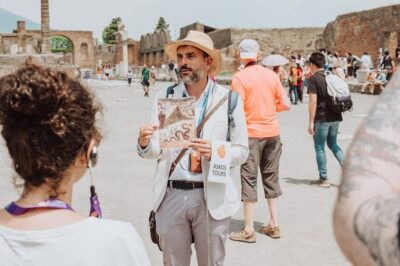
Pompeii is a huge site. You’re dealing with 66 hectares in total, with about 50 hectares excavated. If you show up with only a printed map, you can end up walking past the same walls and wondering what mattered and why it mattered.
A solid guide changes that. They connect the dots between the city’s public life, religious buildings, and private homes—so you understand the layout and the daily routines, not just the ruins. That’s the real value of a focused archaeology-led tour like this one: you get meaning, not just mileage.
And this tour is structured around visual “anchors.” You’ll see the amphitheater, the forum area, major temples, and thermal baths. You’ll also hit the houses famous for mosaics and paintings, so the art isn’t an afterthought.
Price and park tickets: what you’re really paying for
The tour price is $203.70 per person. On the surface, that’s not cheap. The reason it can still feel fair is that you’re booking a private archaeology guide for about four hours, with admissions handled for the specific stops listed as included.
But you should plan your total budget because the Archaeological Park of Pompeii ticket is separate: €20 per person. This is the one extra cost that can surprise people.
So, think of it like this:
- You’re paying for a guided, time-efficient route with expert interpretation.
- You still pay the park entry ticket separately, so your final spend is tour price + €20.
If you’re traveling as a couple or small group, private tours often make sense because splitting guide time across fewer people keeps the experience personal. If you’re traveling with teens or adults who want context, you’ll likely feel the payoff.
Meeting point at Piazza Esedra: how to start without stress
You meet at Piazza Esedra, 80045 Pompei NA, Italy, and you’ll end back at the same spot. The operator notes that, at your discretion, the tour can end at the exit of Piazza Esedra—useful if you’re trying to connect quickly with transport.
Practical tips that matter here:
- Wear comfortable clothing and shoes. You’re walking a lot on uneven surfaces.
- Bring a hat and sunglasses. Even in mild weather, the open-air ruins can feel exposed.
- Your backpack can’t be bigger than 30x30x15. Pack light enough that you can move easily.
- Service animals are allowed, and the meeting area is near public transportation.
Also, bring patience for crowds. Pompeii is popular. A guide helps most when it’s busy, because you’re not wandering in circles trying to match signage to what you want to see.
The smart flow: first stops that set the Pompeii story
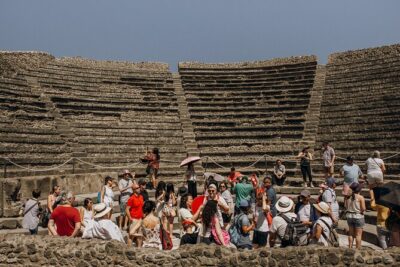
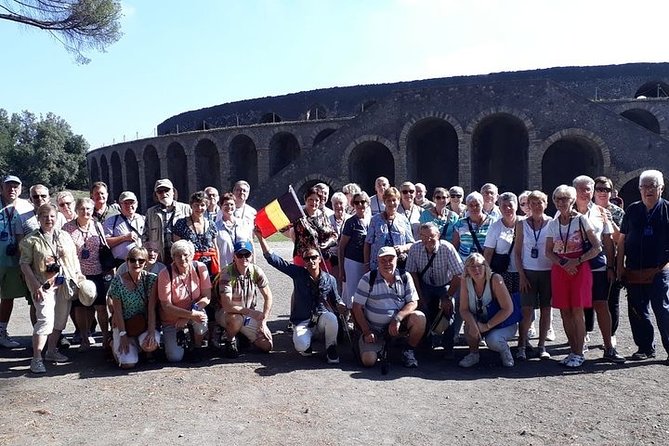
You start at the Anfiteatro Romano (Roman amphitheater), described as the oldest in the Roman world and very well preserved. This matters because an amphitheater isn’t just a cool wall of stone—you’re seeing a civic entertainment machine. Once you understand how Pompeians gathered for spectacles, the rest of the city feels more alive.
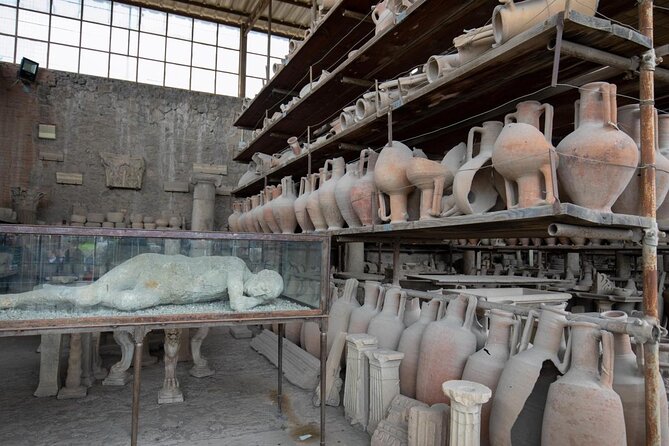
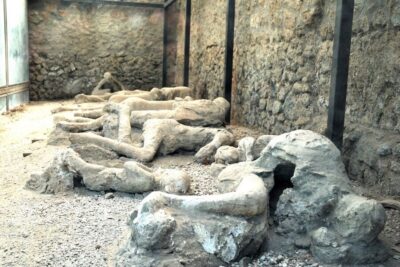
Next is the Orto dei Fuggiaschi. This is where people took refuge during the eruption. What makes it stand out is the way the area connects physical place to human survival, and the tour includes a look at the famous plaster casts. It’s emotional, but it’s also a key piece of how archaeology turns tragedy into evidence.
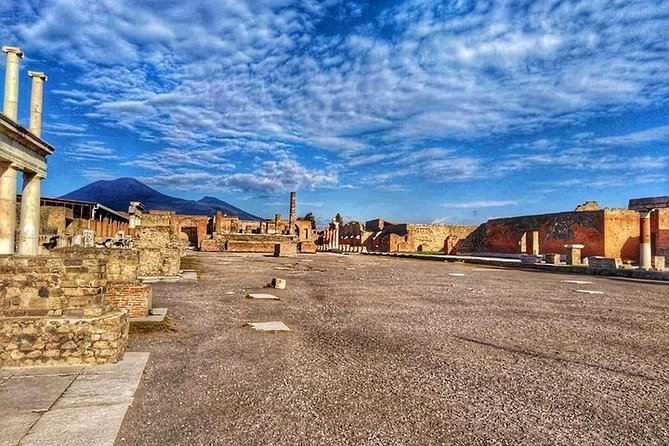
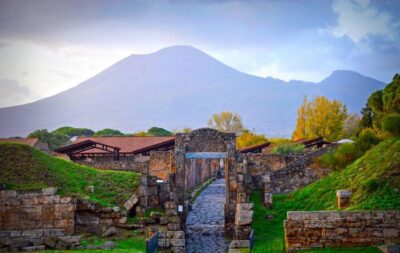
Then comes the Tempio di Giove Capitolino. The big reason to stop here is the combination of religion and viewpoint. You get a famous panoramic angle toward Mount Vesuvius—exactly the kind of framing that makes Pompeii feel like a real place, not a museum set.
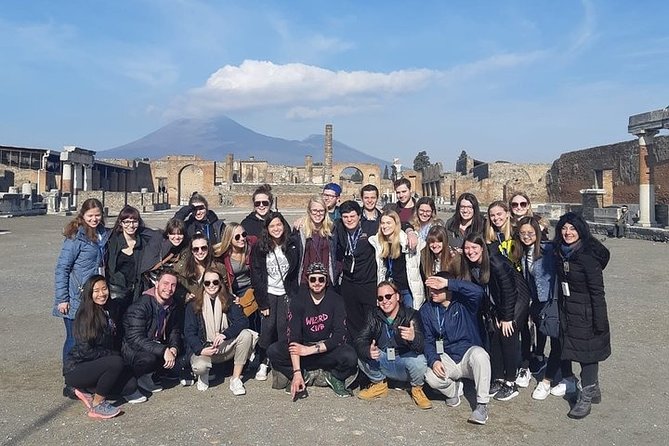
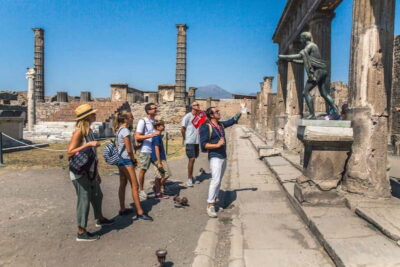
After that, you move into the city center at the Foro di Pompeya. This is the heart of Pompeii’s political, religious, civil, and economic life. You also get a dedicated photo stop with Vesuvius behind. If you love pictures, don’t skip this moment. It’s timed for a reason: it’s one of the easiest ways to visualize how the city sat under the mountain.
More guided runs around Pompeii



Casa del Fauno and Casa dei Vettii: mosaics that make you slow down
Pompeii’s private homes are where you stop thinking in ruins and start thinking in lived-in space. The tour includes a run of domus highlights, and they’re chosen for variety—size, artwork, and what they tell you about status.
You’ll visit the Casa del Fauno, described as the largest house in Pompeii, with about 32,000 square feet (the tour also references roughly 3,000 square meters later). The big draw is seeing it as a complex home with gardens and multi-color mosaics. A standout is the mosaic connected to Alexander the Great. This is the kind of art that makes you realize how connected wealthy Romans were to ideas, stories, and prestige culture.
You’ll also see the Casa dei Vettii, one of the best-preserved examples of a Roman domus. The tour notes magnificently preserved mythological frescoes and mosaics. This stop is often where the experience feels most intimate. You’re not just looking at a room; you’re looking at surfaces that once displayed identity, taste, and status.
Two other home-adjacent stops help fill in the picture:
- Casa del Cinghiale, a nearby house where you’ll see a mosaic floor featuring a wildboar image.
- House of Venus in the Shell, later on, known for its garden and a fresco showing the birth of Venus.
If you’re a photography person, this is where your camera battery earns its keep. And if you’re not, it’s still worth it because the mosaics and frescoes change your understanding of what people valued inside their homes.
Temples, theaters, and everyday Rome on Via dell’Abbondanza
Pompeii isn’t only homes and tragedy. It’s also a functioning Roman city with worship, performance, law, and commerce.
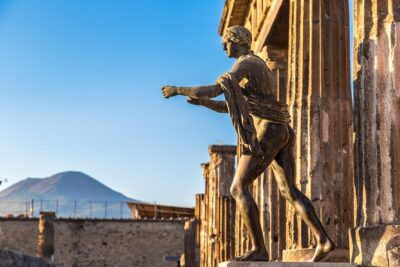
You’ll stop at the Temple of Apollo, restored not long ago in the tour description. The tour includes the idea of a sun god temple, plus its connection to Apollo’s twin sister Diana, goddess of the moon. The practical payoff is the viewpoint again—another chance to look out toward Vesuvius while you grasp the city’s sacred geography.
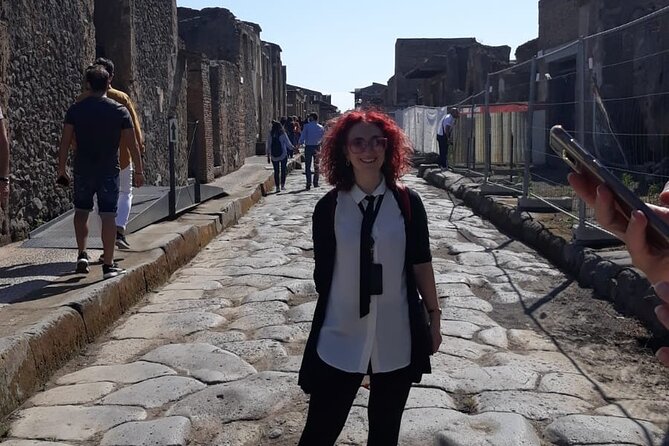
Then it’s Via dell’Abbondanza, Pompeii’s main commercial street. This is the part where you start noticing small patterns: shops, houses, and public fountains. It’s not as dramatic as the amphitheater, but it’s the most “everyday.” If you want to picture life beyond elite homes, this street helps.
You’ll also visit the Odeon – Teatro Piccolo. The tour calls out details like a precious marble floor and notes it was used for music and poetry. This is a great contrast to the big amphitheater. Here, the arts feel closer, more specific, and easier to imagine as routine entertainment.
For civic structures, you’ll include the Basilica. Don’t get distracted by the name. It’s not a religious building here—it’s an ancient Roman courthouse. You get a chance to see how law and public business worked, which makes the forum area feel less abstract.
Finally, there’s Tempio di Venere, dedicated to the main goddess of Pompeii, and placed in a panoramic location. Think of it as a last big viewpoint and a reminder that worship wasn’t tucked away. It was woven into the city’s best angles.
Stabian Baths: the Roman day spa you’ll actually remember
The Stabian Baths (Terme Stabiane) are one of the tour’s most practical stops because they help you understand Roman routines. The tour describes a typical thermal bath setup with a gym, pool, and rooms dedicated to sauna and massages.
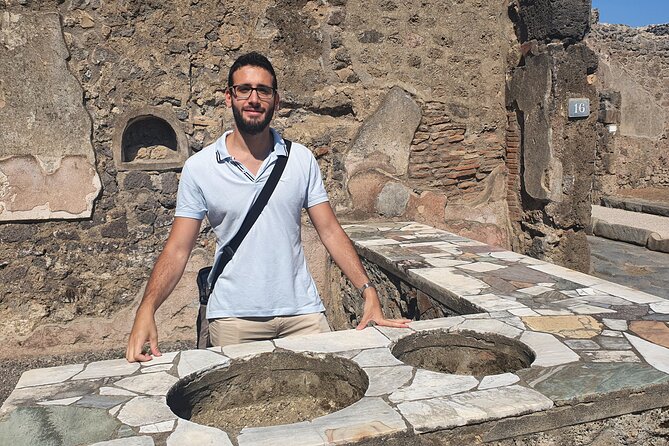
Even if you’re not thinking about bathing, this is valuable because the baths were social hubs. They were where people talked, exercised, and dealt with everyday life. When you see a complex like this, it’s easier to understand how Pompeii worked as a whole city—beyond monuments.
This stop also gives your legs a moment of different “visual rhythm.” After temples and homes, you’re walking through spaces that feel designed for movement and repeated use.
The optional Lupanar and the House of Venus in the Shell
One of the unique choices in this tour is the Lupanar. The tour says you can visit it at your discretion. It’s the House of Pleasure, and the reason it’s optional is clear: the tour description notes erotic frescoes.
If you’re traveling with kids, you might decide to skip it. If you’re an adult and you want a fuller snapshot of daily life—including the parts that were real and not polished—you can use the option. Either way, having it as a choice makes the tour feel more respectful and less one-size-fits-all.
After that, you’ll see the House of Venus in the Shell, near the amphitheater. It’s famous for its beautiful garden and for a fresco representing the birth of Venus. This is a calmer, more art-focused note to end on, especially if you want something elegant after more adult subject matter.
Who this Pompeii 360° tour fits best
This tour fits well if you want structure. Pompeii can be overwhelming. A guided route that includes amphitheater, forum, baths, temples, and major domus stops gives you a balanced cross-section in about four hours.
It also fits families in a specific way. The reviews you provided mention Martina being patient with kids and helping them understand the historical significance. So if you’ve got younger travelers, this format can work better than a long, self-guided slog.
You might want to reconsider if:
- You’re the type who needs tons of free time wandering slowly. This is a tight visit.
- You want only the biggest “icon” sites and nothing else. This tour is broad by design, so there’s less time for deep detours.
For couples, small groups, and anyone who wants a guide to turn ruins into real context, this is a strong match.
Should you book Pompeii 360°?
I think you should book it if you want a private, archaeology-led Pompeii experience that covers both public spaces and standout homes in one well-paced loop. The price only makes sense if you care about interpretation—this tour is built around expert guidance, not just access.
I’d especially book it if you value:
- Vesuvius viewpoints timed into the route
- mosaics and frescoes you can actually understand
- a stop at the Stabian Baths and the forum center, not just a quick sweep
One last callout: plan for the extra €20 park entry ticket. Do that, and you’ll walk in ready, not stuck calculating at the gate.
FAQ
Do I need to buy the Pompeii Archaeological Park ticket separately?
Yes. The Archaeological Park of Pompeii entrance fee is not included and costs €20.00 per person.
How long is the Pompeii 360° tour?
The tour is approximately 4 hours.
Is the tour private?
Yes. It is a private tour/activity, so only your group participates.
What language is the tour offered in?
The tour is offered in English.
Is the Lupanar included?
The Lupanar visit is optional. The description says you can visit it at your discretion.
What is the cancellation policy?
You can cancel for a full refund if you cancel at least 24 hours before the experience’s start time. If you cancel less than 24 hours before, the amount paid is not refunded.
More Tours in Pompeii



More Tour Reviews in Pompeii

More Pompeii Tours to Compare
More Pompeii tours, freshly reviewed



Pompeii Tours, compared.
 ★ 4.8Pompeii: Entry Ticket and Guided Tour with an ArchaeologistFrom $3519,459 reviews
 ★ 4.1Pompeii: Entry Ticket with Audio GuideFrom $4013,491 reviews
 ★ 4.8Pompeii: Small Group Tour with an ArchaeologistFrom $4012,264 reviews
 ★ 4.3Pompeii Ruins & Mount Vesuvius Day TourFrom $12011,459 reviews
★ 5.0Pompeii Small Group Tour with an ArchaeologistFrom $356,593 reviews
★ 4.3Pompeii Ruins & Mount Vesuvius Day TourFrom $12011,459 reviews
★ 5.0Pompeii Small Group Tour with an ArchaeologistFrom $356,593 reviews
 ★ 4.5Skip-the-line Pompeii – Small Group TourFrom $544,401 reviews
 ★ 4.6Naples or Sorrento: Full-Day Pompeii and Mount Vesuvius TourFrom $1044,235 reviews
 ★ 3.9Pompeii: Skip-the-line Entry Ticket with Audio Guide & MapFrom $433,153 reviews