
Review · POMPEII TOURS
Guided Tours of Pompeii Excavations Historical and Cultural Itineraries
Pompeii can feel like a blur of stones, not facts. This tour keeps it human, with a clear cultural story that moves from baths and temples to the homes where daily life played out, and it culminates at the Villa dei Misteri. I especially love how the guide frames Pompeii as Hellenistic (not just Greek or Roman), and how the route hits big architectural ideas alongside intimate house details. One possible drawback: the Pompeii entrance ticket isn’t included, so your real total cost will be a bit higher, and the pace means you will not linger forever at any single stop.
What makes it work is the format. You get a specialist guide in archaeology, history, and philosophy, and the group stays small (max 15 people), which makes questions and back-and-forth easier. The tour lasts about 4 hours 10 minutes, with roughly 25 minutes at each major site, so you get momentum without feeling rushed through everything.
In This Review
- Key highlights you’ll feel during the tour
- Why This Pompeii Tour Feels More Like a Story Than a Checklist
- Price and What $57.62 Really Buys You
- Timing and the Practical Flow of a 9:30 Start
- Pompeii’s Big Public World: Baths, Basilicas, and the City’s Power
- Venus, the Forum, and the Imperial Cult in One Route
- Terme del Foro: Wellness, Stucco, and an Egypt-Linked Detail
- Casa del Fauno and Casa dei Vettii: Art You Can Read Like a Map
- Casa degli Amorini Dorati: Mirrors, Isis, and the Domestic Sacred
- Villa dei Misteri: The Fresco Ending That Changes How You Remember the Whole Tour
- Who This Tour Suits Best (and Who Might Prefer Another Style)
- What I’d Do Differently Next Time
- Final Verdict: Should You Book This Pompeii Guided Tour?
- FAQ
- Is the entrance ticket to the Pompeii ruins included?
- How long is the tour?
- What time does the tour start, and where do I meet?
- How large is the group?
- What does the tour include?
- Is a mobile ticket provided?
- Is free cancellation available?
Key highlights you’ll feel during the tour
- Small group size (up to 15) with a guide specialized in archaeology, history, and philosophy
- Villa dei Misteri fresco (first century BC) presented as a cultural centerpiece with exceptional state of conservation
- Hellenistic Pompeii perspective: a commercial, industrial hub with connections across the wider Mediterranean world
- Memorable art moments like the bronze Daedalus statue by Igor Mitoraj at the Tempio di Venere and bronze figures of Apollo and Diana
- Baths and domestic life side by side: frigidarium and SPA-like spaces balanced with mosaics, peristyles, and wall paintings
- Classic house cycles in the fourth Pompeian style, including the Vettii’s Cupids-at-work scenes and mythological panels
Which Pompeii ticket and guide? Compare a few more.
- Pompeii Small Group Tour with an Archaeologist★ 5.0 · 6,593 reviews
- Discover the Ancient Ruins of Pompeii: Day Trip from Rome★ 3.5 · 2,247 reviews
- Pompeii and Herculaneum Small Group Tour with an Archaeologist★ 5.0 · 1,350 reviews
- Skip the Line Guided Tour of Pompeii led by an Archaeologist★ 5.0 · 703 reviews
Why This Pompeii Tour Feels More Like a Story Than a Checklist
Pompeii is easy to tour wrong. If you just hop from one site to the next, it turns into pretty pictures with no connective tissue. I like this approach because it explains Pompeii as a cultural complex that mattered across the Mediterranean. You do not only see ruins; you get the sense of what they were for, and why the city’s identity was more nuanced than the usual labels.
A big part of that is the guide’s focus on Pompeii as Hellenistic. The city wasn’t simply a Greek place that later became Roman. You’ll hear how it functioned as a large commercial and industrial center, with relationships reaching toward Asia Minor, and even farther narratives that people linked to the broader ancient world. This matters because it changes how you read the art and architecture. Temples, baths, and household spaces start to feel like parts of one living system, not separate attractions.
And then there’s the emotional framing. The eruption is often described through the lens of punishment myths and religious interpretation. This tour keeps that conversation on the table, including references to biblical-style punishment imagery such as Sodom and Gomorrah, which helps explain why later writers treated Pompeii’s end as something moral and dramatic, not only geological.
Price and What $57.62 Really Buys You
The listed price is $57.62 per person, and that’s for the guided experience. The key value point you should clock immediately: the entrance ticket to the Pompeii ruins is not included. So before you compare prices with other options, add the park admission to this total.
Now the good news. For a guided tour through a big archaeological site, you are paying for more than talking. You’re paying for:
- a specialized guide who can connect art, architecture, and cultural meaning
- a small group size (max 15), so you’re not swallowed by crowds
- a focused route designed to cover major zones without you getting lost
If you’re the type who likes explanations that make the stones click—especially about cults, daily life, and what these spaces meant—this format is a strong value. If you prefer total freedom to wander slowly on your own, then the fixed schedule might feel like a constraint. In Pompeii, I usually recommend guided time if it’s your first visit, because it helps you return later and see twice as much.
Timing and the Practical Flow of a 9:30 Start
This tour starts at 9:30 am and ends at the same meeting location on Via Villa dei Misteri, 2. The meeting point is the Porta Marina audioguide official area. It’s a good choice because you can orient yourself without a complicated scavenger hunt.
You’ll be moving through about ten major stops, with around 25 minutes at each. That schedule is intentional. Pompeii is huge, and “just one more room” turns into “we missed everything else.” Here, the pace is structured so you get:
- public buildings and temples
- bath and wellness spaces
- the major house highlights
- and then the Villa dei Misteri as a strong ending
Bring the basics that make this easier: comfortable footwear for uneven surfaces, sun protection, and a water plan. Snacks are not included, so if you think you’ll need a mid-tour boost, plan around that.
Pompeii’s Big Public World: Baths, Basilicas, and the City’s Power
The tour begins at the Pompeii Archaeological Park area, where you’ll visit the suburban baths. This is not the kind of stop people always expect first, and that’s a plus. It’s a reminder that leisure and hygiene were serious parts of Roman-and-neighboring cultures. You’ll see the frigidarium, including a nymphaeum made with glass paste and polychrome, glazed tiles. There’s also a swimming pool with Nilotic subjects—another clue that Pompeians consumed ideas from far away, not only local life.
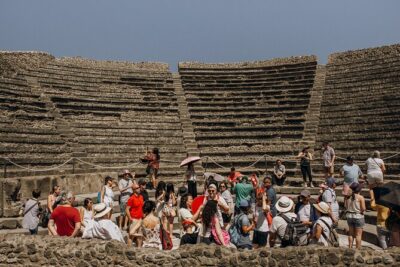
From there, the route leans into authority and civic space. At the Basilica, you’ll stand in Pompeii’s largest public building. It has three naves, and the architecture is discussed as anticipating the typology later associated with Christian basilicas. Even if you’re not an architecture nerd, the scale helps you understand the basilica’s job: a place for big gatherings, public business, and the daily machinery of the city.
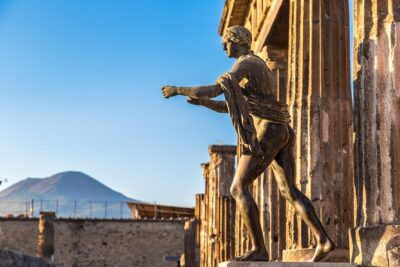
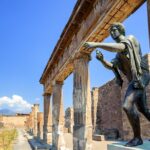
Then you shift toward worship and prophecy at the Temple of Apollo. This temple is presented through a Greek design lens, and you’ll hear how ethical and prophetic worship functioned. Two bronze statues—representations of Apollo and Diana—dominate the space. It’s a striking way to talk about religion as both belief and public life, not something tucked away.
More guided runs around Pompeii



Venus, the Forum, and the Imperial Cult in One Route
If you want a quick “who had power here?” answer, the route through the Tempio di Venere and the Forum area gives it to you.
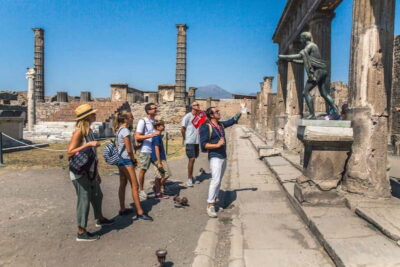
At the Tempio di Venere, the focus is the imperial cult and Venus as goddess of sailors. The temple sits on a terrace that dominates the landscape around it, which makes sense once you understand the message: this is where ideology is displayed, not just prayed. A particularly memorable modern touch is a bronze statue depicting Daedalus, by Igor Mitoraj. That contrast—ancient terrace, modern bronze—can help your brain hold onto the symbolism instead of only seeing fragments.
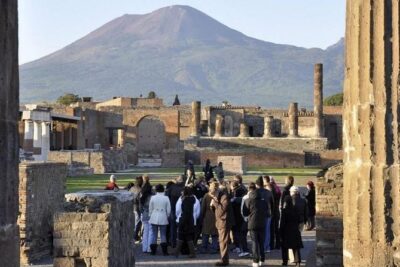
Next comes the Forum of Pompeii, described as the city’s commercial, administrative, and religious center. This is an urban complex built with grandeur in mind, and it’s dominated by the Temple of Jupiter, Juno, and Minerva. In plain terms: you’re walking through the city’s operating system. If you ever wondered where laws, taxes, public announcements, and worship overlapped, the forum is where the overlap becomes visible.
Terme del Foro: Wellness, Stucco, and an Egypt-Linked Detail
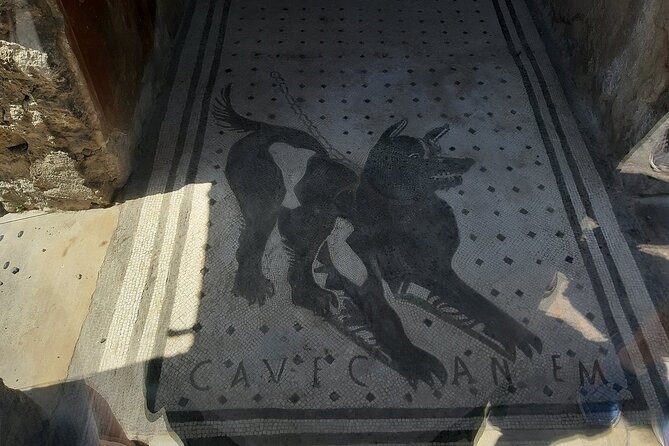
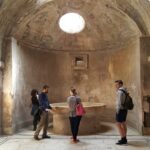
Pompeii’s baths are more than pools. The stop at the Terme del Foro is your chance to see the community’s wellness side, with a thermal complex that’s presented as perfectly preserved. The tepidarium is highlighted for stuccoes linked to the Neronian school. You’ll also notice the calidarium feature: a grand alabaster labrum said to be of Egyptian origin.
That Egyptian connection is the kind of detail that makes you realize Pompeii wasn’t isolated. People moved styles, materials, and tastes across the ancient world. Even when you’re standing in a small corner of the ruins, these hints expand the story beyond the city walls.
Casa del Fauno and Casa dei Vettii: Art You Can Read Like a Map
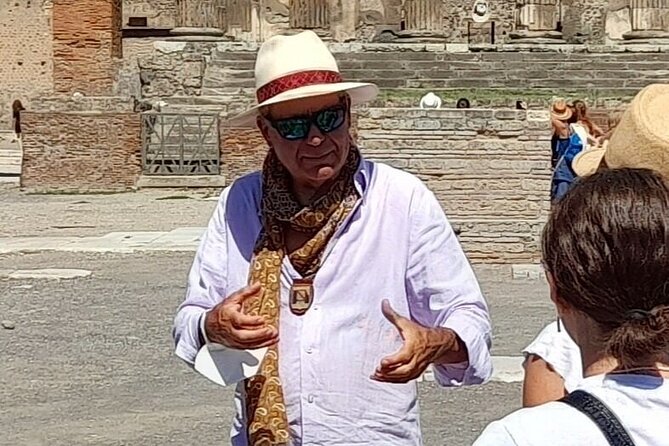
Now you get into the part that most people picture when they say Pompeii: the houses.
At the Casa del Fauno, you’ll see one of the largest palace houses, from the Hellenistic era. The highlight here is mosaic art—an excellent copy of the Battle of Issus (333 BC) showing Alexander the Great versus Darius III of Persia. It’s an important reminder: elite households didn’t just live in these homes. They curated identity through images tied to power, myth, and politics.
Then the tour goes to the Casa dei Vettii, known for frescoes in the fourth Pompeian style. The guide focuses on standout figures like Priapus from the Neronian school, and on the Hall’s production of Cupids working at tasks. That choice of subject matters. These aren’t just pretty paintings; they show how even playful myth themes could be pressed into a household’s mood and self-presentation.
You’ll also hear about the “grand pictorial cycle” of the Neronian school in the house, including mythological paintings featuring Daedalus and the Minotaur. If your goal is to understand how Greek myths were repurposed inside Roman-era domestic life, this stop makes the connection tangible.
Casa degli Amorini Dorati: Mirrors, Isis, and the Domestic Sacred
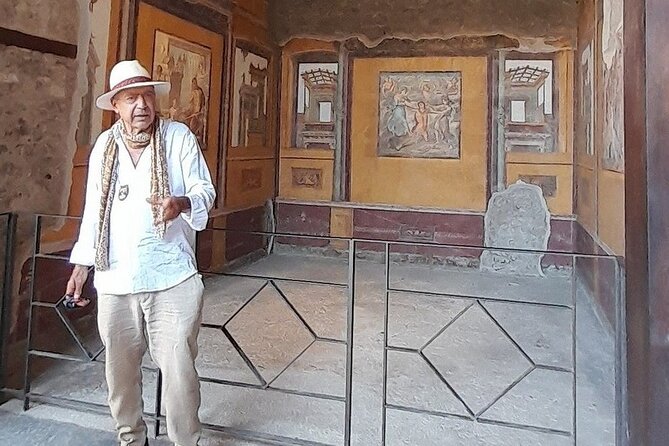
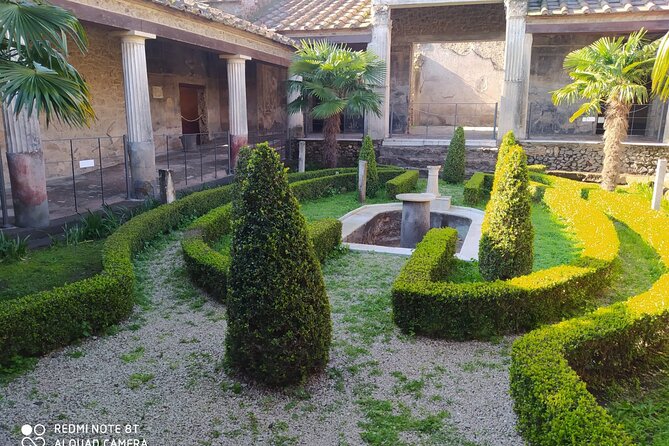
The Casa degli Amorini Dorati is where domestic life feels sharply preserved. The house is described as perfectly conserved, with a Rhodian-style peristyle. You’ll also see obsidian mirrors, which are one of those details that can stop you mid-walk because they feel so specific.
The religious layer inside a home is another key theme here. The tour points you toward a shrine dedicated to the cult of Isis and the lararium, the household protector gods. This helps you avoid a common mistake: thinking religion only lived in temples. In Pompeii, households turned belief into daily environment.
The frescoes tied to the Trojan War round out the stop. Together with the earlier house art moments, this gives you a sense of how elite identity worked. Myth wasn’t just entertainment. It was a language.
Villa dei Misteri: The Fresco Ending That Changes How You Remember the Whole Tour
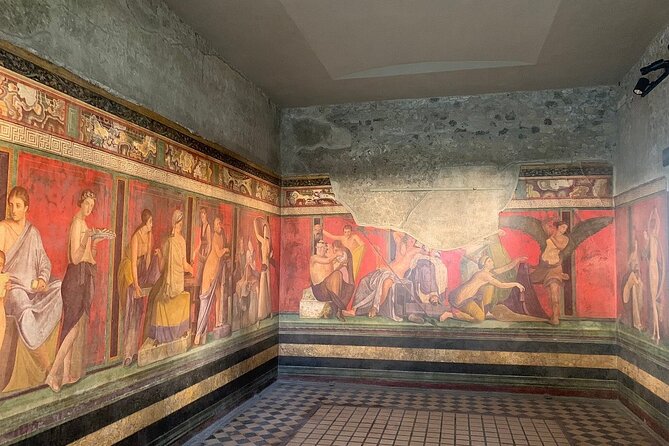
The last stop is the Villa dei Misteri, centered on the famous Dionysian fresco from the first century BC. The tour emphasizes its unique state of conservation, which is exactly why this stop works as an ending. After you’ve seen temples, baths, civic grandeur, and wealthy homes, the fresco becomes more than a single artwork. It reads like the cultural center of the day’s themes.
What the guide adds is a cultural interpretation, not just art description. The Dionysian and Isiac mystery cults are brought into the conversation, and the house setting helps you understand how ritual and belief might have felt inside a private space. This is where the earlier talk about Pompeii’s Hellenistic character can make sense. Mystery cult symbolism travels well across regions, and it shows up here as part of Pompeii’s broader connections.
By the time you reach the fresco, you’re not only looking at paint on plaster. You’re seeing a belief system that once shaped real lives. That’s the moment when Pompeii stops being scenery and starts acting like history.
Who This Tour Suits Best (and Who Might Prefer Another Style)
This tour is a great fit if you:
- want a structured first visit that covers the major Pompeii highlights without getting lost
- like interpretation that blends archaeology with cultural meaning and philosophy
- enjoy house art and temple symbolism, not only streets and monuments
- appreciate small groups (max 15) where you can actually hear and ask questions
It may not be the best match if you:
- want long, slow time in just one house or one zone
- already know Pompeii deeply and prefer total independent wandering
- don’t want to manage the extra step of buying the Pompeii ruins entrance ticket
What I’d Do Differently Next Time
If you’re planning this on a day when you also want other stops in the area, keep your expectations realistic. Pompeii rewards focus. The tour’s 4 hours 10 minutes and roughly 25 minutes per stop give you a strong overview, but it also means you’ll likely want a second visit someday if you fall in love with a particular house.
Also, plan your energy like it’s a walking day. Pompeii is a park of surfaces, steps, and uneven ground. Bring shoes you trust and water you can manage. Snacks aren’t included, so build that into your schedule.
Final Verdict: Should You Book This Pompeii Guided Tour?
Yes, I’d book this one if you want more than a photo tour. The combination of specialist guiding, small group size, and a route that connects public power, cult worship, baths, and household art makes the experience stick. The Villa dei Misteri ending is the kind of stop that gives the whole day a clear shape.
Just do one thing before you commit: budget for the Pompeii ruins entrance ticket, since it’s not included in the $57.62 price. After that, you’re set up for a very efficient, meaningful introduction to Pompeii’s most memorable corners.
FAQ
Is the entrance ticket to the Pompeii ruins included?
No. The tour price includes the guide and assistance, but the entrance ticket to the Pompeii ruins is not included.
How long is the tour?
It lasts approximately 4 hours 10 minutes.
What time does the tour start, and where do I meet?
The start time is 9:30 am. You meet at Porta Marina audioguide official, Via Villa dei Misteri, 2, 80045 Pompei NA, Italy.
How large is the group?
The tour has a maximum of 15 travelers per guide.
What does the tour include?
It includes the guide and assistance for the full duration of the tour, and the guide is specialized in archaeology, history, and philosophy.
Is a mobile ticket provided?
Yes, the tour uses a mobile ticket.
Is free cancellation available?
Yes. You can cancel up to 24 hours in advance for a full refund. If you cancel less than 24 hours before the start time, the amount paid is not refunded.
More Tours in Pompeii


More Tour Reviews in Pompeii

More Pompeii Tours to Compare
More Pompeii tours, freshly reviewed


Pompeii Tours, compared.
 ★ 4.8Pompeii: Entry Ticket and Guided Tour with an ArchaeologistFrom $3519,459 reviews
 ★ 4.1Pompeii: Entry Ticket with Audio GuideFrom $4013,491 reviews
 ★ 4.8Pompeii: Small Group Tour with an ArchaeologistFrom $4012,264 reviews
 ★ 4.3Pompeii Ruins & Mount Vesuvius Day TourFrom $12011,459 reviews
★ 5.0Pompeii Small Group Tour with an ArchaeologistFrom $356,593 reviews
★ 4.3Pompeii Ruins & Mount Vesuvius Day TourFrom $12011,459 reviews
★ 5.0Pompeii Small Group Tour with an ArchaeologistFrom $356,593 reviews
 ★ 4.5Skip-the-line Pompeii – Small Group TourFrom $544,401 reviews
 ★ 4.6Naples or Sorrento: Full-Day Pompeii and Mount Vesuvius TourFrom $1044,235 reviews
 ★ 3.9Pompeii: Skip-the-line Entry Ticket with Audio Guide & MapFrom $433,153 reviews
Browse the lists this tour appears in