
Review · POMPEII TOURS
2 Hours Pompeii Group Tour with Archaeologist Guide and Skip the Line
One of Italy’s most striking ruins, in just two hours. This skip-the-line Pompeii group tour packs the site’s big, recognizable areas into a tight loop, with an archaeologist guide bringing everyday life into focus as you walk. You start at Piazza Esedra, move through major public and private spaces, and finish back where you began.
I especially like the small group size (max 15) and the way the route hits major highlights without feeling random. I also appreciate that you’re not just looking at stones—you’ll spend time on places tied to real routines, like laundry work at the Fullonica di Stephanus, performances at both theaters, and bathing at the Stabian Baths.
One possible drawback: this is a fast highlights format. Pompeii is huge, and with only about two hours, you’ll likely want to return later if you prefer slow wandering over targeted stops.
In This Review
- Key Highlights Worth Noticing
- Why a 2-Hour Pompeii Loop Actually Makes Sense
- Price and Value: How $132.03 Fits With the 18€ Ticket
- Meeting at Piazza Esedra: Getting Your Bearings Fast
- Vicolo di Gladiatori: Gladiators Barracks in 10 Minutes
- Fullonica di Stephanus: Roman Laundry That Feels Personal
- Forum-Era Temples: Giove Capitolino, Apollo, and Venus
- Odeon (Teatro Piccolo) and Teatro Grande: Music and Big Performances
- Casa del Menandro: Luxury Home Details in a Tight Stop
- Lupanar: The Famous Brothel and Its Uncomfortable Details
- Temples, Justice, and the City’s “Main Street” Feeling
- City Market and the Temple of Apollo: Commerce Meets Religion
- Stabian Baths and Pompei 3D: Where You Get Perspective
- The Guide Factor: What Makes the Short Tour Feel Complete
- Who This Tour Is Best For (And Who Should DIY)
- Should You Book This 2-Hour Pompeii Highlights Tour?
- FAQ
- How long is the Pompeii group tour?
- Is this tour in English?
- What’s the group size?
- What’s included in the price?
- What is not included?
- Where do we meet for the tour?
- Do minors get free entry?
- What if the weather is bad?
Key Highlights Worth Noticing
- Skip-the-line ticket help so you spend less time at the ticket office and more time inside
- Archaeologist-style interpretation in English for a clearer sense of what you’re seeing
- A balanced route: gladiators, temples, theaters, homes, baths, and daily-life spaces
- Two “wow” stops that many first-timers love: the Lupanar frescoes and Pompei 3D
- Most stops include standing time rather than long museum-style pacing, which helps when you’re limited to 2 hours
- Guides matter here, and named guides from recent groups (like Eliana Sandretti, Mariagrazia, and Luisa) are praised for turning ruins into stories you can picture
Which Pompeii ticket and guide? Compare a few more.
- Pompeii Small Group Tour with an Archaeologist★ 5.0 · 6,593 reviews
- Discover the Ancient Ruins of Pompeii: Day Trip from Rome★ 3.5 · 2,247 reviews
- Pompeii and Herculaneum Small Group Tour with an Archaeologist★ 5.0 · 1,350 reviews
- Skip the Line Guided Tour of Pompeii led by an Archaeologist★ 5.0 · 703 reviews
Why a 2-Hour Pompeii Loop Actually Makes Sense
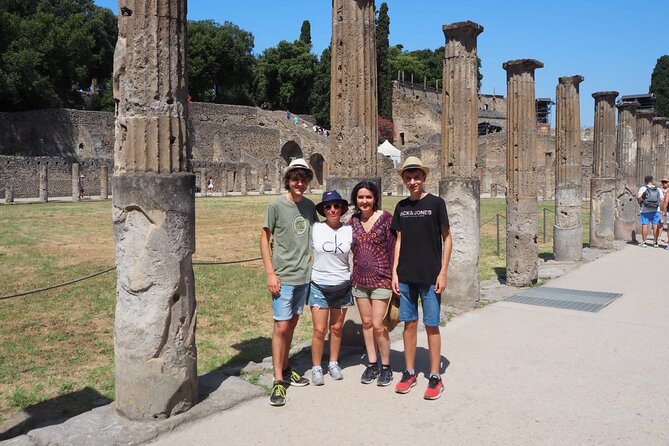
Pompeii can overwhelm you fast. The streets stretch, the buildings stack, and every corner looks important. This tour makes a smart promise: you get the main attractions in about two hours, paced in a way that’s meant for first-time visitors.
The big win is the structure. You’re not wandering and guessing. A guide leads you stop to stop—Vicolo di Gladiatori, laundry spaces, forum-area temples, two theaters, a luxury house, the Lupanar, baths, and a 3D stop—so you leave with a grounded sense of how the city was laid out.
And because it’s a group tour capped at 15 people, it’s easier to hear the guide and keep your place. In Pompeii, that matters. Loose groups spread out, and then you end up reading signs without understanding them.
Price and Value: How $132.03 Fits With the 18€ Ticket
The listed price is $132.03 per person, and the entrance ticket is extra (18€ for adults, free for minors). That means you’re paying for more than the ability to enter—you’re paying for a guide and the time-saving ticket process.
Here’s how I think about value on this one:
- You get an authorized guide for the full duration and a focused route.
- You get skip-the-line help for ticket purchase, which can be the difference between enjoying Pompeii or standing around waiting.
- You visit a lot of the most famous and visually strong spaces in a short span: theaters, baths, a luxury home, and the Lupanar.
If you were to DIY the same set of stops, you’d still need tickets and you’d likely spend time figuring out what to prioritize and how everything connects. Paying for an archaeologist-style guide is often worth it when your schedule is tight—like when you only have a half-day in the area.
One note for budgeting: minors are free with the right identification (an identity card is required, according to the tour details).
Meeting at Piazza Esedra: Getting Your Bearings Fast
The tour meets at the main entrance of the Ristorante Suisse in Piazza Esedra (10/13, Pompeii). The organizer notes that it ends back at the same meeting point.
That location is convenient because it’s a straightforward “anchor point” for a short, guided loop. You’re also close to public transportation (the tour lists it as near public transportation), which helps if you’re pairing Pompeii with other stops in the region.
The tour uses a mobile ticket, which is handy if you’re trying to travel light and keep everything on your phone. And since you get skip-the-line to purchase tickets on site, your first minutes in Pompeii are more likely to turn into walking—not queueing.
Vicolo di Gladiatori: Gladiators Barracks in 10 Minutes
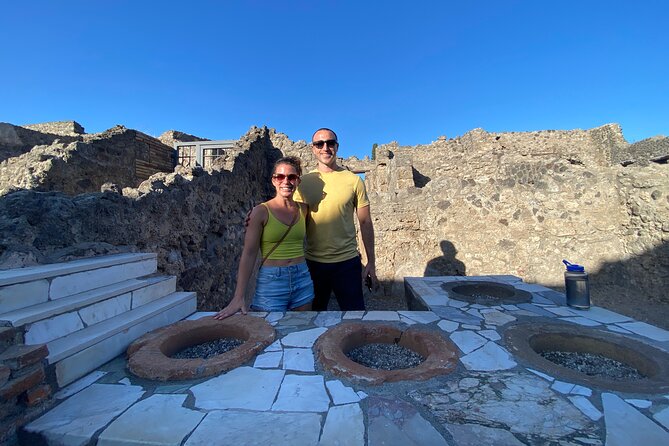
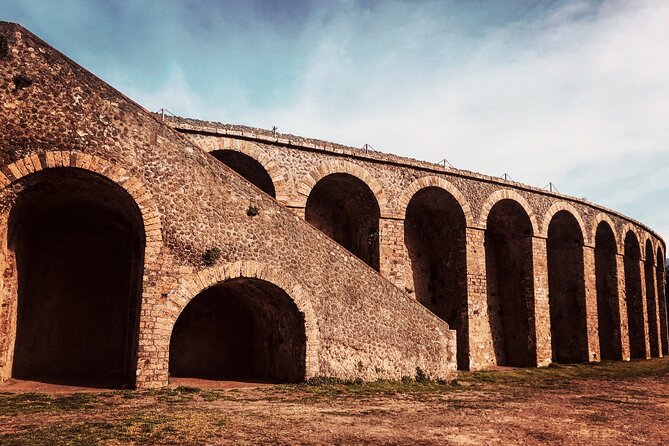
Your first stop is Vicolo di Gladiatori, described as the gladiators’ barracks—where they trained and fought. It’s one of the most evocative areas in Pompeii, and even in a short time, it helps set the tone for the rest of the city.
In practical terms, this is a good early stop because:
- you’re primed for the story of Pompeii after you enter
- the setting is visually recognizable, so you can connect the guide’s explanations quickly
- it gives you a “character” feel for the ruins before you move into more everyday spaces
Potential drawback: if your group is sensitive to intensity, this isn’t a gentle intro. It’s tied to training and combat, so keep that in mind if you’re traveling with young kids and prefer softer stops first.
More guided runs around Pompeii



Fullonica di Stephanus: Roman Laundry That Feels Personal
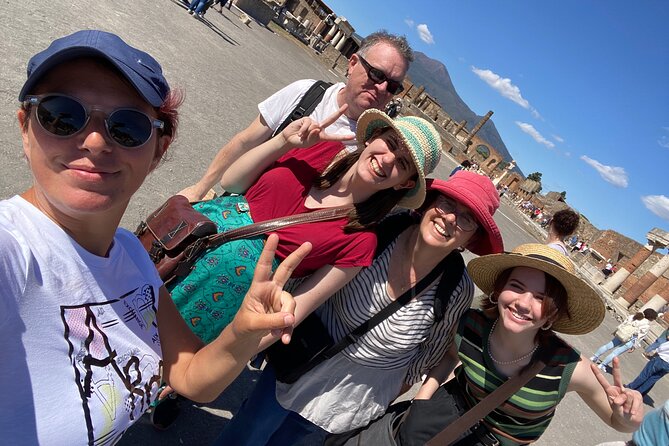
Next up is the Fullonica di Stephanus, called the most famous laundry in Pompeii. The tour frames it around washing clothes and roughing fabrics—basically, the behind-the-scenes labor that kept daily life running.
This stop works well because it answers a question you might not ask on your own: what did people actually do all day? A laundry isn’t just a building. It’s workflow—materials, methods, and repeated effort.
You’ll spend about 10 minutes here, which is just enough time to understand the function without rushing too much. If you like “how it worked” explanations, this is one of the stops that tends to stick with people.
Forum-Era Temples: Giove Capitolino, Apollo, and Venus
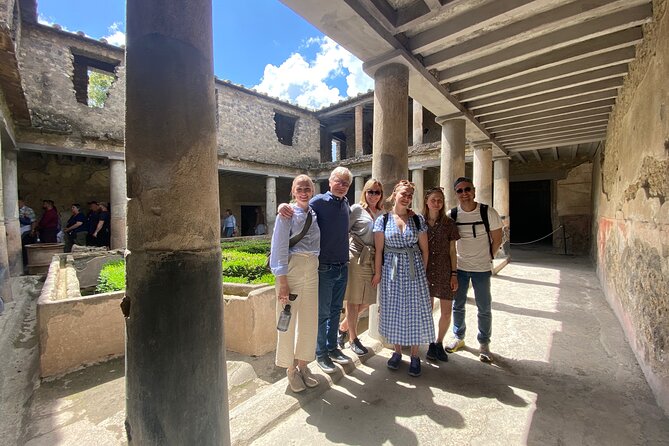
The itinerary includes temple spaces connected to religion and the forum-area daily rhythm.
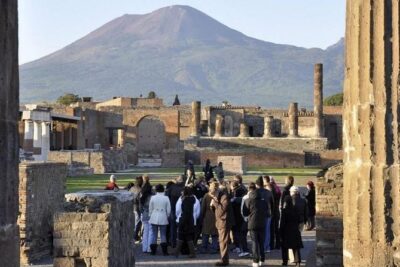
You’ll visit the Tempio di Giove Capitolino (around 5 minutes), located in the large forum area where the Romans carried out mercantile and cult activities. Even with the short timing, a forum-adjacent temple stop is useful because it shows how civic life and religious life were tied together.
Later, the route also includes:
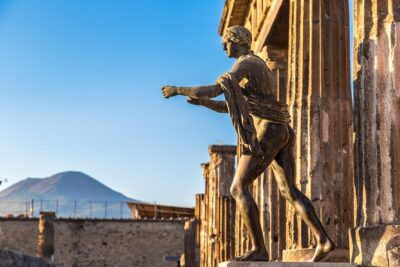
- Temple of Apollo, noted as one of the most popular in Pompeii
- the Temple of Venus, described as partly destroyed during the Second World War
How to approach these stops: don’t just look at columns or fragments. Pay attention to what the guide is connecting—where these spaces sat relative to everyday activity. That’s the difference between “cool ruins” and “I understand how the city functioned.”
Possible consideration: temple stops are short on time (some are only a few minutes). If you’re hoping for lots of slow photo time at each sacred spot, you may feel slightly compressed.
Odeon (Teatro Piccolo) and Teatro Grande: Music and Big Performances
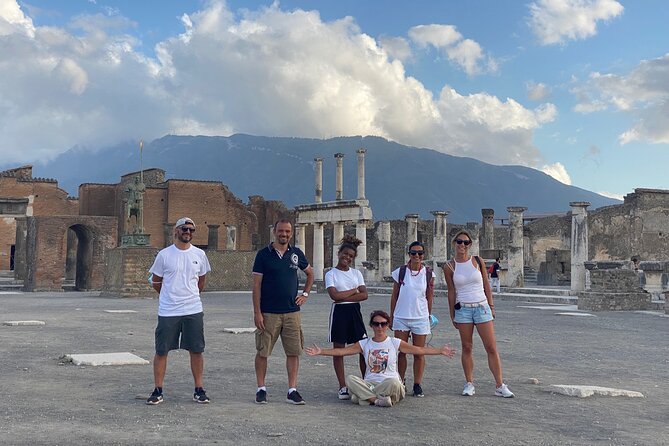
You’ll then move into the entertainment side of Pompeii, with two major theater stops.
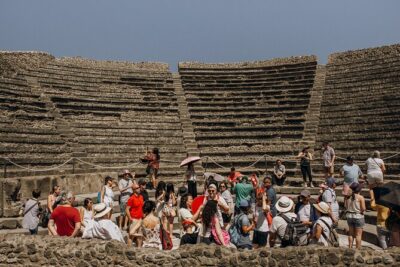
First is the Odeon – Teatro Piccolo, a theater for musical events, with the added detail that musical instruments were found inside and are currently in the Antiquarium. This stop is more than architecture—it’s a reminder that performances were part of regular culture.
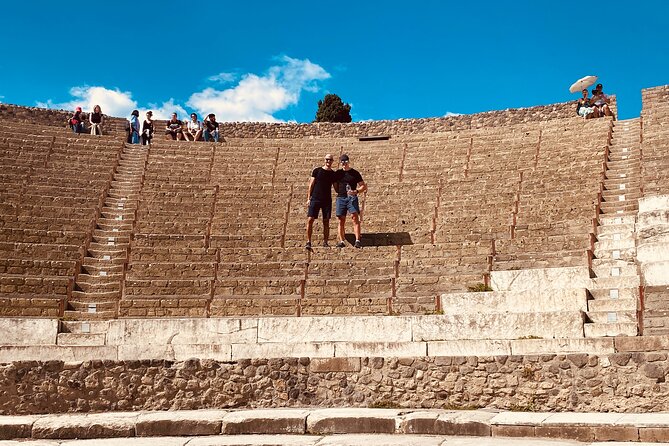
Then you’ll visit the Teatro Grande, the largest theater in Pompeii. The tour notes that it was totally renovated thanks to grants of the gens Holconia, one of Pompeii’s important families.
Why I like this pairing: it gives you scale. You see how music and drama fit together in different venue sizes. In a short tour, that kind of contrast helps your brain build a mental map of the city’s “public life.”
If you’re someone who reads well from visual cues, theaters are a great choice. If you prefer quiet spaces, these stops can be busier—because theaters attract cameras.
Casa del Menandro: Luxury Home Details in a Tight Stop
The tour includes Casa del Menandro, presented as a luxury house with frescoes, decorations, and sculptures. This is a key change of pace: you go from public spaces into private lifestyle.
You’ll have about 15 minutes here, which matters. It’s long enough to notice decorative themes and connect them to the idea of wealth and domestic display—without turning into a museum-style slow crawl.
One practical thought: frescoes and small details can be harder to see from a crowd. In a group of up to 15, you’ll do better if you keep moving to slightly different viewing angles when the guide pauses.
Lupanar: The Famous Brothel and Its Uncomfortable Details
Next is the Lupanar, one of the best-known brothels in the world, where you can see original frescoes with scenes described in the tour details as scenes from the kamasutra.
This stop is not subtle. It’s also part of why Pompeii feels so real: it includes everything, not just the polished or dignified parts of city life.
Why it’s included in a highlights tour:
- It’s instantly recognizable as a major Pompeian site.
- It shows how art and daily life intersected, even in spaces we’d consider taboo.
- It often creates strong memories because it’s so specific and visual.
Consideration: if you’re traveling with kids or you have a low tolerance for adult-themed content, you’ll want to think about whether this stop is right for your group.
Temples, Justice, and the City’s “Main Street” Feeling
After Lupanar, you head back into civic structures and everyday movement.
You’ll visit Pompei La Basilica, described as the place where justice was administered, located near the main square. The tour gives about 15 minutes for this stop, which makes sense—justice-administration spaces help explain the city’s governance and public order.
Then you’ll pass:
- a street full of shops, described as the main street of the archaeological site
- “one of the streets of Pompeii” (time not specified in the provided details)
This portion is valuable because it changes your mindset from “site-viewing” to “city-walking.” When you move along commercial streets, you start imagining how people traveled between temples, markets, theaters, and housing.
Practical advice: take a moment to look at the space between buildings and doorways, not just at signage or fragments. Pompeii’s layout is the point here.
City Market and the Temple of Apollo: Commerce Meets Religion
The route also includes the city market, located near the large forum. The tour description notes that it was where large purchases of goods took place so they could be resold in shops.
That matters because it’s a direct link between the “big” forum life and the shopping streets you walked right after. You’ll see how commerce wasn’t separate from public life—it was woven in.
And then you’ll include the Temple of Apollo, described as one of the most popular in Pompeii. When you connect markets to temples, you get a fuller sense of daily rhythm: buy, sell, worship, return to life.
Stabian Baths and Pompei 3D: Where You Get Perspective
Two stops near the end help you understand Pompeii beyond what your eyes can do in a short walk.
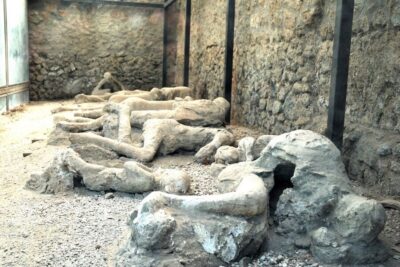
First are the Stabian Baths (Terme Stabiane), described as the first baths built in Pompeii, with casts and frescoes still present. You’ll have about 15 minutes.
Then there’s Pompei 3D (Bodies of Pompeii) for about 5 minutes.
Why this pairing works:
- Baths give you a vivid, human-scale routine—something daily, physical, and social.
- The 3D stop adds context in a different format. Even with only five minutes, it can help you grasp the scale and the emotional punch of Pompeii’s story when you’re surrounded by fragments.
One consideration: five minutes at 3D is brief by design. If you prefer longer interpretation time, you might want extra time after the tour to revisit the area independently.
The Guide Factor: What Makes the Short Tour Feel Complete
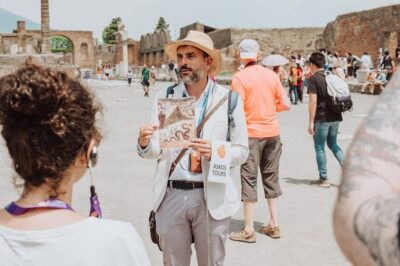
A two-hour route lives or dies on the guide. The tour details say it’s led by an authorized tourist guide and an archaeological guide, with many groups describing guides who tell stories clearly.
Names that come up include Eliana Sandretti (the listed provider) plus guides like Mariagrazia and Luisa. Across these guides, the common thread is plain: they connect sites to daily life, answer questions, and help the group keep moving without getting stuck in the thickest crowds.
In one example from a scientific group, the guide was praised for organizing the tour to avoid clashing with large tourist crowds while still seeing maximum highlights. That’s exactly what you want on a short schedule.
If you’re bringing kids, look for a guide who can handle real-world issues like heat and pacing. One guide (Luisa) was praised for being patient with young children, which is a big deal in Pompeii where standing and walking can wear people down.
Who This Tour Is Best For (And Who Should DIY)
This tour is a strong match if:
- you’re visiting Pompeii for the first time and want the main attractions in about two hours
- you prefer a structured walk over choosing stops yourself
- you want help understanding what you’re seeing, in English
- you care about minimizing waiting time via skip-the-line ticket purchase
You might consider a DIY plan instead if:
- you want to linger for long at individual sites
- you’re the type who likes reading every sign without a guide steering you
- you’re specifically focused on one area (for example, only temples, or only baths), and two hours feels too short
This isn’t a “sit down and study” experience. It’s a highlights sprint with context.
Should You Book This 2-Hour Pompeii Highlights Tour?
Yes, I’d book it if you want a smart, time-efficient first look. The combination of skip-the-line help, a small group, and a stop list that covers public life (forum temples, basilica), culture (theaters), daily routine (laundry, baths), and the more surprising corners (Lupanar) means you’ll leave with a coherent Pompeii picture—not just random ruins.
Skip it if you’re set on slow, detailed exploration. This is designed for a short window, and it keeps moving. If you can, plan a longer second visit later, so the stones you missed can become stories you actually have time to absorb.
FAQ
How long is the Pompeii group tour?
The tour runs for about 2 hours.
Is this tour in English?
Yes, the tour is offered in English.
What’s the group size?
The tour has a maximum of 15 travelers.
What’s included in the price?
The tour includes skip the line to purchase tickets on site, an authorized tourist guide, and assistance for the entire duration, plus a group tour focused on Pompeii’s main attractions.
What is not included?
The entrance ticket (18 euros for adults; free for minors with an identity card), plus food and beverages, transport, and tips are not included.
Where do we meet for the tour?
Meet at the main entrance of Ristorante Suisse in Piazza Esedra (10/13, 80045 Pompei NA, Italy). The tour ends back at the same meeting point.
Do minors get free entry?
Yes. The entrance ticket is free for minors as long as they bring an identity card.
What if the weather is bad?
The tour notes that it requires good weather. If it’s canceled due to poor weather, you’ll be offered a different date or a full refund.
If you tell me your travel dates and whether you’re going with kids or adults who want adult-content details, I can suggest whether this route’s pacing and the Lupanar stop are likely to feel right for your group.
More Tours in Pompeii



More Tour Reviews in Pompeii

More Pompeii Tours to Compare
More Pompeii tours, freshly reviewed



Pompeii Tours, compared.
 ★ 4.8Pompeii: Entry Ticket and Guided Tour with an ArchaeologistFrom $3519,459 reviews
 ★ 4.1Pompeii: Entry Ticket with Audio GuideFrom $4013,491 reviews
 ★ 4.8Pompeii: Small Group Tour with an ArchaeologistFrom $4012,264 reviews
 ★ 4.3Pompeii Ruins & Mount Vesuvius Day TourFrom $12011,459 reviews
★ 5.0Pompeii Small Group Tour with an ArchaeologistFrom $356,593 reviews
★ 4.3Pompeii Ruins & Mount Vesuvius Day TourFrom $12011,459 reviews
★ 5.0Pompeii Small Group Tour with an ArchaeologistFrom $356,593 reviews
 ★ 4.5Skip-the-line Pompeii – Small Group TourFrom $544,401 reviews
 ★ 4.6Naples or Sorrento: Full-Day Pompeii and Mount Vesuvius TourFrom $1044,235 reviews
 ★ 3.9Pompeii: Skip-the-line Entry Ticket with Audio Guide & MapFrom $433,153 reviews
Browse the lists this tour appears in