
Review · HERCULANEUM TOURS
Private Herculaneum for Families: Kids Archaeology Adventure
Herculaneum feels like a town frozen in time. I love how this private family tour turns preserved Roman details into kid-friendly clues, and I also like that the guide-style here is built around keeping children focused with playful, age-appropriate activities. The biggest watch-out is simple: you do a decent amount of walking, and even with a great guide, little legs can get tired fast.
You get a compact, high-impact visit to one of the best-preserved Roman towns anywhere, plus take-home extras like a site map and a Herculaneum4Kids package. This is a private experience for your group only, in English, with flexible pickup options from the Ercolano area and a mobile ticket for day-of ease.
In This Review
- Key highlights you’ll feel right away
- Why Herculaneum clicks for families (and why it feels different from Pompeii)
- Private family guide energy: how the visit stays fun instead of lecture-y
- Getting there: Ercolano pickup, meeting point, and what to bring
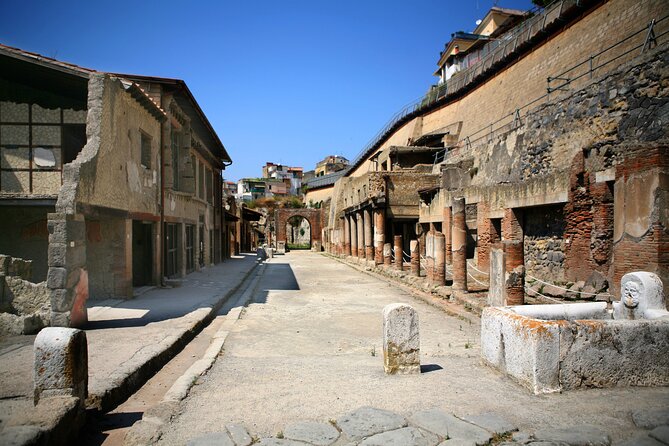
- Parco Acheologico Di Ercolano: the “frozen neighborhood” effect
- Vesuvius views: learning the eruption story without the doom-and-gloom
- Antiquarium: charred wood that turns history into a real object
- Boat Pavilion: Herculaneum as a seaside town, not just a city of walls
- Houses that teach status and style: Casa dei Cervi and Casa di Nettuno e Anfitrite
- Palestra and Women’s Baths: ancient fitness and ancient social life
- Ad Cucumas and the Thermopolium: ancient food and shopping cues kids understand
- Casa del Bicentenario: charred wood with legal paperwork clues
- Sacello Augustali: religion tied to civic identity
- Casa del Tramezzo di Legno and Casa dello Scheletro: rare wood and a mystery name
- The ancient shoreline and the skeleton chambers: history that asks for care
- Value and practical takeaways: is the $221.70 price fair?
- Should you book this private family Herculaneum tour?
- FAQ
- How long is the private Herculaneum for Families tour?
- What does the tour cost?
- Is the tour private, or is it shared with others?
- Is pickup available?
- Is admission included?
- What language is the tour in?
- What’s the meeting point?
- What kind of fitness level is needed?
- What should I wear or bring?
- What’s the cancellation policy?
- Can service animals join?
Key highlights you’ll feel right away
- Private, Blue Badge–accredited guide who can tailor explanations for adults and kids
- Herculaneum4Kids package plus a keepsake site map so learning doesn’t stop when you leave
- Vesuvius viewing moments that help kids grasp what happened in AD 79
- Preserved wood and charred materials that make history feel real, not abstract
- A mix of homes, baths, gym space, shops, and the shoreline so every age stays interested
- A walkable site layout compared with bigger ruins, with plenty of visual “spotting” for children
Herculaneum keeps a few more tours worth your time
- Herculaneum: Skip-the-Line Guided Tour with Archaeologist★ 4.8 · 3,439 reviews
- Herculaneum Small Group Tour and Ticket With an Archaeologist★ 5.0 · 994 reviews
- Herculaneum: Skip-the-Line Entry Ticket with Audio Guide★ 4.3 · 870 reviews
- From Naples: Pompeii & Herculaneum with Archaeologist Guide★ 4.8 · 665 reviews
Why Herculaneum clicks for families (and why it feels different from Pompeii)
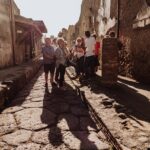
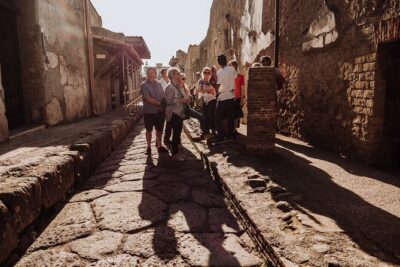
Herculaneum is the kind of place where your brain understands fast. The streets are tight, buildings sit close together, and you can picture everyday life without needing a big imagination budget. That matters with kids. When the environment is easy to follow, you spend less time saying wait, stay close, and more time noticing details.
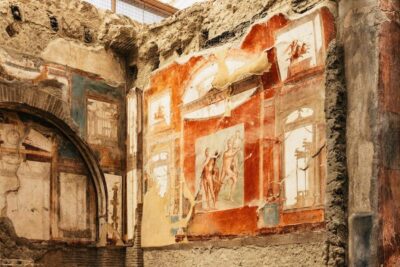
The other reason it works is preservation. Where Pompeii often feels like stone shells, Herculaneum can feel lived-in. Volcanic material covered the town in AD 79, protecting far more than just walls. You see evidence of daily routines through things like mosaics, painted surfaces, and surprisingly intact materials. It’s the difference between touring ruins and investigating a neighborhood.
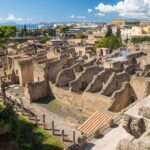
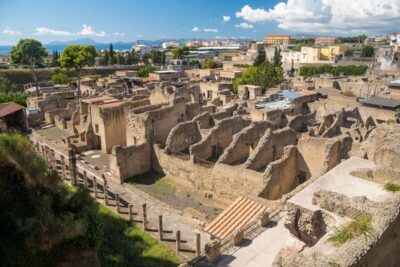
One practical note: you’ll still do a good walk. The good news is that Herculaneum’s footprint is compact enough that a smart guide can keep everyone moving without turning it into a slog.
Private family guide energy: how the visit stays fun instead of lecture-y
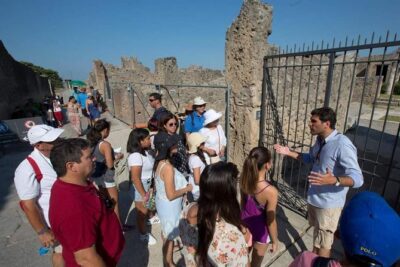
This is a private tour, so you’re not stuck listening to a one-size-fits-all script. The guide for your group is Blue Badge–accredited, and that professional framework shows up in how the explanation is paced.
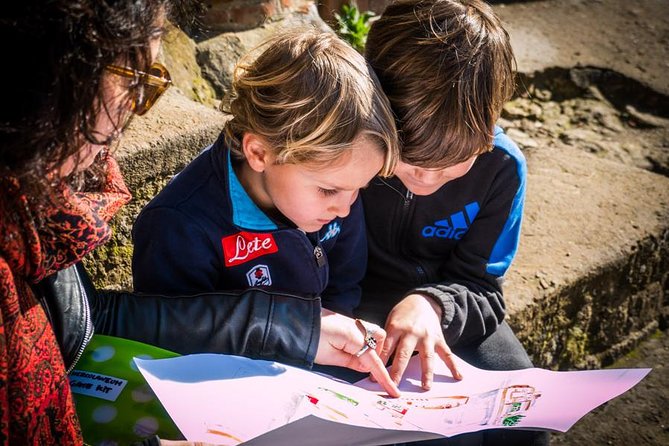
In particular, I like how this kind of family-focused archaeology approach uses quick activities and “find it” moments rather than long speeches. The goal is to keep kids curious while still giving adults real context. It’s also why different ages usually do well together: kids get tasks and surprises, and adults get clear connections to Roman daily life.
I’ve seen this work with families where a 4-year-old needs frequent hooks, and with older kids who can handle more details. It’s not magic. It’s planning, timing, and a guide who knows how to pitch the story.
Getting there: Ercolano pickup, meeting point, and what to bring
The meeting point is in 80056 Ercolano. Pickup is flexible, and the tour notes that pickup is included in the premium option. Either way, plan to meet at the agreed location and expect the tour to end back where it began.
Practical packing matters here. Wear appropriate shoes. The route is on archaeological surfaces, so good grip is worth it. If you’re visiting from May to September, bring sun protection. A hat and water are not optional if you want everyone to stay cheerful.
The tour also says moderate physical fitness is best, and service animals are allowed. It’s near public transportation too, in case you’re not using the pickup option.
Parco Acheologico Di Ercolano: the “frozen neighborhood” effect
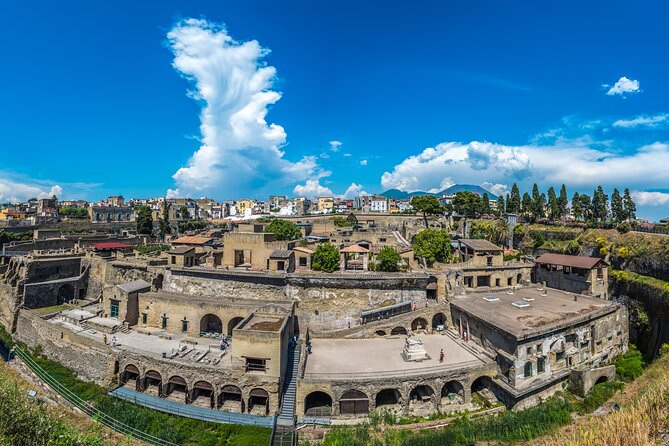
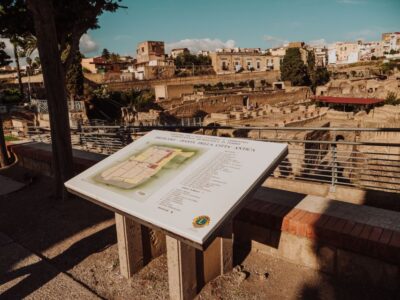
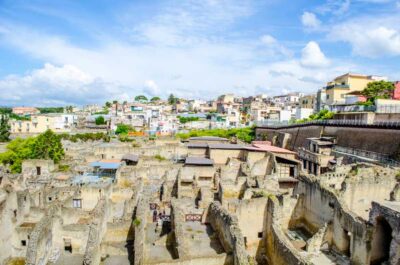
You start at the Parco Acheologico Di Ercolano. This is where the experience clicks into place. Herculaneum feels like a Roman neighborhood paused mid-life. Because the town is compact, you can move from one scene to the next without losing the thread.
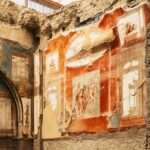
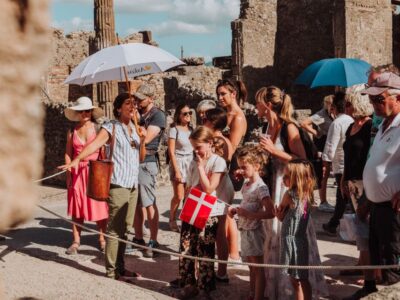
A big win for families: your guide can point out details that kids spot naturally. Children often zero in on visual patterns and small elements adults miss, like decorative figures, everyday shop features, and household clues. That makes the ruins feel like a place where people actually lived, not an abstract set of artifacts.
Admission is included for the main archaeological segment (the tour notes about 2 hours for this stop). That’s good value because you’re not paying extra on top of the guide cost.
What to consider: since you’re walking through multiple rooms and outdoor pockets, it’s smart to keep an eye on your kids’ energy level. If you know your child gets cranky mid-morning, plan for water breaks and a slower pace when needed.
Rather go private? More options in Naples



Vesuvius views: learning the eruption story without the doom-and-gloom
On the way in, you’ll often get views of Parco Nazionale del Vesuvio, the protected landscape around the volcano. Seeing Vesuvius first helps you explain what’s coming. Kids usually understand scale quickly when they can match the mountain they’re seeing to the town under it.
Once inside the site area, the volcano can still be visible in the background. That visual anchor helps kids grasp the timeline of AD 79 without a complicated lecture. It’s one of those rare moments where nature and archaeology cooperate.
I also like that this doesn’t just become a history detail. It becomes a tool. When your guide points to preservation and volcanic layers, the explanation makes sense because you’ve already “met” Vesuvius.
Antiquarium: charred wood that turns history into a real object
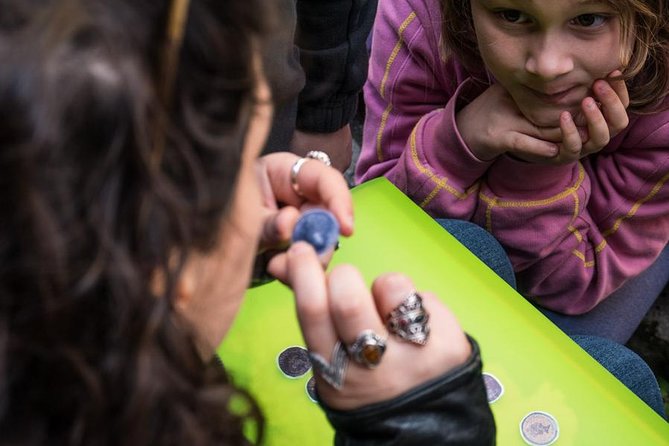
The Antiquarium is a smart early stop. Instead of dropping you into houses first, you get a guided introduction with objects that connect to everyday life: jewelry, coins, writing tools, household items, and children’s belongings.
The standout feature here is preserved charred wood. You might see wooden elements from furniture and architectural fragments that survived because the intense heat carbonized organic materials. Kids tend to find this unforgettable. The idea that those blackened pieces are still real wood, nearly two thousand years old, makes the archaeology feel tangible.
Adults often appreciate the “why” here. Preservation isn’t luck. It’s the result of a specific kind of burial. When you understand that, you read the site differently.
Boat Pavilion: Herculaneum as a seaside town, not just a city of walls
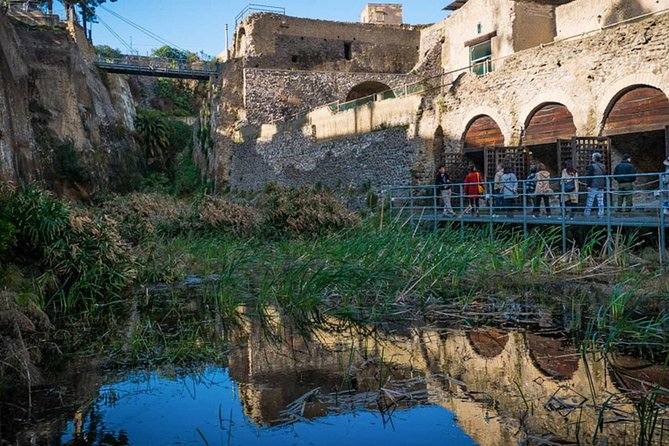
The Boat Pavilion is one of the most surprising stops for families. You’ll see a remarkably preserved Roman boat, along with tools and equipment connected to sailors. Even if your kids don’t care about ancient shipping, the idea clicks: Herculaneum was connected to trade and travel through the Bay of Naples.
It’s also a great pacing stop. You can slow down, look closely, and let kids ask questions. Adults get a break from the walking while still learning something concrete and distinctive.
The emotional undercurrent here is subtle but real. The preservation ties the story to the eruption, but the boat points to normal life before the disaster.
Houses that teach status and style: Casa dei Cervi and Casa di Nettuno e Anfitrite
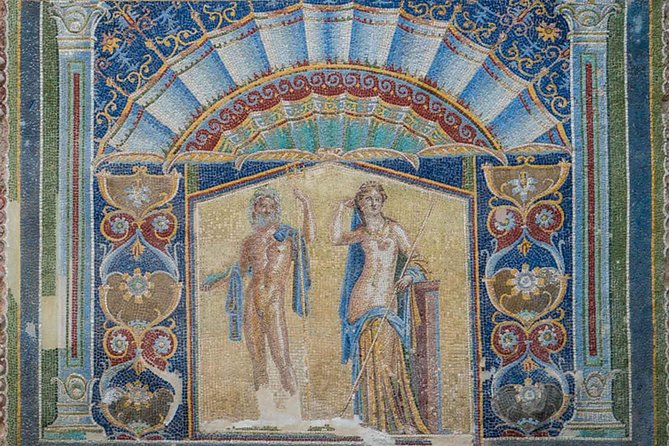
Herculaneum’s residential houses are where kids learn that ancient Romans were not all the same. Different houses reflect different wealth, interests, and social habits.
Casa dei Cervi is known for an elegant courtyard and marble statues of stags attacked by hunting dogs. The scene is dramatic, and it often helps children remember the house because it’s visually clear. You also get a sense of refinement through marble details, painted surfaces, and the layout itself.
Then you move to Casa di Nettuno e Anfitrite, celebrated for its mosaic featuring Neptune and Amphitrite. Kids often pause for color and pattern. Adults often enjoy understanding how myth connects to everyday identity. Roman mythology wasn’t just for stories. It showed up in homes as decoration and self-expression.
A drawback to keep in mind: houses can be visually packed. If your child is easily distracted, ask your guide to focus on the “must-see” features first. A good guide can do that without making you feel rushed.
Palestra and Women’s Baths: ancient fitness and ancient social life
Next up are spaces that make Roman daily life feel oddly familiar: exercise and bathing.
The Palestra (ancient gymnasium) shows how young people trained and socialized. A courtyard once hosted games and training, while shaded porticoes offered space to rest and talk. Kids usually love the idea that Roman teenagers trained in a sports-like setting, even without modern equipment.
Then the Women’s Baths give you a clear window into cleaning, relaxation, and conversation. You’ll move through changing areas, warm rooms, and hot rooms, noticing mosaic floors, marble benches, and the heated system under the floors. Even if you’ve never studied ancient engineering, the sequence is easy to follow.
Parents often like that the baths feel almost like a spa routine. It helps kids picture a day that included work, meals, and social downtime. And because it’s a “process” route, it’s easier for children to follow than a single room with lots of background noise.
Ad Cucumas and the Thermopolium: ancient food and shopping cues kids understand
Two stops can feel surprisingly modern: the Thermopolium and the painted shop façade advertisement.
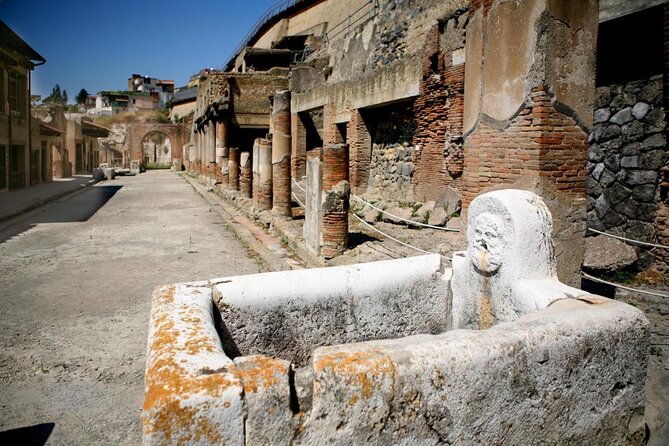
At the Thermopolium, you see a Roman street-food counter. Hot meals were served from large terracotta jars set into a decorated countertop. Kids tend to catch on instantly because the concept is recognizable: grab food fast, talk while you eat, move on. Parents get a lesson in how urban life worked without home refrigeration or global supply chains.
Nearby, the tour includes a charming detail: the Ad Cucumas wine advertisement painted directly onto a shop façade. Kids like spotting symbols and guessing what they mean. Adults often enjoy the point that marketing and daily commerce were already part of the street scene. No printed menus needed.
If your kids love “spotting games,” these are excellent moments. If they get tired of rules and explanations, these stops often bring them back to life because the objects are front-and-center and visual.
Casa del Bicentenario: charred wood with legal paperwork clues
Casa del Bicentenario is one of the more impressive residential buildings in the set. It’s organized around a central courtyard, hinting at both family life and social entertaining.
One reason it hits hard for families is the evidence of preserved charred wooden elements—doors, window frames, and internal partitions that survived because of the eruption’s intense heat. Kids often respond to this like a sci-fi twist: the wood is still shaped like what it once was.
Adults get a special thread here: archaeologists discovered wooden writing tablets inside, containing court records. That detail turns the house from “pretty rooms” into a snapshot of bureaucracy and legal life in Roman times.
Sacello Augustali: religion tied to civic identity
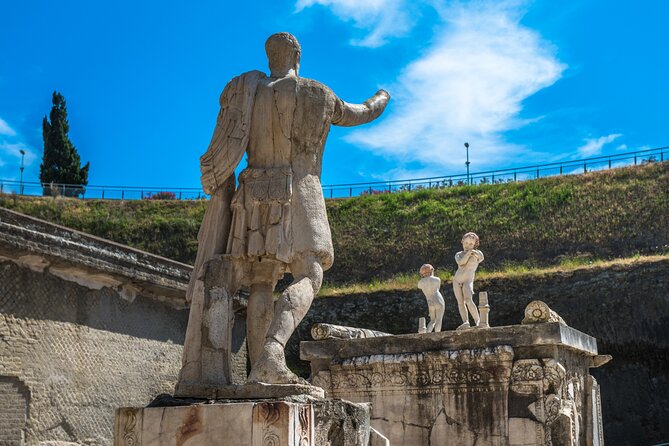
The Sacello Augustali shows the religious side of the town, especially how Romans honored the emperor as a symbol of unity and prosperity. Inside, you can see statues and finely decorated panels that once formed a backdrop for rituals linked to the imperial cult.
For kids, it can be a hunt for mythological figures and an invitation to imagine ceremonies. For adults, it’s a chance to connect everyday life to politics. In Roman cities, religion wasn’t separated from civic identity. You see that connection in the way this space fits into the town’s story.
Casa del Tramezzo di Legno and Casa dello Scheletro: rare wood and a mystery name
Two late-tour houses are especially memorable because they keep the focus on preserved materials and human curiosity.
Casa del Tramezzo di Legno centers on a large folding screen that once separated areas of the home. The wood is carbonized yet retains its shape and decorative details. Kids often find it startling that the partition is still real wood after nearly two thousand years.
Then there’s Casa dello Scheletro, named after a skeleton found during early excavations. Today, you explore rooms with wall paintings, decorative niches, and architectural features that help reconstruct daily routines. Kids are drawn to the story behind the name, and adults can appreciate how archaeology plus research turns finds into a more coherent picture of life before the eruption.
The ancient shoreline and the skeleton chambers: history that asks for care
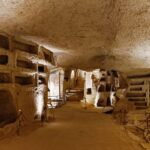
One of the most powerful moments comes at the ancient shoreline. Here, you can look into vaulted chambers where hundreds of skeletons were discovered. The evidence ties to people seeking shelter from superheated gases during the eruption.
This stop is emotional, and your family guide is the key to getting it right for younger visitors. The tour format notes that sensitivity matters here while still honoring the archaeological truth. That balance is what makes this stop meaningful rather than scary.
Parents often find that this is where kids truly understand that history involves people, not just buildings. If your child is prone to strong reactions, you can ask your guide to handle pacing and language in a way that fits your family.
Value and practical takeaways: is the $221.70 price fair?
At $221.70 per person, this tour isn’t a bargain-basement option. But it also isn’t just a ticket and a map. You’re paying for a private, Blue Badge–accredited guide, admission included for the main archaeological segment, plus kid-focused structure through the Herculaneum4Kids package and a keepsake site map.
For families, the value often comes down to two things:
- Time and attention. In a private setup, your guide can keep kids engaged long enough to get real learning out of the visit.
- Quality of details. Preserved wood, mosaics, baths, shop signage, and the shoreline story are easier to understand with someone who can translate the site into clear, kid-safe explanations.
If your kids can sit through museums with short breaks and you want a guided experience that feels tailored, this price starts to make sense. If you’re traveling with very young children who need lots of stops, consider whether you want a shorter plan or a slower pace.
Also, the tour notes group discounts and flexible pickup (premium option). Those can improve the value depending on your family size and where you’re starting.
Should you book this private family Herculaneum tour?
Book it if you want Herculaneum to feel like a story your kids can follow. The combination of a private guide, kid-focused activities, and preservation-heavy stops makes the ruins easier to understand and harder to forget. If you’re also planning Pompeii later, you’ll likely appreciate how Herculaneum teaches different kinds of everyday Roman life, including street-food counters and preserved wood details.
Skip it or rethink timing if your family struggles with walking. The site is compact, but the overall route still adds up. Bring sun protection, water, and plan for lower energy near the end.
If you can handle the walking and you like the idea of learning through objects and real preserved material, this is a strong family archaeology adventure in Naples.
FAQ
How long is the private Herculaneum for Families tour?
The duration is listed as about 2 to 4 hours.
What does the tour cost?
The price is $221.70 per person.
Is the tour private, or is it shared with others?
It’s private. Only your group participates.
Is pickup available?
Pickup is flexible. Pickup is included in the premium option, and you can let the provider know where you’d like to meet.
Is admission included?
Admission ticket is included for the Parco Acheologico Di Ercolano segment (listed as about 2 hours).
What language is the tour in?
The tour is offered in English.
What’s the meeting point?
The start is at 80056 Ercolano, Metropolitan City of Naples, Italy, and it ends back at the meeting point.
What kind of fitness level is needed?
The tour notes a moderate physical fitness level.
What should I wear or bring?
Wear appropriate shoes. Sun gear is recommended from May to September.
What’s the cancellation policy?
Free cancellation is available. You can cancel up to 24 hours in advance for a full refund.
Can service animals join?
Yes, service animals are allowed.
More Private Tours in Naples






More Tour Reviews in Naples




Herculaneum, a Few More Tours

More Naples tours, freshly reviewed



Herculaneum Tours, compared.
 ★ 4.8Herculaneum: Skip-the-Line Guided Tour with ArchaeologistFrom $533,439 reviews
 ★ 5.0Pompeii and Herculaneum Small Group Tour with an ArchaeologistFrom $771,350 reviews
 ★ 5.0Herculaneum Small Group Tour and Ticket With an ArchaeologistFrom $53994 reviews
 ★ 4.3Herculaneum: Skip-the-Line Entry Ticket with Audio GuideFrom $15870 reviews
 ★ 4.8Pompeii: Small-Group Tour of Pompeii and Herculaneum867 reviews
 ★ 4.8Pompeii & Herculaneum with Archaeologist GuideFrom $168665 reviews
 ★ 3.9Pompeii, Herculaneum, & Vesuvius Full-Day TourFrom $152602 reviews
 ★ 4.1Ercolano: Herculaneum Entry Ticket with Optional Audio GuideFrom $21581 reviews
Browse the lists this tour appears in