
Review · POMPEII TOURS
Pompeii Unveiled: 3-Hour Private Tour In-Depth Discovery
Three hours, and Pompeii feels personal.
This private tour strings together the places that explain how Pompeiians worked, trained, shopped, relaxed, and gathered—with a private guide and built-in Pompeii Forum views as the payoff.
I especially like the route rhythm: it starts at a Roman amphitheatre, then moves into everyday life at the gym and houses before slowing down at the Stabian Baths and ending at the Forum. I’ve also heard how guides such as Annarosa and Mariarosa keep explanations lively, answering tons of questions and adjusting the story to the energy of a small group.
One consideration: 3 hours is short, so you’ll focus on highlights rather than trying to cover every corner. Also, check the ticket situation carefully, since the tour notes admissions per stop but also lists the main Pompeii site entrance ticket as not included.
In This Review
- Quick Highlights You’ll Remember
- A 3-Hour Private Tour That Hits the Right Notes (Without Exhausting You)
- Stop 1: Anfiteatro Romano and Pompeii’s Big-Screen Theater
- Stop 2: Palestra Grande, Training Grounds, and Charred Remains Displays
- Stop 3: Casa di Ottavio Quartione and the Garden-First House Experience
- Stop 4: Pompei Casa Dei Ceii and the Hunting Scene on the Garden Wall
- Stop 5: Stabian Baths (Terme Stabiane) for a Reset
- Stop 6: Foro de Pompeya and the Vesuvius View That Makes It Click
- Price and Value: When a Private Guide Actually Makes Sense
- How the Meeting Point and Ending Points Affect Your Day
- Who Should Book This 3-Hour Pompeii Private Tour
- Should You Book Pompeii Unveiled: 3-Hour Private Tour In-Depth Discovery?
- FAQ
- How long is the Pompeii private tour?
- How many people are in the group?
- What language is the tour offered in?
- What’s included besides the private guide?
- Is the Pompeii site entrance ticket included?
- Where does the tour start and end?
Quick Highlights You’ll Remember
- Roman amphitheatre with seating for up to 20,000 and Pompeii’s earliest known amphitheatre style
- Palestra Grande training spaces plus displays of charred organic remains found in Pompeian homes
- Casa di Ottavio Quartione for a garden you’ll want to linger in
- Casa dei Ceii and one of Pompeii’s best hunting scenes on a garden wall
- Stabian Baths (Terme Stabiane) for a fast, refreshing hit of daily routine
- Forum of Pompeii to see the city’s center and the Vesuvius view
Which Pompeii ticket and guide? Compare a few more.
- Pompeii Small Group Tour with an Archaeologist★ 5.0 · 6,593 reviews
- Discover the Ancient Ruins of Pompeii: Day Trip from Rome★ 3.5 · 2,247 reviews
- Pompeii and Herculaneum Small Group Tour with an Archaeologist★ 5.0 · 1,350 reviews
- Skip the Line Guided Tour of Pompeii led by an Archaeologist★ 5.0 · 703 reviews
A 3-Hour Private Tour That Hits the Right Notes (Without Exhausting You)
Pompeii can feel like a firehose of ruins. This tour avoids that by using a tight, logical loop. You’re not just hopping from landmark to landmark; you’re building a mental picture of the city.
The format helps. With a private guide and up to 8 people, the pacing stays human. That matters because the difference between a tiring “see everything” day and a satisfying one is usually the guide’s tempo, not your stamina.
And because the stops are short (about 30 minutes each), you get multiple “aha” moments instead of one long slog. One reviewer’s experience centered on a guide who could answer everything from family questions to deeper study-level curiosities, which is exactly what you want in a limited time window.
Stop 1: Anfiteatro Romano and Pompeii’s Big-Screen Theater
The tour opens at the Anfiteatro Romano. This amphitheatre is noted as the oldest among those known from Roman times in the region, and it could hold up to 20,000 spectators. That scale alone is the point: Pompeii wasn’t a quiet village stuck in the past. It had public life on a grand stage.
Here’s what I like about beginning at the amphitheatre: it gives you a framework. Once you’ve seen a place built for mass attention, the rest of Pompeii starts to make more sense. You start noticing how public gathering worked—where people sat, how crowds moved, and how status showed up in the space.
Possible drawback: amphitheatres are exposed spaces. If you’re visiting in hot months, you’ll appreciate having a guide who can keep you moving smartly rather than making you stand around for photos.
Stop 2: Palestra Grande, Training Grounds, and Charred Remains Displays
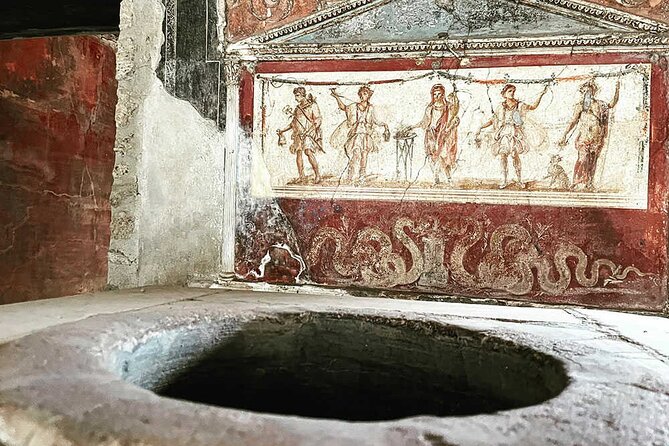
Next is Palestra Grande, the big gymnasium where ancient Pompeians trained. This is where the ruins stop being only dramatic and start being daily. Training spaces tell you about bodies, habits, and social life.
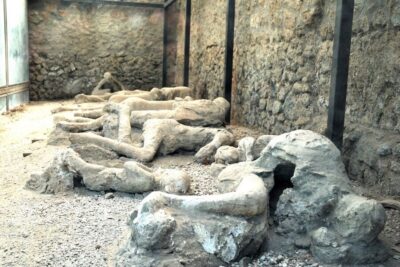
The standout detail is the three showcases with charred organic remains found in Pompeian domus (private homes). It’s not a casual museum moment. It’s a reminder that the tragedy left physical evidence inside ordinary houses, and the objects people left behind can still carry meaning.
I’d treat this stop like a slow-down moment. Even a short visit becomes more powerful if your guide helps you connect what you see to what life might have been like: exercise routines, social mixing, and the way homes and neighborhoods fit together.
Stop 3: Casa di Ottavio Quartione and the Garden-First House Experience
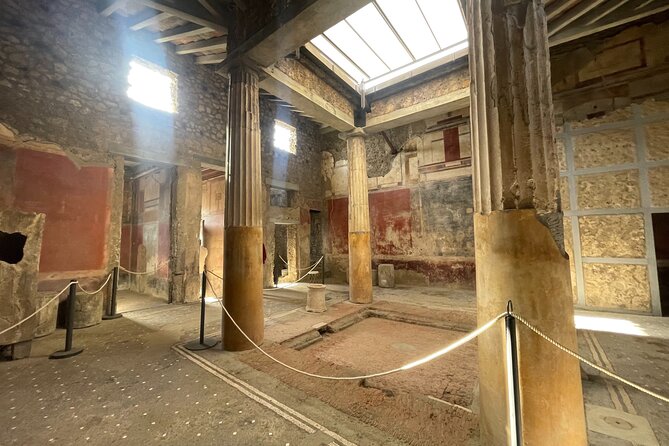
Then you get one of Pompeii’s more scenic houses: Casa di Ottavio Quartione. The highlight here is the garden, described as breathtaking. In real terms, that garden acts like a stage within the house. It’s where daily life gathered energy—light, shade, plants, and movement.
This stop is especially valuable if you’ve ever visited ruins that felt like piles of stones. Houses like this teach you how Romans organized private space. You start seeing the city as a set of lived-in rooms rather than a checklist of monuments.
What to watch for: your guide can point out how the house layout supports cooler air, daily routines, and the flow between public-ish areas and more private corners. You don’t need to be an architecture nerd to appreciate that. You just need someone who explains why the layout matters.
Rather go private? More options in Pompeii



Stop 4: Pompei Casa Dei Ceii and the Hunting Scene on the Garden Wall
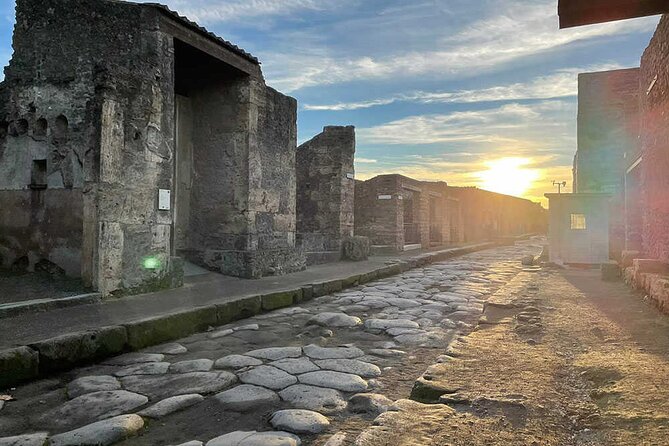
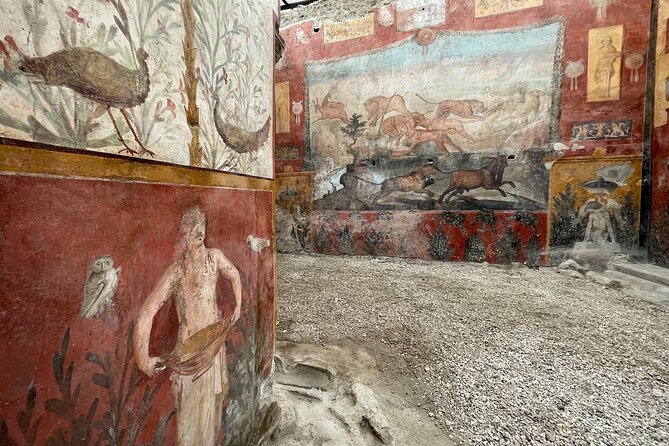
At Casa Dei Ceii, you’ll get a smaller, more colorful Pompeian domus. This is the kind of stop that often gets skipped if someone only chases the biggest names. Don’t. The details are where Pompeii becomes human.
The big wow factor here is the hunting scene on the back wall of the garden—one of Pompeii’s finest. Hunting art isn’t just decoration. It points to status, interests, and the kinds of stories people liked to display in their private spaces.
A useful way to experience this stop: ask your guide what the scene might have meant to the owners. Even without fancy explanations, you can often feel the difference between an image meant for public prestige and one meant to set a mood at home.
Stop 5: Stabian Baths (Terme Stabiane) for a Reset
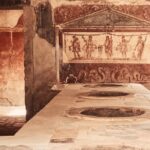
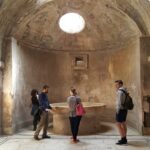
After houses, you move to the Stabian Baths (Terme Stabiane). This is where the tour gives you a break in tone and pace. You get the chance to focus on everyday comfort: water, routine, and social life around bathing.
The tour description frames it as a must-do stop to regenerate a little. That’s practical advice, not just sales talk. Baths can also help you “read” Pompeii. When you see how bathing worked as a daily rhythm, the rest of the city’s spaces stop feeling random.
One thing I’d keep in mind: baths are often more about atmosphere and function than about one single photo-perfect view. If your guide is good at storytelling, you’ll come away feeling like you understand how people spent time, not only how they posed in rooms.
Stop 6: Foro de Pompeya and the Vesuvius View That Makes It Click
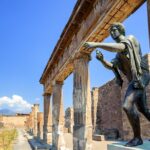
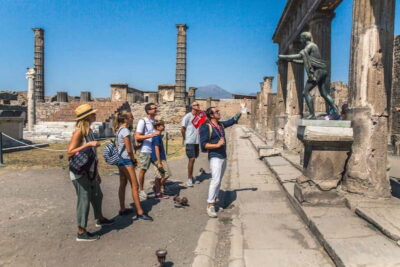
The final stop is Foro de Pompeya, the Forum—the beating heart of the city. Expect it to feel busy. The Forum is central for a reason, and it’s also where the city’s power and daily movement converge.
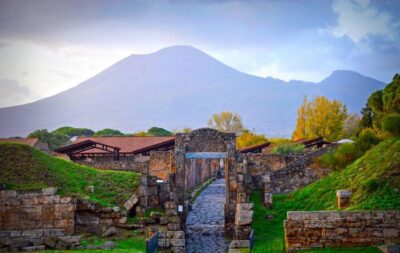
The payoff is twofold. First, you see the city as a place with civic life, not just private homes. Second, you get a view of Vesuvius that’s described as truly remarkable.
This is the moment where many first-time visitors go quiet for a second, even if they don’t mean to. When the volcano shows up in the same frame as the Forum, you feel the scale of the story that swallows the whole city. A good guide helps you keep the mood grounded: what life in the Forum meant, who would gather there, and how the ruins around you connect back to real movement and routines.
Price and Value: When a Private Guide Actually Makes Sense
The price is $361.23 per group, up to 8 people, for about 3 hours. Tickets for Pompeii are listed as not included overall, even though the itinerary notes admission tickets for each stop.
So what are you paying for?
- Time-saving and route control. In Pompeii, the shortest path is not always the best path. A guide can help you avoid dead-end confusion and keep you moving through the most meaningful pieces of the city.
- Meaning, not just sights. A private guide turns carved stones into daily life. In particular, guides linked with this experience (including Annarosa and Mariarosa) are noted for passion, adaptability, and answering lots of questions without rushing your group.
- A better match for families and mixed interests. If you’ve got kids or different comfort levels in your group, this kind of tour format is often the difference between everyone getting something out of it and half the group wishing they’d booked something else.
If your goal is a quick, high-impact Pompeii visit, the value is strong. If your goal is to cover every major site in one go, you might feel restricted. But that’s not a flaw of the tour—it’s a reality of time.
How the Meeting Point and Ending Points Affect Your Day
The tour starts at Pompei, P.zza Anfiteatro and ends at the Foro di Pompei, with the nearest exit listed as Porta Marina Inferiore. If you need to walk back to the same entrance as the start, plan at least 15 minutes.
That matters because Pompeii can surprise you with how quickly your feet rack up time. If you’re pairing this with other activities in Naples, keep the walking in mind. The best plan is usually to let the tour end where it ends, then connect onward from Porta Marina Inferiore rather than trying to retrace every step.
Who Should Book This 3-Hour Pompeii Private Tour
This works best if you:
- Want a high-quality highlights tour without spending your whole day on trains, tickets, and navigation
- Prefer learning through conversation, not reading signs
- Have a family group where questions are part of the fun
- Care about everyday life spaces (gym, baths, houses), not only the big public monuments
You might consider a different option if you:
- Want to see Pompeii in a strict “walk every street” way
- Are hoping for a much longer tour that covers more than these six core stops
- Don’t want to manage the ticket question before you arrive (since ticket details can vary)
Should You Book Pompeii Unveiled: 3-Hour Private Tour In-Depth Discovery?
Yes, if you want Pompeii that feels like a story instead of a checklist. The stop sequence makes sense: amphitheatre for public life, gym for routine, houses for private space, baths for comfort, and the Forum for the city center plus the Vesuvius view.
The biggest reason to book is the private-guide approach. If you’re the kind of person who likes to ask why something was built a certain way or what a wall scene might have meant, you’ll likely feel like you got your money’s worth in the explanations alone.
My only hesitation is time. Three hours gives you depth in the right spots, but it can’t replace a full-day Pompeii exploration. If that trade-off sounds right for your trip, this is a smart pick.
FAQ
How long is the Pompeii private tour?
It lasts about 3 hours.
How many people are in the group?
It’s private, and the group size is up to 8.
What language is the tour offered in?
The tour is offered in English.
What’s included besides the private guide?
A private guide is included. The itinerary also notes admission ticket inclusion for each listed stop.
Is the Pompeii site entrance ticket included?
The tour information says ticket entrance to the Pompeii site is not included, so it’s worth confirming ticket details before you go.
Where does the tour start and end?
It starts at P.zza Anfiteatro in Pompeii and ends at the Foro di Pompei. The nearest exit is listed as Porta Marina Inferiore.
More Tours in Pompeii



More Tour Reviews in Pompeii

More Pompeii Tours to Compare
More Pompeii tours, freshly reviewed



Pompeii Tours, compared.
 ★ 4.8Pompeii: Entry Ticket and Guided Tour with an ArchaeologistFrom $3519,459 reviews
 ★ 4.1Pompeii: Entry Ticket with Audio GuideFrom $4013,491 reviews
 ★ 4.8Pompeii: Small Group Tour with an ArchaeologistFrom $4012,264 reviews
 ★ 4.3Pompeii Ruins & Mount Vesuvius Day TourFrom $12011,459 reviews
★ 5.0Pompeii Small Group Tour with an ArchaeologistFrom $356,593 reviews
★ 4.3Pompeii Ruins & Mount Vesuvius Day TourFrom $12011,459 reviews
★ 5.0Pompeii Small Group Tour with an ArchaeologistFrom $356,593 reviews
 ★ 4.5Skip-the-line Pompeii – Small Group TourFrom $544,401 reviews
 ★ 4.6Naples or Sorrento: Full-Day Pompeii and Mount Vesuvius TourFrom $1044,235 reviews
 ★ 3.9Pompeii: Skip-the-line Entry Ticket with Audio Guide & MapFrom $433,153 reviews
Browse the lists this tour appears in