
Review · POMPEII TOURS
Pompeii the Buried city
Pompeii packs a punch fast. This private tour runs with an authorized Campania Region local guide, built to show you both the big sights and the quieter streets. I love how the route mixes headline stops like the Forum and Thermal Baths with intimate views inside homes, not just a quick skim. I also love the way you reach the southern ruins for the plaster casts, where the tragedy of 79 A.D. turns from an idea into something you can really see.
You’ll spend time at places that explain daily life: Menandro’s House, the theaters, and the brothel called the Lupanare with its erotic frescoes. The guide Ilaria gets name-checked for a reason, too: she’s the type who can connect art, architecture, and everyday routines into clear answers while keeping the pace human.
One thing to consider: this is Pompeii-only and it doesn’t include the 16 euro admission ticket. So your final cost depends on buying entry separately for each person.
In This Review
- Key things I’d plan around
- Pompeii, but with a guide who actually connects the dots
- Your start at Porta Marina: where the tour begins and why it matters
- What you see: Forum and Thermal Baths without the rush
- Menandro’s House: where private life becomes readable
- The Lupanare brothel and its erotic frescoes: intense, but contextual
- Plaster casts in the southern area: where tragedy becomes visible
- Theaters and the north side: closing in on daily rhythm
- Guide quality: why Ilaria keeps showing up in the stories
- Price and value: $229.28 per group plus the admission ticket
- Practical planning: mobile ticket, walking pace, and weather reality
- Who this private Pompeii tour suits best
- Should you book this Pompeii buried city tour?
- FAQ
- How much does the Pompeii private tour cost?
- How long is the tour?
- Where do we meet for the tour?
- Is the Pompeii admission ticket included in the tour price?
- Do I receive a mobile ticket?
- Is this tour private?
- What fitness level do I need?
- What happens if the weather is bad, and can I cancel?
Key things I’d plan around
- Authorized local guidance for the off-the-beaten-path feel, led by professionals cleared by the Campania Region authorities
- Forum + Thermal Baths + homes in one tight 2-hour route, so you don’t miss the must-know highlights
- Lupanare (the brothel) and its erotic frescoes, handled with context so it’s more than shock value
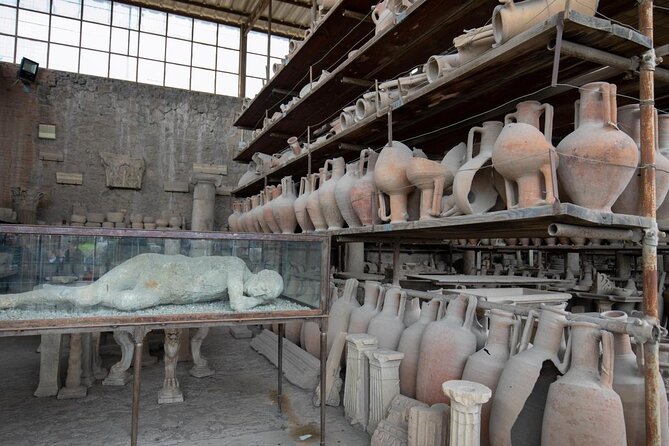
- Southern-area plaster casts that hit hardest when you see them in person
- Private group format (up to 6) that keeps questions easy and the walk focused
Which Pompeii ticket and guide? Compare a few more.
- Pompeii Small Group Tour with an Archaeologist★ 5.0 · 6,593 reviews
- Discover the Ancient Ruins of Pompeii: Day Trip from Rome★ 3.5 · 2,247 reviews
- Pompeii and Herculaneum Small Group Tour with an Archaeologist★ 5.0 · 1,350 reviews
- Skip the Line Guided Tour of Pompeii led by an Archaeologist★ 5.0 · 703 reviews
Pompeii, but with a guide who actually connects the dots
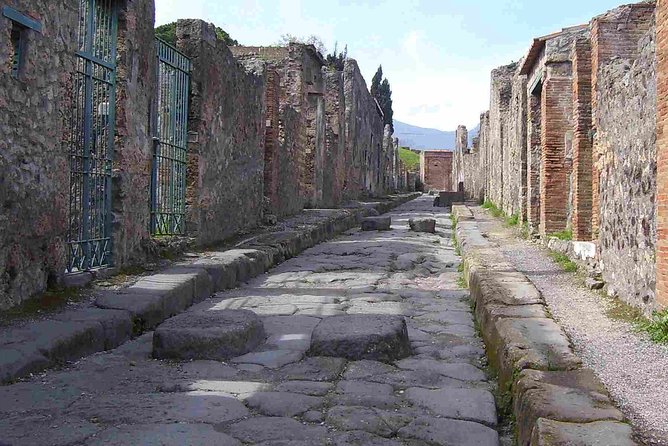
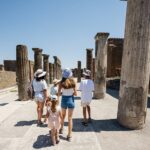
Pompeii is famous for a reason. You walk through streets frozen in time, and the city feels less like a museum and more like a place that simply paused. What I like about this tour is the format: you get a professional local guide, authorized by Campania Region authorities, and you follow a route designed to make sense of what you’re seeing.
Two hours sounds short until you realize how much Pompeii covers. This tour doesn’t try to conquer the whole park. Instead, you hit the core public spaces and then balance them with homes and special-interest stops, including the darker corner of the city at the Lupanare. That mix matters. A straight checklist of ruins can leave you with names but no understanding.
The best part, in my view, is the pacing and choice of areas. You move through the more uncrowded southern side where the plaster casts sit in a way that feels intimate, not rushed. Those casts are the reason Pompeii still grabs people years after they’ve read the story of Mount Vesuvius.
Your start at Porta Marina: where the tour begins and why it matters
You meet at Pompei-porta Marina – scavi, postcode 80045 Pompei. This matters because Pompeii is huge, and getting oriented quickly saves energy and time. Starting at a clear park entry point also helps if you’re juggling a train schedule or bus connections, since the meeting area is described as near public transportation.
The tour ends back at the meeting point. That loop is useful. It removes the stress of wondering how you’ll get back out after your guided walk. You’re basically booking a tight guided “chapter” of Pompeii, not a long scavenger hunt.
Also note the operating window: Monday through Sunday, roughly 9:00 AM to 1:00 PM within the period listed (01/10/2025 to 11/30/2026). If your trip schedule is tight, aim for a morning slot so you’re not stuck trying to fit Pompeii into the last hours of daylight.
What you see: Forum and Thermal Baths without the rush
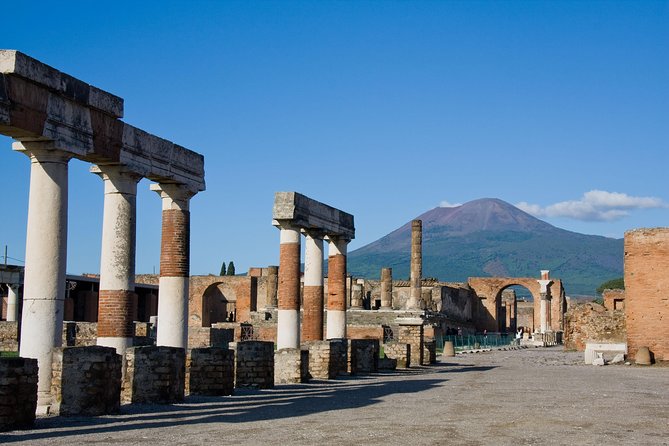
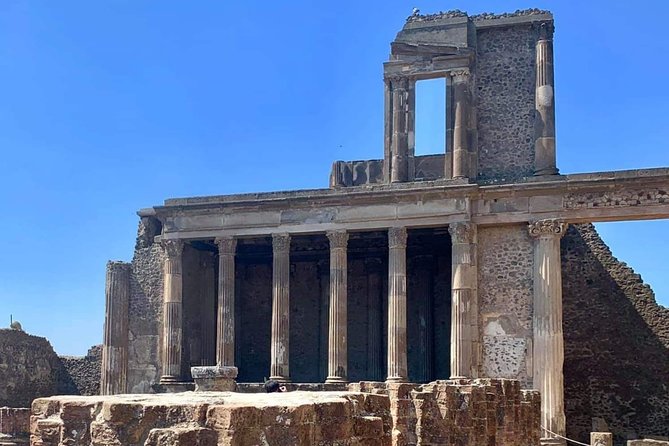
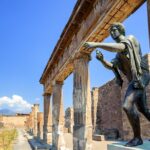
Your walk covers the Pompeii Archaeological Park and focuses on important public and private sites. The Forum and the Thermal Baths are the kind of stops you’d want even if you only had an hour in Pompeii, because they show how people used space every day.
At the Forum, you’re looking at Pompeii’s civic heartbeat. Think of it as the place where social life, public decisions, and street-level business all overlapped. Even if you’ve seen photos, the scale is different when you’re standing in the layout, walking the edges, and imagining movement. The guide’s job here is huge: translating stone geometry into lived routines.
Then the Thermal Baths bring you back to the body side of daily life. Baths weren’t just hygiene. They were social time, conversation time, and relaxation time. When your guide points out the layout and how people would have used the spaces, the ruins start to feel practical instead of purely dramatic.
Menandro’s House: where private life becomes readable
After the big public zones, you head toward homes, including Menandro’s House. This is where Pompeii stops being just history and starts being human. You get a sense of private space—how rooms might connect, how light and movement could work, and how decoration signals status or personality.
Homes can be hit-or-miss on guided tours. Too often, guides treat them as photoshoot backdrops. Here, you’re guided through key areas so the house becomes part of the story of the city, not just a stop on the way.
Menandro’s House also helps you compare two worlds: public life around the Forum and a quieter domestic reality inside homes. That contrast is one of the reasons this tour feels “complete” even though it stays within a short time window.
More ways to take in Pompeii in a day


The Lupanare brothel and its erotic frescoes: intense, but contextual
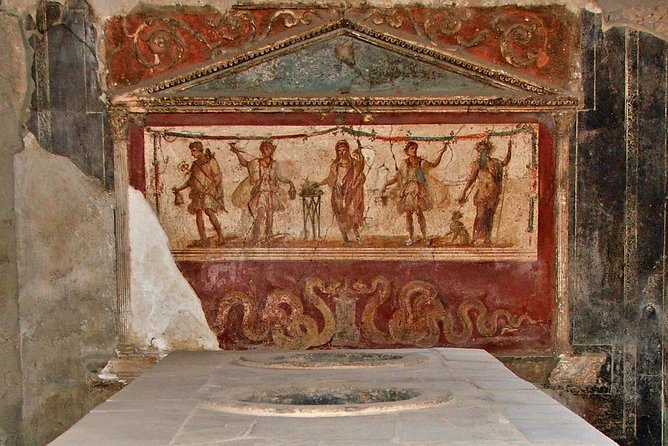
Next comes one of Pompeii’s most talked-about spaces: the brothel called Lupanare, famous for its erotic frescoes. This is the stop that turns Pompeii from serious to startling. It’s also the stop that can easily become awkward if a guide treats it like a circus attraction.
What you want is context. The way this experience is described centers on guided interpretation—key insights into what life was like in Pompeii—so you’re not just staring at shocking imagery. You’re learning how the city expressed sexuality, commerce, and social behavior in built form.
If you’re sensitive to adult subject matter, this is the one moment to flag ahead of time. It’s still part of Pompeii’s reality, but it is not a hands-off, “skip it if you want” kind of highlight in most routes. Going with a guide who can keep it grounded is the difference between discomfort and understanding.
Plaster casts in the southern area: where tragedy becomes visible
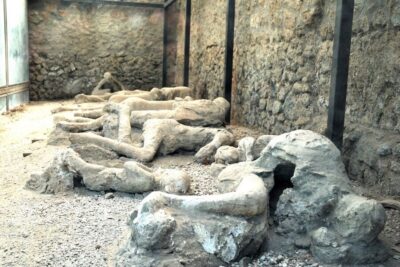
One of the strongest parts of the tour is the southern-side walk designed to be less crowded. In this area, you visit the famous plaster casts—the molded forms of people who died during the eruption of Mount Vesuvius in 79 A.D.
This is the section where Pompeii stops being a story you already know. The casts are physical. You see posture, scale, and placement in the ruins. They make the timeline feel immediate.
Your guide leads this area so it doesn’t turn into doom theater. You’re given enough interpretation to understand what you’re looking at, without the experience becoming a heavy lecture. You’re also given time to walk in the space so it feels like you’re moving through the same streets the people once walked.
Theaters and the north side: closing in on daily rhythm
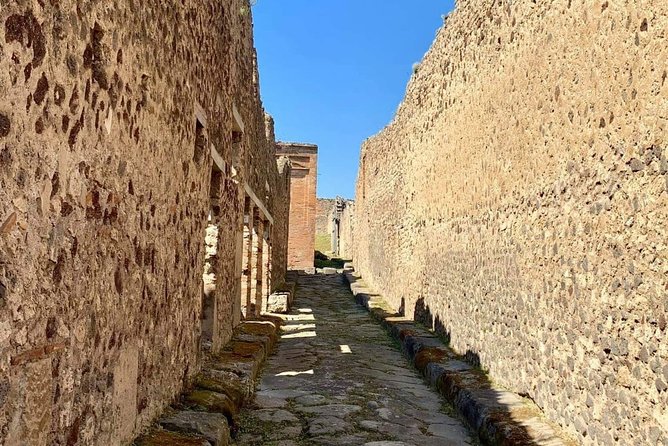
After the plaster casts, you head to the theaters, then cross streets along the north side. Theaters matter because they show public culture—how people gathered for entertainment and shared experiences.
The north side route helps tie the city together. You start by understanding public order in the Forum, you see private life in homes, you learn about communal routines in baths, and then you round it out with public performance spaces. That rhythm gives the whole city a shape.
You’ll also get that “you can almost feel it” moment some people talk about, helped by the fact that the route includes time for walking and noticing rather than sprinting between highlights. The experience is built around a guided pace that lets you catch small cues—street layout, how spaces connect, and how Pompeii’s design supported everyday movement.
Guide quality: why Ilaria keeps showing up in the stories
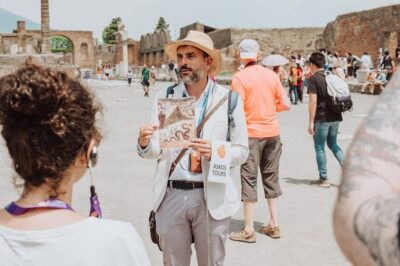
Good ruins tours rise or fall on the guide. In this case, the guide name Ilaria comes up in multiple accounts for a reason. People describe her as very knowledgeable and able to answer questions with clarity, not just recite facts.
What I value in that style is the practical angle: key insights into what life was like in Pompeii, plus the ability to switch gears when you ask something specific. That makes a short tour feel longer, because your brain isn’t stuck waiting for the next stop. You’re learning as you go.
A strong guide also helps you decide what to look at. In Pompeii, you could spend hours staring and still miss the point. With a guide, you’re pointed at the right details at the right time—exactly what makes a 2-hour experience work.
Price and value: $229.28 per group plus the admission ticket
The tour price is $229.28 per group (up to 6) for about 2 hours. That’s the guided service. Pompeii admission tickets are not included, and you should budget 16 euro per person. Under 18 can enter for free with a valid ID document.
Here’s where the value math helps. If you use the full group size (6 people), the tour cost works out to roughly $38 each before the 16 euro admission. If you’re fewer than 6, your per-person guide cost goes up.
So who does this work best for? It’s strongest for couples, small families, and friend groups that want a private guide without paying per-person guide rates. If you’re solo, it may feel pricier than a large-group walking tour, simply because you’re paying for a private format. But you’re also getting a short, focused route and a guide who can respond to questions.
Practical planning: mobile ticket, walking pace, and weather reality
You’ll receive a mobile ticket for the guided service. The tour is near public transportation, which is helpful if you’re combining Pompeii with Naples or another stop.
The tour also calls for moderate physical fitness. That’s a polite way of saying you’ll be walking and spending time on uneven ground typical of archaeological sites. Wear shoes you trust. Bring water if you run hot. And plan your energy so you can enjoy the stops rather than endure them.
Finally, this experience requires good weather. If it’s canceled due to poor weather, you’ll either get a different date or a full refund. In practical terms, that means you should avoid booking Pompeii as a lone “must-do” on a day when the forecast looks shaky, unless you’re ready to reschedule.
Who this private Pompeii tour suits best
This is a smart choice if you:
- Want Pompeii in two hours without feeling like you missed the essentials
- Like a guide who connects public life, private homes, and darker side stories (Forum, baths, Menandro’s House, Lupanare)
- Prefer a private group format so questions don’t get swallowed by a crowd
- Are okay paying the separate 16 euro admission to get the guided value
It may be less ideal if you want to roam the entire park independently for the whole day. Pompeii is big, and two hours won’t cover everything. This experience focuses on a specific, well-chosen slice.
Should you book this Pompeii buried city tour?
If you want the best “guided understanding per minute,” I’d book it. The private format keeps it efficient, and the route combines the big recognizable sites with the parts that make Pompeii feel real—the plaster casts and the lived-in details inside houses. Plus, the guide strength, including Ilaria’s reputation for clear answers, is exactly what you want when time is limited.
Book it especially if you’re traveling with up to 6 people and want a professional, Campania-authorized guide rather than piecing together your own route. Just remember the timing and extra cost of the 16 euro entry ticket, and plan for walking in moderate conditions.
If you’d like, tell me your travel month and how many people are in your group, and I can help you estimate the total cost and pick the best time window within the listed opening hours.
FAQ
How much does the Pompeii private tour cost?
The price is $229.28 per group, up to 6 people.
How long is the tour?
It lasts about 2 hours.
Where do we meet for the tour?
You meet at Pompei-porta Marina – scavi, 80045 Pompei, Metropolitan City of Naples, Italy.
Is the Pompeii admission ticket included in the tour price?
No. Pompeii admission tickets cost 16 euro per person. Under 18 can enter for free with a valid ID document.
Do I receive a mobile ticket?
Yes, this experience provides a mobile ticket.
Is this tour private?
Yes. It’s a private tour/activity, and only your group participates.
What fitness level do I need?
You should have a moderate physical fitness level.
What happens if the weather is bad, and can I cancel?
The experience requires good weather. If it’s canceled due to poor weather, you’ll be offered a different date or a full refund. You can cancel for a full refund up to 24 hours in advance of the experience start time.
More City Tours in Pompeii


More Tour Reviews in Pompeii




More Pompeii Tours to Compare
More Pompeii tours, freshly reviewed




Pompeii Tours, compared.
 ★ 4.8Pompeii: Entry Ticket and Guided Tour with an ArchaeologistFrom $3519,459 reviews
 ★ 4.1Pompeii: Entry Ticket with Audio GuideFrom $4013,491 reviews
 ★ 4.8Pompeii: Small Group Tour with an ArchaeologistFrom $4012,264 reviews
 ★ 4.3Pompeii Ruins & Mount Vesuvius Day TourFrom $12011,459 reviews
★ 5.0Pompeii Small Group Tour with an ArchaeologistFrom $356,593 reviews
★ 4.3Pompeii Ruins & Mount Vesuvius Day TourFrom $12011,459 reviews
★ 5.0Pompeii Small Group Tour with an ArchaeologistFrom $356,593 reviews
 ★ 4.5Skip-the-line Pompeii – Small Group TourFrom $544,401 reviews
 ★ 4.6Naples or Sorrento: Full-Day Pompeii and Mount Vesuvius TourFrom $1044,235 reviews
 ★ 3.9Pompeii: Skip-the-line Entry Ticket with Audio Guide & MapFrom $433,153 reviews
Browse the lists this tour appears in