

Review · POMPEII TOURS
Pompeii, skip-the-line ticket with smartphone audio guide on App
Pompeii hits fast, even at your own pace. This ticket is built for time savings, with skip-the-line entry and a smartphone audio guide to help you connect the ruins to real history. One snag to be aware of: you may be asked to leave identification documents to access the audio guide, and that can feel like an alarming hassle.
What I like most is that you’re free to roam while still getting structure—starting from the Roman core and working outward at a comfortable rhythm. You’ll see the Roman forum area, streets with shops and residences, and the dramatic framing of Mount Vesuvius behind key viewpoints. The trade-off is that this is not a guided walkthrough in the classic sense; you’re doing the exploring, using the audio as your guide.
Plan on serious walking and uneven ground. Bring hiking shoes, carry a reusable water bottle, and note that large bags and luggage aren’t allowed, plus there are rules around pets, drones, and alcohol/drugs. If that doesn’t fit your style, you’ll want to adjust how you travel light.
In This Review
- Key highlights you’ll care about
- How the skip-the-line ticket works at Pompeii
- What you’ll see first: Forum streets and Vesuvius in the background
- Aqueducts, fountains, public baths, and daily life under ash
- Homes, businesses, statues, and the fresco detail that still surprises
- Amphitheater and theaters: entertainment you can still picture
- Audio guide on your smartphone: helpful, but handle ID with care
- Practicalities that matter: footwear, bags, and getting around
- Price and logistics: does $40 feel fair?
- Who this Pompeii experience is best for
- Should you book this Pompeii skip-the-line audio ticket?
- FAQ
- Where do I meet for this Pompeii experience?
- Is this a guided tour with a person?
- What is included with the ticket?
- What is the duration of the activity?
- What languages are available for the audio guide?
- Do I need to bring identification documents?
- What happens if I do not want to leave my ID for the audio guide?
- What should I bring?
- What is not allowed at Pompeii with this activity?
- Is the activity wheelchair accessible?
Key highlights you’ll care about

- Skip-the-line express entry: less time stuck at the entrance, more time among the ruins.
- Smartphone audio guide + picture map: you get both narration and a visual way to find your bearings.
- Pompeii’s everyday layout: forum life, aqueduct remains, fountains, baths, homes, businesses, statues.
- Entertainment survives: amphitheater and theaters let you picture crowds and performances.
- Color still shows: remnants of frescoes help you understand how much the city wasn’t gray.
- ID requirement for the audio guide: keep this in mind before you arrive, so you’re not surprised.
Which Pompeii ticket and guide? Compare a few more.
- Pompeii: Entry Ticket and Guided Tour with an Archaeologist★ 4.8 · 19,459 reviews
- Pompeii: Small Group Tour with an Archaeologist★ 4.8 · 12,264 reviews
- Pompeii: Skip-the-line Entry Ticket with Audio Guide & Map★ 3.9 · 3,153 reviews
- Naples: Pompeii and Mt. Vesuvius with Lunch and Wine Tasting★ 4.5 · 2,454 reviews
How the skip-the-line ticket works at Pompeii
You’re visiting the Pompeii Archaeological Park on your own, which is a big deal in a place like this. Even with the “self-guided” format, priority entry means you can spend your energy on the ruins instead of waiting at the gate.
Your ticket includes an Express skip to enter, plus the smartphone audio guide and a picture map. The meeting point is the Wellcome box, and the activity ends back at that same spot—so you’re not dealing with complicated drop-offs or transfers once you start exploring.
One more practical note: the ticket is valid for 1 day, with starting times depending on availability. That matters because Pompeii works best when you can choose a time window that matches your energy level (and the crowd level outside your control).
What you’ll see first: Forum streets and Vesuvius in the background
Pompeii’s layout gives you a natural “story” as you walk. You’ll begin by moving through the heart of the ancient city, including the Roman forum area, where civic life would’ve played out. It’s the kind of place where ruins feel like a lived-in stage set—especially once you notice the street edges, building shapes, and the way the city funnels movement.
A major visual feature is the way Vesuvius shows up in the background as you explore. That isn’t just scenery. It’s the reminder of why the city is here in the first place—and why the archaeological park has such a strong sense of time being frozen in place.
As you walk through streets, you’ll encounter remains of public and private spaces: aqueduct-related structures, fountains, and the foundations of homes and shops. This is where the audio guide becomes especially useful, because it helps you connect what you’re looking at—without forcing you into a rigid route.
Aqueducts, fountains, public baths, and daily life under ash
Pompeii isn’t only temples and big landmarks. It’s water systems, sanitation, leisure, and the routine of regular people. You’ll see remnants of an aqueduct and fountains, which are great anchors for understanding how the city functioned.
From there, you’ll be able to shift your attention to public baths—a key Roman invention. Even when you’re just looking at stone remains, it’s usually pretty clear these weren’t “bathrooms” in the modern sense. They were places where social life and daily hygiene overlapped, and the spaces were designed for people to stay a while.
This is also a good area to slow down. Take a minute to look at the transitions: where water would have flowed, how public areas relate to nearby streets, and what kind of buildings cluster together. The audio narration helps you fill in the blanks, and the picture map can keep you from spiraling into random corners.
Homes, businesses, statues, and the fresco detail that still surprises

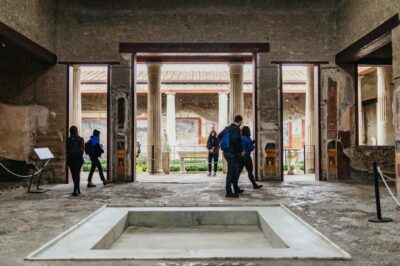
One reason Pompeii keeps drawing repeat visitors is how personal the ruins can feel. You’ll pass remains of private houses and businesses, and there are statues and other details that make the city feel less like a museum and more like a place that had neighbors.
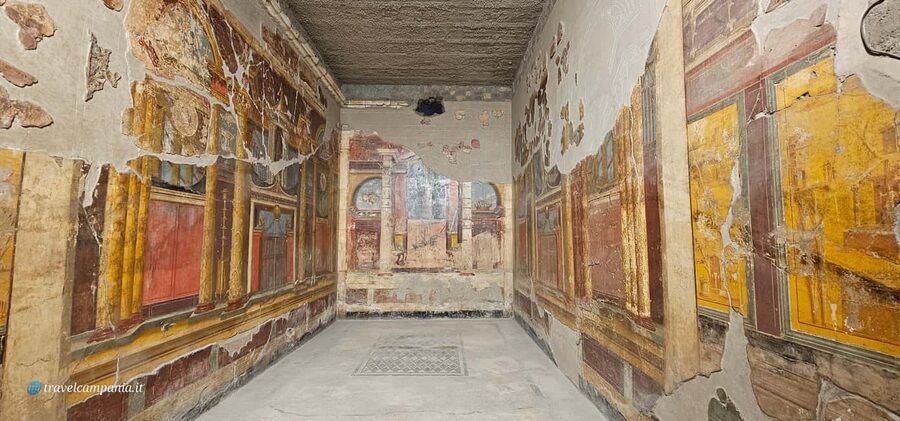
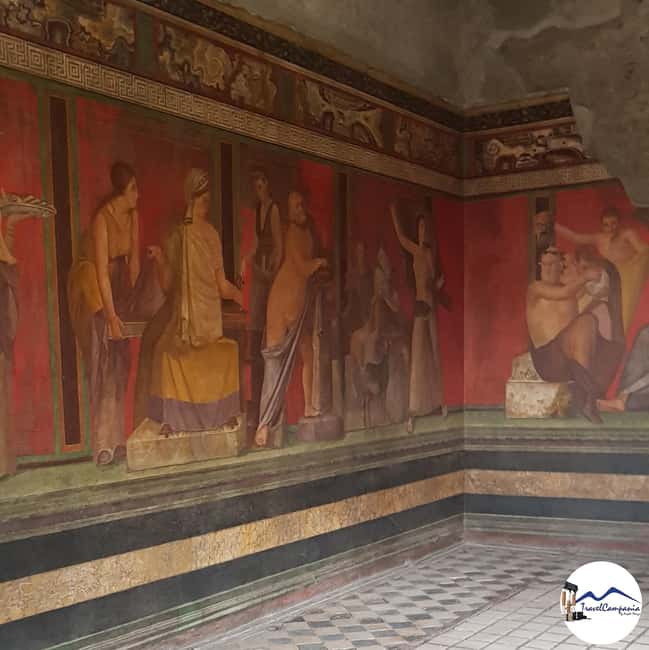
The standout sensory element here is the mention of colorful frescoes. Even when only fragments remain, it changes how you imagine the city. Instead of thinking of “ancient ruins,” you start picturing painted walls, decorative shop fronts, and interiors meant to impress.
I like this part because it’s where your imagination has room to work, but you’re not guessing from scratch. The audio guide helps explain what you’re seeing—buildings, uses, and the meaning of architectural features—so you’re not stuck with only visual interpretation.
A good caution: fresco remnants can be easy to miss if you’re moving quickly. If you care about that “color still exists” effect, stop often. Five extra minutes at the right spot in Pompeii can make the difference between seeing ruins and understanding them.
Other tickets and entries for Pompei Campania





Amphitheater and theaters: entertainment you can still picture

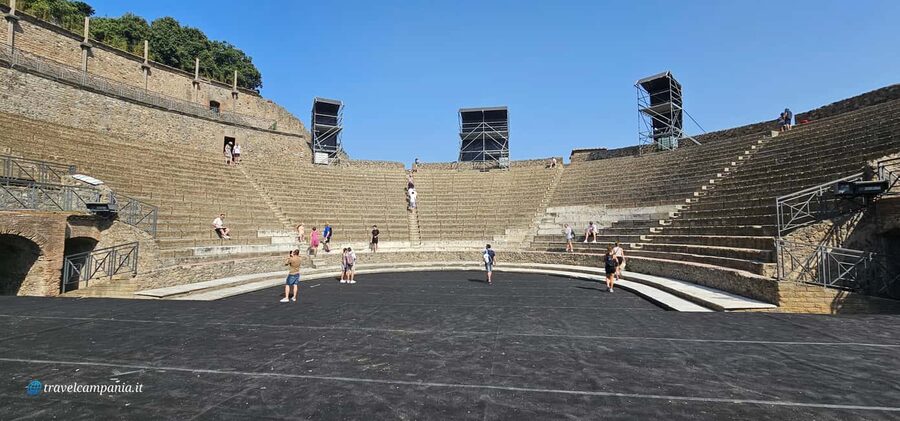
Pompeii’s amphitheater and theaters give you a different lens on the city. Once you find these spaces, it’s easier to grasp the scale of public life—crowds, performances, and public events that pulled people out of their homes and into shared experiences.
You’ll also likely notice how these venues sit within the broader urban plan. The amphitheater and theaters aren’t isolated monuments; they relate to nearby streets and the flow of daily movement.
If you’ve ever wondered how a city spent its free time, this is where Pompeii answers fast. It’s dramatic, even in ruins. And the audio guide can help you keep track of what each space was for, so you’re not just standing there thinking, Great, theater. You’re connecting it to social life.
Audio guide on your smartphone: helpful, but handle ID with care

The smartphone audio guide is part of the value here, since it’s what turns “rocks in a park” into a readable city. I like that it matches the self-guided format—listen when you want, pause when you need a breather, and rewind if something didn’t click the first time.
But there’s a real-world consideration: the experience requires identification documents. One person had a frustrating moment when they were asked to leave an ID to access the audio guide, and they felt the setup was not worth the extra cost compared with just buying on-site tickets. That reaction doesn’t mean it’s always a disaster, but it does mean you should treat the ID requirement as serious.
So here’s your best move: bring your identification documents with you and plan for the possibility that you’ll need them for access to the audio guide. If you hate handing over sensitive documents anywhere, this is the part to think through before you commit.
Language support is Italian and English, which is good if you don’t want to rely on translations on the fly.
Practicalities that matter: footwear, bags, and getting around
Pompeii Archaeological Park rewards comfortable shoes. You should bring hiking shoes, and a reusable water bottle is a smart move in a place where walking can add up fast.
Your luggage situation matters, too. Luggage or large bags aren’t allowed, and that’s not a small detail—having to manage a big bag can waste the energy you’d rather spend inside the park. Drones are also not allowed, and pets aren’t allowed (with assistance dogs permitted).
If you’re traveling with a partner or family, pay attention to the ID detail: you need to provide the full name and age of all participants. I’d treat that as a must-do before your day at the park, so you’re not stuck scrambling at the meeting point.
Good to know if you use mobility aids: the activity is listed as wheelchair accessible. That doesn’t mean every surface is smooth or easy, but it does suggest the route planning should consider mobility needs.
Price and logistics: does $40 feel fair?

The price is $40 per person, and you should judge it as a trade-off: you’re paying for (1) priority entry, and (2) the smartphone audio guide plus a picture map, rather than assembling these pieces yourself.
That can be fair value if you want to avoid lines and you’ll actually use the audio narration. Pompeii is so spread out that arriving efficiently helps your overall experience more than it does in a compact site.
That said, one negative experience tied directly to the cost. The person who rated it poorly said they paid more than double what it would have cost to buy standard tickets on-site, and they felt they didn’t get enough benefit to justify the extra expense—especially after encountering an issue with leaving an ID for audio guide access.
How to use that info: if you’re the type who hates extra steps (especially anything involving your passport or ID), prioritize clarity before you go. If you’re okay with the audio guide process and you’ll use it, the $40 can make your day smoother. If you’d rather handle everything at the entrance with minimal friction, you may prefer a different ticket route.
Who this Pompeii experience is best for
This is a good fit if you want:
- Self-paced wandering with a built-in learning layer from the smartphone audio guide.
- A ticket format that values time savings through skip-the-line entry.
- To focus on the “everyday city” side: forum life, baths, streets, aqueduct remains, homes, and businesses.
It may be less ideal if:
- You strongly dislike providing or temporarily surrendering identification documents for access to equipment.
- You prefer a live, spoken guide who explains everything in person rather than using a smartphone audio track.
It’s also well matched to travelers who enjoy planning their own stop-and-stare moments—especially for fresco fragments and the theater/amphitheater areas where imagination matters.
Should you book this Pompeii skip-the-line audio ticket?
I’d book it if your top goal is a smoother entry and a structured way to understand what you’re seeing while you explore on your own. The combination of express entry, a smartphone audio guide, and a picture map is exactly the kind of setup that helps you get more meaning out of a day in Pompeii.
I wouldn’t book it blindly if the ID requirement for accessing the audio guide would make you uncomfortable. In particular, the documented complaint about leaving a passport-style ID is the kind of issue that can turn a “dream day” into a frustrating one. If you can handle that process calmly, you’ll likely find more value. If you can’t, look for a simpler ticket setup.
If you’re ready to walk, take breaks, and let the ruins tell their story street by street, this is a sensible Pompeii option—just go in informed.
FAQ
Where do I meet for this Pompeii experience?
You start at the Wellcome box, and the activity ends back at the same meeting point.
Is this a guided tour with a person?
No. You explore Pompeii on your own with priority admission and a smartphone audio guide.
What is included with the ticket?
You get skip-the-line entrance with an Express ticket, a smartphone audio guide, and a picture map of the city.
What is the duration of the activity?
The ticket is valid for 1 day. Starting times depend on availability.
What languages are available for the audio guide?
The audio guide is available in Italian and English.
Do I need to bring identification documents?
Yes. This visit requires identification documents, and you need to provide full name and age of all participants.
What happens if I do not want to leave my ID for the audio guide?
The information provided says identification is required, and one review notes they were asked to leave an ID to access the audio guide. You should expect there may be an ID step for access.
What should I bring?
Bring hiking shoes and a reusable water bottle.
What is not allowed at Pompeii with this activity?
Luggage or large bags are not allowed. Drones are not allowed. Pets are not allowed (assistance dogs are allowed). Alcohol and drugs are not allowed.
Is the activity wheelchair accessible?
Yes, it’s listed as wheelchair accessible.
More Tickets and Entries in Pompei Campania






More Tour Reviews in Pompei Campania



More Pompeii Tours to Compare
More Pompei Campania tours, freshly reviewed




Pompeii Tours, compared.
 ★ 4.8Pompeii: Entry Ticket and Guided Tour with an ArchaeologistFrom $3519,459 reviews
 ★ 4.1Pompeii: Entry Ticket with Audio GuideFrom $4013,491 reviews
 ★ 4.8Pompeii: Small Group Tour with an ArchaeologistFrom $4012,264 reviews
 ★ 4.3Pompeii Ruins & Mount Vesuvius Day TourFrom $12011,459 reviews
★ 5.0Pompeii Small Group Tour with an ArchaeologistFrom $356,593 reviews
★ 4.3Pompeii Ruins & Mount Vesuvius Day TourFrom $12011,459 reviews
★ 5.0Pompeii Small Group Tour with an ArchaeologistFrom $356,593 reviews
 ★ 4.5Skip-the-line Pompeii – Small Group TourFrom $544,401 reviews
 ★ 4.6Naples or Sorrento: Full-Day Pompeii and Mount Vesuvius TourFrom $1044,235 reviews
 ★ 3.9Pompeii: Skip-the-line Entry Ticket with Audio Guide & MapFrom $433,153 reviews
Browse the lists this tour appears in