
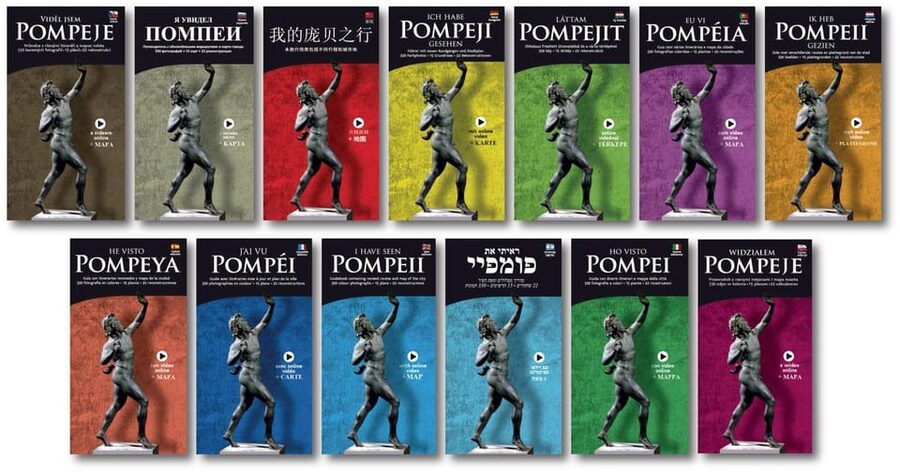
Review · POMPEII TOURS
Pompeii: Skip-the-Line Ticket and Guidebook with Itineraries
Pompeii feels like a time machine. This combo pairs a skip-the-line ticket with a practical Pompeii guidebook + map, so you can see the big sights and also wander into the quieter corners without guessing. I love the freedom to pace yourself, and I love that the guidebook gives you structure via 2, 4, or 6-hour plans. One thing to consider: this is set up as self-guided, so it’s not the same as having a live human guide marching you from stop to stop.
You enter the archaeological park between 9AM and 5PM, then follow the book’s suggested route at your own speed. If you want Pompeii to feel less like a blur and more like a set of readable scenes—amphitheater, fresco houses, spas, shops, Thermopolis, theaters, brothels, and the victim casts—this format helps a lot.
In This Review
- Key things to know before you go
- What You Get for $41: Skip-the-Line Plus a Keepsake Guidebook
- How the Self-Guided Format Works: 2, 4, or 6 Hours
- Entering Piazza Anfiteatro: Getting In Without Stumbling Around
- The Pompeii Core Loop: Amphitheater and Victim Casts
- Frescoed Houses, Shops, and What to Notice as You Walk
- Spas, Temples, and Theaters: Public Spaces You Can Actually Feel
- Thermopolis and the Brothel Squares: Everyday Life Under Ash
- A Practical Route: How to Choose Your Stops for 2, 4, or 6 Hours
- Comfort and Footwear: The Simple Stuff That Makes Pompeii Work
- Who This Fits Best (and Who Should Rethink It)
- Is This $41 Ticket Worth It? My Value Take
- Should You Book This Pompeii Ticket-and-Guidebook Combo?
- FAQ
- How long can I visit Pompeii with this ticket?
- Is the ticket skip-the-line?
- What’s included in the price?
- Do I get a live guide walking with me inside Pompeii?
- What languages are available?
- Where do I meet the staff, and where do I enter the park?
- What should I bring?
- Is food included?
- Can I cancel for a refund?
- Is there a youth price, and who qualifies?
Key things to know before you go

- Skip-the-line entry saves time at the gate when you have limited hours.
- 2, 4, or 6-hour itineraries mean you can match Pompeii to your energy level.
- A keepsake guidebook and updated map help you navigate without constantly checking your phone.
- It’s truly self-paced: you decide what to linger on and what to skip.
- Expect the “guide” to be the book, not a guided walking tour led by a person.
- You’ll learn the why: the city’s story and the eruption context are built into the walk.
Which Pompeii ticket and guide? Compare a few more.
- Pompeii: Entry Ticket and Guided Tour with an Archaeologist★ 4.8 · 19,459 reviews
- Pompeii: Small Group Tour with an Archaeologist★ 4.8 · 12,264 reviews
- Pompeii: Skip-the-line Entry Ticket with Audio Guide & Map★ 3.9 · 3,153 reviews
- Naples: Pompeii and Mt. Vesuvius with Lunch and Wine Tasting★ 4.5 · 2,454 reviews
What You Get for $41: Skip-the-Line Plus a Keepsake Guidebook
For about $41 per person, you’re buying three things that matter on a day trip: a skip-the-line ticket, a guidebook you can keep, and a Pompeii map that comes with three different itineraries. That’s good value if you want to spend your time inside Pompeii instead of waiting outside it.
The ticket covers your entrance to the Pompeii archaeological park, while the guidebook turns the ruins into something you can actually understand as you walk. You also get a map that’s meant to help you find the most interesting points quickly, especially useful when you arrive and Pompeii is already full of people, noise, and choices.
Two costs you should plan for: food and beverages, plus transportation to and from Pompeii. If you’re doing a full route (often 4 hours or more), budget for snacks and water so you don’t feel rushed.
How the Self-Guided Format Works: 2, 4, or 6 Hours
This is designed for independent exploration. You enter between 9AM and 5PM, then use the guidebook’s planning options to build your personal route. That matters because Pompeii doesn’t work like a museum where you can absorb everything in an hour. It’s spread out, and you’ll do best if you give yourself a realistic time window.
Here’s the practical upside: you can start strong, take breaks when your feet demand it, and slow down when something grabs you—like frescoes or the victim casts. You also don’t have to keep up with a group pace, which is a big deal in a place like this.
A quick heads-up on expectations: some people assume this is a live, human-led tour. But the heart of the experience is the guidebook and map approach, plus staff support to get you access smoothly. If you want an on-the-ground narrator constantly explaining every turn, this may not feel like that.
Entering Piazza Anfiteatro: Getting In Without Stumbling Around
Your entry into the archaeological park is through Piazza Anfiteatro using your reservation. Before you reach that point, you meet the team (often with blue and yellow jackets) outside their office.
Once you’re in the area, you’ll check in at the information point on Via Roma 123, Pompeii. The process is straightforward: show your voucher and staff help you access the Pompeii archaeological park.
One practical tip from how this day can unfold: plan a little extra time for anything that involves obtaining paper tickets for entry. I’ve seen situations where people needed to pick up printed tickets nearby before going through security, and it caused a rerouting. You don’t want that stress on your one big day—arrive with buffer time, and follow whatever instruction staff give you at Via Roma 123.
Also, if you rely on clear directions in English at the entry area, don’t be shy about asking on the spot. When signage gets crowded, a quick check can save you time and wrong turns.
The Pompeii Core Loop: Amphitheater and Victim Casts
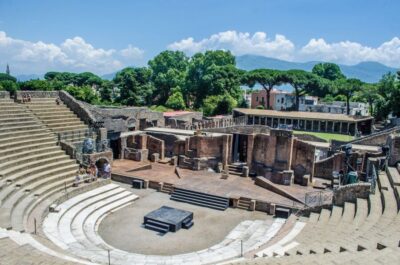
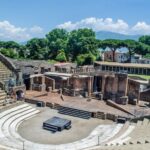
If you do just a few things well in Pompeii, make them these: the amphitheater and the casts of the victims. The amphitheater is one of the most dramatic preserved structures, and it gives you a sense of how public life worked in the city. Even if you’re not a history fanatic, you’ll understand the scale of gatherings once you’re standing there.
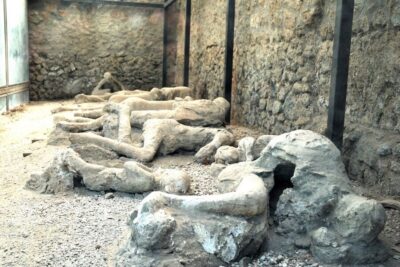
Then the victim casts hit a different note. They make the eruption story immediate. Instead of learning the event as a vague fact, you see its human impact in a physical, unforgettable way. It’s heavy. That’s the point. Give yourself time here rather than rushing through.
In a 2-hour plan, these two stops usually become your anchor. In longer plans, you’ll keep returning to them in your memory as you connect what you’re seeing to what the city was doing day-to-day.
Other tickets and entries for Pompei Campania



Frescoed Houses, Shops, and What to Notice as You Walk
One of the best parts of doing Pompeii with a guidebook is that it tells you what to look for as you pass by. The city is packed with details, and without direction, you can end up just taking photos and moving on.
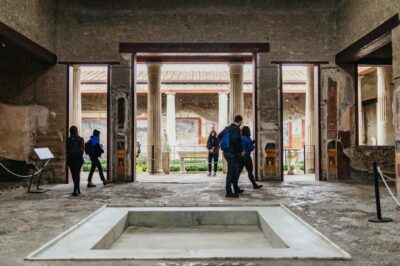
Spend time on the frescoed houses and you’ll start seeing how decorative art worked like a storytelling system. Look for wall paintings, room layout cues, and the way spaces connect to street activity. It’s not just pretty. It’s how people expressed identity and status.
Then watch for shops and street-side commercial life. Even when you don’t know every term, you can still read the pattern: this is a city that ran on daily buying, selling, eating, and repairing. The guidebook helps connect those dots instead of letting them float past you.
If you’re the kind of person who likes tangible details—textures, rooms, and everyday spaces—this is where Pompeii starts to feel personal.
Spas, Temples, and Theaters: Public Spaces You Can Actually Feel
Pompeii isn’t only about homes. You also get a strong hit of public culture: spas, temples, and theaters.
The spas are a great place to slow down. Even if you’re not thinking like a Roman engineer, you’ll understand the rhythm of bathing and the social element of relaxing together. A guidebook helps you pick up why these spaces mattered, instead of treating them as random stone rooms.
Temples are often the easiest place to get the emotional temperature of a city. You’re looking at sacred space and the way people gathered around belief and rituals. Again, the guidebook matters because it frames the why, not just the what.
Finally, theaters. They’re one of those places where your brain clicks into place quickly: people came here for performance, conversation, and community energy. You’ll feel it more than you can explain it. Give yourself a few minutes to look at the structure and imagine the crowd.
Thermopolis and the Brothel Squares: Everyday Life Under Ash
Some ruins are impressive because they’re monumental. Pompeii is powerful because it shows the ordinary. You’ll encounter Thermopolis, which is essentially the ancient version of coffee-fast food—a place built for quick service and regular stops. It’s the kind of detail that makes the city feel lived-in.
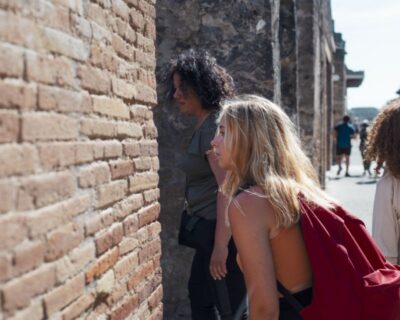
You’ll also see spaces associated with nightlife and sex work, including brothels. This is where Pompeii can surprise you if you came expecting only grand houses and temples. The guidebook helps you stay grounded in what you’re seeing so you don’t turn it into shock tourism. The goal is understanding the city as a real place with real behaviors.
And yes, you’ll still see frescoed houses and other domestic zones. But after Thermopolis and the brothel areas, the city reads differently. You start to see how money, pleasure, routine, and religion all sat side by side.
A Practical Route: How to Choose Your Stops for 2, 4, or 6 Hours
The guidebook includes itineraries of two, four, or six hours, and the best way to use it is to commit to one plan before you start walking. Don’t keep flipping pages once you’re inside. Pick a track, then adjust only when you find a stop you can’t leave.
Here’s a practical way to think about the three time slots based on Pompeii’s main “anchor” areas you’ll likely want:
For two hours, aim for the headline impact: amphitheater plus the victim casts. Then add one domestic zone with frescoes, and one street-level slice like shops or a quick look at Thermopolis. This route won’t feel complete, but it will feel meaningful.
For four hours, you can afford to connect the dots. Add spas, theaters, and another public space like a temple or additional houses. You’ll start seeing patterns—how people moved through neighborhoods, where daily routines likely happened, and how entertainment and worship fit into regular life.
For six hours, you get room for slower looking. You can cover more zones without skipping what you find interesting. This is also the best time slot if you want to re-read your guidebook notes as you walk—using the map to locate points, then going back to linger.
If you’re short on time, don’t punish yourself by forcing every category. Pick your “must sees,” then let the guidebook fill in the rest.
Comfort and Footwear: The Simple Stuff That Makes Pompeii Work
You’ll want comfortable shoes. Pompeii is a walking experience, and your feet will decide how long you actually stay. If you’re wearing anything uncomfortable because it looks good, Pompeii will collect its fee.
The info also mentions dresses, so if you plan to wear one, keep it comfortable for long walking. If you prefer something else, just follow whatever clothing guidance you were given and prioritize movement over style.
Also, remember that food and beverages aren’t included. Bring water and a small snack strategy. Pompeii days go better when you stop for a breather before you hit the wall.
Who This Fits Best (and Who Should Rethink It)
This works especially well for you if you like independence. If you enjoy walking at your own pace and using a map and guidebook to make sense of what you’re seeing, this is a strong setup. It’s also a good choice if you want to control time and hit at least the major highlights.
It may not fit if you’re expecting a fully guided, live commentary-style tour. This experience is built around the guidebook itineraries, and staff mainly help you access the site.
It also helps if you’re comfortable solving light navigation issues with a map. Pompeii has enough complexity that it rewards preparation, not just enthusiasm.
Is This $41 Ticket Worth It? My Value Take
At $41, you’re paying for convenience and understanding, not for a guided lecture. The skip-the-line access can be the difference between an enjoyable first hour and a frustrating one.
You’re also getting a map plus a keep-forever guidebook, with three routes. That turns your visit into a structured experience even though you’re self-guided. For many people, that’s the real value: it keeps Pompeii from becoming a blur.
If you already know Pompeii well and you’re confident you can handle ticketing and entry smoothly on your own, you might decide to buy tickets separately. But if you want simpler planning and an organized visit, this package is a practical way to do it.
Should You Book This Pompeii Ticket-and-Guidebook Combo?
I’d book it if you want an easy, efficient day where you can still think and learn as you walk. The skip-the-line ticket and the map + itineraries are what make it feel worth the money, especially if you plan for 4 hours or at least anchor your time with the amphitheater and victim casts.
I’d pause and read the expectations closely if you’re hoping for a live guide walking you through every stop. This is a guidebook-first experience, with staff support focused on getting you into the park.
If you’re flexible, show up early, and use the 2/4/6-hour plan you choose before you start, you’ll get a day in Pompeii that feels coherent instead of chaotic.
FAQ
How long can I visit Pompeii with this ticket?
You have a valid 1-day entry. The guidebook includes itineraries designed for 2, 4, or 6 hours, and entry is available from 9AM to 5PM.
Is the ticket skip-the-line?
Yes. The package includes a skip-the-line ticket to Pompeii.
What’s included in the price?
You get a skip-the-line ticket, a guidebook (listed with multiple languages), and a Pompeii ruins map with 3 itineraries.
Do I get a live guide walking with me inside Pompeii?
This experience is self-guided using the guidebook and map. Staff support helps you access the archaeological park.
What languages are available?
The package indicates support/instructor languages of English, Italian, Spanish, and French.
Where do I meet the staff, and where do I enter the park?
Meet the team outside their office. Staff are at Via Roma 123, Pompeii, and the archaeological park entrance for your reservation is Piazza Anfiteatro.
What should I bring?
Bring your passport or ID card.
Is food included?
No. Food and beverages are not included.
Can I cancel for a refund?
Yes. Free cancellation is available up to 24 hours in advance for a full refund.
Is there a youth price, and who qualifies?
The youth price (18–24 years old) is only for EU citizens.
More Tickets and Entries in Pompei Campania





More Tour Reviews in Pompei Campania



More Pompeii Tours to Compare
More Pompei Campania tours, freshly reviewed



Pompeii Tours, compared.
 ★ 4.8Pompeii: Entry Ticket and Guided Tour with an ArchaeologistFrom $3519,459 reviews
 ★ 4.1Pompeii: Entry Ticket with Audio GuideFrom $4013,491 reviews
 ★ 4.8Pompeii: Small Group Tour with an ArchaeologistFrom $4012,264 reviews
 ★ 4.3Pompeii Ruins & Mount Vesuvius Day TourFrom $12011,459 reviews
★ 5.0Pompeii Small Group Tour with an ArchaeologistFrom $356,593 reviews
★ 4.3Pompeii Ruins & Mount Vesuvius Day TourFrom $12011,459 reviews
★ 5.0Pompeii Small Group Tour with an ArchaeologistFrom $356,593 reviews
 ★ 4.5Skip-the-line Pompeii – Small Group TourFrom $544,401 reviews
 ★ 4.6Naples or Sorrento: Full-Day Pompeii and Mount Vesuvius TourFrom $1044,235 reviews
 ★ 3.9Pompeii: Skip-the-line Entry Ticket with Audio Guide & MapFrom $433,153 reviews