
Review · POMPEII TOURS
Pompeii excavations: skip-the-line private tour
Pompeii hits hard, even on a short visit. What makes this tour work is the focused route: a certified guide pulls you through the big highlights, from living street scenes to the victims’ casts that make the disaster feel painfully real. I like that you’re not just staring at stones—you’re given a path that connects everyday life to the city’s last moments. The main drawback to plan for: it’s about 2 hours, so you won’t see everything at a slow, everything-in-depth pace, and the entrance fee isn’t included.
This is a private experience, so your group stays together and you can move at a human speed instead of being swallowed by a big bus crowd. The tour starts at Piazza Esedra in Pompei at 10:00 am and returns you to that same spot when you’re done. One more practical point: the experience requires good weather, so if you’re visiting in shoulder season, have a flexible mindset.
In This Review
- Key Highlights You’ll Care About
- Pompeii Still Feels Like People Lived Here
- What a 2-Hour Private, Skip-the-Line Tour Covers (and What It Doesn’t)
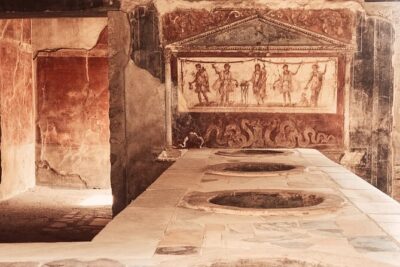
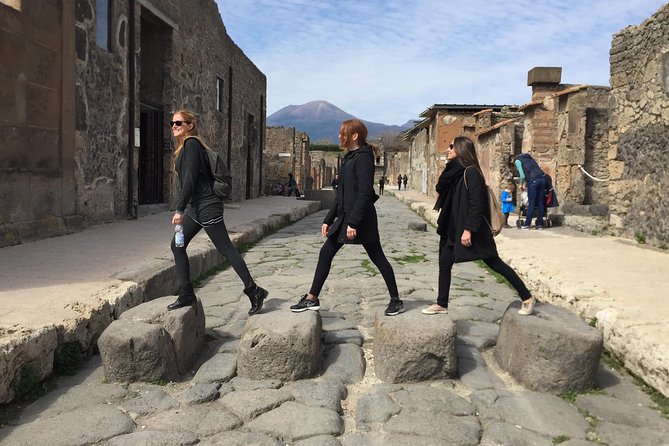
- Street-Level Pompeii: Shops, Taverns, Bakers, and Everyday Life
- Into Homes: Frescoes, Mosaics, and Graffiti You Can Still Read
- Public Spaces That Explain the City: Theaters, Gyms, Spas, Markets
- The Forum: Pompeii’s Nerve Center
- The Victims’ Casts: What You’ll See and How to Handle It
- Price and Value: Is $348.44 Worth It?
- Timing, Tickets, and the Morning Start at 10:00
- Weather and Comfort: Pompeii Outdoors for Real
- Who Should Book This Pompeii Private Tour (and Who Should Rethink It)
- Should You Book This Pompeii Private Tour?
- FAQ
- How long is the Pompeii excavations skip-the-line private tour?
- Is this a private tour?
- Where does the tour start and end?
- Is the Pompeii entrance fee included?
- What’s included in the price?
- Do I get a mobile ticket?
- What happens if the weather is bad?
Key Highlights You’ll Care About
- A true highlight route in ~2 hours: streets, homes, and public spaces without endless wandering
- Villa dei Misteri and fresco-and-mosaic interiors: decorative details you can actually understand on the move
- Forum first-plan focus: Pompeii’s nerve center is worked into the end of the walk
- The haunting casts: fleeing people’s expressions and postures, preserved in ash
- Skip-the-line setup with mobile ticket: you’ll be ready to show your ticket quickly
- Private group only: just your group, not a mixed crowd flow
Which Pompeii ticket and guide? Compare a few more.
- Pompeii Small Group Tour with an Archaeologist★ 5.0 · 6,593 reviews
- Discover the Ancient Ruins of Pompeii: Day Trip from Rome★ 3.5 · 2,247 reviews
- Pompeii and Herculaneum Small Group Tour with an Archaeologist★ 5.0 · 1,350 reviews
- Skip the Line Guided Tour of Pompeii led by an Archaeologist★ 5.0 · 703 reviews
Pompeii Still Feels Like People Lived Here
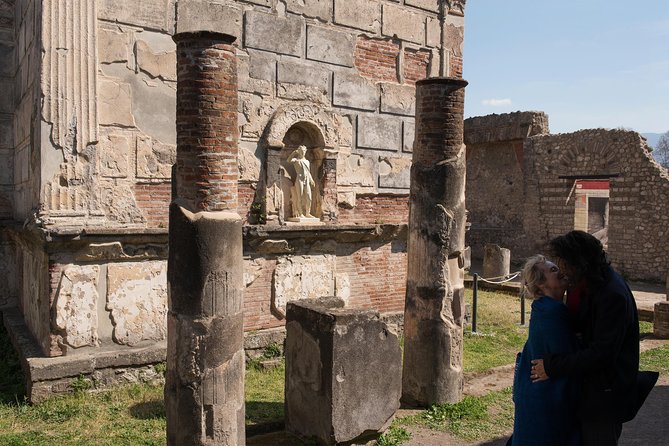
Pompeii is one of those rare places where the ruins don’t feel dead. You’re walking a city that was frozen in a second—homes, shops, and public buildings still arranged like they were waiting for the next person to step through the doorway.
On this tour, that feeling is less random. The guide doesn’t just point out ruins; they connect what you’re seeing to how Romans actually lived—where they shopped, where they relaxed, how neighborhoods worked, and what daily life looked like before Vesuvius put an abrupt stop to it.
If you’ve only got a morning or you want your first visit to feel guided but not rushed, this kind of route makes sense. It also helps if Pompeii feels overwhelming on your own: the site is huge, and a plan keeps you from spinning in circles.
What a 2-Hour Private, Skip-the-Line Tour Covers (and What It Doesn’t)
The duration is about 2 hours, and that’s the key to setting expectations. In that time, you’ll hit major zones—enough to get the story of the city and to see the standout interiors and public spaces.
What you won’t do in 2 hours is “everything, at a slow museum pace.” Pompeii is big, and even with a guide, the best approach is to accept that this visit is about understanding the city’s main beats, not collecting every single detail.
Also remember: the entrance fee is not included. That matters for value and for timing. Your tour can be skip-the-line in the way these services usually operate, but you’ll still want your ticket situation handled smoothly ahead of time so you don’t lose time when you arrive.
Street-Level Pompeii: Shops, Taverns, Bakers, and Everyday Life
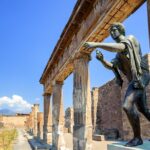
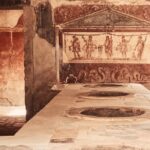
You start with the narrow street experience—those tight lanes that make Pompeii feel intimate. The route moves through areas associated with daily life: houses beside spaces where people ate, shopped, and worked. You’ll see the kind of urban layout that makes you think, not just admire.
This part is more than scenery. The streets are where the city’s “pulse” shows up. When you’re told what a building was used for—what kind of shop or everyday stop it was—you stop seeing disconnected walls and start seeing a working community.
A practical tip for this segment: wear shoes that handle uneven ground and lots of standing. Pompeii’s textures and surfaces are part of the experience, but they can be tiring if your footwear is wrong.
Into Homes: Frescoes, Mosaics, and Graffiti You Can Still Read
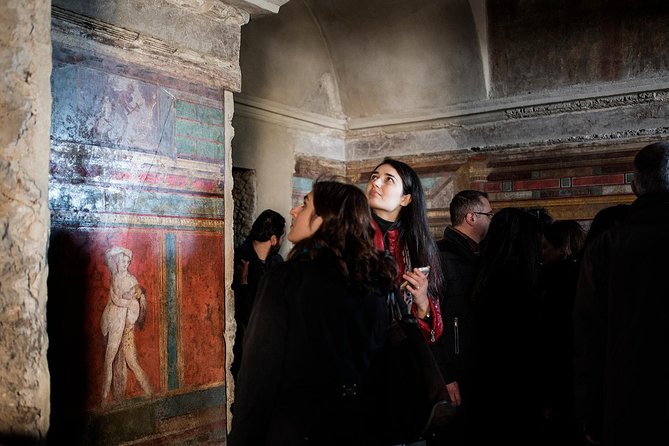
One of the biggest reasons to do a guided Pompeii visit is that houses can be overwhelming if you don’t know what you’re looking at. This tour leans into that. You’ll get into the kind of interiors that make Pompeii feel personal.
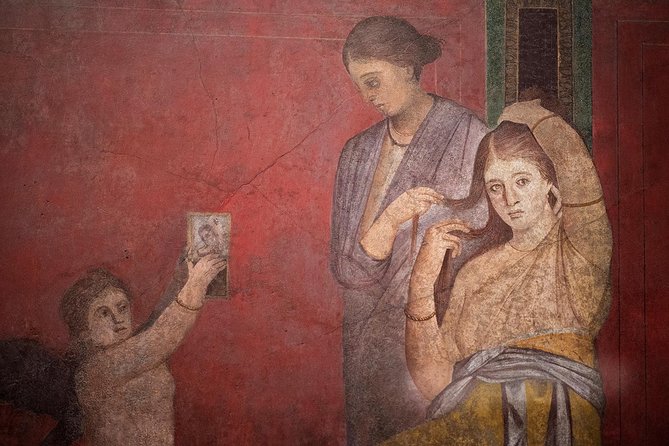
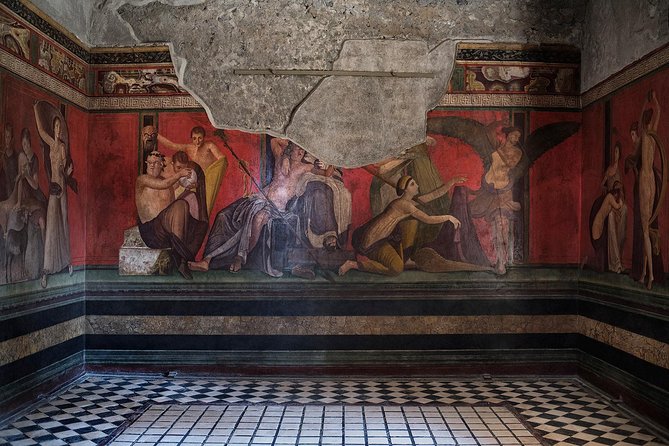
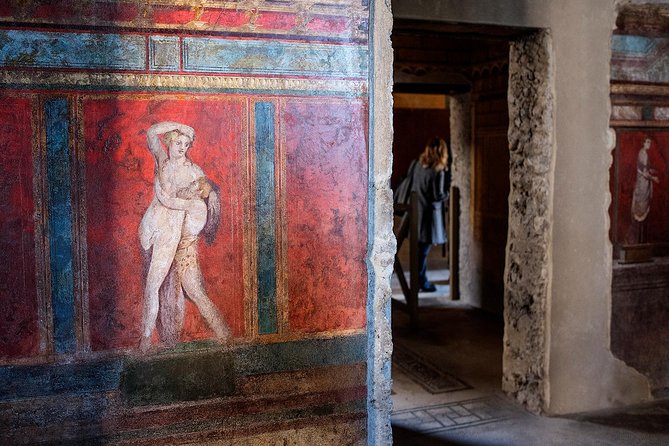
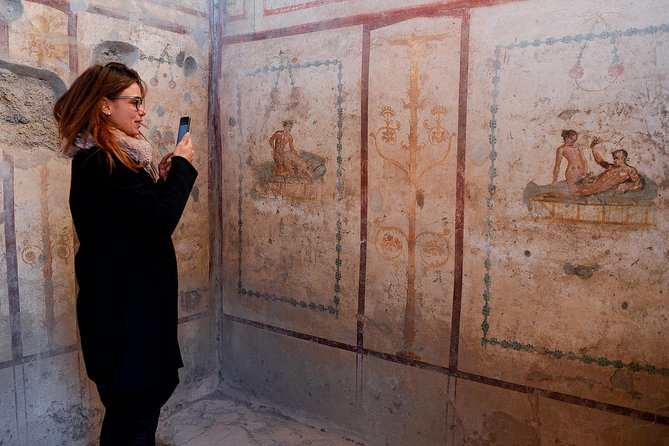
Expect splendid frescoes and refined mosaics, plus the graffiti that still can be read. That graffiti detail is a big deal because it reframes the ruins. This isn’t just art for elites; it’s also scribbles and messages from regular people. It’s the difference between seeing Pompeii as “ancient” and seeing it as human.
You’ll also visit interiors like the Villa dei Misteri, mentioned as an extraordinary stop. Even if you’re not a Roman-art expert, the guide’s job here is to help you notice what matters—colors, themes, layout, and why those decorations were where they were.
The only consideration: house interiors can be visually intense. If you’re prone to information overload, pace yourself mentally. Let the guide’s explanations give meaning, then take a minute to look without listening for a few seconds.
Rather go private? More options in Pompeii



Public Spaces That Explain the City: Theaters, Gyms, Spas, Markets
Pompeii wasn’t only homes and narrow lanes. It was a city with places for public life and leisure—spaces where people gathered, trained, performed, and spent time.
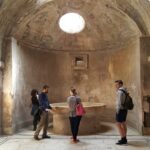
As you move through theaters, gymnasiums, spas, and markets, the city starts to feel organized. You’ll see how social life worked and how the “public” Pompeii shaped the rhythms of a day.
This is also where a guide earns their keep. Without context, it can be easy to lump everything into “ruins.” With context, each building becomes a clue: who used it, what it was for, and how it fit into the larger city plan.
The Forum: Pompeii’s Nerve Center
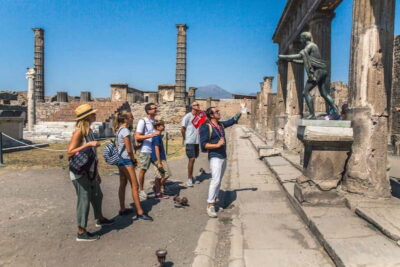
Your walk ultimately reaches the Forum, described as the nerve center of the city. That’s the right place to aim for near the end of a short tour because it ties together what you’ve already seen.
Think of it as Pompeii’s main storyline location: after walking through daily lanes and private living spaces, the Forum gives you the city’s structure—where public decisions and social momentum would have happened.
If you’re the type who wants “one big takeaway,” the Forum is a strong candidate. It helps you connect the city’s everyday life to its power center, and it gives your visit a sense of arrival rather than just movement.
The Victims’ Casts: What You’ll See and How to Handle It
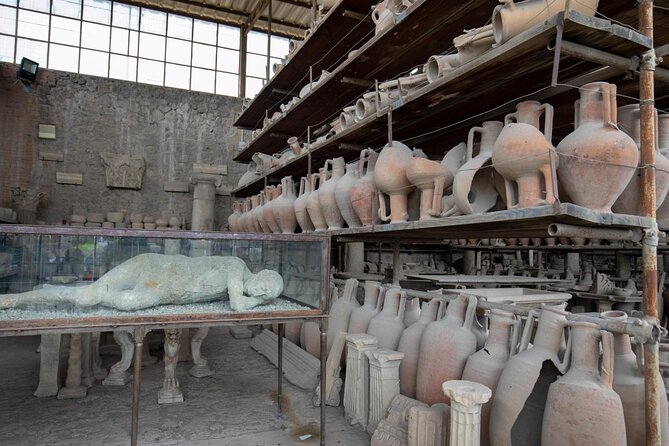
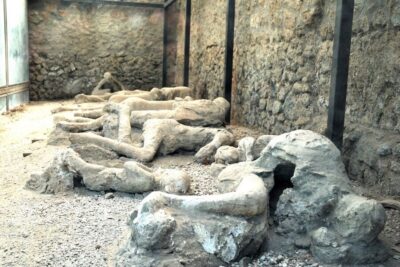
The tour ends with one of Pompeii’s most emotionally difficult highlights: the casts of the fleeing inhabitants. You’re shown figures whose breath stopped suddenly, with ash and lapilli preserving their expressions and postures—desperate on the run, people clinging to each other, women and children huddled, bodies contorted by harmful gases, and even a dog tied to a leash.
This is the part that tends to stick with you. It’s also the part where preparation matters. Go in with two expectations:
1) It will feel intense and personal.
2) Photos won’t help much. Looking directly, slowly, will.
If you’re visiting with kids or people who don’t handle death and tragedy well, you might want to mentally map a quieter exit plan. You can step back for a moment and come back when you’re ready.
Price and Value: Is $348.44 Worth It?
The price is $348.44 per person, and it’s a private skip-the-line guided tour lasting about 2 hours. On paper, that’s not cheap. But it can be good value if you care about time, guidance, and a tight first-visit route.
Here’s how I think about it:
- You’re paying for a plan. Pompeii can swallow time. A guide helps you hit the big story beats—streets, interiors, the Forum—without wasting half your trip figuring out what to see first.
- Private format matters. If you’re traveling as a couple or small family, private often means less friction, fewer delays, and more control over pace.
- Entrance fee is separate. Since the entrance fee isn’t included, factor that into your total budget. I’d treat the tour price as the guide + service component, then add the park entry on top.
If you’re the kind of traveler who already knows Pompeii well and wants total freedom, you might find better value going independently with a map and audio. But if this is your first time and you want the city’s main narrative made clear fast, this pricing can start to look reasonable.
Timing, Tickets, and the Morning Start at 10:00
The tour starts at 10:00 am and begins at Piazza Esedra. It’s set up for easy access: it’s near public transportation, and the experience is described as one most travelers can participate in.
A key practical choice: handle your entry smoothly. Because the entrance fee isn’t included, don’t show up assuming everything is solved. Have your ticket plan ready so you don’t lose your advantage of the skip-the-line style setup.
Also, the tour uses a mobile ticket, so be ready to pull it up on your phone. If your battery is always a risk (I’ve learned this the hard way), bring a small portable charger.
Weather and Comfort: Pompeii Outdoors for Real
The experience requires good weather, which is a reminder that this is an outdoor walking visit across a large archaeological site.
Bring what you need for walking: comfortable shoes and a hat if the sun is strong. Even when the weather is fine, Pompeii can be slow-going underfoot, and you’ll stand and look for periods at each stop.
If you’re the type who runs cold, you might still want layers—Pompeii’s conditions can change, and waiting around for any delay can feel colder than you expect.
Who Should Book This Pompeii Private Tour (and Who Should Rethink It)
This tour is a smart match for you if:
- you want a guided highlight route in about 2 hours
- you like understanding what you’re seeing, not just photographing it
- you’re visiting for the first time and want the story from everyday life to catastrophe
- you value the private pace and a skip-the-line style experience
You may want to rethink it if:
- you want a slow, unhurried “see everything” day. Pompeii needs time, and 2 hours is a strong commitment to highlights
- you’re counting on the tour price alone to cover entry. The entrance fee isn’t included
- you get frustrated if anything small about ticketing or access isn’t perfectly handled before you arrive
Should You Book This Pompeii Private Tour?
I’d book it if you want Pompeii to feel clear and guided without turning into a full-day slog. The route is built around the city’s most meaningful segments: streets that show daily life, homes with frescoes and mosaics, the Villa dei Misteri-style interior focus, the Forum as the city’s core, and the victims’ casts that explain the tragedy in the most unforgettable way.
I’d pass or choose another option if you’re chasing a full, slow “everything” visit, or if you’d rather manage logistics independently.
One final nudge: it’s an experience people book ahead (on average about 5 days in advance). If you’re traveling in high season or on a popular weekend, lock it in early so your schedule stays workable.
FAQ
How long is the Pompeii excavations skip-the-line private tour?
It lasts about 2 hours (approx.).
Is this a private tour?
Yes. It’s private, and only your group participates.
Where does the tour start and end?
It starts at Piazza Esedra, 80045 Pompei NA, Italy at 10:00 am and ends back at the same meeting point.
Is the Pompeii entrance fee included?
No. The entrance fee for Pompeii is not included.
What’s included in the price?
The tour includes a professional guide.
Do I get a mobile ticket?
Yes. The experience includes a mobile ticket.
What happens if the weather is bad?
The tour requires good weather. If it’s canceled due to poor weather, you’ll be offered a different date or a full refund. Also, you can cancel up to 24 hours in advance for a full refund.
More Tours in Pompeii



More Tour Reviews in Pompeii

More Pompeii Tours to Compare
More Pompeii tours, freshly reviewed



Pompeii Tours, compared.
 ★ 4.8Pompeii: Entry Ticket and Guided Tour with an ArchaeologistFrom $3519,459 reviews
 ★ 4.1Pompeii: Entry Ticket with Audio GuideFrom $4013,491 reviews
 ★ 4.8Pompeii: Small Group Tour with an ArchaeologistFrom $4012,264 reviews
 ★ 4.3Pompeii Ruins & Mount Vesuvius Day TourFrom $12011,459 reviews
★ 5.0Pompeii Small Group Tour with an ArchaeologistFrom $356,593 reviews
★ 4.3Pompeii Ruins & Mount Vesuvius Day TourFrom $12011,459 reviews
★ 5.0Pompeii Small Group Tour with an ArchaeologistFrom $356,593 reviews
 ★ 4.5Skip-the-line Pompeii – Small Group TourFrom $544,401 reviews
 ★ 4.6Naples or Sorrento: Full-Day Pompeii and Mount Vesuvius TourFrom $1044,235 reviews
 ★ 3.9Pompeii: Skip-the-line Entry Ticket with Audio Guide & MapFrom $433,153 reviews