
Review · POMPEII TOURS
Pompeii and Herculaneum Small-Group with an Expert Archaeologist
This is one of the fastest ways to see two UNESCO-linked Roman towns in a day. You’ll get an expert archaeologist’s context, skip the logistics, and cover Pompeii first—then head to Herculaneum for a calmer, more intimate walk through structures and everyday rooms preserved under ash.
What I like most is the small-group feel (max 21) paired with included entry tickets—so you’re not burning time figuring out venues, lines, or ticket counters. The second big win is the travel setup: you’re in an air-conditioned vehicle, which matters a lot when Vesuvius-country heats up.
The main drawback to plan around is time. Even though the tour is described as 6 to 11 hours, the on-site visits are broken into many short stops, so if you love slow, photo-by-photo reading, you may want more time than this day trip allows.
In This Review
- Key highlights worth noting before you go
- Pompeii and Herculaneum in one day: what you’re really buying
- Price and logistics: why this is more useful than it sounds
- Getting there in comfort: air-conditioned rides that actually matter
- Pompeii first: how the route builds your understanding fast
- Odeon to Teatro Grande: theaters and social life in Pompeii
- Pompeii houses (Menander, Faun) and the “everyday wow” moments
- Baths and the Lupanar: public space, hygiene, and power
- Via dell’Abbondanza, the Foro, and Basilica: where the city did its work
- Transfer time and the lunch break you should plan for
- Herculaneum’s 2-hour guided visit: the preserved feeling is real
- Herculaneum stops that help you “see the system,” not just the stones
- Central Thermae and the sex-separate routine
- Samnite-style Casa Sannitica and Herculaneum’s courtyard designs
- What the guide experience tends to get right
- Who this tour suits best (and who should think twice)
- Should you book? My practical take
- FAQ
- How long is the Pompeii and Herculaneum small-group tour?
- Is the tour offered in English?
- What’s included in the price?
- What isn’t included?
- Does it include admission tickets for the sites?
- Is there time to eat lunch?
- What are the group size limits?
- Is the vehicle air-conditioned?
- Do children get discounted entry?
- What happens if the tour doesn’t meet the minimum number of passengers?
Key highlights worth noting before you go
- Expert archaeologist-led narration in both Pompeii and Herculaneum, not just a quick walk-through
- Pompeii + Herculaneum same day: different vibes, same eruption story
- Air-conditioned round-trip transport from Naples or Sorrento (and Rome connections via Naples)
- Entry tickets included at every stop, including the “Pompeii Express” style admission
- Real neighborhood variety in Pompeii: theaters, baths, brothel, major houses, and main civic spaces
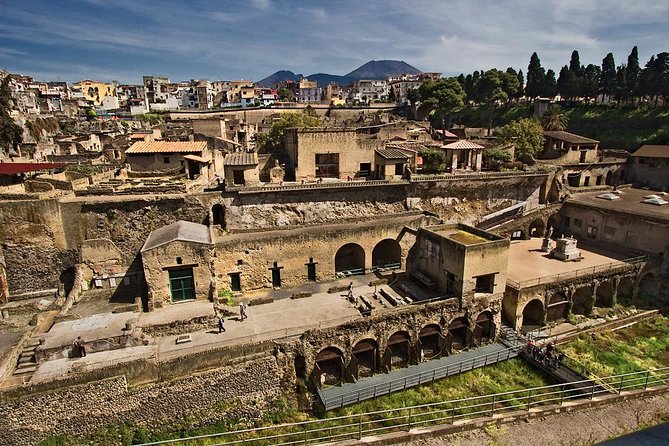
- Herculaneum’s preserved details: mosaics, wooden remains, frescoed rooms, and thermal life
Which Pompeii ticket and guide? Compare a few more.
- Pompeii Small Group Tour with an Archaeologist★ 5.0 · 6,593 reviews
- Discover the Ancient Ruins of Pompeii: Day Trip from Rome★ 3.5 · 2,247 reviews
- Pompeii and Herculaneum Small Group Tour with an Archaeologist★ 5.0 · 1,350 reviews
- Skip the Line Guided Tour of Pompeii led by an Archaeologist★ 5.0 · 703 reviews
Pompeii and Herculaneum in one day: what you’re really buying
You’re paying for a tightly managed day that turns “two big sites” into a single, guided route. Pompeii can be overwhelming on your own: there’s so much stone, so many streets, and not enough time to understand what you’re looking at. With an archaeologist guiding the pace, the ruins become organized in your mind—homes, public spaces, and daily routines start to click.
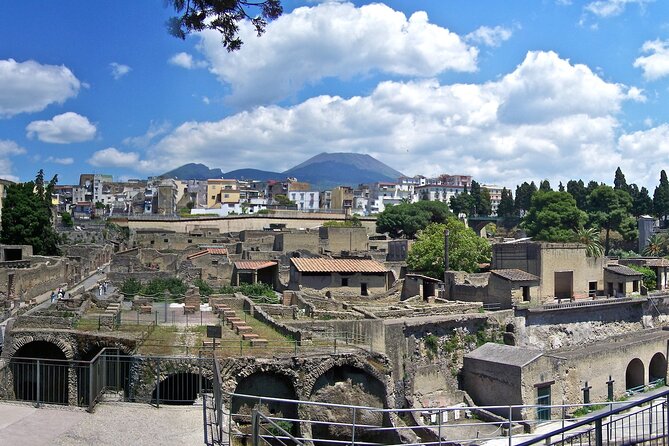
Herculaneum, in contrast, tends to feel smaller and more readable. The ash preservation is a big part of the magic: you don’t just see architecture, you often see traces of how people lived—mosaics and charred wooden elements help you imagine rooms working the way they did before 79 AD.
This is also a value play. At $78.10 per person, you’re not just buying tickets. You’re getting round-trip transportation, guidance at both sites, and the one-way move from Pompeii to Herculaneum. Meals are on you, but the core day is handled.
Price and logistics: why this is more useful than it sounds
Let’s talk practical math. If you tried to assemble this day yourself, you’d spend time on: getting from Naples/Sorrento to Pompeii, managing Pompeii entry, then transferring to Herculaneum, then arranging your return. This package bundles those moving parts and adds a guide who can explain what you’re seeing while you walk.
You’ll also have clearer expectations about duration. It’s listed as 6 to 11 hours (approx.), which usually means the schedule flexes based on your departure point and the day’s timing. That range isn’t a marketing trick; in this region, even short distances can become long travel minutes when traffic and site entry windows come into play.
One more detail I appreciate: you get a mobile ticket. In a place where phones and scanning do the work, that reduces friction when you’re trying to start quickly and keep your day moving.
Getting there in comfort: air-conditioned rides that actually matter
The tour includes round-trip transportation from Naples and Sorrento, and it includes the Rome-to-Naples rail connection plus transportation from Naples. So if you’re coming from Rome, you’re not stuck trying to figure out the last-mile pieces.
The “air-conditioned vehicle” note isn’t fluff. Summer around Naples can turn a good walking day into a sweaty test. When your itinerary has lots of short site segments—often 10 to 15 minutes per stop—being able to cool off between Pompeii and Herculaneum helps you keep your energy for the parts that need attention.
From a comfort standpoint, the day is built for steady movement rather than marathon wandering. That’s exactly what you want when you’ve got one shot at Pompeii and Herculaneum in the same trip.
Pompeii first: how the route builds your understanding fast
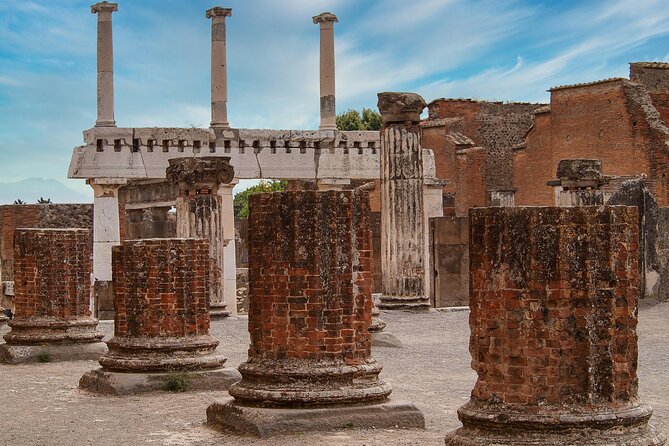
Pompeii gets the first big guided block: about 2.5 hours with the archaeologist at the Archaeological Park of Pompeii. This is where you learn to read the city. The eruption didn’t erase Pompeii into one uniform “ruins” blob—it froze neighborhoods, public spaces, and private life. Your guide’s context helps you stop seeing random walls and start seeing functions: where people gathered, where they sold things, where they bathed, and where they relaxed.
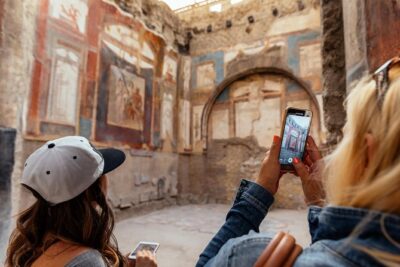
You’ll also focus on famous fresco areas during this time. Frescoes matter here because they show color and branding—what homes wanted visitors to feel and understand. In ruins, those visual cues do a lot of the storytelling.
If you’ve wanted Pompeii for years, this start matters. You’re not just walking in; you’re being taught how to look.
Herculaneum keeps a few more tours worth your time

Odeon to Teatro Grande: theaters and social life in Pompeii
After the main Pompeii orientation time, the route hits performance spaces:
- Odeon – Teatro Piccolo (about 15 minutes): a smaller theater space where you get a sense of how entertainment fit into daily civic life.
- Teatro Grande (about 15 minutes): the big theater, the kind of place that signals civic pride and mass gatherings.
These stops are brief, but that can be a plus. A theater can be hard to understand quickly if you don’t know what you’re looking at. With an archaeologist on hand, you’re more likely to catch why these spaces mattered—not only for shows, but for who had access to public life.
Pompeii houses (Menander, Faun) and the “everyday wow” moments
Pompeii’s domestic architecture is where many first-timers get that sudden, I get it feeling. Two houses on your route:
- House of Menander (about 15 minutes): known for being one of the richest houses in Pompeii, with impressive architecture, decoration, and contents. Even in damaged form, it signals how wealth and taste played out in daily space.
- House of the Faun (about 15 minutes): one of the largest and most impressive private residences.
These are not museums where you stand still forever. You’re moving, looking at layout, then stepping away to keep momentum for the next stop. The value is that your guide can connect the design choices to real social behavior—how guests moved through rooms, how privacy worked, and what “luxury” looked like in practical terms.
Baths and the Lupanar: public space, hygiene, and power
The stops get more vivid after the theaters and houses.
- Stabian Baths (Terme Stabiane) (about 15 minutes): these cover a vast area and are described as the oldest thermal complex in Pompeii. Baths weren’t just about cleanliness; they were social hubs with routines and hierarchy.
- Lupanar (about 15 minutes): the famous brothel in the ruined Roman city.
I’ll be honest: the Lupanar stop is not for everyone in terms of emotional comfort. Still, it’s part of the full picture of how Roman cities functioned. When an archaeologist frames it correctly, you get less sensationalism and more understanding of how people, commerce, and control intersected in urban life.
If you prefer a more neutral tone, you can simply adjust your focus in the moment—look at the layout and context, not the shock factor.
Via dell’Abbondanza, the Foro, and Basilica: where the city did its work
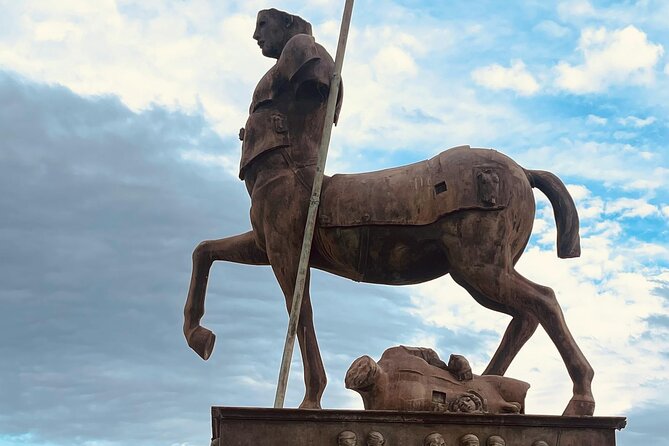
You’ll also walk past and/or look at key streets and civic zones:
- Via dell’Abbondanza (included stop): Pompeii’s famous main thoroughfare. This is where the city’s energy makes sense.
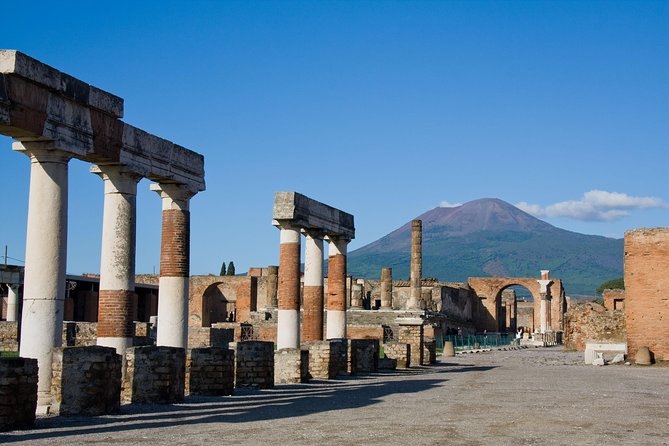
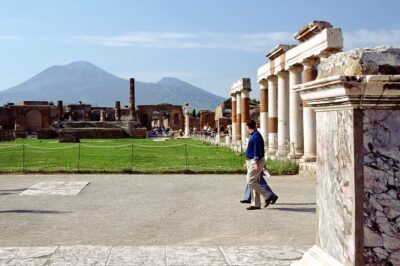
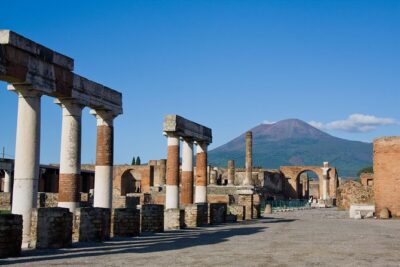
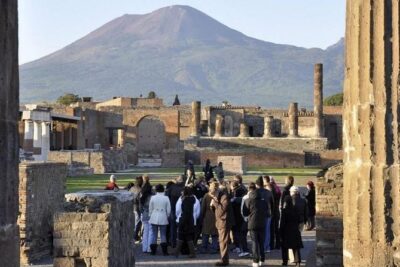
- Foro de Pompeya (about 10 minutes): the ancient main square.
- Basilica (about 10 minutes): an open portico where merchants and other activities took place.
These parts matter because they’re the glue. Houses show private life. The theaters show entertainment. The baths show routine. The forum and basilica show the machinery of trade, decisions, and public movement.
Even with short stop times, these civic anchors keep your mental map from turning into disconnected highlights.
Transfer time and the lunch break you should plan for
After Pompeii, the tour transfers you to Herculaneum. There’s a quick lunch break available, but it’s own expense. This isn’t a full meal stop; think of it as a reset so you can handle the next site without feeling wiped.
My advice: if you’re heat-sensitive, eat something simple and not too heavy, then save your appetite for dinner later. You’ll be walking again.
Herculaneum’s 2-hour guided visit: the preserved feeling is real
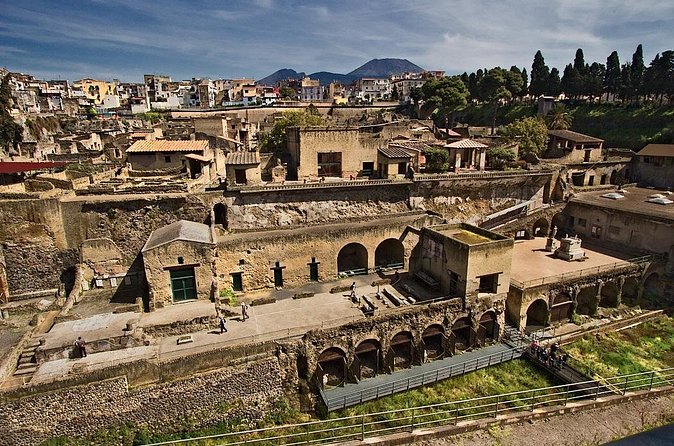
Once you arrive, you get about 2 hours of guided time at the Archaeological Park of Herculaneum. This is where the eruption’s “time capsule” effect becomes tangible. You’ll see wooden structures, mosaics, and everyday objects preserved in a way that makes the Roman city feel close enough to touch.
If Pompeii can feel like a dramatic broad canvas, Herculaneum often feels like you can read a room. And that difference is exactly why doing both works.
Herculaneum stops that help you “see the system,” not just the stones
Your Herculaneum route moves through houses and public life details. Key stops include:
- House of the Deer (about 10 minutes): named for marble stags/deer found in the peristyle.
- La Terrazza di M. Nonio Balbo (about 10 minutes): tied to the city’s major benefactor, with the “long inscription” on his funeral altar noted as a key detail.
- College of the Augustales (about 10 minutes): linked to the cult of Emperor Augustus and the headquarters of the Collegium Augustalium (possibly also the local curia).
- Casa del Rilievo di Telefo (about 10 minutes): unusual for having its own private access to the adjoining Suburban Thermae.
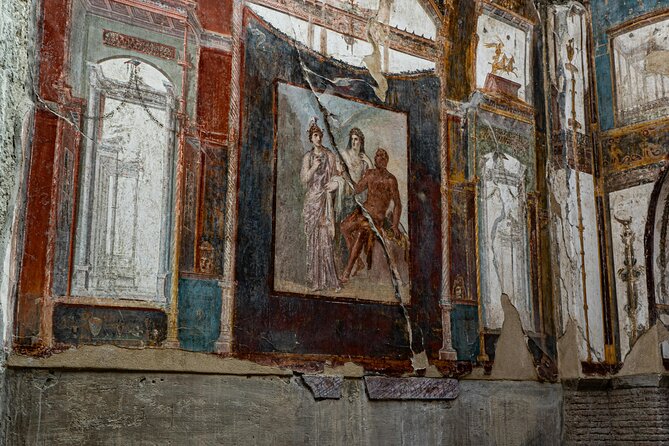
- Partem Domus lignea – Casa del Tramezzo di Legno (about 10 minutes): important for the elegant wooden partition that remained.
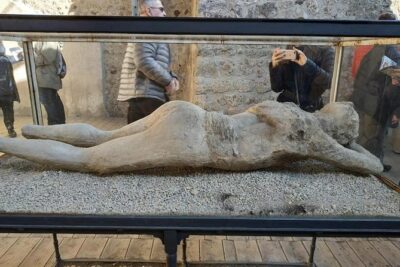
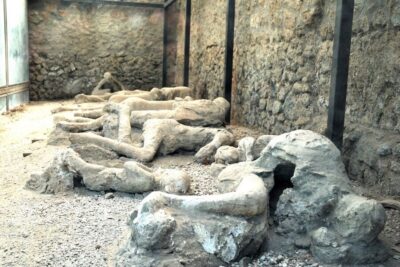
- House of the Skeleton (about 10 minutes): named after human remains discovered in 1831.
Each stop is short, but taken together they teach you how power and daily routines blended: elite patronage, religious/imperial identity, and how private homes related to thermal spaces.
One extra point I think you’ll appreciate: the wooden elements in Herculaneum aren’t just a curiosity. They make the architecture feel more lived-in. When you understand that, you get more out of every doorway and courtyard.
Central Thermae and the sex-separate routine
Next comes more bath life:
- Central Thermae (about 10 minutes): built around the beginning of the 1st century AD, divided into men’s and women’s baths with separate entrances.
It’s a simple detail, but it’s the kind of detail a good guide makes matter. It tells you how Roman cities organized space around identity and routine. Even in ruins, you can feel the structure of daily life.
Samnite-style Casa Sannitica and Herculaneum’s courtyard designs
You’ll also see domestic layouts and decorative choices:
- Casa Sannitica (about 10 minutes): described as typical of the Samnites, with a splendid atrium and a gallery with Ionic columns. Rooms have frescoes.
- Casa del Bel Cortile (about 10 minutes): known for its courtyard with a stairway and a stone balcony instead of an atrium.
- House of the Grand Portal (about 10 minutes): located centrally in the archaeological area, with collonatti, frescoes, and charred remains of wooden parts.
These stops help you compare “ways of living,” not just wealth. You’ll likely notice how courtyards and galleries change the feel of a home, and how decoration signals identity and status.
What the guide experience tends to get right
A recurring theme from real operator feedback is how smoothly the day runs. People talk about guides who bring Pompeii to life with detailed explanations, and drivers who keep pickups on schedule—important when you’re trying to fit two major sites into one day.
You may also hear familiar guide names depending on the day, such as Roberta or Andrea for Pompeii, with other guides mentioned across Pompeii/Herculaneum departures. If you care about having someone who answers questions and explains the logic behind the sights, this is the part to prioritize.
Also: the tour is listed as offered in English, and it’s built for most people (with children under 18 entering for free with valid ID). Max size is 21, which usually keeps the group manageable.
Who this tour suits best (and who should think twice)
This is a strong fit if you:
- Want Pompeii and Herculaneum in one day without planning headaches
- Prefer guided context over reading ruins alone
- Like structured routes with short stops that keep you moving
- Need air-conditioned transport to make the day workable
It’s less ideal if you:
- Want hours in just one house or one street with no time pressure
- Get frustrated when every stop is measured in minutes rather than long wandering
Should you book? My practical take
Book it if your priority is getting the big two sites done with included tickets, guided archaeology, and reliable transport. At $78.10, the value comes from what’s bundled: guidance in Pompeii and Herculaneum plus the transport that would be annoying to assemble on your own.
Skip (or add extra time elsewhere) if you’re the type who wants deep, slow study. This day is designed for momentum and interpretation, not for lingering in every doorway.
If you want one day that turns the eruption story into something you can actually picture, this is one of the better ways to do it.
FAQ
How long is the Pompeii and Herculaneum small-group tour?
The duration is listed as 6 to 11 hours (approx.).
Is the tour offered in English?
Yes, it’s offered in English.
What’s included in the price?
It includes round-trip transportation to/from Naples (and to/from Sorrento), one-way transportation from Pompeii to Herculaneum, train tickets to/from Rome to Naples plus transportation from Naples, Herculaneum entry tickets, Pompeii express entry tickets, and guided tour services in both Pompeii and Herculaneum.
What isn’t included?
Meals and drinks and any personal expenses are not included.
Does it include admission tickets for the sites?
Yes. Admission tickets are included for Pompeii stops and Herculaneum, as listed in the itinerary.
Is there time to eat lunch?
There is a quick lunch break before the transfer to Herculaneum, but it’s own expense.
What are the group size limits?
The tour has a maximum of 21 travelers. It also follows minimum numbers of 6 people per shared tour.
Is the vehicle air-conditioned?
Yes. Transport is by air-conditioned vehicle.
Do children get discounted entry?
Children under 18 enter for free with valid ID.
What happens if the tour doesn’t meet the minimum number of passengers?
In that case, you may be offered an alternative or a full refund.
More Tour Reviews in Pompeii



Herculaneum, a Few More Tours

More Pompeii Tours to Compare
More Pompeii tours, freshly reviewed


Pompeii Tours, compared.
 ★ 4.8Pompeii: Entry Ticket and Guided Tour with an ArchaeologistFrom $3519,459 reviews
 ★ 4.1Pompeii: Entry Ticket with Audio GuideFrom $4013,491 reviews
 ★ 4.8Pompeii: Small Group Tour with an ArchaeologistFrom $4012,264 reviews
 ★ 4.3Pompeii Ruins & Mount Vesuvius Day TourFrom $12011,459 reviews
★ 5.0Pompeii Small Group Tour with an ArchaeologistFrom $356,593 reviews
★ 4.3Pompeii Ruins & Mount Vesuvius Day TourFrom $12011,459 reviews
★ 5.0Pompeii Small Group Tour with an ArchaeologistFrom $356,593 reviews
 ★ 4.5Skip-the-line Pompeii – Small Group TourFrom $544,401 reviews
 ★ 4.6Naples or Sorrento: Full-Day Pompeii and Mount Vesuvius TourFrom $1044,235 reviews
 ★ 3.9Pompeii: Skip-the-line Entry Ticket with Audio Guide & MapFrom $433,153 reviews
Browse the lists this tour appears in