
Review · POMPEII TOURS
Pompeii and Herculaneum Private Walking Tour with an Archaeologist
Pompeii and Herculaneum tell the same disaster story twice. This private tour uses an archaeologist guide to turn the ruins into real daily life, and you’ll move between sites with a train transfer instead of figuring everything out on your own. I love how the pace is built for questions, and I also like that the route hits both volcanic-ash preserved houses in Herculaneum and the big public spaces of Pompeii.
My favorite part is that you get guided attention on specifics you’d otherwise miss: charred wood traces, bath layouts, and the meaning behind household finds like marble stags. One thing to plan for: entry tickets are not included, so you’ll pay for Herculaneum (16 euros adult) and Pompeii separately.
If you want a human guide over a map, this is a strong match—especially for families or groups who can split the cost. Just don’t come in expecting luxury transportation; this is a walking tour with practical logistics and good shoes required.
In This Review
- Key points to know before you go
- Pompeii and Herculaneum in 5.5 hours: how the rhythm works
- Where you meet and how you switch cities without stress
- Herculaneum first: the ash-preserved feel you won’t get elsewhere
- Herculaneum highlights: homes, baths, and carbonized clues
- House of the Deer
- La Terrazza di M. Nonio Balbo
- College of the Augustales
- Casa del Rilievo di Telefo
- Partem Domus lignea: Casa del Tramezzo di Legno
- House of the Skeleton
- Central Thermae
- House of the Black Salon
- Casa Sannitica
- Casa del Bel Cortile
- House of the Grand Portal
- Pompeii after the transfer: public spaces and big-name houses
- Lupanar
- Main street walk and the Forum area
- Granaries of the Forum
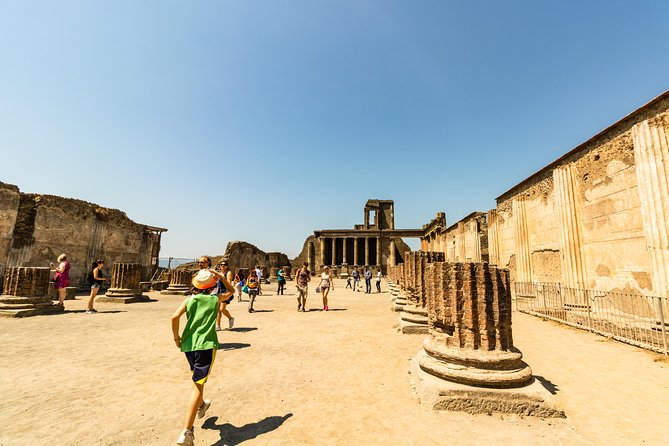
- Basilica
- Stabian Baths (Terme Stabiane)
- House of the Faun and House of Menander
- Teatro Grande and Teatro Piccolo
- Price and value: what $597.36 per group really buys
- Your archaeologist guide: why it matters at these sites
- Logistics that actually affect your day: tickets, heat, and walking
- Who should book this private tour—and who might prefer something simpler
- Should you book? My honest take
- FAQ
- How long is the Pompeii and Herculaneum private walking tour?
- Is this tour private or shared?
- What language is the tour offered in?
- Are admission tickets included for Pompeii and Herculaneum?
- Where do we meet in Herculaneum?
- How do you travel between Herculaneum and Pompeii?
- Is food included?
- What is the cancellation policy?
Key points to know before you go
- Archaeologist-led explanations that connect everyday objects to what Roman life looked like.
- Herculaneum first, then Pompeii, with a train transfer taking about 30 minutes plus a short walk.
- Volcanic-ash preservation details you can actually point at, including carbonized wood.
- Baths, religion, and homes in one sweep, from the College of the Augustales to the Central Thermae.
- Pompeii’s major “everyone wants to see this” stops, plus smaller reveals like Teatro Piccolo.
- Private group of up to 15, so you’re not forced into a slow shuffle behind strangers.
Which Pompeii ticket and guide? Compare a few more.
- From Naples: Pompeii Ruins & Mount Vesuvius Day Tour★ 4.3 · 11,459 reviews
- From Naples: Skip-the-line Pompeii – Small Group Tour★ 4.5 · 4,401 reviews
- Naples or Sorrento: Full-Day Pompeii and Mount Vesuvius Tour★ 4.6 · 4,235 reviews
- Pompeii & Mt.Vesuvius Day Tour from Naples with Pizza Lunch★ 4.0 · 2,901 reviews
Pompeii and Herculaneum in 5.5 hours: how the rhythm works
This is a half-day experience designed to cover two whole archaeological parks without pretending you can sprint through them. The tour runs about 5 hours 30 minutes, and it’s structured around short, repeatable stops (often around 10–15 minutes each), so you get a rhythm: walk, look, listen, move on.
You’ll start in Herculaneum, then transfer to Pompeii. There’s also a quick lunch break if required, but food is on you. I like this approach because you can stay focused on the ruins instead of spending your time “getting there” and “being hungry.”
The private format matters more than you might think. With a group limited to your party only (up to 15), you can ask follow-up questions without feeling like you’re slowing down a bus tour.
Where you meet and how you switch cities without stress
The day has two anchor points, and finding the right one is half the battle.
In Herculaneum, you meet at the Ticket Office of the Herculaneum ruins. You can reach it by car (nearby parking exists in via Pignalver) or by train via Corso Resina 1 (the Circumvesuviana station is about a 10-minute walk away).
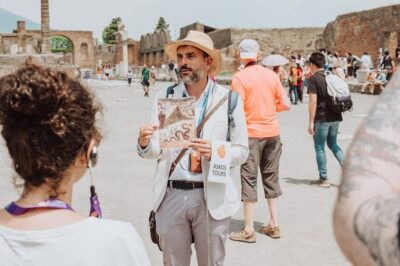
When you head to Pompeii, you meet the guide at the main Pompeii entrance called Porta Marina Superiore. The guide holds a sign for Askos Tours. The tour ends inside the Pompeii ruins, at the location listed as Via Villa dei Misteri, 2, 80045 Pompei NA.
Two small practical tips based on what can go wrong:
- Wear shoes you can walk in for hours. This is not a slideshow.
- Give yourself a bit of buffer for getting from the train drop-off to the meeting spot, because station-to-entrance distances add up.
Herculaneum first: the ash-preserved feel you won’t get elsewhere
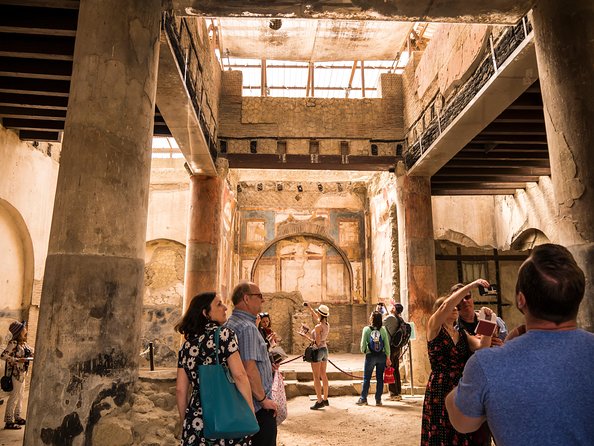
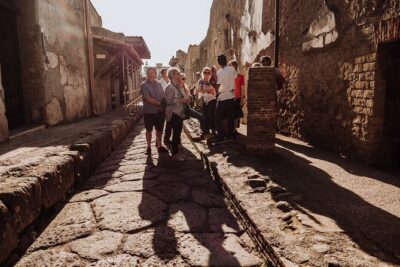
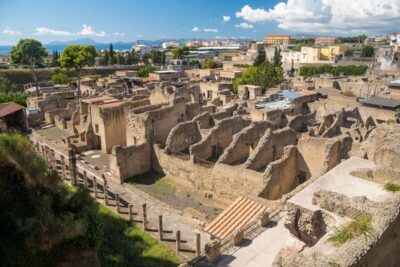
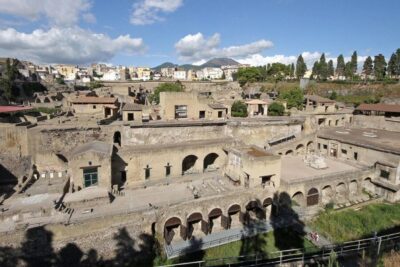
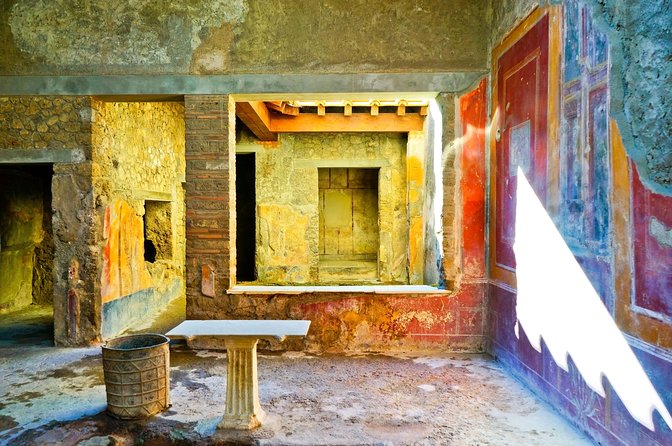
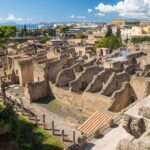
I like starting in Herculaneum because the place feels more “lived-in” than Pompeii. You’re walking through compact streets and houses where volcanic ash helped preserve layouts and materials that Pompeii often loses. The result is that details become your main clues: doorways, bath divisions, room functions, and the way benefactors displayed status.
Your Herculaneum route is packed with domestic and civic stops. It’s not just pretty ruins—it’s the daily-life logic of a Roman town. An archaeologist guide is especially helpful here because Herculaneum’s finds reward interpretation: why a house is shaped a certain way, what a religious building likely served, and how households used space.
Also, the tour includes “quick looks” at a lot of highlights, so you don’t feel locked into one slow mansion for the whole morning. You get variety.
Herculaneum highlights: homes, baths, and carbonized clues
Here’s what you’ll see, and what each stop is doing for your understanding of the city:
Herculaneum keeps a few more tours worth your time

House of the Deer
This house gets its name from marble statue finds of stags/deer in the peristyle. It’s a quick stop, but it’s a good example of how archaeology identifies owner taste and status. You’ll see why the decorative program matters, not just the layout.
La Terrazza di M. Nonio Balbo
This is tied to M. Nonius Balbus, a major benefactor who restored and built public buildings. On his death, he received honours connected to a long inscription. If you like Roman politics and civic life, this is one of the clearer “people behind the buildings” moments.
College of the Augustales
The building is thought to relate to the cult of Emperor Augustus and likely served as a center for the Collegium Augustalium (or possibly a local civic body). This stop helps you understand that not all major architecture was “temple-like.” Some religious life worked through associations and offices.
Casa del Rilievo di Telefo
This house is associated with a leading benefactor (possibly Marcus Nonius Balbus) and stands out for having private access to the adjoining Suburban Thermae to the south. That’s a practical clue to wealth and lifestyle: when you control routes to baths, you control convenience and status.
Partem Domus lignea: Casa del Tramezzo di Legno
This is important because it preserves an elegant wooden partition. Even if you’re not a “wood nerd,” the presence of original wooden structures (or their traces) is what makes Herculaneum special.
House of the Skeleton
The name comes from human remains found in a second-floor room in 1831. This is one of the heavier stops in the itinerary, and your guide’s job here is to explain what the remains likely mean in context—without turning the tragedy into a gimmick.
Central Thermae
You’ll see a large bath complex built around the early 1st century AD, and it’s divided into men’s and women’s baths with separate entrances. This is a great stop for understanding Roman hygiene and routine. Baths weren’t just for washing; they were social infrastructure.
House of the Black Salon
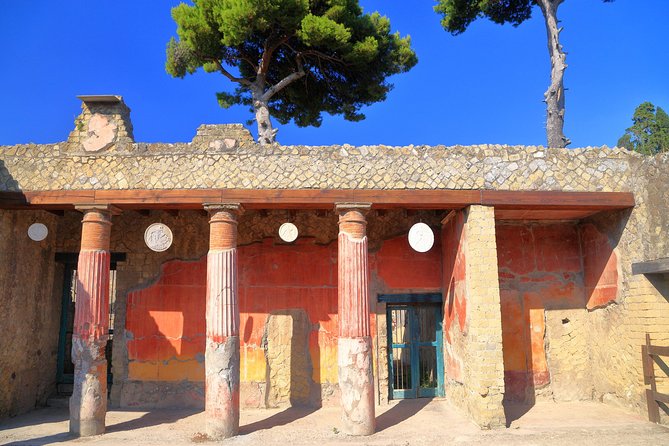
This luxurious mansion has a monumental entrance with carbonised remains of the doorposts and lintel. It’s also a lesson in why ash preservation is not just “cool leftovers.” It can preserve the evidence of everyday threshold life—literally where people entered rooms.
Casa Sannitica
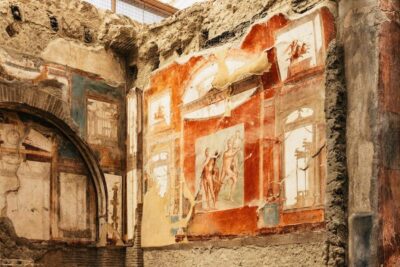
This is described as typical of the Samnites, with an atrium and a gallery with Ionic columns, plus frescoes. It’s useful because it shows cultural mixing and regional styles within central Italy—Rome wasn’t one uniform look everywhere.
Casa del Bel Cortile
This house has an original courtyard setup with a stairway and stone balcony instead of an atrium. I like this stop because it reminds you that “Roman house” is a spectrum. The design changes with local traditions and the owner’s preferences.
House of the Grand Portal
A central domus with multiple environments, colonnati, frescoes, and charred remains of wooden parts. This stop ties together the theme of preservation: you’re not only seeing walls—you’re seeing the ghost of materials that once gave rooms their feel.
Pompeii after the transfer: public spaces and big-name houses
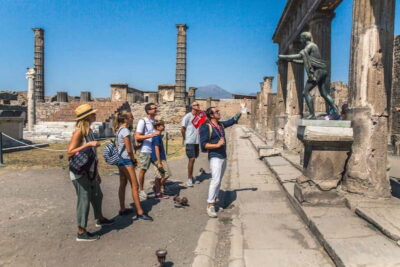
Once you reach Pompeii, the mood shifts. Pompeii is wider, more open, and the ruins often feel like a stage set. The tour still keeps things moving, but you’ll spend more time in public and semi-public spaces: squares, theaters, baths, and the main street.
That matters because it changes the story. Herculaneum often makes you think about private life. Pompeii pushes you toward public life: commerce, performance, religion by presence, and the big visual statements of wealthy households.
Lupanar
The most famous brothel in Pompeii. This is historically important for how Romans discussed and managed sexuality and commerce, but it’s also a stop that can feel uncomfortable. If you’re traveling with kids or anyone who’d rather not look, ask your archaeologist guide how to handle it; often you can learn the context without getting stuck on the details.
Main street walk and the Forum area
You’ll walk through Pompeii’s main street, then see the Foro de Pompeya (main square). This is where you understand daily movement—people coming and going, errands, announcements, and social mixing.
Granaries of the Forum
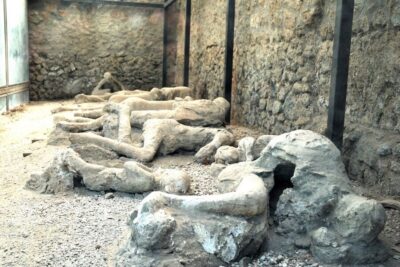
A look inside the granary with marble tables and baths for fountains at entrances of houses. This stop also includes references to casts of victims, plus a dog and a tree. It’s one of those moments where the archaeological record turns tragedy into specific evidence.
Basilica
You’ll see the basilica area—an open portico that gave shelter to merchants and other activities. This helps connect “Roman architecture” to “Roman behavior.” It’s easier to remember when you can picture people making deals and waiting out weather.
Stabian Baths (Terme Stabiane)
These baths cover a vast area and represent the oldest thermal complex in Pompeii. Again, it’s not just about washing. It’s about the role of baths in social time, public routine, and neighborhood life.
House of the Faun and House of Menander
Two major private residences:
- House of the Faun: one of the largest and most impressive homes.
- House of Menander: noted for architecture, decoration, and contents.
These stops are how you see Pompeii’s wealth and visual storytelling. If your guide points out ceiling paintings, room layout, or how visitors moved through the space, you’ll get more from these than just “big house, wow.”
Teatro Grande and Teatro Piccolo
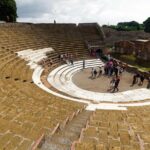
You’ll visit Teatro Grande, the most important theater in Pompeii, then get a look at the Teatro Piccolo. The theaters are your shortcut to understanding entertainment, civic identity, and how Romans used public performance.
Price and value: what $597.36 per group really buys
The price is $597.36 per group (up to 15 people), and the tour is about 5.5 hours. That number sounds steep if you compare it to a standard walking tour price. But compare it to what you’re getting: a private archaeologist-led route that covers both parks, includes a train transfer, and focuses on interpretive explanations instead of just pointing at walls.
Here’s the simple math logic:
- If you fill the group near 15 people, the cost per person drops a lot.
- If it’s only a couple of you, you’ll feel the private-tour premium more.
I think the best value usually comes when you have a small-to-medium group (friends, multi-generation families, or a group of history lovers) who can split the cost and stay engaged. If you’re traveling solo or as a duo, you can still enjoy it, but the tour becomes more about the guide quality and less about “budget efficiency.”
Also, tickets are not included. Herculaneum entry is listed as 16 euros adult and 2 euros for EU citizens 18–25. Pompeii entry uses Pompei express tickets and is not included. Budget those totals before you decide.
Your archaeologist guide: why it matters at these sites
At places like this, the difference between a good visit and a great visit is usually the person talking. This tour is led by an archaeologist guide, and the experience is built around their ability to connect finds and building design to daily routine, civic life, and the disaster context.
Names you may see among past guides include Mena, Vincenzo, Ivan, Sylvia, Raffaele Romano, Paola, Giancarlo, and Giovanni. The common thread is the same: they answer questions with real archaeological framing, not just generic “wow” commentary.
If you want to get the most out of the day, come with one or two themes. For example:
- Ask how ash preservation changed what survives.
- Ask how bath design reflects segregation by sex and social routine.
- Ask how benefactors like M. Nonius Balbo used inscriptions and public projects to build status.
A private format makes those questions worth asking.
Logistics that actually affect your day: tickets, heat, and walking
This tour is a walking route with moderate fitness requirements. Wear comfortable shoes—the info explicitly says no flip flops. Bring sunglasses and sunscreen, because the parks can be bright and exposed.
Tickets are the other major practical factor. You’ll handle Herculaneum entry tickets (16 euros adult, 2 euros EU citizens 18–25) and Pompeii tickets yourself (Pompei express tickets). The tour includes guidance and assistance, but entry cost is not part of the package.
One practical note: you’ll spend time lining up and moving from one zone to another. A private guide can help you time the day better, but it still helps to arrive ready with ticket plans.
Who should book this private tour—and who might prefer something simpler
This is a good match if you:
- Want an archaeologist talking through Roman daily life, not just “look at this wall.”
- Like structured time across both Herculaneum and Pompeii without planning train connections.
- Travel with a group that can split the private cost, up to 15 people.
- Appreciate details like baths, inscriptions, household art, and the material evidence of wooden features.
It’s less ideal if you:
- Want to wander completely freely with no fixed route.
- Don’t want to pay separate entry tickets.
- Are hoping for minimal walking. This is a walking day.
Should you book? My honest take
If your goal is to understand these ruins like a story—private life in Herculaneum, then public life and major monuments in Pompeii—this private archaeologist tour is a strong value use of time. You’re paying for interpretation, not for transportation in luxury mode, and you’re getting a thoughtful mix of homes, baths, religious-civic structures, and iconic Pompeian spaces.
My recommendation is simple:
- Book it if you’ll enjoy asking questions and want the sites connected into one coherent picture of Mount Vesuvius’ aftermath.
- Skip it (or choose a different format) if you prefer self-paced wandering and you’d rather put that money into tickets plus a slower day.
If you do book, go in with good shoes, sunscreen, and a couple of questions ready. Then watch how quickly the ruins stop feeling like lists of buildings and start feeling like places people actually lived.
FAQ
How long is the Pompeii and Herculaneum private walking tour?
It’s approximately 5 hours 30 minutes.
Is this tour private or shared?
It’s a private tour/activity. Only your group participates, and the group size can be up to 15.
What language is the tour offered in?
The tour is offered in English.
Are admission tickets included for Pompeii and Herculaneum?
No. Herculaneum entry tickets are not included and you’ll also need your own Pompeii entry tickets (Pompei express). Herculaneum entry is listed as 16 euros for adults and 2 euros for EU citizens 18–25.
Where do we meet in Herculaneum?
You meet at the Ticket Office of the Herculaneum ruins.
How do you travel between Herculaneum and Pompeii?
The itinerary states a train transfer of about 30 minutes, plus about 10 minutes of walking.
Is food included?
No. Food and drinks are not included, though there is a quick lunch break if required.
What is the cancellation policy?
Cancellation is free up to 24 hours in advance for a full refund. If you cancel less than 24 hours before the start time, the amount paid is not refunded.
More Tour Reviews in Naples




Herculaneum, a Few More Tours


More Pompeii Tours to Compare

More Naples tours, freshly reviewed



Pompeii Tours, compared.
 ★ 4.8Pompeii: Entry Ticket and Guided Tour with an ArchaeologistFrom $3519,459 reviews
 ★ 4.1Pompeii: Entry Ticket with Audio GuideFrom $4013,491 reviews
 ★ 4.8Pompeii: Small Group Tour with an ArchaeologistFrom $4012,264 reviews
 ★ 4.3Pompeii Ruins & Mount Vesuvius Day TourFrom $12011,459 reviews
★ 5.0Pompeii Small Group Tour with an ArchaeologistFrom $356,593 reviews
★ 4.3Pompeii Ruins & Mount Vesuvius Day TourFrom $12011,459 reviews
★ 5.0Pompeii Small Group Tour with an ArchaeologistFrom $356,593 reviews
 ★ 4.5Skip-the-line Pompeii – Small Group TourFrom $544,401 reviews
 ★ 4.6Naples or Sorrento: Full-Day Pompeii and Mount Vesuvius TourFrom $1044,235 reviews
 ★ 3.9Pompeii: Skip-the-line Entry Ticket with Audio Guide & MapFrom $433,153 reviews
Browse the lists this tour appears in