
Review · POMPEII TOURS
Pompeii 3h Private & Quality Tour with your Archaeologist
Pompeii feels personal with the right guide. This private 3-hour Pompeii tour pairs you with an authorized archaeologist, so the ruins turn into stories you can actually follow, not just stone blocks. I especially like the skip-the-line start and the way the route is paced so you can keep up without feeling rushed.
Two things really won me over: the guide brings you to specific highlights like the Forum, domus such as the Domus of Leda and the Swan, and the Amphitheatre, and you get focused attention to ask questions. One consideration: the tour duration is short, and the admission ticket is not included, so you’ll need to plan for the extra €19 per person.
In This Review
- Key Points That Make This Pompeii Tour Worth It
- A 3-Hour Pompeii Route With an Archaeologist Guide
- Skip the Line at Porta Marina Superiore (and Why That Matters)
- Porta Marina Superiore to the Antiquarium: Seeing Excavations Up Close
- The Basilica and Forum Stops: Pompeii’s Public Life in Plain Sight
- Along the Greater Decumano: Baths, Trade, and the Lupanare
- Domus Highlights: From Paintings to Recently Opened Areas
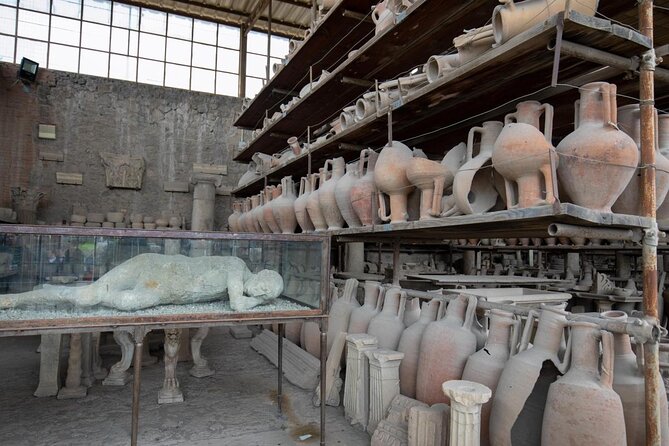
- Via dell’Abbondanza to the Fugitives’ Garden: The Casts That Freeze Panic
- Great Gymnasium and the Amphitheatre: Daily Objects to Public Drama
- Price and Value: $385.32 Per Group for Up to 10
- Who This Private Pompeii Tour Fits Best
- Practical Details That Affect Your Day
- Should You Book This Pompeii Archaeologist Tour?
- FAQ
- How long is the Pompeii 3h Private & Quality Tour with your Archaeologist?
- What does it cost?
- Is the admission ticket included?
- Where do we meet for the tour?
- Is this tour private?
- What language is the tour offered in?
- Can I bring a service animal?
Key Points That Make This Pompeii Tour Worth It
- Archaeologist-led guidance that connects artifacts to real daily life and the eruption timeline
- Skip-the-line entry setup with a link sent before your tour
- A structured 3-hour route from Porta Marina Superiore through major neighborhoods and monuments
- Time-efficient stops like the antiquarium, Great Gymnasium, and Amphitheatre
- Small-group attention since it’s private—only your group participates
Which Pompeii ticket and guide? Compare a few more.
- Pompeii Small Group Tour with an Archaeologist★ 5.0 · 6,593 reviews
- Discover the Ancient Ruins of Pompeii: Day Trip from Rome★ 3.5 · 2,247 reviews
- Pompeii and Herculaneum Small Group Tour with an Archaeologist★ 5.0 · 1,350 reviews
- Skip the Line Guided Tour of Pompeii led by an Archaeologist★ 5.0 · 703 reviews
A 3-Hour Pompeii Route With an Archaeologist Guide
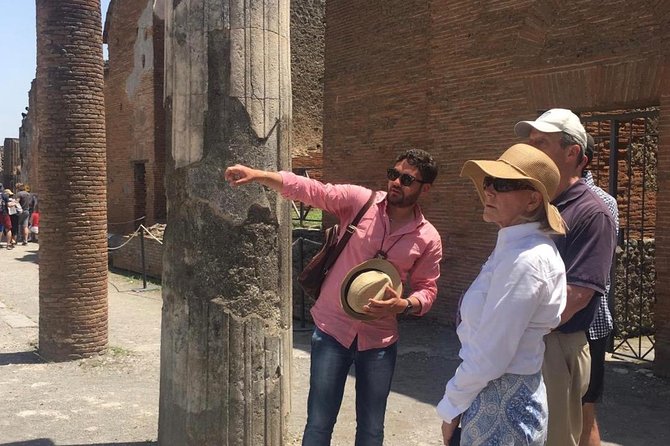
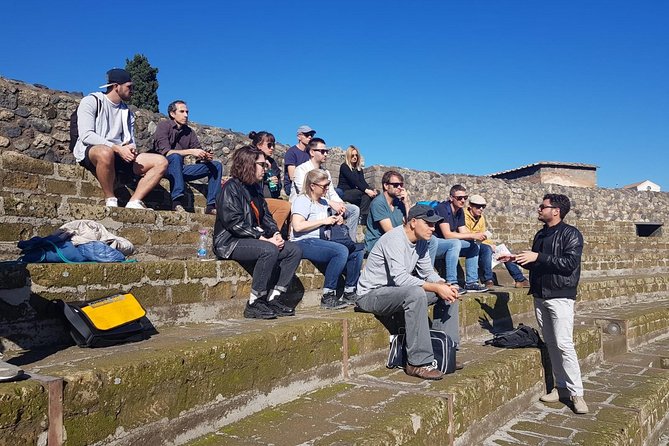
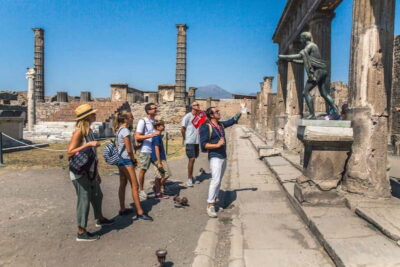
This tour is built around one simple idea: in Pompeii, time flies. A 3-hour visit can either feel like a blur—or it can feel like a guided walk through the city’s logic. Here, you get an authorized guide who is also an archaeologist, which matters because Pompeii rewards detail. The city wasn’t frozen in time; it was a living place, full of work, food, worship, and panic. An archaeologist helps you see how small clues add up.
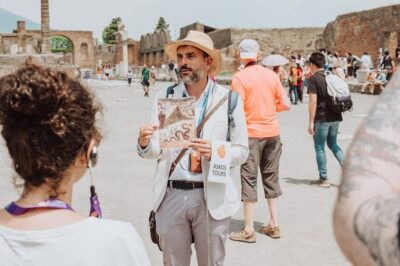
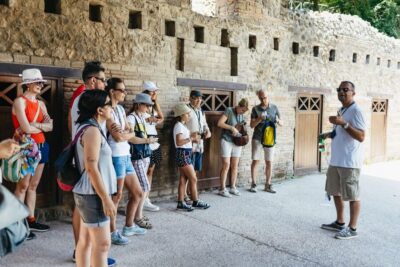
In recent group experiences, guides such as Francesco, Paolo, Patrizia, Riccardo, Raffaele, and Daniela have been praised for doing exactly that: explaining what you’re looking at, answering questions clearly, and keeping the pace workable for families and mixed ages. If you’re coming with kids or multi-generational group members, that “manage the pace” part is more than comfort—it’s how you actually get the full value of the visit.
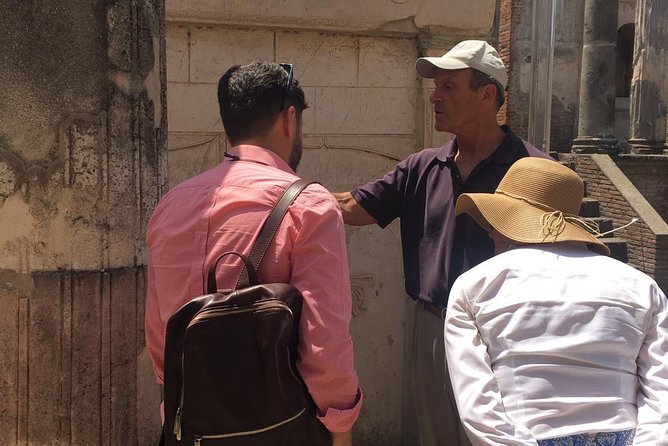
Because it’s private, you can adjust questions and stop intensity. You’re not competing with a large group for a moment at the best wall painting or the most interesting section of casts.
Skip the Line at Porta Marina Superiore (and Why That Matters)
Your tour starts at Scavi di Pompei – Biglietteria Porta Marina Superiore, near Via Villa dei Misteri, 2. The bigger win is how you enter. The tour includes guidance plus a pre-tour web link to buy your direct skip-the-line admission ticket, so you’re not stuck negotiating the longest lines when you’d rather be walking the site.
That doesn’t just save minutes. It changes the feel of the morning or afternoon. You start your Pompeii focus right away—rather than using the first part of your visit waiting, checking times, or figuring out where to stand. For a 3-hour itinerary, that kind of time protection is huge.
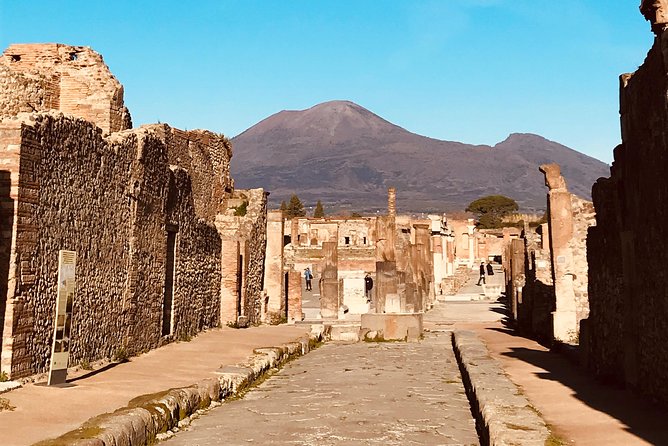
And once you’re in, the route doesn’t bounce randomly around the park. It flows, beginning near Porta Marina Superiore and moving through core civic and residential areas in a way that makes the city’s layout easier to understand.
Porta Marina Superiore to the Antiquarium: Seeing Excavations Up Close
The tour’s first transition is smart: you begin at the main entrance area and then move into the antiquarium. This is where you get context before the “wow” stops.
In the antiquarium, your archaeologist guide points out objects from recent excavations. Two examples mentioned in the tour description and guide materials stand out for the way they change your understanding of the eruption story: a coin that helps modify the date of the eruption, and a very heavy golden arm cuff.
Those aren’t decorative trivia. They’re the kind of details that show how archaeologists build a timeline and how evidence can revise what earlier assumptions suggested. If you’ve ever been frustrated that Pompeii feels like a museum of ruins instead of a city with changing scholarship, this is exactly what fixes that.
After this, you’re ready to walk with better questions: What was important here? Who lived nearby? What would someone notice on a normal day, and what would feel strange in the final hours?
The Basilica and Forum Stops: Pompeii’s Public Life in Plain Sight
From the antiquarium, the route continues toward major public spaces: the Basilica, then the Forum with the market and the main temples.
These stops matter because they give you the “city center” scale. When you look at Pompeii only through doorways and bedrooms, you lose the civic rhythm. Here, you get a sense of where people gathered for business and worship, and where daily conversations would have happened.
You’ll also see how architecture signals function. The Basilica and Forum are not just pretty stones; they’re clues about how people organized their social and economic lives. And the guide’s job is to point out what to look for, not just what you’re seeing.
One tradeoff: in three hours, you can’t go everywhere. So if you’re the type who wants every single dome, wall, and corridor in the park, you’ll need to treat this as a high-impact route. The upside is you’ll leave with a clearer story than many longer, less guided visits.
Rather go private? More options in Pompeii



Along the Greater Decumano: Baths, Trade, and the Lupanare
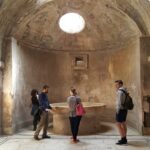
A key stretch is the walk along the Greater Decumano. This is where Pompeii starts feeling like a real city street instead of an outdoor exhibit.
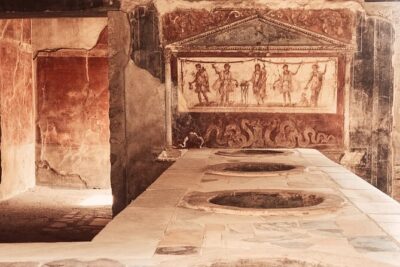
On this path, your guide includes stops connected to the thermal system (so you can visualize how people cooled off and stayed clean) and the Lupanare. The Lupanare is often one of the most talked-about sites in Pompeii, but the value on this tour is how it’s explained as part of urban life rather than as shock value.
If you want Pompeii to make sense beyond “people died here,” this is one of the strongest segments. You’re seeing how entertainment, services, and everyday routines sat alongside civic spaces. With an archaeologist guide, you’re also more likely to understand what’s preserved, what was restored, and why the restoration approach matters.
Domus Highlights: From Paintings to Recently Opened Areas
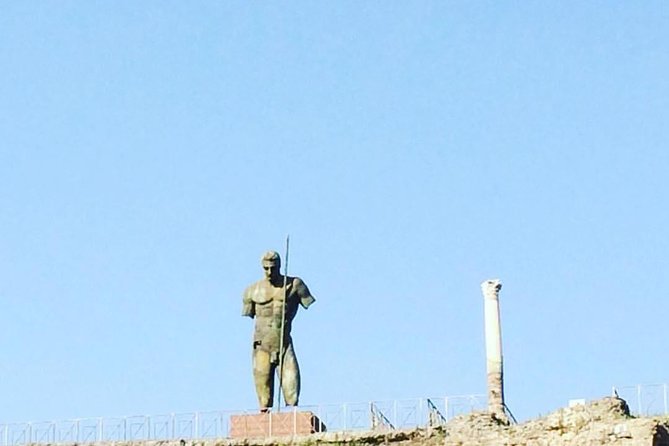
Then comes the residential side—arguably the most moving part of Pompeii. The tour includes many of the most beautiful domus, with mention of areas recently opened, including the Domus of Leda and the Swan.
This is where the “Pompeii really is three-dimensional” feeling tends to hit. Wall painting and interior layout show status, taste, and how people wanted rooms to feel. Even if you only spend a short time in each domus, a focused guide can connect the visual details to how the household functioned.
You’ll also see restorations, including ones connected to the House of Golden Cupids. The tour description notes that these restorations are made up by one of the guide’s teacher, which adds a personal academic link. That kind of connection isn’t just sentimental—it helps explain what reconstruction shows, what it can’t prove, and how archaeologists make careful choices based on evidence.
If you’re the kind of person who loves looking at details but sometimes gets lost without a framework, domus stops are where this tour can feel especially good.
Via dell’Abbondanza to the Fugitives’ Garden: The Casts That Freeze Panic
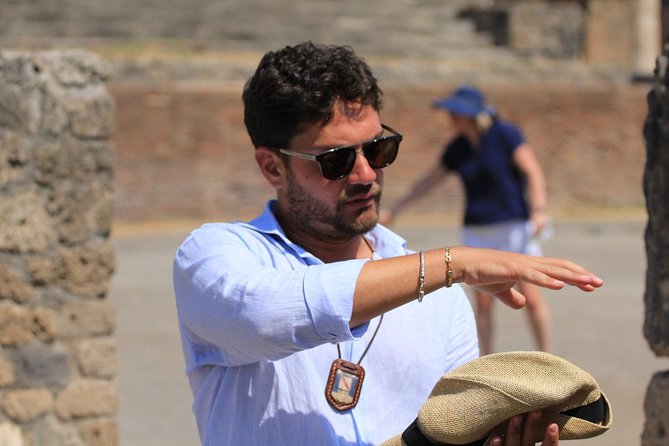
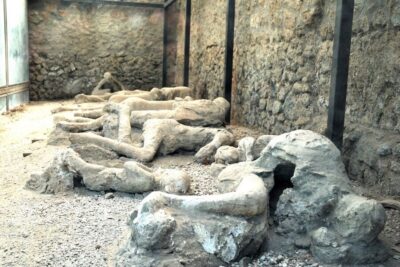
As the route moves along via dell’Abbondanza, you reach the so-called Fugitives’ garden. This is the stop where Pompeii becomes emotionally hard to forget.
During the eruption, some people tried to escape. In this area, you can see moulds related to those final moments. Your guide explains what you’re seeing and why these casts matter scientifically—what they suggest about movement, proximity, and how quickly events unfolded.
Here’s the value of having an archaeologist: the explanation stays anchored to evidence, not melodrama. You’re not just being told tragedy happened. You’re learning how archaeologists interpret physical remains and what that interpretation can and can’t claim.
It’s a powerful moment, so if your group is sensitive, you can ask your guide to pace it. A private format is helpful because you can decide how long to linger.
Great Gymnasium and the Amphitheatre: Daily Objects to Public Drama
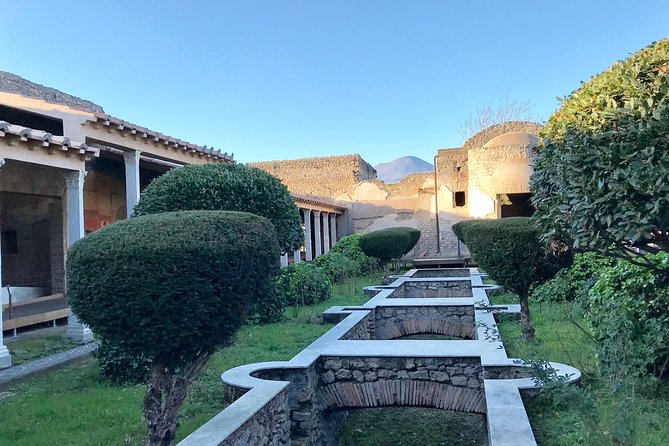
The route continues to the Great Gymnasium, which includes many daily objects exposed in that space, even charred food. This is one of those details you can’t fully grasp from photos, because Pompeii’s power is how specific it feels. Food and household objects make the eruption less abstract. You get a concrete sense of what people were doing before everything stopped.
Then, you finish at the Amphitheatre. Ending here is logical: it’s a big public stage and a good way to close the loop on Pompeii’s civic life. You’ve moved from entrance to context, from public spaces to private homes, from escape attempts to everyday routines, and finally to where crowds gathered.
If you want the trip to leave you with a strong final image, this is a smart close.
Price and Value: $385.32 Per Group for Up to 10
At $385.32 per group (up to 10 people), this is priced as a private tour rather than a per-person ticket. That price structure is where the value can swing.
- If your group is large enough to fill most of the 10-person limit, your effective cost per person can be much lower than booking separate guided entry times.
- If it’s just two or four people, it becomes a “pay for privacy and expert focus” purchase.
The good news: the tour includes a guided tour of Pompeii ruins, an authorized guide, and an expert archaeologist. The admission ticket is not included (it’s €19.00 per person), but the operator provides a link in advance so you can purchase the direct skip-the-line admission ticket.
In other words, you’re not paying extra for logistics confusion. You’re paying for interpretation and time efficiency. For a place as complex as Pompeii, that’s the part you’ll actually feel while you’re walking.
Also, the tour is often booked about 51 days in advance on average. If you’re traveling in high season or on a tight schedule, I’d treat that as a sign to lock in early rather than hoping for last-minute availability.
Who This Private Pompeii Tour Fits Best
This is a strong match if you want Pompeii to feel like more than a list of major buildings. I think it’s ideal for:
- Groups who want private pacing and the freedom to ask questions
- Families with kids and adults together, since guides here have been praised for handling mixed ages
- People who care about archaeology and want to hear how evidence gets interpreted (not just what’s visible)
It may be less ideal if you’re the type who wants to wander freely without structure. This is a guided route with key stops, not an open-ended roam through every corner of the park.
Practical Details That Affect Your Day
You’ll meet at Scavi di Pompei – Biglietteria Porta Marina Superiore (Via Villa dei Misteri, 2, 80045 Pompei). The tour ends back at the meeting point. Service animals are allowed, and the site is near public transportation.
The tour is offered in English, and it’s designed so most travelers can participate. Since the duration is about 3 hours and the route includes multiple major areas, plan your day so you can be present without rushing between other activities.
If food matters to you after the ruins: one small but useful tip from a guide named Raffaele in past groups is to ask him where to eat afterward. The recommendation was for places away from the most tourist-heavy routes.
Should You Book This Pompeii Archaeologist Tour?
I’d book it if you want Pompeii to click—fast. The combination of archaeologist-led explanations, an organized 3-hour route, and a skip-the-line entry plan is a high-value way to avoid the classic Pompeii problem: seeing a lot, but understanding too little.
I wouldn’t book it if you’re chasing total coverage of the entire archaeological park. Pompeii is too big for that in 3 hours, and this tour is intentionally selective. Also factor in the €19 per person admission ticket on top of the group price.
If you’re choosing between a basic entry visit and a private expert walk, this is the choice that turns ruins into a story you can retell.
FAQ
How long is the Pompeii 3h Private & Quality Tour with your Archaeologist?
The tour lasts about 3 hours.
What does it cost?
It’s $385.32 per group, up to 10 people. Admission is not included (€19.00 per person).
Is the admission ticket included?
No. You’ll purchase the entrance ticket separately for €19.00 per person. The provider sends a web link before the tour to buy the direct skip-the-line admission ticket.
Where do we meet for the tour?
You meet at Scavi di Pompei – Biglietteria Porta Marina Superiore, Via Villa dei Misteri, 2, 80045 Pompei NA, Italy.
Is this tour private?
Yes. It’s a private tour, and only your group participates.
What language is the tour offered in?
The tour is offered in English.
Can I bring a service animal?
Yes. Service animals are allowed.
More Tours in Pompeii


More Tour Reviews in Pompeii

More Pompeii Tours to Compare
More Pompeii tours, freshly reviewed



Pompeii Tours, compared.
 ★ 4.8Pompeii: Entry Ticket and Guided Tour with an ArchaeologistFrom $3519,459 reviews
 ★ 4.1Pompeii: Entry Ticket with Audio GuideFrom $4013,491 reviews
 ★ 4.8Pompeii: Small Group Tour with an ArchaeologistFrom $4012,264 reviews
 ★ 4.3Pompeii Ruins & Mount Vesuvius Day TourFrom $12011,459 reviews
★ 5.0Pompeii Small Group Tour with an ArchaeologistFrom $356,593 reviews
★ 4.3Pompeii Ruins & Mount Vesuvius Day TourFrom $12011,459 reviews
★ 5.0Pompeii Small Group Tour with an ArchaeologistFrom $356,593 reviews
 ★ 4.5Skip-the-line Pompeii – Small Group TourFrom $544,401 reviews
 ★ 4.6Naples or Sorrento: Full-Day Pompeii and Mount Vesuvius TourFrom $1044,235 reviews
 ★ 3.9Pompeii: Skip-the-line Entry Ticket with Audio Guide & MapFrom $433,153 reviews
Browse the lists this tour appears in