
Review · HERCULANEUM TOURS
From Naples: 2-Hour Herculaneum Kid-Friendly Tour
Herculaneum hits different when kids are part of the story. I like that this is a kid-customized, 2-hour walking tour and that your guide uses tablets, reconstructions, and multimedia to make the buried city feel real. You’ll see major stops and also get time to explore houses and public spaces so your children aren’t just watching from the sidelines.
One thing to consider: this tour is a walking experience with no transportation included, and the site is labeled both wheelchair accessible and not suitable for wheelchair users, so if that applies to you, you’ll want to confirm details before booking.
In This Review
- Key points worth knowing
- Why Herculaneum feels made for kids
- Meeting point and what the first minutes set up
- Skip-the-line and admission included (the practical value)
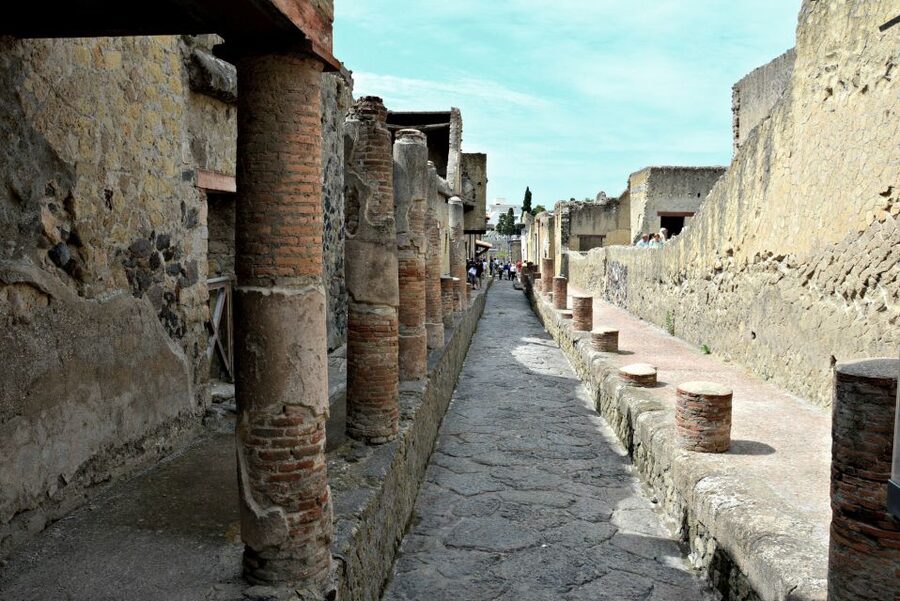
- Walking Herculaneum’s main road: the Northern Cardo
- Casa di Nettuno ed Anfitrite: living rooms from the Roman world
- Casa del Salone Nero: a stop that grabs attention fast
- Casa dei Cervi and the House of the Skeleton
- Thermopolium: seeing where people ate
- Baths and public life: men’s thermal bath
- Temple of the Augustali and the forum: belief plus community
- Houses you can recognize by their personality: Neptune, Black Saloon, Bel Cortile, and more
- Sacellum of The Augustales: smaller spaces, clearer meaning
- Marina gate terrace of Marcus Nonius Balbus and the beach of the victims
- How the tablets and multimedia keep kids on track
- Language options: English or Italian
- The overall pace for families: 2 hours is the sweet spot
- Who should book this tour
- Should you book the Naples: 2-Hour Herculaneum Kid-Friendly Tour?
- FAQ
- How long is the kid-friendly Herculaneum tour?
- What’s included in the price?
- Is transportation included from Naples?
- Does the tour skip the ticket line?
- Where do we meet the guide?
- What languages are available?
- Is it wheelchair accessible?
Key points worth knowing
- Kid-first guiding with a local certified guide specialized in tours with children
- Tablets, reconstructions, and multimedia to explain what you’re seeing in kid-friendly ways
- Skip-the-ticket-line plus admission included in the price (16 euros each)
- A full walk through the town: roads, houses, temples, shops, and the beach where victims were found
- Private group format so your family’s pace is the focus
- Two languages available: English and Italian
Herculaneum keeps a few more tours worth your time
- Herculaneum: Skip-the-Line Guided Tour with Archaeologist★ 4.8 · 3,439 reviews
- Herculaneum Small Group Tour and Ticket With an Archaeologist★ 5.0 · 994 reviews
- Herculaneum: Skip-the-Line Entry Ticket with Audio Guide★ 4.3 · 870 reviews
- From Naples: Pompeii & Herculaneum with Archaeologist Guide★ 4.8 · 665 reviews
Why Herculaneum feels made for kids
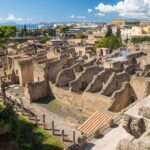
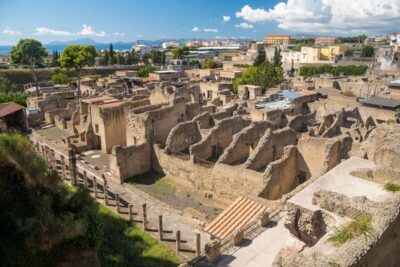
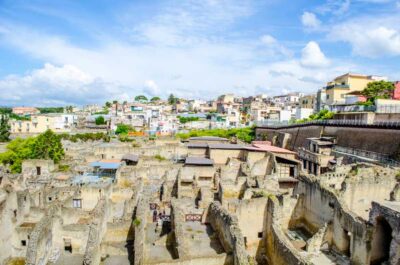
Herculaneum is one of those rare archaeological places where the setting does the explaining. In a good tour, you don’t just learn facts. You walk through the parts of the city that show everyday life: where people ate, bathed, shopped, prayed, worked out, and lived.
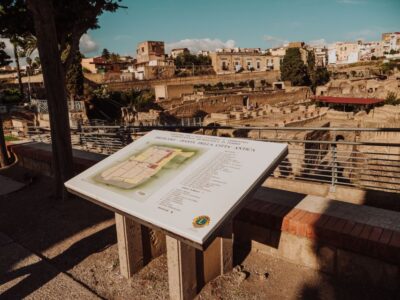
This tour is built around that idea. It’s designed to keep children engaged while still covering the big, memorable landmarks. The big difference is the tools your guide brings into the ruins. Using tablets plus reconstructions and multimedia, your guide can help kids understand what they’re looking at when the city is mostly stone, floor plans, and shapes in the ground.
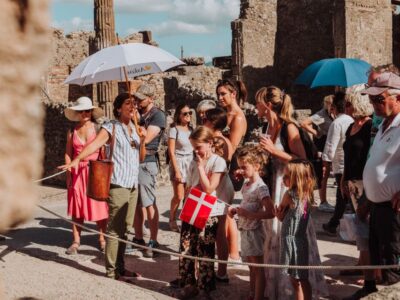
And because it’s a 2-hour walking tour with a private group, the pace tends to be more realistic for families than a fast, large-group shuffle.
Meeting point and what the first minutes set up
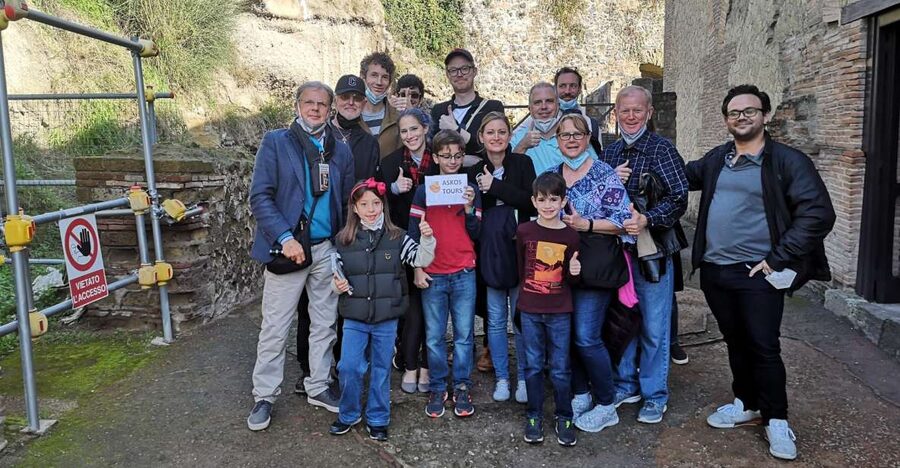
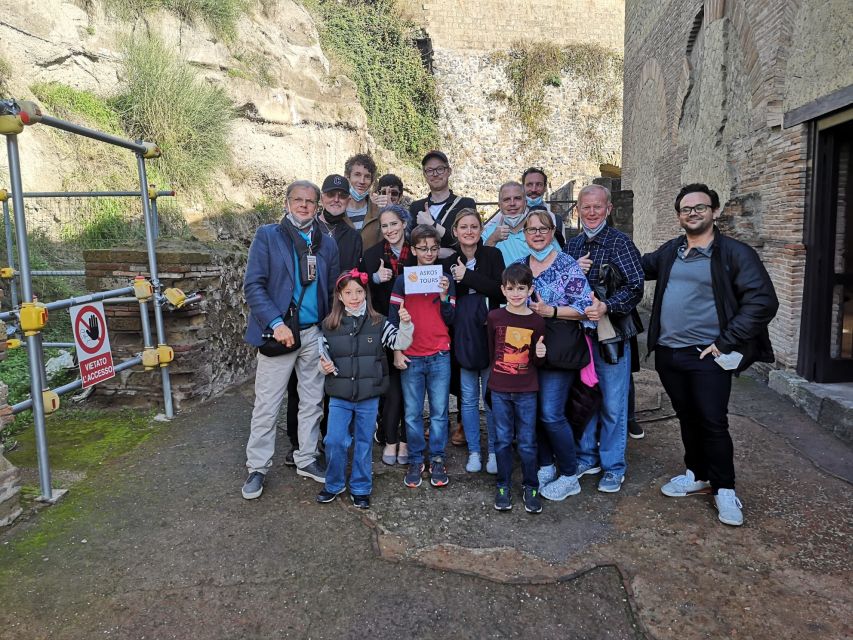
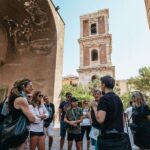
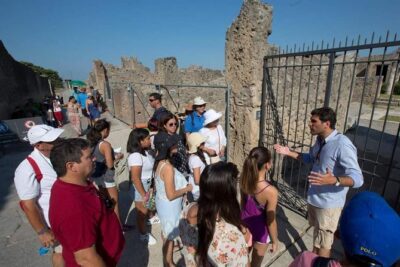
The tour starts at the Herculaneum ticket office at Via dei Papiri Ercolanesi, 21. Your guide will be holding a sign with your name, so you can match up quickly and avoid the stressed wandering that can happen with popular sites.
Since there’s no transportation included, it helps to treat this as a straightforward walk-based plan from the start. Once you’re grouped with your guide, the tour structure is clear: you’ll move stop to stop across the archaeological area, with guided pauses that focus on making the site understandable for children.
Skip-the-line and admission included (the practical value)
This tour includes the Herculaneum admission fee (16,00 euros each), and it also offers skip-the-ticket-line. That matters more than it sounds. When you’re traveling with kids, time spent waiting can turn a good morning into a cranky one fast.
Now about price. At $206.75 per person for a private group 2-hour tour, it’s not a budget option. But you’re paying for three things that add up: a locally certified guide specialized in children’s tours, entry costs included, and the “work” of converting ruins into an experience your kids actually follow. If your family benefits from guided storytelling and you’d otherwise buy individual entry plus struggle through explanations on your own, the value starts to make sense.
Walking Herculaneum’s main road: the Northern Cardo
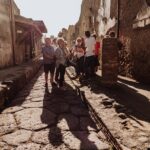
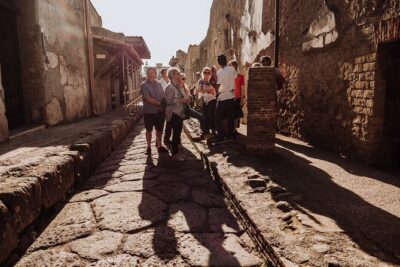
One of the tour’s early anchors is the Northern Cardo, the main road running north-south through the town. For kids, a road is an easy way to understand the city’s logic: it’s the spine where daily movement happens.
For adults, this stop gives context for everything else. When you can picture the main street layout, the houses and public buildings stop feeling like random ruins. You begin to see how the city was organized, and your guide can point out what the road likely meant for foot traffic and neighborhood life.
This is also where you’ll start to get comfortable with the pace of the walk. It’s not rushed sightseeing. It’s designed around short guided visits that help children keep track of what’s happening next.
Other Naples outings worth a look before you book





Casa di Nettuno ed Anfitrite: living rooms from the Roman world
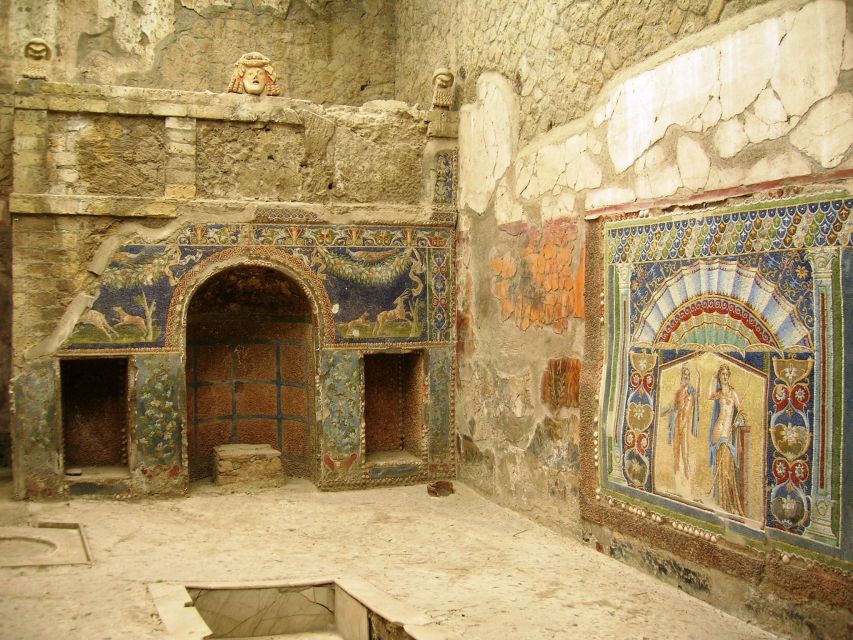
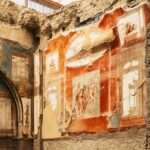
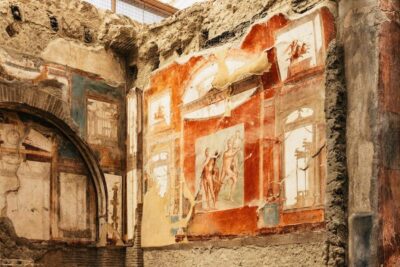
You’ll visit Casa di Nettuno ed Anfitrite (Neptune and Amphitrite). House visits are a highlight because they let your kids see the idea of a Roman home rather than only temples and public spaces.
Herculaneum’s preservation is a key part of why this works. When you step into a house and your guide shows reconstructions or helps interpret what you’re seeing, kids can start to build a mental picture: entrances, rooms, and the visual cues that were meant to impress visitors.
One practical drawback with house interiors: they can be visually busy, even when well explained. If your children are the type that need frequent breaks, you’ll rely on the guide’s pacing and on how your family handles quiet indoor time versus open-air areas.
Casa del Salone Nero: a stop that grabs attention fast
Next is Casa del Salone Nero (House of the Black Saloon). This is one of those places that naturally grabs attention because the features are dramatic and memorable. For kids, a strong visual “thing” helps them stay focused, even when the details are technical.
Your guide’s job here is to connect the look of the space with Roman daily life. A black saloon isn’t just a room color story. It’s a window into wealth, social display, and the way rooms were set up to impress.
Casa dei Cervi and the House of the Skeleton
From there, you’ll get Casa dei Cervi (House of the Deer) and then a major emotional/visual stop: the House of Skeletons.
The House of the Skeletons is specifically part of the planned route because it’s one of the clearest, most unforgettable reminders of what happened during the eruption. It can be intense for some children, but it’s also where your guide’s kid-focused approach matters most. A good children’s guide doesn’t just drop grim details; they help kids process what they’re seeing and keep the explanation age-appropriate.
If you’re traveling with kids who are sensitive to morbid topics, this is the part to evaluate carefully. The tour does include a stop at the beach where victims were discovered too, so you may want to think about what your child can handle and whether you’d want extra guidance in advance.
Thermopolium: seeing where people ate
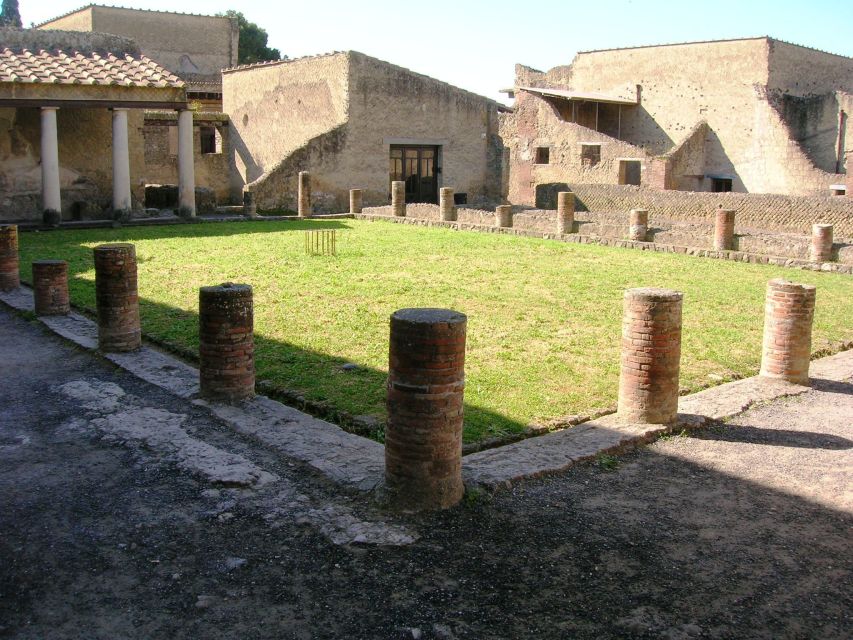
Your tour route also includes a thermopolium, essentially a Roman fast-food counter for hot food and everyday meals. This stop is gold for families. It’s one thing to see ruins. It’s another to realize people were buying food here the way many tourists understand lunch today.
For kids, food-related stops are sticky in memory. For adults, it adds realism to the city picture. It shows that Herculaneum wasn’t only ceremonies and fancy houses. It was working life, too.
If your children are typically food-driven, this is likely one of the easier moments for them to stay engaged without needing constant prompting.
Baths and public life: men’s thermal bath
The route also features the men’s thermal bath. Baths are a strong way to explain Roman routines because bathing wasn’t just hygiene; it was social time and daily habit.
For your guide, this is a chance to talk about movement through the city: people weren’t stationary. They went from home to public spaces, and their days had rhythm. When that rhythm clicks, kids start to understand the city as a place where life happened, not just a backdrop for tragedy.
Temple of the Augustali and the forum: belief plus community
You’ll also visit the Temple of Augustali and the forum, the main square.
These stops help connect religion and politics to everyday geography. The temple gives you a framework for the spiritual or ceremonial side of Roman life. The forum shows how community and public business functioned in the city center.
The guide’s tablet and multimedia tools can be especially useful here. Temples and forums can feel abstract if you only see fragments. With reconstructions, your children are more likely to picture the space as it once worked.
Houses you can recognize by their personality: Neptune, Black Saloon, Bel Cortile, and more
Beyond the named house stops in the core itinerary, the tour also covers additional homes and features that make Herculaneum feel like a real neighborhood.
Along the way you’ll see:
- House of Neptune and Amphitrite
- House of Bel Cortile
- The Samnite House
- House of the Wooden Partition
- The bakery
- The gym
- Home of the Bucks
What makes this valuable is not just variety. It’s the pattern. You get a “tap-tap” set of different daily-life rooms and workspaces: eating, training, preparing goods, living spaces, and social activity. That variety keeps kids from zoning out because the tour keeps changing visual cues.
For adults, the variety also prevents a common mistake: treating Herculaneum like one long cemetery. This walk shows a functioning town with distinct categories of life.
Sacellum of The Augustales: smaller spaces, clearer meaning
A key stop is the Sacellum of The Augustales. “Small sanctuary” type spaces often get skipped in generic tours, but here it’s part of the guided storyline.
This is a helpful stop because it gives your guide an opportunity to explain how different scales of devotion or community worked in the city. Kids can learn that religion and public identity weren’t only in grand structures; they showed up in smaller settings tied to roles and groups.
Marina gate terrace of Marcus Nonius Balbus and the beach of the victims
The route ends with the Marina gate terrace of Marcus Nonius Balbus and the beach area where hundreds of skeletons of eruption victims were discovered.
This part of the tour is emotionally heavy. It’s also why Herculaneum stands apart among archaeological sites. Your guide’s kid-friendly approach and the use of multimedia and reconstructions can help children understand the sequence and the impact without turning the experience into pure shock.
Still, this is a consideration for families. If you know your child shuts down with intense content, it helps to plan how you’ll handle that moment. You’ll be on your feet through the whole tour, and ending on this scene means there’s no easy “light” reset built into the schedule.
How the tablets and multimedia keep kids on track
The tour’s standout method is that it doesn’t rely only on what’s visible in stone. Your guide uses tablets, reconstructions, and multimedia so kids can connect present-day remains with their original function.
Here’s what that changes for you as a parent: you spend less time translating. Your child can hear a guide’s explanation tied directly to what’s in front of them. That reduces the common problem of kids getting lost mid-sentence while adults try to improvise.
And it helps with attention. When a kid sees the same space explained in more than one way—visual reconstruction plus real remains—understanding becomes easier.
Language options: English or Italian
The live guide is offered in English and Italian. That’s useful even for mixed-language families, and it means you can match the guide’s language to your kids’ needs so the explanations land cleanly.
The overall pace for families: 2 hours is the sweet spot
A 2-hour timeframe is often what works best with kids at archaeological sites. Long tours can test stamina and focus, while shorter tours sometimes skip too much.
This one focuses on a concentrated set of stops, including major houses, public spaces, and the beach scene. You get variety without being dragged through the whole site. The walking route also tends to be manageable because it’s organized into clear visits rather than open-ended roaming.
Who should book this tour
This is a strong fit if:
- You want a private, kid-customized guided experience rather than a self-guided visit
- Your children like stories and visual tools, and you want an adult guide doing the explaining
- You care about seeing both houses and public life, not only monuments
It may be less ideal if:
- Your kids have a hard time with intense historical scenes, especially the skeleton-related stops
- Your family needs frequent breaks beyond what a structured 2-hour walk allows
Should you book the Naples: 2-Hour Herculaneum Kid-Friendly Tour?
If you’re choosing between a self-guided visit and a guided kids program, I think this one makes sense when you value guided interpretation and you want your children to actually follow along. The combination of children-specialized guiding, skip-the-ticket-line, and admission included helps justify the higher price for families who would otherwise struggle to make sense of what they’re seeing.
But be honest about the walking and the emotional content near the end of the route. If your child is sensitive to the eruption aftermath, consider that before booking.
FAQ
How long is the kid-friendly Herculaneum tour?
It’s a 2-hour walking tour. You can check availability to see starting times.
What’s included in the price?
The tour includes a local certified guide specialized in tours with children and the Herculaneum admission fee (16,00 euros each).
Is transportation included from Naples?
No. This is a walking tour, and no transportation is included.
Does the tour skip the ticket line?
Yes. It includes skip-the-ticket-line entry.
Where do we meet the guide?
Meet at the ticket office of the Herculaneum ruins, located at Via dei Papiri Ercolanesi, 21, and the guide will be holding a sign with your name.
What languages are available?
The live guide is available in English and Italian.
Is it wheelchair accessible?
The activity information lists wheelchair accessible, but it also states not suitable for wheelchair users. I’d confirm accessibility details directly with the provider before you book.
More Tours in Naples



More Tour Reviews in Naples

Herculaneum, a Few More Tours

More Naples tours, freshly reviewed


Herculaneum Tours, compared.
 ★ 4.8Herculaneum: Skip-the-Line Guided Tour with ArchaeologistFrom $533,439 reviews
 ★ 5.0Pompeii and Herculaneum Small Group Tour with an ArchaeologistFrom $771,350 reviews
 ★ 5.0Herculaneum Small Group Tour and Ticket With an ArchaeologistFrom $53994 reviews
 ★ 4.3Herculaneum: Skip-the-Line Entry Ticket with Audio GuideFrom $15870 reviews
 ★ 4.8Pompeii: Small-Group Tour of Pompeii and Herculaneum867 reviews
 ★ 4.8Pompeii & Herculaneum with Archaeologist GuideFrom $168665 reviews
 ★ 3.9Pompeii, Herculaneum, & Vesuvius Full-Day TourFrom $152602 reviews
 ★ 4.1Ercolano: Herculaneum Entry Ticket with Optional Audio GuideFrom $21581 reviews
Browse the lists this tour appears in