
Review · POMPEII TOURS
2 Hours Private Tour of Pompeii for Journey Through Time
Pompeii in two hours, without the chaos. This private tour is built for walking the Roman streets with an expert guide while you connect what you see to the story of Mt. Vesuvius and the AD 79 eruption. I love getting full attention from a private guide (not a crowded group shuffle) and I like the tight route that hits three big areas: the Amphitheatre, Via dell’Abbondanza, and the Stabian Baths. One drawback to plan for: the archaeological site entrance fee is €18 per person and the amphitheatre stop specifically doesn’t include its admission ticket.
Your guide also brings the details into focus—things like how gladiator contests worked, how public slogans and nicknames fit the culture, and how Pompeii’s daily life showed up on a single main street. The tour ends at the ruins near Via Villa dei Misteri, so it’s easy to keep moving on your own once you’ve checked off Pompeii’s must-see highlights.
This is a smart pick if you want Pompeii to feel understandable, not overwhelming. It runs about 2 hours, you’ll have an English-speaking guide, and the group is private (up to 8 people), which helps you ask questions and stay on pace without feeling rushed.
In This Review
- Key Highlights You’ll Actually Feel on This Tour
- Pompeii in Two Hours: The Value of a Private Route
- Price and Ticket Math: What You’re Really Paying For
- Stop 1: Anfiteatro Romano and the Crowd Mindset
- Stop 2: Via dell’Abbondanza, One Street With Many Lives
- Stop 3: Stabian Baths (Terme Stabiane) and the Roman Bath Routine
- Mt. Vesuvius and AD 79: The Story That Makes the Stones Mean Something
- The Guide Experience: Communication, Local Tips, and Q&A
- Where You Start and Finish: Planning Your Day Smoothly
- How to Prepare for a 2-Hour Pompeii Walk
- Who This Tour Suits Best (and Who Might Want Longer)
- Should You Book This 2-Hour Pompeii Private Tour?
- FAQ
- Is the tour duration exactly 2 hours?
- How many people are in the private tour?
- What language is the tour offered in?
- What does the tour cost and what’s included?
- Do I need to pay an entrance fee for Pompeii?
- Is admission included at all the stops?
- Where do I meet the guide?
- Where does the tour end?
- Is the tour near public transportation?
- What is the cancellation policy?
Key Highlights You’ll Actually Feel on This Tour
- Private guide time so you can ask questions and get answers that make Pompeii click
- Short, efficient stops (30 minutes, then two 45-minute blocks) that fit a tight schedule
- Amphitheatre context for gladiator contests, nicknames, and how the crowd experience worked
- Via dell’Abbondanza street-life scale showing houses, shops, workspaces, and public buildings in one view
- Stabian Baths flow from apodyterium to frigidarium, tepidarium, and caldarium
Which Pompeii ticket and guide? Compare a few more.
- Pompeii Small Group Tour with an Archaeologist★ 5.0 · 6,593 reviews
- Discover the Ancient Ruins of Pompeii: Day Trip from Rome★ 3.5 · 2,247 reviews
- Pompeii and Herculaneum Small Group Tour with an Archaeologist★ 5.0 · 1,350 reviews
- Skip the Line Guided Tour of Pompeii led by an Archaeologist★ 5.0 · 703 reviews
Pompeii in Two Hours: The Value of a Private Route
Pompeii can be a bit of a trap. The ruins are everywhere, your time is limited, and the site doesn’t politely organize itself for you. This tour solves that problem by picking three places that answer three big questions: How did people entertain themselves? How did everyday life run? And what did Romans do to relax and stay clean?
You’ll get an expert guide who keeps the focus tight. That matters because the “stuff” in Pompeii is visual, but the meaning can be hard to piece together fast—especially when you’re staring at stone walls and wondering what they used to be. With a private format, you spend your energy looking instead of trying to interpret everything alone.
Also, the schedule is realistic. About 2 hours means you’re less likely to feel fried by the time you reach the best parts. You still get enough time at each stop to take in key features and hear how they connect to the catastrophe of AD 79 and the nearby story of Mt. Vesuvius.
Price and Ticket Math: What You’re Really Paying For
The headline price is $216.27 per group (up to 8). That private structure is where the value comes from: if you have a group, your cost per person can drop a lot compared to buying separate tickets and joining a big tour.
Here’s the practical way to think about it:
- If you fill the group with 8 people, the tour portion works out to about $27 per person before the site entrance fee.
- If you’re only 2 or 3 people, the per-person cost stays much higher because it’s still one private guide for your group.
Then add the site entrance fee: €18 per person is listed as not included. Also, the amphitheatre stop specifically notes that an admission ticket isn’t included, while the Via dell’Abbondanza and Stabian Baths stops include admission ticket coverage.
Bottom line: you’re paying for time, direction, and a guide who can turn the ruins into a coherent walk. If you’d rather spend your limited energy on a curated path than wandering and guessing, this is the kind of private tour that pays off.
Stop 1: Anfiteatro Romano and the Crowd Mindset
Your first stop is the Anfiteatro Romano—Pompeii’s Amphitheatre. This is one of the best places to start because it frames the culture. Even if you don’t know much about Roman entertainment, the amphitheatre layout helps you understand what kind of show this was: loud, physical, and built for spectators.
What I like about this stop is that the guide doesn’t treat it as just a big stone bowl. You’ll hear how gladiator contests worked and you’ll get details about slogans and nicknames—small things that make the experience feel less distant. The tour also connects those fan-style details to modern sports poster energy. It’s a clever bridge: you recognize the marketing vibe, then your brain fills in the ancient version.
Time here is about 30 minutes. That’s short enough to keep momentum, but long enough for you to grasp how seating and sightlines shape the crowd experience. The main consideration is that amphitheatre entry may cost extra since the admission ticket isn’t included for this stop. Plan on that so you don’t get stuck at the start.
Stop 2: Via dell’Abbondanza, One Street With Many Lives
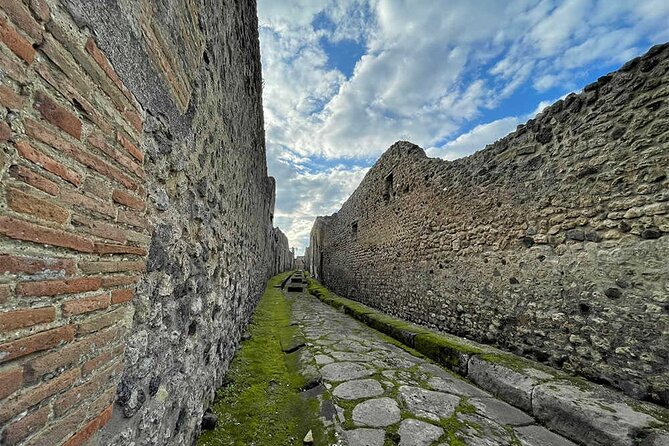
Next you head to Via dell’Abbondanza, the street that functioned like Pompeii’s main drag. If you want a “wow, people really lived here” moment, this is one of the best places to get it fast.
This street wasn’t just houses. It held apartments, shops, workspaces, and also grand public buildings and shrines. In other words, it shows social mix in a single walk. A city isn’t only monuments—life happens on streets, outside doorways, and in the spaces where trade and daily routine overlap.
The guide’s job here is to help you read the street like a story:
- You’ll see how different types of buildings lined up.
- You’ll understand why a single thoroughfare could serve multiple roles at once.
- You’ll get a sense of how people of different classes shared the same urban space.
You’ll spend about 45 minutes here, and admission ticket coverage is included for this stop. That’s helpful because it keeps costs simpler as you move through Pompeii.
One practical note: this is a street scene, which means you’ll likely be standing and walking more than you would in a museum room. Wear shoes you trust.
Rather go private? More options in Pompeii



Stop 3: Stabian Baths (Terme Stabiane) and the Roman Bath Routine
The last major stop is the Stabian Baths—Terme Stabiane. The key detail I’d highlight is age. These baths date back to the 2nd century BC, which is a big deal when you’re looking at surviving features and trying to understand Roman daily life beyond the big-ticket monuments.
This stop works well because it’s a process, not just a single view. You’ll tour the bathing circuit in sequence:
- Apodyterium (the dressing room)
- Frigidarium (cold baths)
- Tepidarium (medium temperature baths)
- Caldarium (hot baths)
When you walk through these spaces in order, Pompeii becomes more than disaster ruins. It becomes a window into routine. You start to imagine the rhythm: change clothes, shift temperatures, warm up, cool down. That chain makes the site feel human.
Time here is also about 45 minutes, and admission ticket coverage is included. That helps you avoid last-minute payment hassles while still spending enough time to understand what each room was for.
The only “watch out” is comfort. Bath areas can include uneven ground and stairs. If you have mobility limits, it’s still marked as most travelers can participate, but you’ll want to take your pace and use breaks when you need them.
Mt. Vesuvius and AD 79: The Story That Makes the Stones Mean Something
Pompeii without the AD 79 context can feel like a set of impressive ruins. With the context, it turns into a place with consequences. This tour includes the big thread you need: stories tied to Mt. Vesuvius and the tragic eruption in AD 79.
A good guide doesn’t just announce dates. They connect the eruption to what you’re seeing in everyday spaces—entertainment venues, social streets, and public bathing places. When you hear how the city lived and functioned, the ruins don’t feel like “what happened to a dead place.” They feel like a snapshot of an active city that was interrupted.
You’ll also get explanations that help you interpret clues around each stop. Even if you only catch a few lines during a quick stop, they can dramatically change what you notice next—like how public messaging tied into sports culture, or how the design of a street supported mixed daily activity.
The Guide Experience: Communication, Local Tips, and Q&A
One of the most praised parts of this tour is the human side of the experience—how easily you can get clear answers and how smoothly the tour moves. I like knowing the guide team behind this experience (including Anarosa and Carla, in the shared feedback) is known for strong communication before and during the walk.
That matters more than people think. Pompeii is a place where small timing and orientation details can save you stress. If your guide is organized, you’re more likely to:
- find the right pace for your group,
- ask the questions you actually care about,
- and leave with practical next steps rather than just photos.
You’ll also get local recommendations, which can be handy after the tour ends near Via Villa dei Misteri. Instead of wandering in a fog, you can move toward a meal or a viewpoint with more confidence.
Where You Start and Finish: Planning Your Day Smoothly
The meeting point is Piazza Immacolata, 2, 80045 Pompei NA, Italy. The tour ends at the ruins near Ruins of Pompei, Via Villa dei Misteri, 2, 80045 Pompei NA, Italy.
Why this matters: Pompeii logistics can eat time. Starting at a clear location helps you show up ready, and the end point near Via Villa dei Misteri can make it easier to continue exploring without backtracking.
It’s also listed as near public transportation, which is helpful if you’re building a day around train or bus connections. If you’re coming in from Naples or staying in another part of the area, plan to arrive a bit early and keep your route simple.
How to Prepare for a 2-Hour Pompeii Walk
This tour is short, so you don’t want to lose time to basics.
- Bring water. Even in cooler months, Pompeii walking adds up.
- Use comfortable shoes with grip. Uneven stone and steps are common.
- Dress for sun and wind. You’ll be outside most of the time.
- Keep your camera ready, but don’t rush your eyes. The guide’s explanations are what make the visuals stick.
If you’re visiting in the heat of the day, aim for earlier hours when possible. Short tours feel longer when you’re tired, and you’ll enjoy this more if you can stay alert.
Who This Tour Suits Best (and Who Might Want Longer)
This private 2-hour format is a good match if:
- you’ve got limited time in Pompeii,
- you want a guided route without getting swallowed by the site,
- you like understanding “how it worked,” not just seeing “what survived,”
- you’re traveling with friends or family (up to 8 people) and want shared, private attention.
It may be less ideal if you:
- want to explore a wide spread of Pompeii beyond three core areas,
- love slow museum-style wandering,
- or need lots of breaks and extra time at every stop.
Think of this as a focused hit. You’ll leave feeling oriented and informed, not exhausted and not like you skipped everything.
Should You Book This 2-Hour Pompeii Private Tour?
If you want Pompeii to make sense quickly, I’d book it. The mix of amphitheatre culture, street-life realism on Via dell’Abbondanza, and the bath routine at Stabian Baths is a smart trio. The private setup (up to 8 people) keeps the experience personal, and the guide-led AD 79 thread helps you connect the ruins to the tragedy that defines Pompeii.
Just do the cost check first: you’ll still need to budget the €18 per person entrance fee, and the amphitheatre stop doesn’t list admission ticket inclusion. If you factor that in and you’re okay with a tight 2-hour pace, this is a strong value way to see Pompeii without turning your day into a scavenger hunt.
FAQ
Is the tour duration exactly 2 hours?
It’s listed as approximately 2 hours, with time split between three stops (30 minutes at the amphitheatre, then 45 minutes each at Via dell’Abbondanza and the Stabian Baths).
How many people are in the private tour?
This is a private tour/activity, and your group will be the only participants. The price is per group up to 8 people.
What language is the tour offered in?
The tour is offered in English.
What does the tour cost and what’s included?
The tour price is $216.27 per group (up to 8) and includes a private guide. Admission tickets are not fully included—see next questions.
Do I need to pay an entrance fee for Pompeii?
Yes. The entrance fee to the archaeological site is €18.00 per person and is not included in the tour price.
Is admission included at all the stops?
Admission ticket details vary by stop. The amphitheatre stop notes admission ticket not included, while admission ticket is included for Via dell’Abbondanza and the Stabian Baths stops.
Where do I meet the guide?
The meeting point is Piazza Immacolata, 2, 80045 Pompei NA, Italy.
Where does the tour end?
The tour ends at Ruins of Pompei, Via Villa dei Misteri, 2, 80045 Pompei NA, Italy.
Is the tour near public transportation?
Yes, it’s listed as near public transportation.
What is the cancellation policy?
You can cancel for a full refund if you cancel at least 24 hours in advance of the experience’s start time. Free cancellation is available up to 24 hours before.
More Tours in Pompeii



More Tour Reviews in Pompeii

More Pompeii Tours to Compare
More Pompeii tours, freshly reviewed



Pompeii Tours, compared.
 ★ 4.8Pompeii: Entry Ticket and Guided Tour with an ArchaeologistFrom $3519,459 reviews
 ★ 4.1Pompeii: Entry Ticket with Audio GuideFrom $4013,491 reviews
 ★ 4.8Pompeii: Small Group Tour with an ArchaeologistFrom $4012,264 reviews
 ★ 4.3Pompeii Ruins & Mount Vesuvius Day TourFrom $12011,459 reviews
★ 5.0Pompeii Small Group Tour with an ArchaeologistFrom $356,593 reviews
★ 4.3Pompeii Ruins & Mount Vesuvius Day TourFrom $12011,459 reviews
★ 5.0Pompeii Small Group Tour with an ArchaeologistFrom $356,593 reviews
 ★ 4.5Skip-the-line Pompeii – Small Group TourFrom $544,401 reviews
 ★ 4.6Naples or Sorrento: Full-Day Pompeii and Mount Vesuvius TourFrom $1044,235 reviews
 ★ 3.9Pompeii: Skip-the-line Entry Ticket with Audio Guide & MapFrom $433,153 reviews
Browse the lists this tour appears in