
Review · POMPEII TOURS
Skip-the-lines Private full-day Ancient Pompeii and Herculaneum Ruins Tour
Waking up to Vesuvius feels different. This skip-the-lines private tour helps you see Pompeii and Herculaneum in one guided flow, with entrance tickets included and a focus on how Romans lived—politics, religion, markets, and everyday habits. I especially like that you’re not stuck wrestling with crowds; you’re guided onto the sites quickly and then led through the details that turn ruins into real human places.
The main thing to consider: it’s labeled full-day, but the guided time is about 4 hours total, and lunch plus transportation between sites aren’t included—so you’ll want to plan the rest of your day around that.
In This Review
- Key things to know before you go
- Pompeii and Herculaneum in About Four Hours
- Skip-the-Lines and a 9:00am Start: how the tour begins
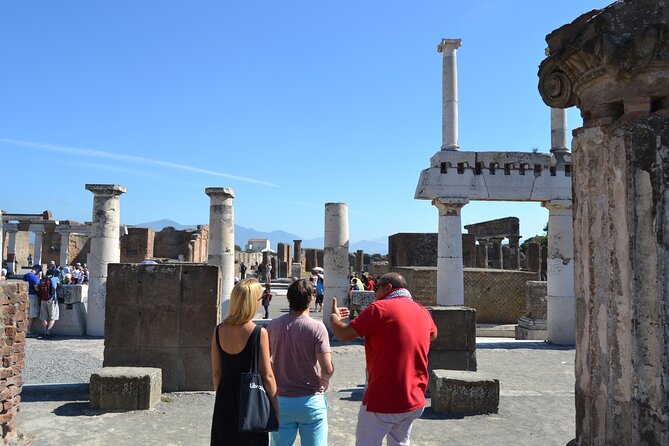
- Stop 1: Pompeii Archaeological Park (2 hours of Roman street life)
- Streets you can step onto, and the places people actually used
- Houses and the art on the walls
- Amphitheater acoustics, Forum life, and the city’s social map
- Stop 2: Herculaneum (2 hours, with the burn-preserved wooden details)
- Thermal baths and everyday comfort
- Frescoes and mosaics with a different visual style
- The big wow factor: wood preserved by lava and ash
- The Guide Makes the Difference: tailoring, humor, and real explanations
- Price and Value: is $414.22 per person worth it?
- What you’re paying for
- Where the cost pays off
- The best way to make it feel like a deal
- Logistics That Actually Matter on This Route
- Getting to the sites
- When and where you end
- What to bring
- Who This Tour Is For (and who should skip it)
- Should You Book This Pompeii and Herculaneum Skip-the-Line Tour?
- FAQ
- How long is the Pompeii and Herculaneum skip-the-line tour?
- What’s included in the ticket price?
- Does the tour really skip the lines?
- Is this tour private?
- Where do we meet, and where does it end?
- Is lunch or transportation included?
- What is the cancellation window?
Key things to know before you go
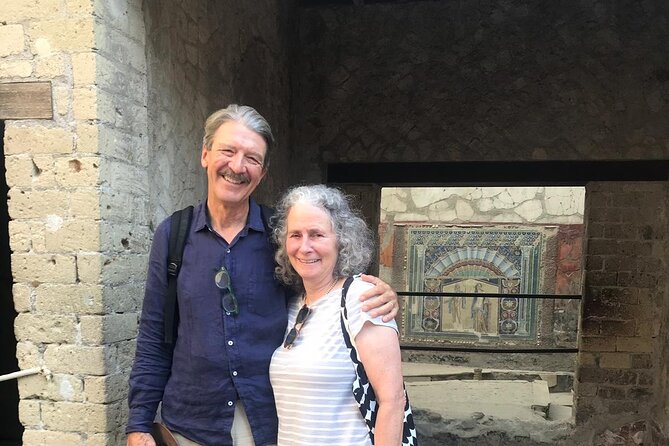
- Guaranteed skip-the-line access so you spend time walking, not queuing
- Two guided blocks of about 2 hours each at Pompeii and Herculaneum
- Admission tickets included for both archaeological parks
- A private experience with only your group, in English
- A licensed guide who explains more than what you can see at a glance
Which Pompeii ticket and guide? Compare a few more.
- Pompeii Small Group Tour with an Archaeologist★ 5.0 · 6,593 reviews
- Discover the Ancient Ruins of Pompeii: Day Trip from Rome★ 3.5 · 2,247 reviews
- Pompeii and Herculaneum Small Group Tour with an Archaeologist★ 5.0 · 1,350 reviews
- Skip the Line Guided Tour of Pompeii led by an Archaeologist★ 5.0 · 703 reviews
Pompeii and Herculaneum in About Four Hours
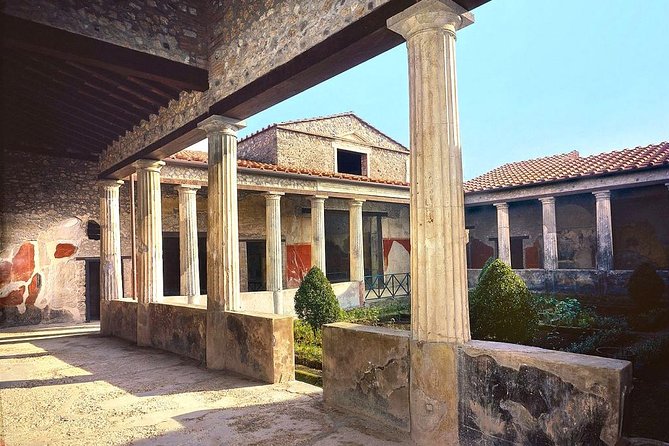
If you’ve ever walked through ruins on your own, you know the problem: you can look at a wall, but you can’t always tell what it meant. This tour fixes that fast. In roughly 4 hours, you get a guided storyline that connects the two cities—why they looked similar, how they differed, and what the 79AD eruption did to people’s lives.
It’s also a smart choice if Pompeii feels intimidating. The archaeological parks are big, and signage only gets you so far. With a guide, you can focus on the human stuff: where people ate, worked, worshipped, argued, flirted, entertained themselves, and gathered in public spaces.
Just don’t expect a slow, lingering day with breaks built in. The tour is structured, and it moves. If you want to roam freely for hours on end, this might feel a bit paced. If you want a “best hits with meaning,” it’s a strong format.
Skip-the-Lines and a 9:00am Start: how the tour begins
The tour starts at 9:00am at Hotel Vittoria, Piazza Esedra, in Pompeii (80045). It’s a clear, fixed meeting point—good for reducing that early-morning confusion.
From there, the big promise is guaranteed line-skipping. In practice, that matters for two reasons:
- You avoid spending your limited time stuck at entrances.
- You can get your bearings faster, so the first sights hit harder (instead of arriving already tired).
You’re also given a mobile ticket, which helps on a day when phones are already the default for maps and photos. The day ends at the Herculaneum Archaeological Park (Ercolano Scavi 80056), so you won’t be retracing your steps to finish where you started.
And yes—this is in English, which is especially helpful for learning the why behind what you see.
Stop 1: Pompeii Archaeological Park (2 hours of Roman street life)
Pompeii is the loudest name in the region for a reason. The ruins feel theatrical, and the guide’s job is to turn the spectacle into context.
Your Pompeii time focuses on a full slice of ancient urban life:
Streets you can step onto, and the places people actually used
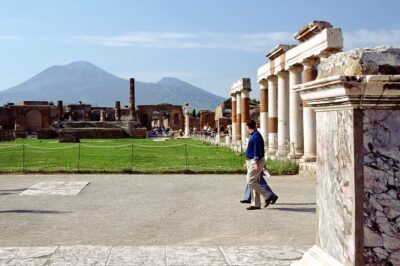
You’ll walk along original pavements, which is where Pompeii really changes the experience. Standing on worn stone, you get a physical sense of scale. Then you’ll move into areas like shops and what are described as ancient fast-food spots—places tied to daily routines rather than elite power.
That shift is important. It’s easy to treat Pompeii as a museum of dramatic architecture. A good guided flow keeps the focus on ordinary living.
Herculaneum keeps a few more tours worth your time

Houses and the art on the walls
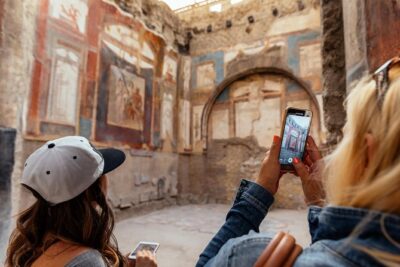
Pompeii’s frescoes are famous for a reason, but you’ll get more out of them with a guide who explains what you’re looking at. The tour includes time for the setting of houses and the richness of frescoes, so you can spot patterns: what rooms were for, how decoration signaled status, and how art mixed with everyday behavior.
Amphitheater acoustics, Forum life, and the city’s social map
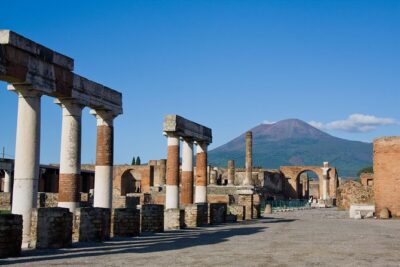
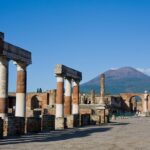
You’ll also see the amphitheater and its acoustics—one of those details that reminds you Romans weren’t just building; they were performing and gathering. After that, the route leads toward the city’s political and social center, including the Forum, described as where political, religious, artistic, and social life intertwined.
And yes, the tour includes the red-light district. That sounds sensational, but handled well, it’s actually useful. It helps you understand that cities always have multiple layers of life, not just temples and senators. It’s another way the guide makes Roman society feel grounded and human.
What to watch for: Pompeii can swallow your attention fast. The best value in this tour comes from letting the guide’s sequence do the work. If you try to outpace the plan, you might miss the connections they’re building.
Stop 2: Herculaneum (2 hours, with the burn-preserved wooden details)
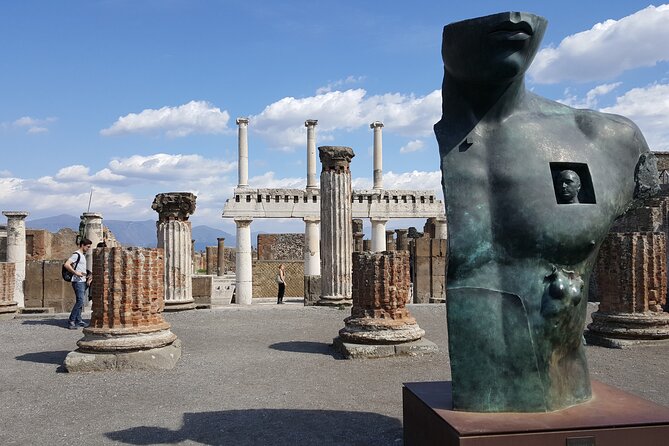
Herculaneum doesn’t always get the same headline attention as Pompeii, but it’s often the more emotionally specific place. It’s described as smaller, yet wealthier, with a different feel—more luxury, more private spaces, more craft preserved in place.
Your Herculaneum stop centers on several standout areas:
Thermal baths and everyday comfort
You’ll see thermal baths, which is a great way to understand Roman leisure as something structured and social. Baths weren’t just about hygiene; they were a routine where people interacted, relaxed, and traded news.
Frescoes and mosaics with a different visual style
The tour highlights the luxurious frescoes and mosaics. If Pompeii can feel like a dramatic stage set, Herculaneum often feels more like rooms that still had purpose. The art tends to read as lived-in, not just decorative.
The big wow factor: wood preserved by lava and ash
Here’s the feature that makes Herculaneum feel oddly intimate: the tour points out wooden structures—ceilings, doors, and even items like chairs—that were burned but then preserved by lava and ash. That means you’re not only looking at stone foundations; you’re seeing the material reality of daily life.
It’s one of those details that changes how the site hits you. Fire and destruction usually mean loss. In this case, it means preservation.
A practical note: because you’ll be walking and looking closely, comfortable shoes matter here more than in most “quick photo stops.” You’ll want support for steady steps on uneven ground.
The Guide Makes the Difference: tailoring, humor, and real explanations
This is a private tour, which is where the quality shows up. A group can only absorb so much at a time, and ruins are info-heavy. With a private guide, the explanations can match your pace and your interests.
You may meet licensed guides who are particularly strong with deep context and storytelling. From the names connected with this tour style, you might encounter guides such as Catello (aka Lello), Elaria, Antonio, or Salvo. People have praised them for mixing detailed knowledge with humor, and for keeping kids engaged—even when the tour isn’t just “pretty stones.”
One of the most useful skills a guide can bring is the ability to translate what you see. This tour is described as including attention to details like ancient Latin inscriptions—not just pointing at them, but explaining them in a way you can actually use while you’re there.
Why this matters for your value: admission alone gets you entry. The guide is what turns entry into understanding. If you’re the type who wants the story behind why a room existed or why a street layout mattered, this private setup is where you’ll feel the cost makes sense.
Price and Value: is $414.22 per person worth it?
At $414.22 per person, this isn’t a bargain tour. But it’s not priced like a ticketed bus ride either.
Here’s how I’d think about value with this option:
What you’re paying for
- A licensed guide
- Guaranteed skip-the-line access
- Entrance tickets included for both Pompeii and Herculaneum
- A private format for only your group
- English commentary
Where the cost pays off
Skip-the-lines can be a big deal in peak season. With a time-limited itinerary, that time saved isn’t trivial. Entrance fees being included also helps you avoid surprise add-ons once you arrive.
Where you need to be honest with yourself is time. The guided portion is about 4 hours total, and the tour does not include lunch or transportation. If you’ll still spend money getting to the meeting point and figuring out the day after the end point, you should budget for that.
The best way to make it feel like a deal
If you’re traveling as a small group (friends or family), private tours often become much more reasonable per person than solo. You also get to tailor pacing and focus—something you can’t do with generic audio tracks.
Logistics That Actually Matter on This Route
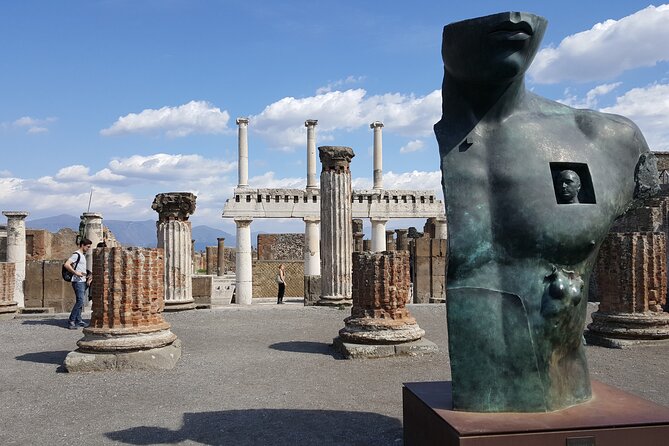
You’ll want to think about two things: getting to Pompeii and getting on with your day after Herculaneum.
Getting to the sites
The tour information notes that Pompeii and Herculaneum are reachable by Circumvesuviana train from both Sorrento and Naples. That’s useful if you’re basing yourself in those bigger towns and don’t want to rely on taxis.
The tour does not include transportation to or between sites. So you’ll handle that part yourself.
When and where you end
The tour ends at Ercolano Scavi (Herculaneum Archaeological Park). That’s a helpful detail because it affects where you’ll want to head next—your return plan should be ready for ending in Herculaneum rather than back in Pompeii.
What to bring
Wear comfortable shoes. You’ll be walking, and the surfaces aren’t smooth. Also bring your camera—this kind of tour is built for close-looking and photo-worthy details like preserved wooden pieces at Herculaneum and the layout cues at Pompeii.
Who This Tour Is For (and who should skip it)
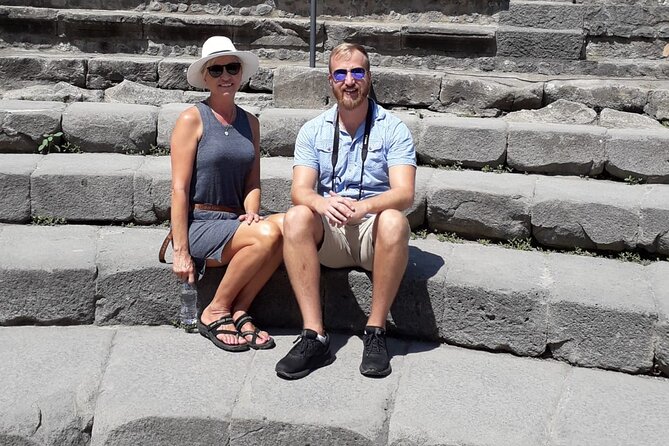
This tour is a good match if you:
- Love archaeology and history, and want explanations that connect the dots
- Want to avoid long entrance waits with a skip-the-lines approach
- Prefer a private guide who can answer questions and tailor pacing
- Appreciate both big public spaces (Forum, amphitheater energy) and quieter “how people lived” details (homes, baths, wood preserved by ash)
It may be less ideal if you:
- Want a full day with long breaks and lots of free time (the guided time is about 4 hours)
- Hate structured itineraries and prefer to wander without someone steering your focus
- Expect lunch or transportation to be included (it’s not)
Should You Book This Pompeii and Herculaneum Skip-the-Line Tour?
I’d book it if your goal is understanding, not just sightseeing. The combination of private guidance, guaranteed skip-the-line access, and entrance tickets included makes it one of the more time-efficient ways to see both sites. And the Herculaneum focus on preserved wood is the kind of detail you’ll remember because it feels personal, not just impressive.
Skip it if you’re the type who enjoys museum wandering at your own speed and you don’t need help interpreting what you see. Also, if you’re expecting a relaxed “full day” with lunch included, the structure here won’t match that.
If you want an afternoon that turns Pompeii and Herculaneum into lived-in places—rather than random walls and columns—this is a strong choice.
FAQ
How long is the Pompeii and Herculaneum skip-the-line tour?
It runs for about 4 hours in total, with roughly 2 hours at Pompeii and about 2 hours at Herculaneum.
What’s included in the ticket price?
A local licensed guide, guaranteed skip-the-line entry, and the admission tickets for both Pompeii Archaeological Park and Parco Acheologico di Ercolano.
Does the tour really skip the lines?
Yes. The tour includes guaranteed skip-the-lines access and immediate entry to the sites.
Is this tour private?
Yes. It’s a private experience, and only your group participates.
Where do we meet, and where does it end?
Meeting is at Hotel Vittoria, Piazza Esedra, 80045 Pompei, Italy at 9:00am. The tour ends at the Archaeological Park of Herculaneum (Ercolano Scavi, 80056).
Is lunch or transportation included?
No. Lunch and transportation to/from and between the sites aren’t included.
What is the cancellation window?
You can cancel for a full refund up to 24 hours before the experience’s start time.
More Tour Reviews in Pompeii



Herculaneum, a Few More Tours

More Pompeii Tours to Compare
More Pompeii tours, freshly reviewed

Pompeii Tours, compared.
 ★ 4.8Pompeii: Entry Ticket and Guided Tour with an ArchaeologistFrom $3519,459 reviews
 ★ 4.1Pompeii: Entry Ticket with Audio GuideFrom $4013,491 reviews
 ★ 4.8Pompeii: Small Group Tour with an ArchaeologistFrom $4012,264 reviews
 ★ 4.3Pompeii Ruins & Mount Vesuvius Day TourFrom $12011,459 reviews
★ 5.0Pompeii Small Group Tour with an ArchaeologistFrom $356,593 reviews
★ 4.3Pompeii Ruins & Mount Vesuvius Day TourFrom $12011,459 reviews
★ 5.0Pompeii Small Group Tour with an ArchaeologistFrom $356,593 reviews
 ★ 4.5Skip-the-line Pompeii – Small Group TourFrom $544,401 reviews
 ★ 4.6Naples or Sorrento: Full-Day Pompeii and Mount Vesuvius TourFrom $1044,235 reviews
 ★ 3.9Pompeii: Skip-the-line Entry Ticket with Audio Guide & MapFrom $433,153 reviews
Browse the lists this tour appears in