
Review · POMPEII TOURS
Exclusive Pompeii with Wine and Lunch on Vesuvius-Skip-the-line
Pompeii without the usual time sink is the whole idea here. You get skip-the-line entry and a private, certified guide who ties the ruins together into a walkable story. It’s one of those days where you’re busy the whole time, but nothing feels rushed.
I especially love how the tour is built around the parts of Pompeii that help you understand daily life fast: the Forum, the Bath-House, and homes like the House of the Vettii. And I like the real-world payoff at the end—Vesuvius views plus a winery visit with a guided cellar and a full 3-course lunch.
One consideration: this is still a walking day. You’ll want moderate fitness, good shoes, and sun protection in warmer months. Also, there’s no climb up Mount Vesuvius—just views while you’re on the slopes.
In This Review
- Key highlights
- From hotel pickup to skip-the-line entry: how this tour saves your day
- Pompeii start point: Antiquarium di Pompei sets the stage
- Porta Marina and Pompeii’s walls: your first taste of how the city worked
- Forum of Pompeii: the city’s power center, explained without overwhelm
- Basilica and Temple of Apollo: religion and law side by side
- Macellum and Forum Baths: eating and washing were big deals
- Casa dei Vettii: the frescoes and the lifestyle of wealthy Pompeii
- Insula dei Casti Amanti and Teatro Grande: seeing neighborhoods and entertainment
- Premium Plus: why the Villa of the Mysteries is worth the upgrade for some people
- Russo Family Winery on Vesuvius: 5 wines, a real lunch, and volcano views without the climb
- Price and value: is $575.35 per person actually a good deal?
- Practical tips: pacing, shoes, and how to make the day easier
- Should you book this Pompeii with wine and lunch tour?
- FAQ
- How long is the Pompeii with wine and lunch tour?
- Is skip-the-line entry included for Pompeii?
- Is the tour private?
- Do you offer hotel pickup?
- What’s included in the Pompeii visit?
- Does Premium Plus include the Villa of the Mysteries?
- Is there a climb to Mount Vesuvius?
- What are the winery inclusions?
Key highlights
- Skip-the-line tickets that help you zip past the worst of the entry crowds
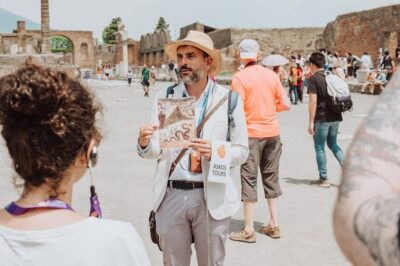
- Private certified guide who keeps Pompeii organized and your pace flexible
- Forum to baths to elite homes so you see daily life, not just random walls
- Russo Family Winery on Vesuvius with vineyard/cellar tour, 5-wine tasting, and lunch
- Premium Plus includes Villa of the Mysteries on top of the standard Pompeii time
Which Pompeii ticket and guide? Compare a few more.
- Pompeii Small Group Tour with an Archaeologist★ 5.0 · 6,593 reviews
- Discover the Ancient Ruins of Pompeii: Day Trip from Rome★ 3.5 · 2,247 reviews
- Pompeii and Herculaneum Small Group Tour with an Archaeologist★ 5.0 · 1,350 reviews
- Skip the Line Guided Tour of Pompeii led by an Archaeologist★ 5.0 · 703 reviews
From hotel pickup to skip-the-line entry: how this tour saves your day
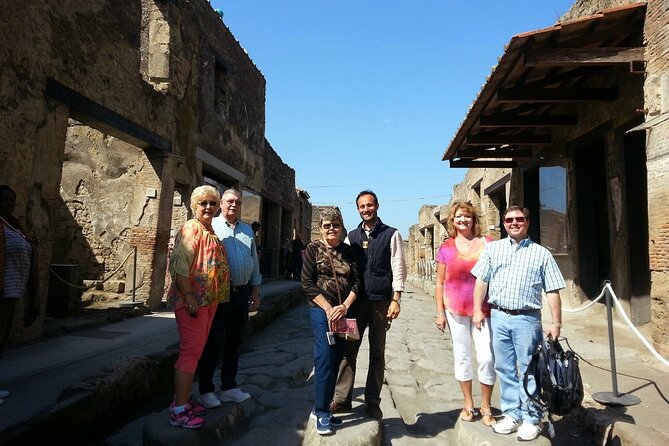
The biggest win here is simple: you don’t have to plan transport on your own while juggling train times, buses, or parking. Pickup is offered from Naples, Sorrento, Pompeii, and other locations like vacation rentals, train stations, airports, and cruise terminals/ports. You just specify your pickup place at booking, and the day runs on their schedule.
Once you’re at Pompeii, the skip-the-line part matters more than you’d think. Pompeii is huge, and time lost at the entrance turns into time lost on the best sections. With a private guide and a planned route, you’re not wandering around hoping you’re seeing the right “highlights.”
There’s also a practical bonus: this is described as a private tour/activity, so it’s only your group. That usually means you spend less time waiting for the slowest moment and more time using the day well.
Pompeii start point: Antiquarium di Pompei sets the stage
Your day gets a strong kickoff with the Antiquarium di Pompei. Think of it like an orientation room before you hit the streets and buildings outside.
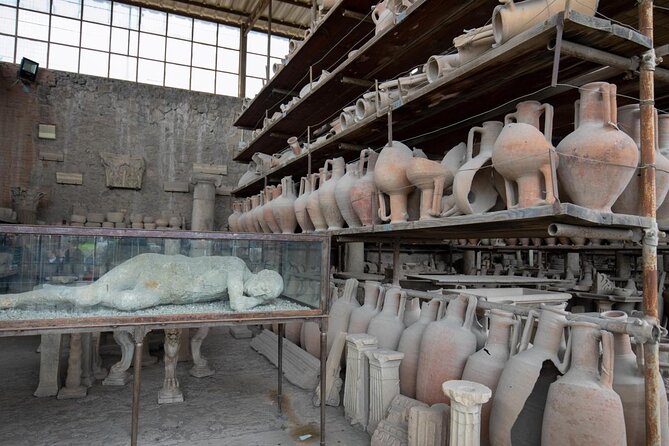
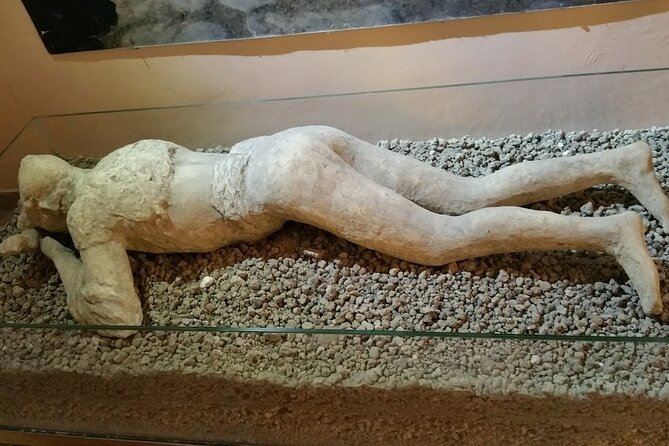
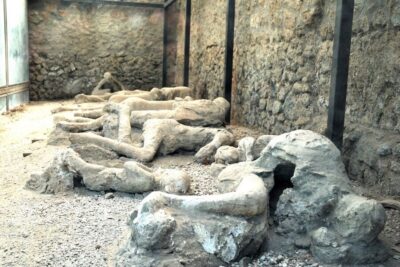
Inside, you’ll see artifacts like statues, household objects, inscriptions, and jewelry recovered during excavations. The point isn’t to replace the ruins—it’s to help you recognize what you’re looking at once you’re out in the open. Elevated platforms and glass cases protect delicate items you can’t really study up close in the main archaeological park. Then you get a heavier emotional section with plaster casts of victims plus eruption material, which gives the rest of Pompeii a more grounded context.
If you’ve ever felt museum-to-ruins transitions are awkward, this helps. You start the walk with the “why” already in your head.
Porta Marina and Pompeii’s walls: your first taste of how the city worked
Right after orientation, you’ll pass through Porta Marina and see the surrounding defensive walls. Porta Marina was one of the main gates and tied into access from the port area. Even though it’s only a short stop, it sets an important mental map: Pompeii wasn’t just a grid of streets for tourists. It controlled who came in and how.
You can still walk along an original stone ramp connected to the fortifications. For me, that’s where Pompeii starts to feel real—stone you can step on that was designed for movement, commerce, and protection.
If you’re short on mobility, this is still likely manageable because the time here is brief, but you’ll still want to keep your shoes comfortable. Pompeii is uneven in places.
Forum of Pompeii: the city’s power center, explained without overwhelm
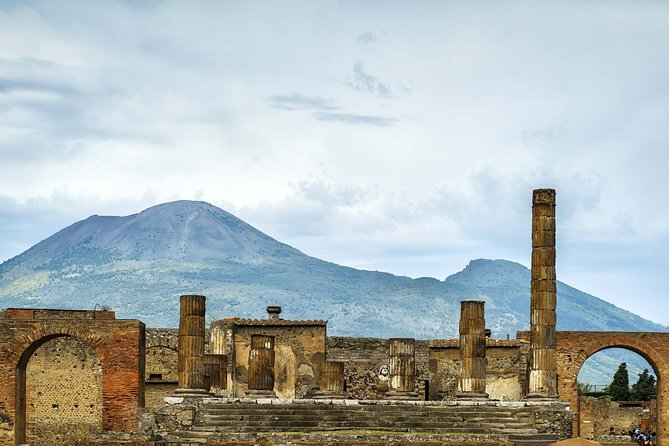
The Forum is the heart of civic life. Here, you’ll get the kind of overview that makes the ruins make sense—temples, administrative buildings, and market structures all arranged around the central square.
From the elevated walkways and terraces, the layout reads better. You’ll likely notice how the Capitolium, Basilica, and Macellum connect in one working system. The guide’s job is to put these buildings in order: what people used them for, when announcements happened, and how religion and politics mixed with daily commerce.
This is also where a private guide earns their keep. Without help, it’s easy to stare at columns and forget what they meant. With a good guide, you get daily life in Pompeii as a sequence, not a pile of facts.
More ways up the crater, side by side


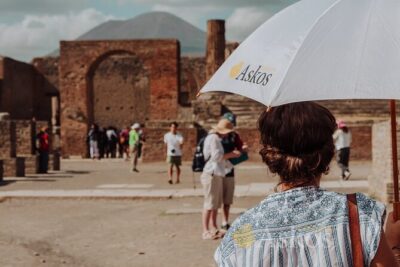



Basilica and Temple of Apollo: religion and law side by side
Two quick but meaningful stops follow that civic core.
At the Basilica, you see one of the oldest major examples of this kind of public building, dating to the 2nd century BC. It stood in the Forum area because this was where public business happened—law, administration, and social order.
Then you move to the Temple of Apollo, a key religious site dedicated to Apollo, god of the sun, music, and prophecy. The temple sat in a larger open courtyard near the Forum. The description includes how it once featured elegant columns and statues, and the idea that worshippers made offerings and sought guidance.
Even if you’re not a “religion ruins” person, this stop works because it shows Pompeii’s rhythm. People didn’t separate civic life from worship. They braided them together, and the architecture reflects that.
Macellum and Forum Baths: eating and washing were big deals
The Macellum is Pompeii’s main food market. Here you’ll get the covered complex idea—stalls for fish, meat, fruit, and imported goods. The layout of counters and spaces for storage helps you understand how food supply and trade shaped everyday routines.
Then you’ll step into Terme del Foro (the Forum Baths). This is one of the most impressive contrasts in Pompeii: public life plus comfort engineering. You’ll see how the bath complex was divided into men’s and women’s areas. It included changing rooms, warm and hot bathing halls, and a cold plunge pool. The description highlights an advanced hypocaust system (the underfloor heating style Romans used), plus stucco reliefs and vaulted ceilings preserved enough to still feel atmospheric.
If you only picture baths as hygiene, the baths add a different angle: leisure and conversation were part of it, and the Romans treated the routine like social time.
Casa dei Vettii: the frescoes and the lifestyle of wealthy Pompeii
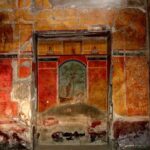
Next comes a shift from public spaces to elite domestic life at the House of the Vettii. This is one of Pompeii’s finest aristocratic residences, known for richly decorated frescoes and a layout built around atria and peristyle gardens.
What I like about including a major residence like this is that it gives you scale. Pompeii isn’t one single Pompeii—there are social levels everywhere. You start seeing how wealthy merchant owners expressed taste and status. The guide should point out the mythological paintings and the refined domestic spaces so you aren’t just walking from room to room.
This stop also helps you understand why Pompeii is so powerful. It’s not only disaster. It’s architecture, art, and everyday choices.
Insula dei Casti Amanti and Teatro Grande: seeing neighborhoods and entertainment
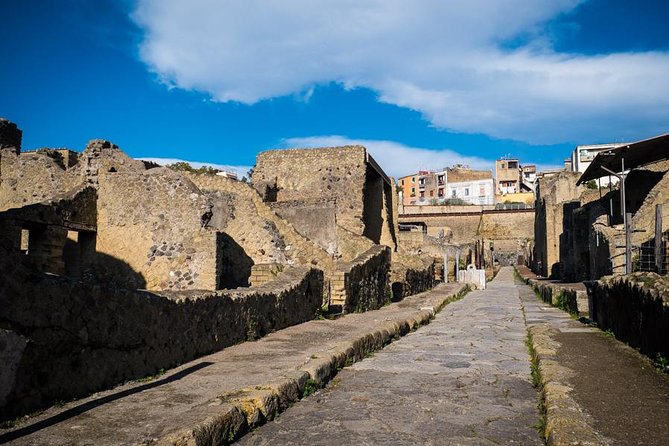
The Insula dei Casti Amanti is named after a fresco depicting lovers. It’s also one of those parts of Pompeii that helps you grasp neighborhoods as living spaces, not just isolated monuments.
You’ll access it via elevated ramps so you can view workshops, storerooms, and domestic rooms below without harming fragile surfaces. From above, it’s easier to picture how craftspeople worked and families moved between spaces. The description also notes the neighborhood feels like it’s caught mid-routine right before the eruption in AD 79, which is exactly the kind of detail that turns ruins into story.
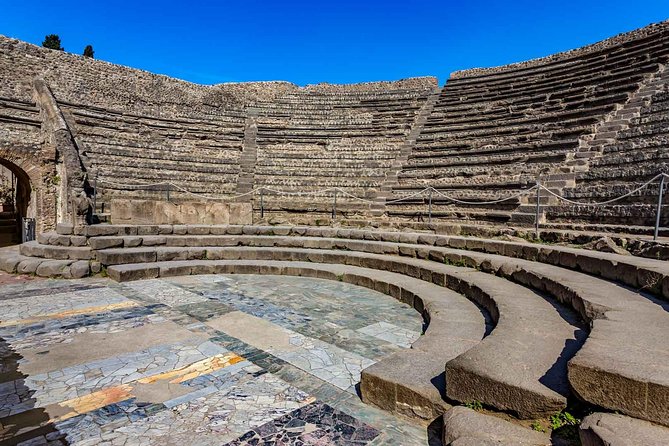
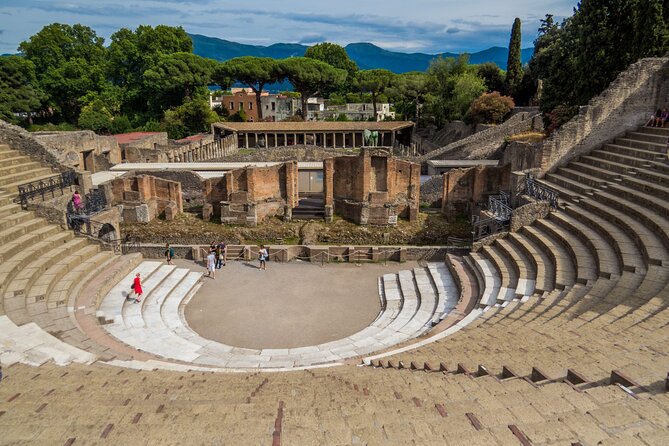
Then you’ll head to the Teatro Grande. The theater gives you Pompeii’s entertainment side. From terraces and modern walkways, you can look down onto semicircular seating tiers, the stage building, and the orchestra area. The acoustics and views toward the city and Mount Vesuvius are part of why performances mattered.
Standing within the auditorium area (as described) helps you imagine the scale of public events—comedy, tragedy, and ceremonies with crowds. This is where you start to feel the city’s social energy again.
Premium Plus: why the Villa of the Mysteries is worth the upgrade for some people
In the standard version, the focus is on a big, high-impact Pompeii circuit plus the winery day.
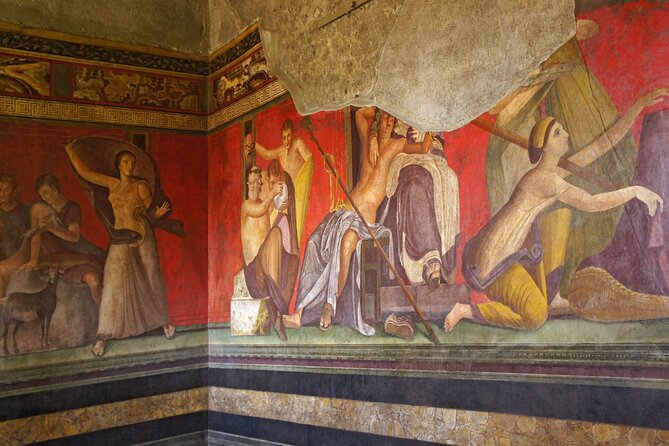
With Premium Plus, you get extra time: an extended 3-hour private guided tour that includes the Villa of the Mysteries, located just outside the city walls. The villa is famous for remarkably well-preserved frescoes depicting a mysterious Dionysian ritual.
If you care about frescoes and symbolic art (or you simply want more time in the ruins without feeling rushed), this upgrade makes sense. It’s also helpful if Pompeii feels overwhelming—more guided time usually means better connections between what you see and what it meant.
Russo Family Winery on Vesuvius: 5 wines, a real lunch, and volcano views without the climb
Here’s the part that makes the day feel like a two-course experience: history first, then the modern local culture of the volcano slopes.
After Pompeii, you head to the slopes for a visit at Cantina del Vesuvio (Russo Family Winery, family-run since 1930). The winery overlooks the Bay of Naples, and the tour description is clear: there’s no Mount Vesuvius climb, but you’ll have the dramatic volcano presence around you while you’re tasting and eating.
What’s included:
- A guided tour of the vineyard and cellar
- Tasting of 5 wines (classic or superior)
- A 3-course lunch with traditional ingredients, including items like salami and cheeses (provolone and ricotta), casatiello, roasted eggplant, bruschetta with Piennolo tomatoes, pasta with Piennolo cherry tomatoes and basil, and dessert (Neapolitan Pastiera)
Dietary needs are mentioned: vegetarian, vegan, and gluten-free options are available.
This isn’t just a stop for photo ops. You get a proper guided winery experience plus a meal that fits the region, and it’s a nice reset after hours walking in Pompeii.
Price and value: is $575.35 per person actually a good deal?
At $575.35 per person, this isn’t a bargain-basement option. So you should ask what you’re buying, not just the headline number.
In your favor:
- Private certified guide at Pompeii, not a shared whisper-boat of strangers
- Skip-the-line tickets that protect your time
- Round-trip transportation via pickup from multiple areas
- At the winery: vineyard/cellar tour, 5-wine tasting, and a 3-course lunch, with dietary alternatives
If you tried to DIY this, you’d spend time sorting tickets, transport, and timing. You might save money—but you’d almost certainly spend more mental effort. And Pompeii is one of those places where a guide changes how satisfying the visit feels.
This tour tends to be best value for pairs and small groups who want a smooth day with minimal hassle. If you’re traveling solo or on a strict budget, you might decide you only want Pompeii and skip the winery package. But if you like history and you want the Vesuvius payoff without extra planning, the total package can feel fair.
Practical tips: pacing, shoes, and how to make the day easier
This tour is built for moderate physical fitness, and you should plan for steady walking and lots of stairs or uneven surfaces depending on the exact routes.
- Wear appropriate shoes. Pompeii is not the time for fancy slip-ons.
- In May to September, bring sun gear. The day can be bright and hot.
- If you have mobility concerns, the tour description encourages requests, and the pattern from guide handling shows they try to make the experience work for you. For example, Danilo was specifically praised for accommodating a spouse’s mobility issues while still delivering a good visit.
Also note the tone of the itinerary: it’s structured to avoid overwhelm. The Pompeii walk is at your pace, and there are short stops for the key structures so you’re not trapped in one long, exhausting stretch without breaks.
Should you book this Pompeii with wine and lunch tour?
If you want Pompeii to feel organized and human—civic life, markets, baths, homes, entertainment—this is a strong pick. The guide-led route helps you make sense of the site instead of treating it like a photo scavenger hunt. And the winery finish is a practical way to cap the day with local food and wine plus volcano views, without spending time climbing.
I’d skip it if you hate walking, or if you’re looking for a purely independent, self-paced Pompeii day. This is more structured than that. And since there’s no Vesuvius climb, don’t book expecting a summit hike.
If you’re deciding between standard and Premium Plus: choose Premium Plus if frescoes and deeper Pompeii time matter to you—Villa of the Mysteries is the kind of stop that rewards extra attention.
Either way, you’ll come away with more than ruins. You’ll have a clearer sense of how Pompeii worked day to day, and why the eruption is so unforgettable.
FAQ
How long is the Pompeii with wine and lunch tour?
The duration is listed as about 5 to 7 hours.
Is skip-the-line entry included for Pompeii?
Yes. The tour includes skip-the-line tickets for Pompeii.
Is the tour private?
Yes. It’s described as a private tour/activity with only your group.
Do you offer hotel pickup?
Pickup is offered from Naples, Sorrento, Pompeii, and other locations such as vacation rentals, train stations, airports, and cruise terminals/ports. You choose your pickup place when booking.
What’s included in the Pompeii visit?
The tour includes a guided visit to major areas and buildings such as the Forum, plaster casts of victims, private homes like the Casa dei Vettii, the Bath-House area, the theater, and the eruption-related materials, with admission tickets included.
Does Premium Plus include the Villa of the Mysteries?
Yes. The Villa dei Misteri is included only with the Premium Plus option, along with an extended 3-hour private guided tour.
Is there a climb to Mount Vesuvius?
No. The tour does not include a climb. You get views of Mount Vesuvius during the day and then visit the slopes for wine tasting and lunch.
What are the winery inclusions?
At Cantina del Vesuvio (Russo Family Winery), you’ll get a guided tour of the vineyard and cellar, a tasting of 5 wines, and a 3-course lunch with traditional local ingredients. Vegetarian, vegan, and gluten-free options are available.
More Tour Reviews in Pompeii




Up Vesuvius, More Ways to Climb






More Pompeii Tours to Compare
More Pompeii tours, freshly reviewed

Pompeii Tours, compared.
 ★ 4.8Pompeii: Entry Ticket and Guided Tour with an ArchaeologistFrom $3519,459 reviews
 ★ 4.1Pompeii: Entry Ticket with Audio GuideFrom $4013,491 reviews
 ★ 4.8Pompeii: Small Group Tour with an ArchaeologistFrom $4012,264 reviews
 ★ 4.3Pompeii Ruins & Mount Vesuvius Day TourFrom $12011,459 reviews
★ 5.0Pompeii Small Group Tour with an ArchaeologistFrom $356,593 reviews
★ 4.3Pompeii Ruins & Mount Vesuvius Day TourFrom $12011,459 reviews
★ 5.0Pompeii Small Group Tour with an ArchaeologistFrom $356,593 reviews
 ★ 4.5Skip-the-line Pompeii – Small Group TourFrom $544,401 reviews
 ★ 4.6Naples or Sorrento: Full-Day Pompeii and Mount Vesuvius TourFrom $1044,235 reviews
 ★ 3.9Pompeii: Skip-the-line Entry Ticket with Audio Guide & MapFrom $433,153 reviews
Browse the lists this tour appears in