

Review · POMPEII TOURS
Pompeii from Naples: Smart Audio Guide with Travel Instructions
Pompeii, guided by your phone. This Naples-to-Pompeii experience uses a Smart Audio Guide app with GPS to point you to each major ruin, with pictures and plain-language history on your mobile. The itinerary is built for a full day (about 8 to 10 hours), and it’s designed so you can move at your speed instead of getting herded around.
What I like most is the flexibility—no strangers tour group pacing your day—and the GPS audio directions that help you find the next stop fast. One important consideration: the app needs active roaming or mobile data to work while you’re exploring, so plan around that before you get there.
In This Review
- Key highlights at a glance
- How this Pompeii day trip works without the tour-group stress
- Smart Audio Guide app: GPS, photos, and how you use it on-site
- Value check: $24.10 plus the real costs you should budget
- Pompeii route highlights: what each stop gives you (and how to time it)
- Villa dei Misteri: Dionysus frescoes first
- Forum of Pompeii: the civic center in scale
- Temple of Jupiter: Roman religion with a later twist
- Basilica: law court and marketplace vibes
- Santuario di Apollo: a formal sanctuary setting
- Lupanar: the brothel and what it says about daily life
- Teatro Grande: massive entertainment space
- Amphitheatre of Pompeii: built for spectacle
- Praedia di Giulia Felice: a property-rental clue in stone
- Stabian Baths (Terme Stabiane): baths from an older era
- Palestra Grande: athletic training and social space
- Centauro di Igor Mitoraj: modern sculpture in an ancient city
- Torre de Mercurio XI: a commercial-and-living tower idea
- Casa del Fauno: the dancing faun centerpiece
- House of the Dioscuri: Castor and Pollux symbolism
- Casa di Meleagro: atrium to peristyle
- Casa dei Vettii: freedmen owners named in inscriptions
- Casa del Menandro: a silver hoard detail you’ll remember
- Practical tips that make the day easier (not harder)
- Who this Pompeii-from-Naples audio guide is best for
- Should you book this Pompeii smart audio guide?
- FAQ
- How long does the Pompeii from Naples smart audio guide take?
- How much does it cost?
- Is pickup offered from Naples?
- Is this a group tour?
- What do I need to access the experience?
- Do I need roaming or mobile data?
- Are entrance tickets included?
- Does the guide cover the trip from Naples to Pompeii and back?
- Can I get help during the tour?
- Is it possible to use the audio guide on more than one phone?
Key highlights at a glance
- GPS step-by-step navigation that finds your location and guides you stop by stop
- Personal pacing: you can linger where you care and speed up where you don’t
- A preloaded mobile app you access before the tour starts (plus a mobile ticket)
- WhatsApp support from a human assistant during the experience
- A long, curated Pompeii route that hits major sights and several house museums
Which Pompeii ticket and guide? Compare a few more.
- From Naples: Pompeii Ruins & Mount Vesuvius Day Tour★ 4.3 · 11,459 reviews
- From Naples: Skip-the-line Pompeii – Small Group Tour★ 4.5 · 4,401 reviews
- Naples or Sorrento: Full-Day Pompeii and Mount Vesuvius Tour★ 4.6 · 4,235 reviews
- Pompeii & Mt.Vesuvius Day Tour from Naples with Pizza Lunch★ 4.0 · 2,901 reviews
How this Pompeii day trip works without the tour-group stress
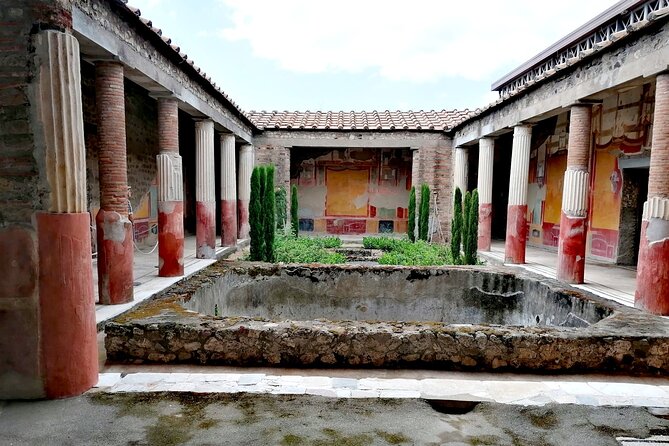
If your idea of fun is not being stuck behind someone who moves at a glacier pace, this setup makes a lot of sense. Instead of boarding a classic group tour and waiting for people to catch up, you follow a custom audio itinerary from Naples to Pompeii and back. It’s private, meaning only your group uses the plan.
The experience is built around a “you pick the rhythm” model. Many stops are allotted around 30 minutes, but the real win is that you’re not locked to a guide’s schedule. I like this for Pompeii because the ruins reward curiosity. If you want to zoom in on frescoes or architecture, you can. If you’d rather skim and move on, you’re not punished for it.
You also get a human safety net. The listing includes non-stop access to an assistant via WhatsApp. That’s helpful when you’re trying to manage logistics in a place where signage and walking routes can feel confusing.
Smart Audio Guide app: GPS, photos, and how you use it on-site

This is not just an audio file you press play on. The Smart Audio Guide app uses GPS to identify where you are in Pompeii and then walks you through what to look at next. It also includes pictures, plus useful information for each site, so you’re not stuck reading labels that are hard to find while you’re standing in bright sun.
A practical detail: you can use the same Smart Audio Guide on multiple phones at the same time. If you’re traveling with a partner or family, you don’t need everyone sharing one screen or one set of headphones.
One thing to take seriously: you must have active roaming or mobile data. Pompeii is outdoors, and mobile networks can be hit or miss in any region, so check your plan before you leave Naples. If the app can’t connect, the whole “GPS guide” concept falls apart.
Also, the app includes travel information for the round trip from Naples to Pompeii and back. That matters because the day already has enough walking—making the transport piece clearer helps you spend your brainpower on the ruins instead of the transit shuffle.
Value check: $24.10 plus the real costs you should budget
At $24.10 per person, you’re paying mainly for the guided routing system: the custom mobile itinerary, GPS audio directions, and WhatsApp support. That’s usually the hardest part of Pompeii planning—figuring out the smartest order of stops and not losing time between sights.
However, the listing is clear that entrance and public transport tickets are not included, and you should budget about 30 euro for those. Even if many stops in the app are marked admission ticket free, you’ll still want to plan for the main Pompeii access and getting there from Naples.
So the value looks best if you:
- want a structured route but hate group-tour timing
- will actually use the app on-site (and have data/roaming ready)
- want a low-stress way to hit both civic areas and domestic houses
If you already have a very tight, self-guided plan and don’t care about GPS help, this might feel less essential. But if you’d rather spend your time looking at Pompeii instead of reading maps, it’s a strong trade.
Pompeii route highlights: what each stop gives you (and how to time it)

The itinerary is built to move through Pompeii’s big “themes,” from villa frescoes to temples, public venues, baths, athletic spaces, and the famous houses. Below is what you can expect at each stop, plus a small timing note so you don’t get stuck on the wrong thing.
More guided runs around Naples




Villa dei Misteri: Dionysus frescoes first
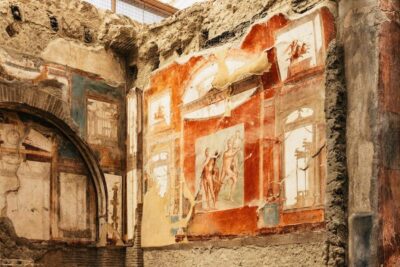
This villa is known for frescoes that cover multiple rooms. The scenes connect to rituals and myths tied to the cult of Dionysus. If you’re wondering where Pompeii’s storytelling energy really shows up early, this is a great start.
Timing tip: because the fresco program is visually dense, 30 minutes can feel quick. If frescoes are your thing, keep your phone volume ready and take a slow pass through each room described by the app before you rush to the next stop.
Forum of Pompeii: the civic center in scale
The Forum is a large open rectangle, roughly 38 by 142 meters, paved with stone and ringed by important public buildings, temples, and statues. Even when you’re not reading every detail, you can feel the “center of public life” concept.
Timing tip: don’t just stand in the middle. Move around the edges where temples and major structures sit, because that’s where the scale really clicks.
Temple of Jupiter: Roman religion with a later twist
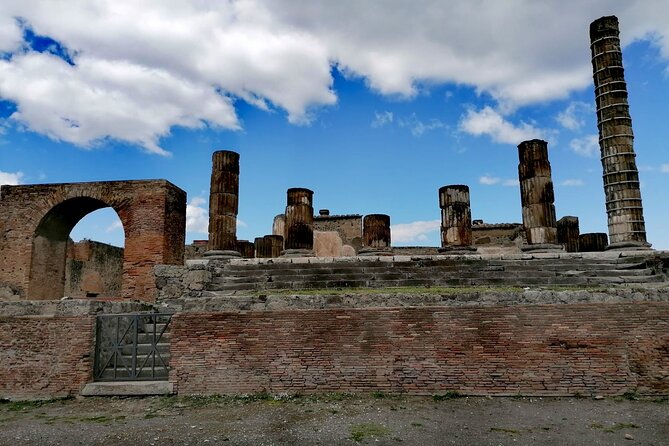
The temple started as a dedication to Jupiter, the chief god tied to sky and thunder. Later, it became part of the Capitoline Triad, associated with Jupiter, Juno, and Minerva.
Timing tip: try to connect the architecture you see to the shift the app describes—Pompeii’s religious spaces weren’t frozen in time.
Basilica: law court and marketplace vibes
Pompeii’s basilica was the kind of public building Romans used for civic meetings, law courts, or commercial activity. It’s a big clue to how everyday business and government overlapped.
Timing tip: basilicas are easy to underlook if you’re hungry for frescoes and houses. If you’re short on time, spend a little longer here than you think. This is where the city’s machinery shows.
Santuario di Apollo: a formal sanctuary setting
This sanctuary is arranged with a portico or colonnade, forming a peristyle that encloses the courtyard. That layout matters: it creates a grand, controlled environment for rituals and gatherings.
Timing tip: walk the perimeter slowly. Peristyles are designed spaces, and the “frame” of columns can help you visualize ceremonies.
Lupanar: the brothel and what it says about daily life
The Lupanar Grande is one of Pompeii’s best-known structures and was the city’s main brothel. The site offers a direct look at Roman attitudes toward sexuality.
Timing tip: this stop can feel different from the temples and forums. If you’re sensitive to the topic, give yourself a little extra time to decide how long you want to stay, since the app’s descriptions can be detailed.
Teatro Grande: massive entertainment space
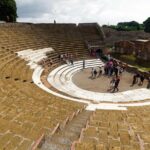
The Teatro Grande could hold about 5,000–6,000 spectators. It’s a key reminder that Pompeii wasn’t just a place for rituals and commerce—people gathered for performances too.
Timing tip: if you love architecture, pause to consider seating arrangement and sightlines. If you care more about the social story, listen to the app’s context while you scan the stage area.
Amphitheatre of Pompeii: built for spectacle
Pompeii’s amphitheater is described as the oldest surviving stone amphitheater in the Roman world, built around 70 BCE. It’s one of the most remarkable structures in the city, and it predates later stone amphitheaters that became more common across the empire.
Timing tip: this is a great “breathe and look around” stop. Step back enough to appreciate shape and size, then return to read details with the audio.
Praedia di Giulia Felice: a property-rental clue in stone
This area is named after Julia Felix, whose name appears on an inscription connected to a property rental advertisement found during excavations. It’s a small detail with a big effect: it makes Pompeii feel business-real, not just myth-real.
Timing tip: if the inscription detail is hard to spot while you’re moving, let the app’s narration do the work first, then come back with a second look.
Stabian Baths (Terme Stabiane): baths from an older era
The Stabian Baths are among the oldest in the Roman world. The initial construction dates to the Samnite period before Roman control, and later updates changed the complex over time.
Timing tip: baths can blur together if you don’t have a story. Use the app here like a map for how the space evolved—then you’ll see the changes instead of just the rooms.
Palestra Grande: athletic training and social space
The Large Palaestra was a major public area for athletic training and exercise, with an obvious social component. The architecture shows how central physical training was in Roman public life.
Timing tip: you’ll get more out of this if you imagine movement and activity. Stand where groups would gather and follow the app’s cues to understand layout.
Centauro di Igor Mitoraj: modern sculpture in an ancient city
This stop is a specific sculpture by Igor Mitoraj, an artist known for modern interpretations of classical forms. In Pompeii, it creates a conversation between what you’re seeing and how we still interpret antiquity today.
Timing tip: treat it like a break from pure reconstruction. If you’re on your feet all day, this pause-and-look stop can reset your attention.
Torre de Mercurio XI: a commercial-and-living tower idea
The Torre di Mercurio XI is thought to have been multi-story, possibly with living quarters above and commercial uses at street level, such as shops or workshops. It’s a practical clue to how business and home life could share a building.
Timing tip: this is an architecture-thinking stop. Don’t rush—try to picture daily life across floors, even if the structure you see is only part of the story.
Casa del Fauno: the dancing faun centerpiece
This house is famous for a bronze statue of a dancing faun found in the impluvium (the basin to collect rainwater) of the Tuscan atrium. It’s the kind of object that makes Pompeii feel suddenly personal.
Timing tip: spend time on the “why here” logic: the app’s explanation plus the placement of the statue helps you connect art to the lived-in space.
House of the Dioscuri: Castor and Pollux symbolism
The house is named for the Dioscuri, Castor and Pollux, twin brothers tied to Greek and Roman mythology. They were viewed as protectors of sailors, which adds an interesting symbolic layer to what you’re walking through.
Timing tip: if you like mythology, this is a good stop to slow down. The house name is doing real interpretive work.
Casa di Meleagro: atrium to peristyle
Casa di Meleagro features a preserved atrium with an impluvium at the center, surrounded by decorated walls. The highlight is a large peristyle with a colonnaded courtyard.
Timing tip: this house rewards two different “looks”: first, the atrium layout; then the courtyard space. Don’t mentally merge them.
Casa dei Vettii: freedmen owners named in inscriptions
Casa dei Vettii is linked to two freedmen, Aulus Vettius Conviva and Aulus Vettius Restitutus, based on inscriptions found in the house. That turns the story from generic luxury into a specific social history.
Timing tip: spend your time where the app focuses your attention. When houses are this complex, you need a guide’s “what matters first” logic.
Casa del Menandro: a silver hoard detail you’ll remember
This house is known for artifacts found on-site, including a treasure hoard of over 100 silver items—cups, plates, and bowls stored in a storage room.
Timing tip: even if you don’t see every item directly, the scale of the hoard is the point. Let the app’s info give you the context so the space feels purposeful rather than decorative.
Practical tips that make the day easier (not harder)
Here are the small things that help you get the most from a phone-guided Pompeii route:
- Protect your phone connection. The app needs active roaming or mobile data to work while you travel and explore.
- Use headphones, even at moderate volume. You’ll be walking a lot, and audio helps you avoid stopping constantly to reread.
- Don’t treat 30 minutes as a rule. Use it as a starting point. Some stops need longer, especially frescoes or houses with major features.
- Keep your route order in mind. A GPS guided itinerary works best when you follow the intended flow instead of freelancing wildly.
Also, keep expectations realistic. Pompeii is big, uneven, and full of details. This experience helps you move smarter, but you’ll still do plenty of walking.
Who this Pompeii-from-Naples audio guide is best for

This is a great match if you want:
- a self-guided feel with structure
- a route that hits civic spaces, entertainment, baths/athletics, and major houses
- the option to pause, listen, and keep going without waiting on a group
- practical support via WhatsApp if you get stuck
It might be less ideal if you:
- prefer a fully live guide talking face to face
- don’t want to rely on mobile data while you’re outdoors
- want zero phone interaction during your day
Should you book this Pompeii smart audio guide?

I’d book it if your priority is freedom with direction. The GPS app, pictures, and stop-by-stop guidance solve the main problem most first-timers have at Pompeii: figuring out where to go next without wasting hours wandering.
I would double-check before booking if your phone plan doesn’t cover reliable data/roaming. Since the app depends on connection to function properly, this is the make-or-break detail.
If you can handle that, this is a solid way to experience Pompeii from Naples with a route that doesn’t just skim the big names—it also gives you the civic buildings and the houses where the city’s personality shows.
FAQ

How long does the Pompeii from Naples smart audio guide take?
The experience runs about 8 to 10 hours.
How much does it cost?
The price is $24.10 per person.
Is pickup offered from Naples?
Yes, pickup is offered, and the meeting point is near public transportation.
Is this a group tour?
No. It’s private, and only your group participates.
What do I need to access the experience?
You’ll use a mobile app Smart Audio Guide and you’ll receive access to the app before the tour. You should also have a mobile ticket.
Do I need roaming or mobile data?
Yes. The app is mobile-based, and you need active roaming or mobile data to use it while traveling and exploring.
Are entrance tickets included?
Entrance and public transportation tickets are not included (budget about 30 euro). Many stops are marked as admission ticket free in the itinerary, but you should still plan for site access and transport costs.
Does the guide cover the trip from Naples to Pompeii and back?
Yes, it includes travel information for the round trip between Naples and Pompeii.
Can I get help during the tour?
Yes. There is non-stop access by a human assistant via WhatsApp.
Is it possible to use the audio guide on more than one phone?
Yes. The experience includes 1 Smart Audio Guide that you can use on multiple phones at the same time.
More Guided Tours in Naples





More Tour Reviews in Naples





More Pompeii Tours to Compare




More Naples tours, freshly reviewed





Pompeii Tours, compared.
 ★ 4.8Pompeii: Entry Ticket and Guided Tour with an ArchaeologistFrom $3519,459 reviews
 ★ 4.1Pompeii: Entry Ticket with Audio GuideFrom $4013,491 reviews
 ★ 4.8Pompeii: Small Group Tour with an ArchaeologistFrom $4012,264 reviews
 ★ 4.3Pompeii Ruins & Mount Vesuvius Day TourFrom $12011,459 reviews
★ 5.0Pompeii Small Group Tour with an ArchaeologistFrom $356,593 reviews
★ 4.3Pompeii Ruins & Mount Vesuvius Day TourFrom $12011,459 reviews
★ 5.0Pompeii Small Group Tour with an ArchaeologistFrom $356,593 reviews
 ★ 4.5Skip-the-line Pompeii – Small Group TourFrom $544,401 reviews
 ★ 4.6Naples or Sorrento: Full-Day Pompeii and Mount Vesuvius TourFrom $1044,235 reviews
 ★ 3.9Pompeii: Skip-the-line Entry Ticket with Audio Guide & MapFrom $433,153 reviews
Browse the lists this tour appears in