
Review · POMPEII TOURS
Pompeii with an Archaeologist Shared or Private Tour from Naples
Pompeii is easier when someone points. This archaeologist-guided 4-hour tour turns the ruins into a clear route, with skip-the-line Pompeii express entry and English commentary. You’re not just wandering stone after stone.
I like that you cover the big emotional range of Pompeii in one go: public life (theaters and the Forum), private life (elite homes), and everyday routines (baths and street shops). The tour also includes air-conditioned transportation with a driver, or a driver plus an English-speaking assistant, which matters when you’re on a tight schedule.
One thing to consider: the stops are timed, so it can feel like a 4-hour sprint rather than a slow, stay-all-day explore. And if you upgrade to private, double-check what private actually means for transport and timing, since one bad experience shared that expectations didn’t match what was provided.
In This Review
- Key points to know before you go
- Pompeii, organized: how a 4-hour route helps your brain
- Transportation from Naples and the Amalfi hydrofoil mention
- Skip-the-line Pompeii express entry and mobile tickets
- Group size choices: shared, small-group, semi-private, and private
- Stop 1 and 2: Odeon and Teatro Grande
- Stop 3: House of Menander and what “elite life” looks like
- Stop 4 and 5: Stabian Baths and the Lupanar
- Stop 6: Via dell’Abbondanza is where the city feels real
- Stop 7 and 8: House of the Faun and the main square
- Stop 9: Basilica and the merchant rhythm
- Price and value: is $60.21 fair for this package?
- What could go wrong: private expectations and transport timing
- Who should book this Pompeii tour
- Should you book? My practical recommendation
- FAQ
- How long is the Pompeii tour?
- What languages is the tour offered in?
- Is skip-the-line entry included?
- Are admission tickets included for the sights?
- What transportation is included?
- What group sizes are available?
- Where is this tour located?
- When can I get a full refund if I cancel?
- How far in advance is this tour commonly booked?
Key points to know before you go
- Skip-the-line Pompeii express entry saves time at one of the biggest bottlenecks.
- Archaeologist context helps you connect buildings to daily life, not just dates and names.
- Small-group options range from group size up to semi-private and private, so you can choose how much space you want.
- A smart selection of sites covers theaters, elite houses, baths, the brothel, and the main civic area.
- Timed stops (10–15 minutes) keep you moving, but you’ll want to plan which parts you’ll revisit later.
- Transport included includes an air-conditioned car and mentions round-trip hydrofoil from Amalfi (if it’s part of your package).
Which Pompeii ticket and guide? Compare a few more.
- From Naples: Pompeii Ruins & Mount Vesuvius Day Tour★ 4.3 · 11,459 reviews
- From Naples: Skip-the-line Pompeii – Small Group Tour★ 4.5 · 4,401 reviews
- Naples or Sorrento: Full-Day Pompeii and Mount Vesuvius Tour★ 4.6 · 4,235 reviews
- Pompeii & Mt.Vesuvius Day Tour from Naples with Pizza Lunch★ 4.0 · 2,901 reviews
Pompeii, organized: how a 4-hour route helps your brain
Pompeii is vast, and it’s also repetitive in the best and worst ways. Without a plan, you can end up seeing a lot of walls and not much meaning. This tour keeps you on a thread: theater → wealthy homes → daily life spots → street and civic center.
The highlight for me is the balance between “wow” and “I get it now.” The itinerary includes major public spaces like the Teatro Grande and Foro de Pompeya, then anchors them with homes and street life so you can imagine how the city worked. With an archaeologist guide, you’re more likely to leave with a mental map of Pompeii’s neighborhoods.
The other practical win is the pacing. Each stop is short—often 10 to 15 minutes. That’s not enough to memorize everything, but it is enough to get your bearings fast and decide what deserves a longer look later.
Transportation from Naples and the Amalfi hydrofoil mention
This experience includes air-conditioned transportation with a driver, or a driver and an English-speaking assistant. That reduces stress when you’re traveling between your base and Pompeii.
You’ll also see the note about round-trip transportation from Amalfi by hydrofoil in the tour highlights. If your schedule includes that connection, treat it as a core part of your day, not an afterthought. Boat times can be sensitive, and a delay affects everything downstream—especially if your day includes other stops.
Practical tip: if you’re trying to protect a later plan (like dinner reservations or another island excursion), give yourself buffer time. This tour is listed as about 4 hours, and the rest of your day depends on how the transportation timing plays out.
Skip-the-line Pompeii express entry and mobile tickets
One of the most valuable things here is that you get skip-the-line Pompeii express entry tickets and a mobile ticket. Pompeii is popular. Lines and slow entry can eat the best part of your day.
With timed guided stops, cutting down entry friction makes a real difference. You don’t just lose less time—you start the tour feeling like you’re on schedule, which makes the walking and quick explanations land better.
Also, the tour is offered in English, and that matters in Pompeii because the architecture and layout reward clear explanations. You’ll want to understand why something is where it is, even if you only get a quick pass at each location.
Group size choices: shared, small-group, semi-private, and private
This is offered with multiple group formats, and that affects how much you can ask questions.
- Group tour: maximum 30/40 passengers
- Small-group: maximum 19/21 passengers
- Semi-private: maximum 12 passengers
- Private tour: fully private and customizable for your group only
Even though the overall maximum is listed as 40 travelers, the presence of smaller options is a big deal. In Pompeii, you often stand in spots where you need to hear the guide clearly and see details up close. A smaller group helps you do that without constant repositioning.
If you’re the type who wants to ask follow-ups—about mosaics, building layout, or how to interpret the street signs—lean toward small-group or semi-private. If your group has specific interests and you want flexibility in pacing, the private option is the obvious match, as long as you confirm the logistics clearly.
Rather go private? More options in Naples






Stop 1 and 2: Odeon and Teatro Grande
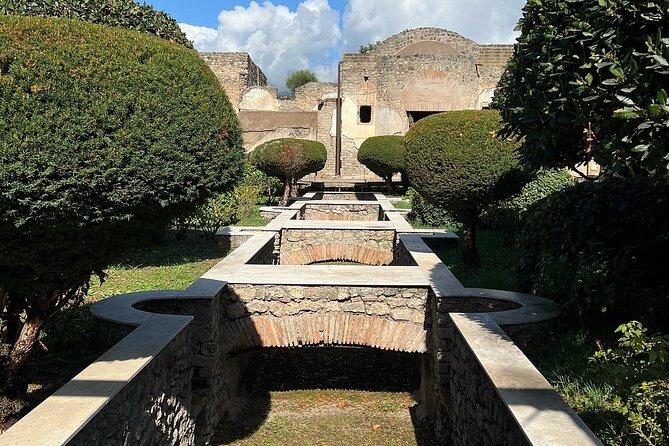
The tour starts at Odeon – Teatro Piccolo and then moves to Teatro Grande, the most important theater in Pompeii. These are more than entertainment buildings. They’re social engines.
At the Odeon/Teatro Piccolo stop, you’re getting your first visual lesson in how Pompeii handled performances and gatherings. Even with a short visit, you can see how theaters shaped movement through the city—where people would have come from and how crowds would have spread out.
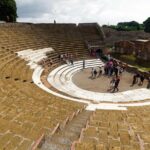
Then Teatro Grande is where you get the big scale. The tour description frames it as the key theater, and that fits the feeling you get standing in a major Roman venue. This is a good stop to pay attention to viewpoint and orientation—because theaters are often placed to take advantage of the city’s layout.
Drawback to keep in mind: with only about 10 minutes here, the guide will hit the essentials. If you want a slow, picture-every-angle theater experience, this stop will feel fast.
Stop 3: House of Menander and what “elite life” looks like
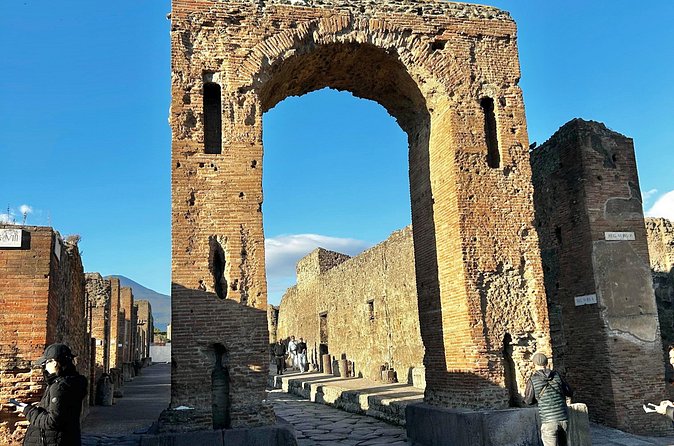
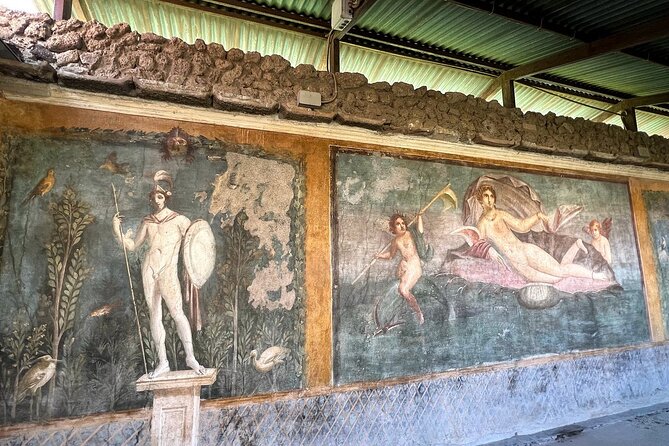
Next up is the House of Menander, one of the richest and most magnificent Pompeian houses, known for architecture, decoration, and contents. This is where Pompeii shifts from public spectacle to private identity.
A mansion like this isn’t just big. It’s a statement. The rooms and decoration show what mattered to wealthy owners: display, status, and daily comfort. If you pay attention to layout (where you would move through), you’ll start to see how visitors, family life, and service areas fit together.
The time here is listed as about 15 minutes. For me, that’s enough to pick out the big artistic and architectural themes the archaeologist will explain, without pretending you can fully tour a palace in one quick stop.
One practical tip: if you’re a photographer, decide in advance whether you’re aiming for wide shots (showing space and layout) or close-ups (details on decoration). Time is short, so you’ll waste less energy if you focus.
Stop 4 and 5: Stabian Baths and the Lupanar
Then comes a two-part contrast: Stabian Baths (Terme Stabiane) and the Lupanar.
The Stabian Baths cover a vast area and are described as the oldest thermal complex in the city. Baths in Pompeii weren’t only about cleanliness; they were social spaces, workout places, and casual meeting hubs. In a quick visit, the trick is not to expect full restoration views. Instead, listen for how the complex functions and how circulation would have worked.
Then you walk straight into the city’s darker side with the Lupanar, Pompeii’s most famous brothel. It’s an unforgettable stop, mostly because it’s so specific—rooms meant for encounters, with the building arranged for that purpose. The guided context is key here, because you’ll want to understand what you’re seeing without reducing it to shock value.
If you prefer tours that keep things polite and distant, you might find the Lupanar stop a bit much. It’s included for a reason, though. Pompeii tells the full story, not just the pretty parts.
Stop 6: Via dell’Abbondanza is where the city feels real
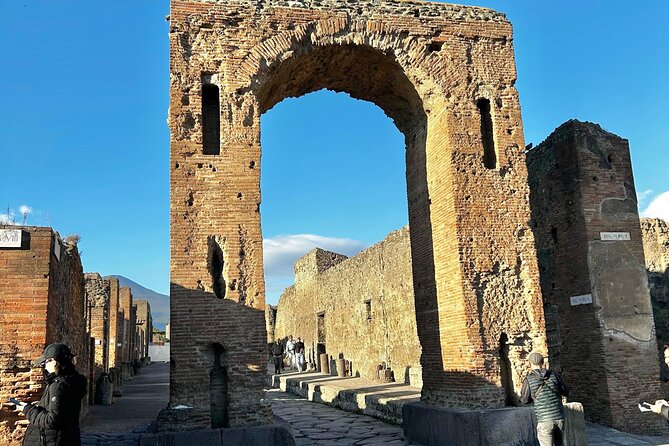
Via dell’Abbondanza is the street stop, and it’s important. Streets are where Pompeii stops being a set of monuments and starts being a lived-in city.
On this tour, it’s listed as 15 minutes and includes entry access. That means you’ll likely move along a defined stretch while the guide connects the route to commerce and everyday movement. In other words, it’s where the city becomes legible.
A street like Via dell’Abbondanza also helps you understand how the other stops connect. The theaters bring crowds. The houses show wealth. The baths and brothel show routine and need. The street is the glue between them.
Practical tip: this is a great moment to slow down just a little and look at what’s near the street line—because storefront-style spaces and building frontages can be easy to miss when you’re rushing.
Stop 7 and 8: House of the Faun and the main square
After the street, you get a major residential landmark: the House of the Faun, described as one of the largest and most impressive private residences in Pompeii. This is a step up from the Menander house in scale and impact, and it’s a strong “big picture” stop.
Large houses can be overwhelming if you don’t have context. That’s where the archaeologist guide earns their keep. They can point out what the grand spaces were for, why certain rooms mattered, and how you would have moved through the property.
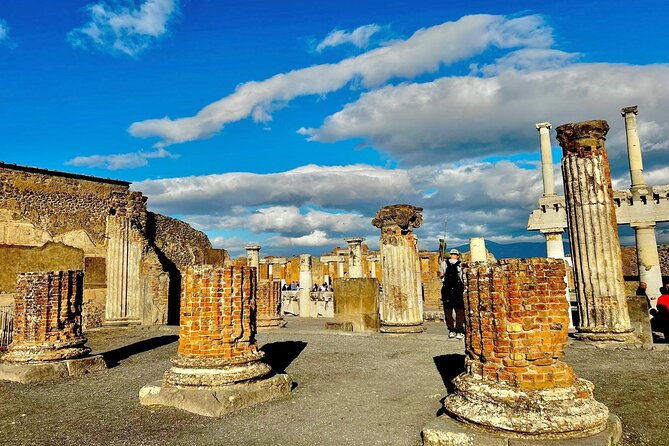
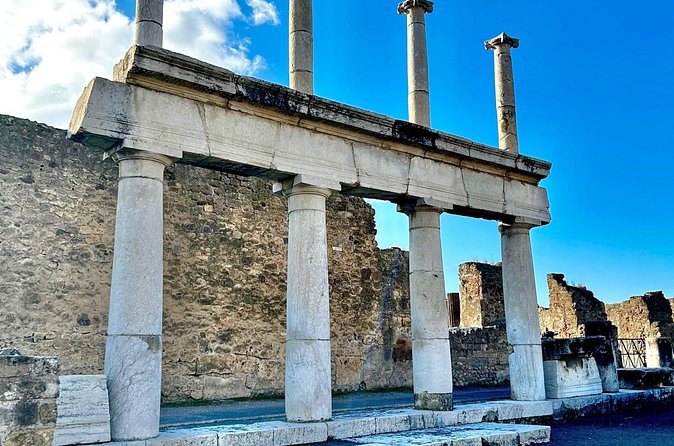
Next is the Foro de Pompeya, the ancient main square. This is Pompeii’s civic heartbeat. Even in a brief stop, you can feel the difference from the street and the home. The Forum is about law, commerce, religion, and public assembly.
If you only remember one “city feel” moment, make it the Foro. It’s the easiest place to connect what you’ve seen so far into a single mental picture of Pompeii functioning day-to-day.
Stop 9: Basilica and the merchant rhythm
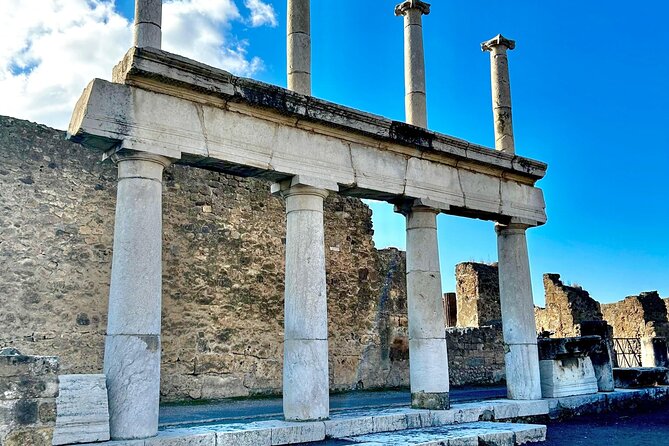
The tour ends (in this itinerary sequence) at the Basilica, described as an open portico that sheltered merchants and other activities. This is a classic Roman civic structure, and it helps you picture the daily tempo of the square.
A basilica like this is where people would gather around business and legal functions. It’s not just an empty stone shell; it’s a framework for social and economic life. Even with only about 10 minutes, the concept makes the architecture click.
Try this: when you stand here, imagine the foot traffic and the noise level. It changes how you see the space, and the guide’s commentary will likely make that transformation happen faster.
Price and value: is $60.21 fair for this package?
At $60.21 per person, this is positioned as a budget-friendly way to get a structured Pompeii experience. What makes the price make sense is the bundle:
- an archaeologist-led ~2-hour tour inside Pompeii (core value)
- round-trip entry efficiency via skip-the-line Pompeii express tickets
- air-conditioned transportation with a driver (plus assistant option)
- English narration
- entry tickets are included for the listed stops
The trick is that you’re paying for focus and time savings. You’re not paying for hours of wandering. With timed stops, you should treat it like a “best-of Pompeii overview” guided by a specialist. If you want deep study in one place, you’ll still need extra time on your own afterward.
Also, the overall rating is listed as 4.6 from 9 reviews. That doesn’t guarantee your personal experience will match it, but it does suggest the model generally works when schedules and logistics line up.
What could go wrong: private expectations and transport timing
The big caution I’d give you is about matching expectations to what’s actually being delivered.
One reported issue was a description that allegedly didn’t match what the customer received: private upgrade expected to feel luxury, but the experience described turned out basic and public. Another issue mentioned departure being late, cutting into other planned time. A final snag involved transportation details not matching what was paid for, and an underwhelming boat experience in terms of comfort (no seats/shade/drinks were mentioned).
I can’t verify those specifics for your booking, but the lesson is practical: if you’re selecting a private option (or any option that sounds more comfortable than the default), confirm three things in writing or via the booking notes:
- exact pickup/departure timing
- what vehicle type is used
- if any boat ride is part of your routing, what comfort level is provided
Then build your day with buffer time. Pompeii days get busy fast, and late logistics can shrink what you came for.
Who should book this Pompeii tour
This is a strong fit if:
- you want the highlights of Pompeii without planning the day yourself
- you like having an archaeologist translate ruins into stories
- you’d rather spend your energy learning than fighting ticket lines
- you’re okay with stops being timed (10–15 minutes)
It may not be ideal if:
- you want a slow museum-like experience with long stays in a few rooms
- you strongly prefer smaller groups and haven’t chosen the small-group or semi-private option
- you’re packing in other tight commitments that are sensitive to delays
If you’re traveling with kids or older adults, the guided structure can help. Still, check that the pace and walking fit your comfort level since the itinerary is stop-heavy.
Should you book? My practical recommendation
I’d book this if you want a structured, English-speaking Pompeii overview with specialist context and you care about reducing entry friction. The combination of skip-the-line, transport support, and a guide-led route from theaters to houses to the Forum is a solid value at $60.21.
I would also choose the smaller group format (small-group or semi-private) if you can, because Pompeii rewards seeing details, not just passing by them. And if you’re paying extra for private, treat it like a contract: confirm what “private” includes, especially around transport and timing.
If you want maximum flexibility after the tour, plan to return on your own later for the one or two stops that grabbed you most. This tour gives you the map; your follow-up walk fills in the rest.
FAQ
How long is the Pompeii tour?
The tour is listed as about 4 hours (approx.).
What languages is the tour offered in?
It’s offered in English.
Is skip-the-line entry included?
Yes. It includes skip the line Pompeii express entry tickets.
Are admission tickets included for the sights?
Yes. Admission ticket access is included for each listed stop in the itinerary.
What transportation is included?
The tour includes air-conditioned transportation with a driver, or a driver and an English-speaking assistant.
What group sizes are available?
Options range from group tours up to 30/40 passengers, small-group tours up to 19/21, semi-private tours up to 12, and private tours for your group only.
Where is this tour located?
It’s listed as being in Naples, Italy, and it’s near public transportation.
When can I get a full refund if I cancel?
You can cancel up to 24 hours in advance of the experience for a full refund.
How far in advance is this tour commonly booked?
On average, it’s booked about 60 days in advance.
More Tours in Naples





More Tour Reviews in Naples

More Pompeii Tours to Compare


More Naples tours, freshly reviewed





Pompeii Tours, compared.
 ★ 4.8Pompeii: Entry Ticket and Guided Tour with an ArchaeologistFrom $3519,459 reviews
 ★ 4.1Pompeii: Entry Ticket with Audio GuideFrom $4013,491 reviews
 ★ 4.8Pompeii: Small Group Tour with an ArchaeologistFrom $4012,264 reviews
 ★ 4.3Pompeii Ruins & Mount Vesuvius Day TourFrom $12011,459 reviews
★ 5.0Pompeii Small Group Tour with an ArchaeologistFrom $356,593 reviews
★ 4.3Pompeii Ruins & Mount Vesuvius Day TourFrom $12011,459 reviews
★ 5.0Pompeii Small Group Tour with an ArchaeologistFrom $356,593 reviews
 ★ 4.5Skip-the-line Pompeii – Small Group TourFrom $544,401 reviews
 ★ 4.6Naples or Sorrento: Full-Day Pompeii and Mount Vesuvius TourFrom $1044,235 reviews
 ★ 3.9Pompeii: Skip-the-line Entry Ticket with Audio Guide & MapFrom $433,153 reviews