
Review · POMPEII TOURS
Pompeii the Ancient City (Tour+Transfer)
Pompeii is history you can walk through. This Pompeii Ancient City tour with transfer is a smart way to hit the big highlights fast, with a licensed guide and easy shuttle logistics from the Naples-area towns. I especially like that you get a guided route through the UNESCO Pompeii Archaeological Park instead of wandering and guessing.
What I like most is the pacing: about 4 hours that still covers major stops like the Forum, the theater, and the main street. The second big win is the setup—pickup by vintage classic van from a long list of towns means you’re not stuck figuring out trains, parking, or bus connections.
One thing to consider: this runs on a sharing shuttle schedule, so the pickup window can be less precise than a private taxi. Also, the guide is offered in English/Italian, not French, so plan accordingly if that matters to you.
In This Review
- Key highlights that make this Pompeii tour work
- Why this Pompeii tour is a great half-day plan
- Price and what you’re really paying for
- Pickup by vintage classic van: easy logistics, one scheduling reality
- Start time and how long you’ll be in Pompeii
- Entering the Pompeii Archaeological Park with a real plan
- Foro di Pompei: the city’s power center, not just an open square
- The Macellum: where food supply met daily life
- Casa del Fauno: wealth, art, and how the elite lived
- Teatro Grande: imagine the performances that once filled the seats
- Via dell’Abbondanza: Pompeii’s main street and the best walking vibe
- Group size, tickets, and what to bring
- Is this Pompeii tour worth booking?
- Should you book this Pompeii Ancient City tour+transfer?
- FAQ
- What’s included in the $70.89 per person price?
- How long is the tour?
- Do I need to buy the Pompeii entrance ticket separately?
- What language is the guide?
- Where does pickup work?
- What time does the tour start?
- Is there free cancellation?
Key highlights that make this Pompeii tour work
- Round-trip shuttle by vintage classic van from many nearby towns (not Naples)
- Licensed guide in English/Italian to give meaning to what you’re seeing
- Mobile ticket for smoother entry
- A well-chosen circuit through Forum, Macellum, Casa del Fauno, Teatro Grande, and Via dell’Abbondanza
- Max 25 travelers, so it usually stays manageable and not a cattle-herd situation
Which Pompeii ticket and guide? Compare a few more.
- From Naples: Pompeii Ruins & Mount Vesuvius Day Tour★ 4.3 · 11,459 reviews
- From Naples: Skip-the-line Pompeii – Small Group Tour★ 4.5 · 4,401 reviews
- Naples or Sorrento: Full-Day Pompeii and Mount Vesuvius Tour★ 4.6 · 4,235 reviews
- Pompeii & Mt.Vesuvius Day Tour from Naples with Pizza Lunch★ 4.0 · 2,901 reviews
Why this Pompeii tour is a great half-day plan
Pompeii can feel overwhelming fast. It’s big, spread out, and full of stone walls that look similar until someone explains what you’re actually looking at. This tour is designed to solve that problem with a guided route that focuses on the city’s most recognizable public and private spaces.
You’re looking at a 4-hour experience, which is the sweet spot for many first-timers. You’ll get close to the ruins in a way that feels personal—more like walking through an ancient neighborhood than reading bullet points on a sign. And because it’s an organized circuit, you don’t waste time trying to “optimize” your own itinerary.
The other reason this works: logistics are handled for you. The tour pairs a guided visit with private transportation that brings you to Pompeii and back to your pickup area.
Price and what you’re really paying for
The tour price is $70.89 per person, which covers the guided experience and the transportation component. The big separate cost is the Pompeii entrance ticket (€22.00 per person), which is not included.
I think that’s a fair split for two reasons. First, the guide is part of the value—Pompeii is so much more understandable with interpretation than without. Second, the shuttle isn’t a tiny detail. Getting to Pompeii and back efficiently is often what turns a day trip into a headache. Here, that burden is reduced.
So when you budget, plan on:
- $70.89 for tour + transfer
- €22 entrance ticket (Pompeii Archaeological Park)
- Lunch on your own (not included)
If you want a tight schedule and don’t want to spend your day on transportation, this pricing makes sense.
Pickup by vintage classic van: easy logistics, one scheduling reality
The transfer is one of the most practical parts of this experience. You can be picked up from a long list of towns, including Castellammare di Stabia, Torre Annunziata, Pompei, Scafati, Angri, Gragnano, Pimonte, Agerola, Vico Equense, Seiano, Meta, and more.
There’s one clear boundary: no pickup from Naples. If you’re staying in Naples proper, you’ll need to reach the pickup zone on your own—one option listed is using the Circumvesuviana train to Castellammare di Stabia and then heading to the office.
Two shuttle details are worth knowing before you go:
- Pickup time is confirmed after booking, and the shuttle pickup works in sharing mode. That means the pickup time is treated as a window—starting at the indicated time and continuing for the next 30 minutes.
- Traffic and pickup delays can shift exact timing, since it’s a shared route.
This isn’t a dealbreaker. It’s just reality on the Amalfi Coast/Naples side. If you’re the type who hates uncertainty, plan to be flexible in the morning.
Start time and how long you’ll be in Pompeii
The experience start time is listed as 9:00 am, and the operator notes there are several convenient start times you can choose from. Either way, you’re working with a half-day structure—enough time to hit major highlights without turning it into a marathon.
The itinerary is designed for a smooth flow: you’ll move from the archaeological park to a concentrated set of sites and then back via shuttle. Think of this as a guided “greatest hits” approach with context, not an all-day deep catalog of every street corner.
More ways to take in Naples in a day




Entering the Pompeii Archaeological Park with a real plan
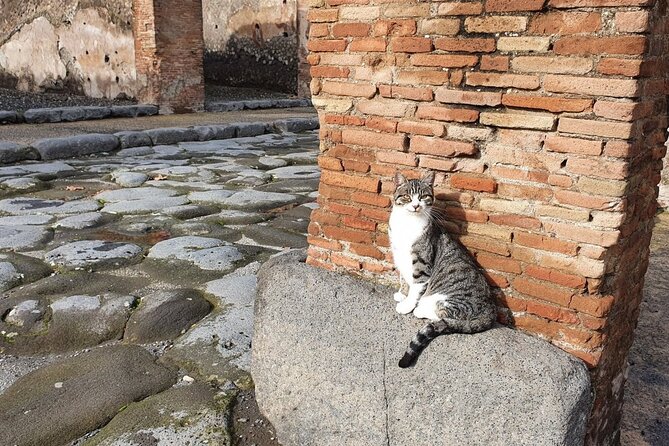
Your visit begins at the Pompeii Archaeological Park with a licensed multilingual tourist guide (listed for English/Italian). Admission is not included, so you’ll want the entrance ticket ready in advance.
The best part of arriving this way is that you don’t start blind. Pompeii can trick you: a wall can look like a wall until you know whether it was part of a shopfront, a public building, or a wealthy home. The guide’s job is to make those connections fast—so you can start recognizing what mattered to people living there.
Also, the tour uses a mobile ticket, which is helpful if you want to reduce paperwork and keep everything on your phone.
Practical tip: Pompeii in daytime is hot. Bring a hat, water, and sunscreen, and pack wind-protective clothing if you’re going during a breezier season. The ruins don’t offer much cover.
Foro di Pompei: the city’s power center, not just an open square
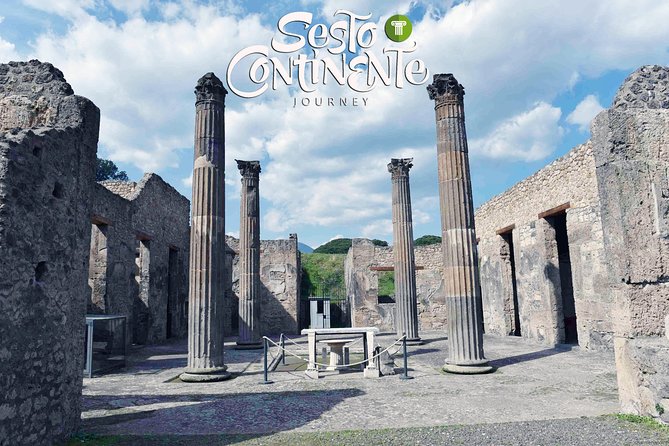
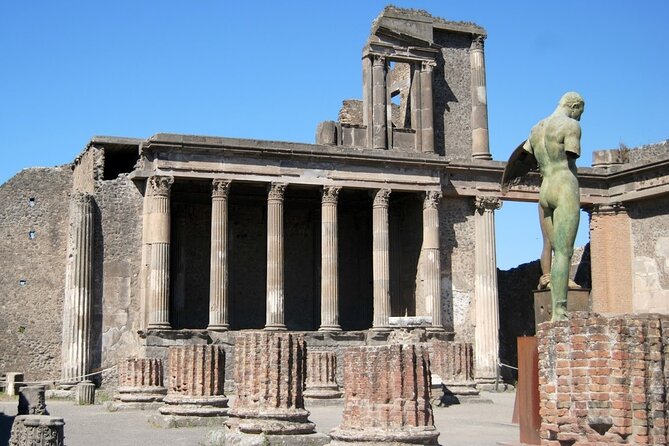
The route takes you to the Foro di Pompeii, the Roman forum—the main square and the political, economic, and religious heart of the city. This is where people negotiated, debated, and held public life in motion.
What makes the Forum worth your time is the way it connects different kinds of power. You’re not just looking at architecture; you’re seeing the layout of decisions. Once you understand that this was the day-to-day stage for major events, the stone becomes more than scenery.
This stop is relatively short, so go in with the mindset of pattern recognition:
- Notice how the forum functioned as a center for commerce and debate.
- Look at how public space was organized around civic life.
Admission for this part is listed as free within the tour stops, but you still need the main Pompeii ticket for overall entry.
The Macellum: where food supply met daily life
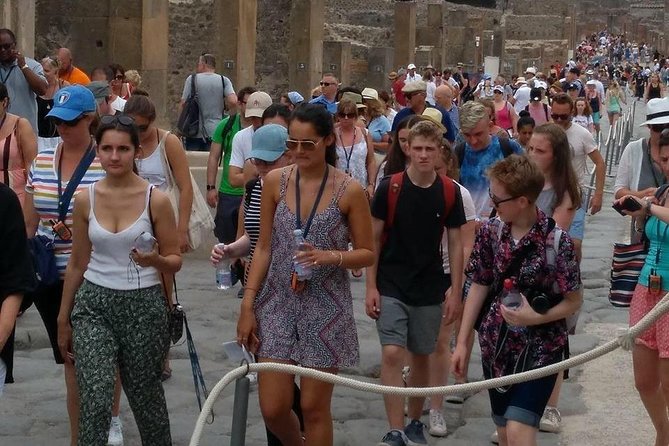
Next up is the Macellum, Pompeii’s provision market located on the Forum area. It wasn’t a small-side feature—it was one of the focal points of the city’s food system.
The useful context here: the building went through multiple phases. An earthquake in 62 CE damaged large parts of Pompeii, and the Macellum was also affected. Excavations show it hadn’t been fully repaired by the time of the eruption in 79 CE.
That detail matters because it adds realism. You’re not touring a perfectly preserved moment. You’re seeing a city in the middle of recovery, still using spaces while repairs lagged. It makes Pompeii feel less like a museum exhibit and more like a lived-in community before the catastrophe.
Casa del Fauno: wealth, art, and how the elite lived
The tour then moves into Casa del Fauno (House of the Faun)—one of the largest and most impressive private residences in Pompeii. This home was built during the 2nd century BC and is known for housing major pieces of art.
What I like about including this house is that it balances the public spaces you’ve just seen. The Forum and theater tell you about communal life. The House tells you about private status—what wealth looked like, how art was displayed, and how elite homes expressed their power in stone.
It’s also described as one of the most luxurious aristocratic houses from the Roman Republic period, and it reflects that era better than many other archaeological finds even in Rome. In practical terms: it helps you understand why Pompeii was a serious cultural stop, not just a tragic footnote.
If you’re a “look at details” traveler, this will reward you. If you’re short on time, it’s still a must because it gives perspective on the social ladder.
Teatro Grande: imagine the performances that once filled the seats
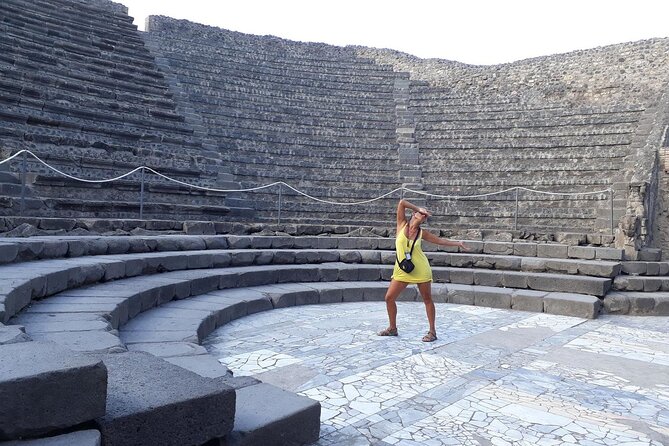
The route includes the Teatro Grande, a Roman theater buried by the eruption and later uncovered through excavations.
Here’s what makes it more than a quick photo stop: the description notes the kinds of performances that happened inside—comedies, mimes, pantomimes, and the atellane. Once you know what those shows were like, it’s easier to picture the audience energy and the role theater played in public entertainment.
This stop is brief, but it offers a strong “soundtrack” to the city. When you combine theater with the Forum earlier, you get a fuller picture of daily Roman life: politics and commerce in the square, performance and spectacle in the theater.
Bring your imagination, and you’ll get more out of those rows than you expect.
Via dell’Abbondanza: Pompeii’s main street and the best walking vibe
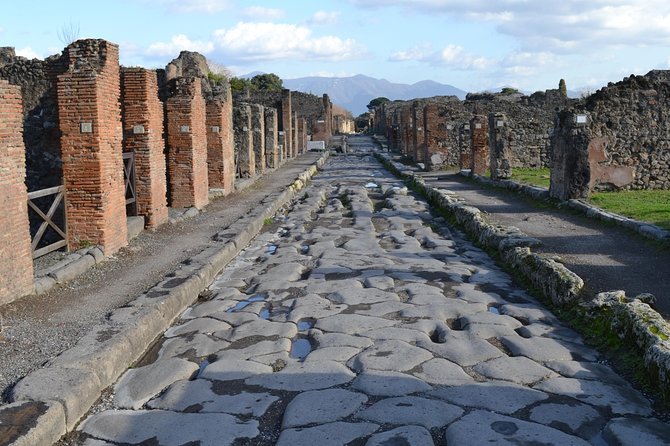
Finally, you’ll walk along Via dell’Abbondanza, described as the Lower Decumanus—the main road connecting key areas of Pompeii between the Forum and Porta Sarno.
This street is called out for a reason: it’s rich in decorations, and it connects major sites including the Stabian Baths, the Theaters, the Temple of Isis, and the Amphitheater. It’s also framed as the liveliest route for visiting the excavations because of its concentration of notable houses, some even with two floors.
The name comes from a bas-relief on a fountain early in the route. That’s a small detail, but it’s a good example of what you’ll gain from a guide: tiny naming clues that help you build a mental map.
If you can only absorb one “street” in Pompeii, this is the one. It gives you a sense of how the city connected—from civic center to entertainment zones to wealthy residences.
Group size, tickets, and what to bring
This tour has a maximum of 25 travelers, which is a sweet spot for guided interpretation. Big enough to feel like a real group, small enough to keep movement relatively smooth.
You’ll also use a mobile ticket. Double-check you have it accessible offline or on your phone so entry is painless.
Bring:
- Hat
- Water
- Sunscreen
- Camera
- Wind-protective clothing
And one personal tip: wear shoes you can walk in for a sustained period. Pompeii has uneven stone and lots of time spent on your feet.
Is this Pompeii tour worth booking?
I’d recommend this tour if:
- You want guided context and a clear plan through Pompeii’s most famous areas
- You’d rather pay a set price than wrestle with independent transportation
- You’re aiming for a half-day experience and not a full-day, slow wander
- You like the idea of being picked up from the Naples-area towns by shuttle instead of driving
I’d think twice if:
- You need a very precise pickup time (sharing mode uses a 30-minute window)
- You need a guide in a language other than English/Italian
- You want to spend most of your day at one or two sites, since this is a highlights circuit built to cover several major stops in about 4 hours
Should you book this Pompeii Ancient City tour+transfer?
If you want the easiest path to Pompeii highlights with a guide, this is a strong choice. The transportation plus guided route is the heart of the value: you save time and stress, and you’ll understand more of what you see than you would on a self-guided walk.
Just budget for the €22 entrance ticket, pack for heat and sun, and choose the pickup option that fits your location since Naples pickup isn’t offered.
FAQ
What’s included in the $70.89 per person price?
The price includes a ride on a vintage classic van and private transportation as part of the tour with transfer. The Pompeii entrance fee is not included.
How long is the tour?
The total duration is about 4 hours.
Do I need to buy the Pompeii entrance ticket separately?
Yes. The Pompeii entrance ticket costs €22.00 per person and is listed as not included.
What language is the guide?
The guide is listed as English/Italian.
Where does pickup work?
Pickup is offered from many nearby towns (including Castellammare di Stabia, Torre Annunziata, Pompei, Scafati, Angri, and others). Pickup from Naples is not included.
What time does the tour start?
The listed start time is 9:00 am, and the operator notes there are several start times available.
Is there free cancellation?
Yes. You can cancel for a full refund up to 24 hours in advance of the experience start time.
If you tell me where you’re staying (town or nearest neighborhood) and your language preference, I can suggest whether the shuttle coverage is likely to fit you and help you plan around the 4-hour pacing.
More Tours in Naples





More Tour Reviews in Naples

More Pompeii Tours to Compare




More Naples tours, freshly reviewed





Pompeii Tours, compared.
 ★ 4.8Pompeii: Entry Ticket and Guided Tour with an ArchaeologistFrom $3519,459 reviews
 ★ 4.1Pompeii: Entry Ticket with Audio GuideFrom $4013,491 reviews
 ★ 4.8Pompeii: Small Group Tour with an ArchaeologistFrom $4012,264 reviews
 ★ 4.3Pompeii Ruins & Mount Vesuvius Day TourFrom $12011,459 reviews
★ 5.0Pompeii Small Group Tour with an ArchaeologistFrom $356,593 reviews
★ 4.3Pompeii Ruins & Mount Vesuvius Day TourFrom $12011,459 reviews
★ 5.0Pompeii Small Group Tour with an ArchaeologistFrom $356,593 reviews
 ★ 4.5Skip-the-line Pompeii – Small Group TourFrom $544,401 reviews
 ★ 4.6Naples or Sorrento: Full-Day Pompeii and Mount Vesuvius TourFrom $1044,235 reviews
 ★ 3.9Pompeii: Skip-the-line Entry Ticket with Audio Guide & MapFrom $433,153 reviews
Browse the lists this tour appears in