
Two of Campania’s biggest legends, one day. This trip pairs Mount Vesuvius with the Pompeii ruins using round-trip bus transport and included entry tickets. You’ll walk from about 1,000 meters down toward the crater, then switch gears to explore the ancient streets of Pompeii at your own pace with an audio guide.
What I like most is how simple it feels: you’re picked up at one of the nearby meeting points, carried between stops, and you get the right tickets sorted. I also love that Pompeii isn’t just a quick look; you get time to choose an audio route and then wander the archaeology site of 79 AD with clear explanations.
One thing to consider: the schedule moves. 1.5 hours on Vesuvius is a hard cap, and at Pompeii you’re working within a set visit window, so you’ll cover what your chosen route prioritizes rather than everything.
In This Review
- Key Points to Know Before You Go
- Two Stops, One Efficient Day on Italy’s West Coast
- Getting to the Meeting Points and Settling Into the Bus
- Mount Vesuvius: The Walk, the Crater Views, and the Time Limit
- Pompeii Archaeological Park: Audio-Guided Walking Through 79 AD
- The Pompeii Timing and Lunch Break (And Why It’s Built This Way)
- Tickets, Lines, and Why This Package Often Feels Worth It
- Group Size, Pace, and What It Feels Like On the Ground
- Practical Stuff: What to Bring and What Not to Bring
- Who This Tour Is Best For
- Price and Value: Paying for Tickets, Transport, and Time
- Should You Book This Mount Vesuvius and Pompeii Day Trip?
- FAQ
- FAQ
- How long is the day trip?
- Where are the meeting points?
- Is round-trip transportation included?
- Are tickets to Mount Vesuvius and Pompeii included?
- Do I get an audio guide?
- Is there a skip-the-ticket-line benefit?
- What happens if Mount Vesuvius is closed due to weather?
- What should I bring and are there luggage restrictions?
Key Points to Know Before You Go
- Skip the ticket line with Vesuvius and Pompeii entry handled for you
- Walk from ~1,000 meters down toward the crater on Mount Vesuvius
- Audio guide at Pompeii lets you pick an itinerary and explore independently
- Round-trip bus transport from Naples or Pompeii cuts planning stress
- Weather backup: if Vesuvius closes, you’ll visit Herculaneum excavations instead
Which Pompeii ticket and guide? Compare a few more.
- From Naples: Pompeii Ruins & Mount Vesuvius Day Tour★ 4.3 · 11,459 reviews
- From Naples: Skip-the-line Pompeii – Small Group Tour★ 4.5 · 4,401 reviews
- Naples or Sorrento: Full-Day Pompeii and Mount Vesuvius Tour★ 4.6 · 4,235 reviews
- Pompeii & Mt.Vesuvius Day Tour from Naples with Pizza Lunch★ 4.0 · 2,901 reviews
Two Stops, One Efficient Day on Italy’s West Coast
If you’re short on time in Naples or staying around Pompeii, this day trip is built for maximum payoff. You hit two icons in one run: Vesuvius, the only active volcano on mainland Europe, and Pompeii, the Roman city frozen by the eruption of 79 AD.
I like how the experience is set up like a practical checklist. Transportation is included, tickets are included, and you’re not scrambling at the last second to figure out timing or lines. That matters on the Amalfi Coast side of Campania, where popular sights can get painfully busy.
You also get a little built-in flexibility. Pompeii is yours to explore with an audio guide, and before you enter, you choose from a range of itineraries. Then your tour ends with a return transfer back to the same meeting point you used in the morning.
Getting to the Meeting Points and Settling Into the Bus
Pick-up and drop-off are handled at set locations, so you don’t have to hunt down a hotel van. The starting options are:
- Via Cristoforo Colombo, 45
- Via Roma, 32
- Via Galileo Ferraris, 40
From there, you board a comfortable bus and ride to the first stop. The timing between places is clearly planned, too, with about 45 minutes to the Vesuvius area, then 40 minutes onward to Pompeii, and roughly 45 minutes back at the end.
Why that matters: you spend less mental energy on logistics and more time on the real point of the day. Even if you’re arriving in Naples already tired from travel, you can treat the bus ride as part of your sightseeing.
Language support is practical rather than fancy. The driver speaks Italian, English, and Spanish, and the tour itself is tied to those languages. If you prefer to listen quietly, that’s fine. If you have questions, you’re not stuck with zero communication.
Mount Vesuvius: The Walk, the Crater Views, and the Time Limit
Mount Vesuvius is the headline, and this trip gives you the classic experience of walking down from higher ground. You disembark at an elevation of about 1,000 meters and then set off toward the crater area.
You’ll get around 1.5 hours for the Vesuvius portion. That usually includes the walk, photo stops, and the moment where you finally look out over the Gulf of Naples and the Sorrento Coast from above. The views are a big part of why this place is famous. On a clear day, you can connect the dots between Naples, the coastline, and the volcanic region that shaped everything.
Here’s the trade-off: the time cap is real. If you’re the type who likes to linger slowly, you may feel slightly rushed. The best approach is to decide what you want most:
- crater views and photos
- a more relaxed walk with stops
- a faster route so you’re fresh for Pompeii
Also, note the weather plan. If Vesuvius National Park closes due to inclement weather, the tour swaps in a visit to the Herculaneum excavations instead. That’s not a consolation prize in theory, but it changes the flavor of your day, so it’s good to expect a possible switch.
Pompeii Archaeological Park: Audio-Guided Walking Through 79 AD
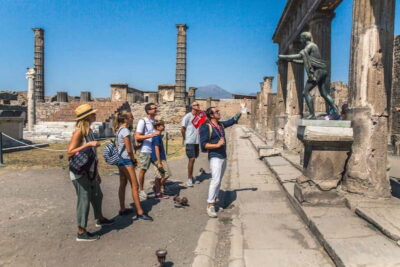
Then the vibe shifts from volcanic drama to ancient city life. You ride to the Pompeii Archaeological Park, and before entry you can choose from a range of itineraries. This matters because Pompeii is so large that one fixed route can feel either perfect or frustrating, depending on what you care about.
You’ll receive an audio guide at the site. The audio guide languages include English, Chinese, Italian, Spanish, German, French, Portuguese, Polish, Dutch, Russian, and Hebrew, so you shouldn’t have trouble finding a language you’re comfortable with.
The key advantage here is control. With audio, you can slow down for a street scene that captures your interest or speed up when you’d rather keep moving. Pompeii can be overwhelming at first glance, and having explanations timed to what you’re seeing helps you keep your bearings.
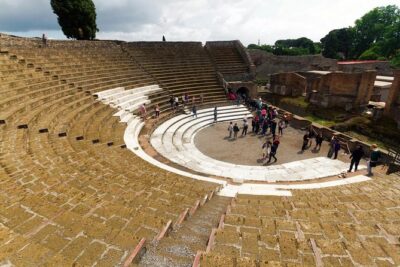
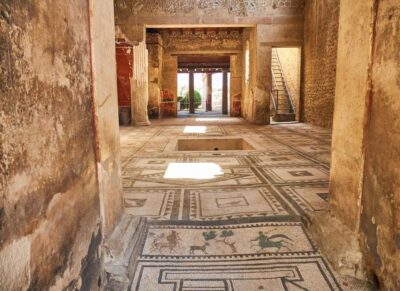
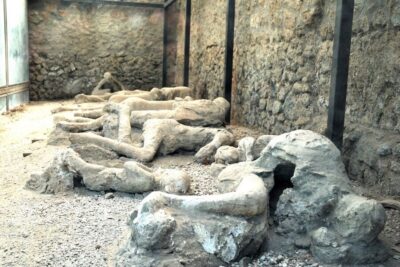
You’ll explore ruins dating back to 79 AD, and the site is the kind where context turns a pile of stones into a real place. You’re walking through the remains of homes, shops, and public areas that were shaped by daily Roman life—then disrupted almost instantly by the eruption.
More ways up the crater, side by side




The Pompeii Timing and Lunch Break (And Why It’s Built This Way)
Your Pompeii window is about 2 hours, followed by roughly 1 hour of lunch and free time in Pompei. This is one of those schedules that looks short on paper but works if you’re strategic.
A practical way to use the two hours:
1) Follow your audio itinerary at a steady pace
2) Stop when something is clearly explained
3) Skip what you can’t absorb without losing the thread
Pompeii rewards focus. If you try to see everything, you end up seeing too little. The audio routing is meant to prevent that, even if it means you don’t hit every single corner of the park.
That lunch + free time break is helpful because Pompeii isn’t right next to your hotel. It’s your chance to reset, grab food, and regroup before you return to the bus.
Tickets, Lines, and Why This Package Often Feels Worth It
One of the big headaches with Vesuvius and Pompeii is demand. Tickets can sell out or you can run into long waits, especially at peak times. This tour helps because Vesuvius National park entrance tickets and Pompeii ruins entrance are included, plus there’s a booking fee and an explicit promise to skip the ticket line.
In plain terms: you pay for convenience. That doesn’t automatically mean it’s cheaper than doing everything yourself, but it often means you’re spending money to buy back time and reduce stress. When your day only has a few hours for two major sights, saving an hour from standing in line is real value.
Also, you’re not just buying a ticket. You’re getting the whole structure: bus transport, the timing between stops, and an audio guide at Pompeii. If you’ve ever planned a day around two “must-sees,” you know the planning effort can be almost as tiring as travel.
Group Size, Pace, and What It Feels Like On the Ground
This is a bus-based day trip, so expect a typical group pace: you’ll move in coordinated chunks. You’ll board the bus at the start, disembark at the stops, then re-board when your window closes.
The most praised parts tend to be the things you can measure: getting there on time, having everything set up efficiently, and not getting stuck in waiting loops. A well-run version of this day feels smooth and predictable, with you going straight from bus to viewpoint to ruins.
The biggest “real-world” limitation is tempo. Vesuvius is about 1.5 hours, and Pompeii is about 2 hours with audio roaming. If you want slower, deeper exploration, you may want a different format—either longer stays or separate guided visits.
The other practical point: there isn’t a live tour guide included. You get an audio guide for Pompeii, but you’ll be responsible for your own route choices based on what you select before entering the park.
Practical Stuff: What to Bring and What Not to Bring
Keep it simple. Bring a passport or ID card, since it’s required. Avoid oversize luggage, which is listed as not allowed.
If you’re packing for a volcano walk, think like you’re heading into outdoor terrain rather than a museum. Comfortable walking shoes are a smart idea, and plan for changing conditions as you move from bus to viewpoints.
If you want to spend time shopping for related materials, you might find that having a book or reference makes the ruins click faster. Pompeii especially benefits from even a small bit of context as you move between buildings.
Who This Tour Is Best For
This day trip is a strong match if you:
- want a fast, organized way to see both Vesuvius and Pompeii
- prefer to explore Pompeii at your own pace with an audio guide
- don’t want to plan transportation between two high-demand attractions
- like panoramic viewpoints and photo opportunities at Vesuvius
It’s less ideal if you:
- want long, unhurried time on Vesuvius
- expect a live guide who answers questions in real time
- have a “must see everything” Pompeii mindset
For families, note that this kind of itinerary often works best when kids can handle walking and audio pacing. The tour duration (listed as 5 to 7.5 hours) also means you’ll need to plan for stamina.
Price and Value: Paying for Tickets, Transport, and Time
The price is listed at $101 per person. That’s not just for a viewpoint and an audio player. You’re paying for:
- round-trip transportation from Naples or Pompeii
- Vesuvius National park entrance tickets
- Pompeii ruins entrance
- a booking fee
- an audio guide for Pompeii
When you’re comparing costs, include the time and friction. If buying tickets yourself would require extra transport planning, or if lines would eat your day, then this package can come out feeling efficient.
Also, there’s another hidden value: your day is already timed. You’re not constantly checking schedules or trying to decide how long you can afford at each stop. That structure makes the day feel more like a plan than a scramble.
Should You Book This Mount Vesuvius and Pompeii Day Trip?
I’d book it if your priority is seeing both places in one go without logistical stress. The combination of included transport, included tickets, and a Pompeii audio guide makes it a practical way to experience two huge highlights of Campania—especially if your time in the region is limited.
Skip it if you’re craving a slow, in-depth visit to Pompeii or if you strongly prefer live guiding over self-paced audio. In that case, you might be happier with a longer-format tour or separate outings where each stop has room to breathe.
My quick decision rule: if you want a well-run day with clear boundaries, this works. If you want maximum wandering time at both sites, you’ll likely feel the schedule.
FAQ
FAQ
How long is the day trip?
The duration is listed as 5 to 7.5 hours, depending on the starting time and availability.
Where are the meeting points?
The meeting point may vary depending on the option booked, with listed starting locations at Via Cristoforo Colombo, 45; Via Roma, 32; and Via Galileo Ferraris, 40.
Is round-trip transportation included?
Yes. Round-trip transportation is included from Naples or Pompeii, and you are dropped off at the same location where you started.
Are tickets to Mount Vesuvius and Pompeii included?
Yes. The tour includes Vesuvius National park entrance tickets and entrance tickets for the Pompeii Ruins.
Do I get an audio guide?
Yes. An audio guide is included for Pompeii, with availability in English, Chinese, Italian, Spanish, German, French, Portuguese, Polish, Dutch, Russian, and Hebrew.
Is there a skip-the-ticket-line benefit?
Yes. The tour includes skipping the ticket line.
What happens if Mount Vesuvius is closed due to weather?
If the Vesuvius National Park is closed due to inclement weather, the tour will instead include a visit of the Herculaneum excavations.
What should I bring and are there luggage restrictions?
Bring a passport or ID card. Oversize luggage is not allowed.
More Tour Reviews in Naples






Up Vesuvius, More Ways to Climb



More Pompeii Tours to Compare


More Naples tours, freshly reviewed





Pompeii Tours, compared.
 ★ 4.8Pompeii: Entry Ticket and Guided Tour with an ArchaeologistFrom $3519,459 reviews
 ★ 4.1Pompeii: Entry Ticket with Audio GuideFrom $4013,491 reviews
 ★ 4.8Pompeii: Small Group Tour with an ArchaeologistFrom $4012,264 reviews
 ★ 4.3Pompeii Ruins & Mount Vesuvius Day TourFrom $12011,459 reviews
★ 5.0Pompeii Small Group Tour with an ArchaeologistFrom $356,593 reviews
★ 4.3Pompeii Ruins & Mount Vesuvius Day TourFrom $12011,459 reviews
★ 5.0Pompeii Small Group Tour with an ArchaeologistFrom $356,593 reviews
 ★ 4.5Skip-the-line Pompeii – Small Group TourFrom $544,401 reviews
 ★ 4.6Naples or Sorrento: Full-Day Pompeii and Mount Vesuvius TourFrom $1044,235 reviews
 ★ 3.9Pompeii: Skip-the-line Entry Ticket with Audio Guide & MapFrom $433,153 reviews
Browse the lists this tour appears in