
Review · NAPLES OLD TOWN TOURS
Naples Walking tour of the Historical Center
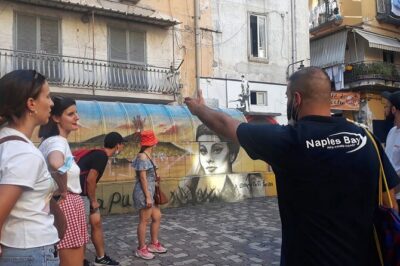
Naples’s historic center isn’t hard to reach, it is hard to read. This walk helps you do both, with a small group and a guide like Valentino who shows you corners you’d likely miss on your own. I also love the mix of street life and big landmarks, plus the simple comfort break built in with coffee and a sfogliatella.
You’ll cover a focused loop through Spaccanapoli, artisan nativity-scene shops on Via San Gregorio Armeno, and the church-and-street layers around San Lorenzo Maggiore and Via dei Tribunali. One possible drawback: it’s weather-dependent and runs on foot, so plan for solid walking and check the forecast.
In This Review
- Key highlights worth knowing
- Price and what you actually get for $120.68
- Starting at Piazza San Domenico Maggiore: your bearings, fast
- Spaccanapoli: the ancient spine of Naples (and the street names to know)
- Via San Gregorio Armeno: nativity workshops that run all year
- Basilica di San Lorenzo Maggiore: old stones and archaeological access
- Via dei Tribunali: learning why the ancient street names matter
- Campanile della Pietrasanta: the bell tower as a clue
- Fontanelle Cemetery: the hillside cave stop that changes the mood
- The pace: short stops that add up to real context
- What kind of traveler this tour suits best
- Guide quality matters here, and it shows
- Should you book this Naples Historical Center walking tour?
- FAQ
- How long is the Naples Walking tour of the Historical Center?
- What does the tour cost?
- Is the tour offered in English?
- What is the maximum group size?
- Where do we meet, and does it end somewhere else?
- Is it suitable for children and are service animals allowed?
Key highlights worth knowing
- Small group (max 20): easier conversations and quicker chances to ask questions
- Off-the-beaten-path focus: you get to see the Fontanelle Cemetery in a hillside cave setting
- Ancient street geometry lesson: Via dei Tribunali follows an ancient Greek road axis
- Nativity craft shops, year-round: real workshops making figurines, canonical and original
- Included coffee + sfogliatella: a proper Neapolitan snack, not just water and vibes
Deeper into the old center of Naples
- Naples: Origins, Cults and Legends Old Town Guided Tour★ 4.8 · 749 reviews
- Naples: The Holy Mile 3-Hour Guided Tour★ 4.9 · 711 reviews
- Naples: Guided Pub Crawl in the Old Town★ 4.7 · 300 reviews
- Naples: Old Town Tour with Veiled Christ and Cathedral★ 4.8 · 276 reviews
Price and what you actually get for $120.68
At $120.68 per person for about 2 hours, this isn’t a bargain “grab-and-go” walk. The value comes from how the time is used: you’re not just passing landmarks, you’re getting context on how Naples built (and renamed) its streets over centuries, plus a guide who’s local to the city’s stories.
You also get a few practical perks that matter more than they sound:
- A professional local guide who can explain what you’re seeing as you walk
- Coffee and/or tea plus a sfogliatella included in the tour flow
- A mobile ticket, so you’re not messing with paper or last-minute scrambling
The sites in the listed stops don’t require paid admission, which helps with overall value. Still, if your plan is mostly self-guided wandering with photos, you might not feel enough “guided payoff” for the price.
Starting at Piazza San Domenico Maggiore: your bearings, fast
The meeting point is Piazza San Domenico Maggiore (P.za S. Domenico Maggiore), and the tour ends back at the same place. That loop matters. Naples can be a puzzle of lanes, and having a clear starting anchor helps you keep your bearings while you learn the city’s street logic.
Also, since this is in the historical center and close to public transportation, it’s easier to stitch into the rest of your day. You can do this as a morning reset (when streets feel less hectic) or as an afternoon course-correction so your later wandering makes more sense.
The tour is offered in English, and confirmation is provided at booking. It also caps at 20 travelers, which is a big difference in places like Naples where crowds can flatten the experience.
Spaccanapoli: the ancient spine of Naples (and the street names to know)
Your walk kicks off with Spaccanapoli. This is the lower decumanus—an important ancient street artery—but locals commonly use the name Spaccanapoli. The official naming you’ll hear tied to this area is via Benedetto Croce and via Forcella, so don’t be surprised if street signs and local talk don’t match perfectly. That mismatch is part of Naples: the city layers old and new in the same breath.
What I like about leading with Spaccanapoli is that it gives you a mental framework. You start to see how Naples grew along major lines, and how today’s daily life sits on top of older urban planning. If you only stroll later without this context, you might pass Spaccanapoli as just another busy road. With a guide, it becomes a map you can carry in your head.
One small consideration: at a “street artery” like this, you should expect normal city noise and foot traffic. The upside is that you’ll learn quickly, because you’re not stuck in one quiet corner—you’re watching Naples move.
Via San Gregorio Armeno: nativity workshops that run all year
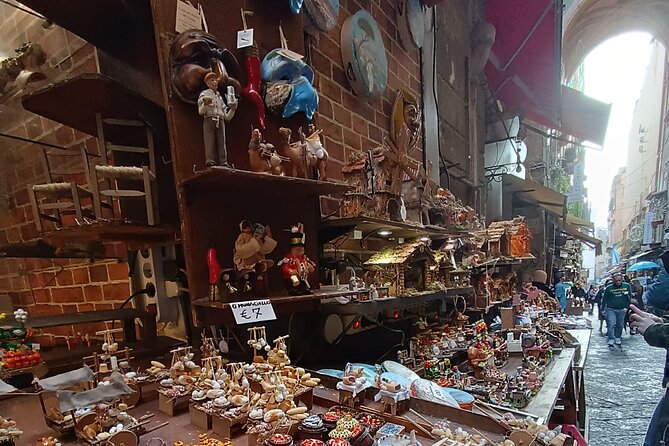
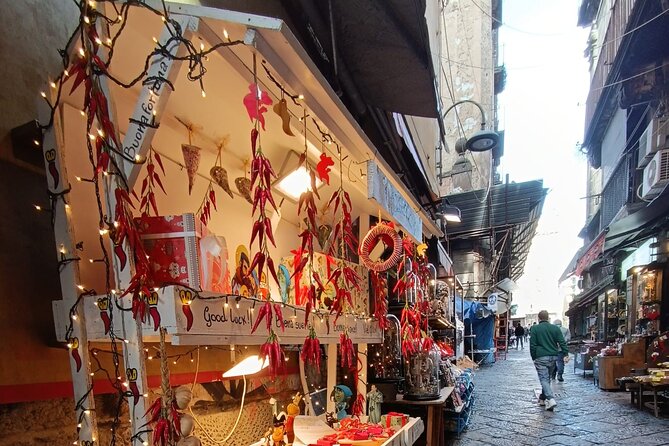
Next is Via San Gregorio Armeno, famous for artisan shops making nativity-scene figurines. Most people think of Christmas crafts as seasonal. Here’s the Naples twist: many artisans make for the nativity tradition all year long, keeping the details polished so the displays feel finished when the season ramps up.
This street is also about imagination and timing. You’ll see both the more canonical figures and more original work—shops sometimes produce characters with features inspired by topical events from the year. That means you can walk the street and feel a snapshot of Naples culture: religion, humor, and current affairs all mixed together.
Practical angle: if you like shopping, this street is the obvious stop. But even if you don’t buy, it’s worth it for the craft context. You start noticing technique and materials instead of treating storefronts like photo backdrops.
The tour time here is about 15 minutes, so the goal isn’t a long shop crawl. You get a taste and the guide’s direction, then you can decide whether to linger afterward.
More of Naples at street pace



Basilica di San Lorenzo Maggiore: old stones and archaeological access
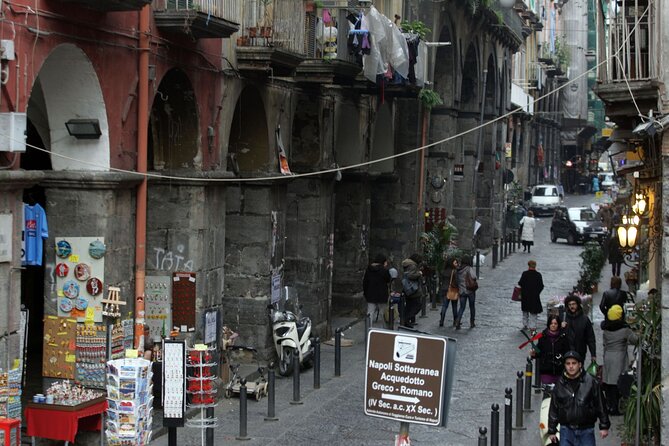
Then you reach Basilica di San Lorenzo Maggiore, one of Naples’s oldest major churches, located near Piazza San Gaetano. This is where the tour shifts from streets-as-layers to buildings-as-layers.
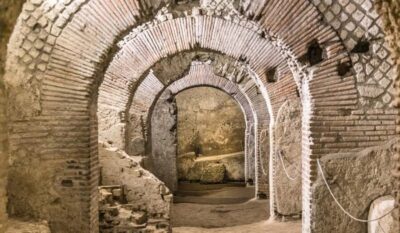
What makes this stop more than a quick look is how the religious complex connects to preservation and study. The area includes the Museo dell’Opera di San Lorenzo Maggiore, and it also provides access to the homonymous archaeological excavations. Even if you don’t spend extra time inside, the guide framing helps you understand why people build heritage tours around this kind of site: it’s a place where different eras overlap in the same footprint.
Timing note: the stop is listed at about 15 minutes, so you’ll likely do a fast exterior-to-interior orientation, plus whatever explanation the guide can cover in that window. If you want longer museum time, plan to come back on a separate visit after the walk.
Via dei Tribunali: learning why the ancient street names matter
After that, you move to Via dei Tribunali, another core street in the historic center. Here’s the key point your guide should make (and this stop is built for it): Via dei Tribunali corresponds to the ancient Greek road axis. The modern street follows the older structure, and that changes how you should think about what you’re seeing.
You may hear the term “decumanus major,” which is a Roman label used to describe a major east-west thoroughfare in some historical naming systems. But the tour context makes it more accurate to understand the original shape as plateia—the Greek term for that type of street grid feature. It’s a small vocabulary lesson, but it turns into a bigger payoff: you stop guessing whether the city’s layout was Roman, Greek, or something else. Instead, you realize Naples’s street lines are a record of who built and rebuilt.
This stop is also tied to something tangible for heritage fans: the street axis is part of a broader historic center designation recognized as a World Heritage Site in 1995. You don’t need to be a history nerd to appreciate this. You just need someone to translate the street plan into human-scale meaning.
Expect a 15-minute stop here—enough time for a guided orientation, not enough time to become lost in details.
Campanile della Pietrasanta: the bell tower as a clue
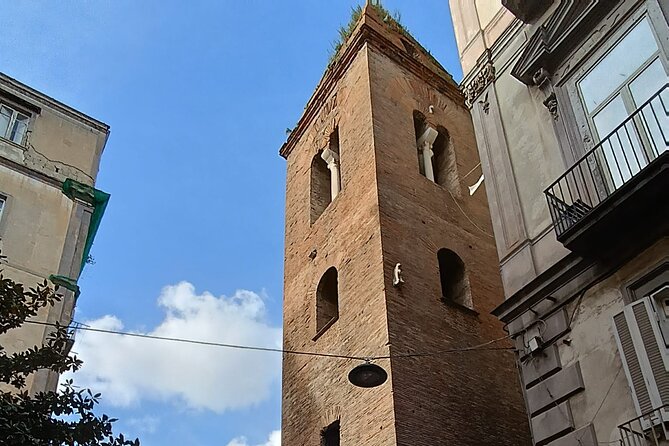
Next you see the Campanile della Pietrasanta, the bell tower connected to the Pietrasanta church. This tower stands out because it’s described as the only remnant of the primitive version of the original structure.
It’s also positioned in a way that makes you notice orientation. The tower has an open facade toward via Tribunali, and there’s also another opening toward via del Giudice. Those details matter because they show you how buildings in dense historic Naples often function like landmarks inside an ongoing maze of lanes.
This stop is shorter—about 10 minutes—which works well here. The guide likely uses it as a visual “pause and look” moment before the route continues. If you’re the type who normally takes photos of only the biggest churches, this is one of those stops that trains you to see the smaller signals that help you understand how the city evolved.
Fontanelle Cemetery: the hillside cave stop that changes the mood
One of the most praised elements of this tour is the chance to go off the beaten path to the Fontanelle Cemetery, described as set in a hillside cave. That’s a big deal in a walking tour like this, because it shifts the experience from sightseeing to atmosphere.
This part is especially valuable because it broadens what “Naples history” means. Instead of only focusing on famous streets and big facades, you get a look at how the city has handled death, memory, and space. A cave setting also changes how sound and light behave, so even at a quick visit, it can feel more personal and less like a routine stop.
Two practical considerations:
- Wear shoes you can trust on uneven ground.
- Keep your expectations respectful and calm; this isn’t built to feel like a casual photo-op.
Even if the cemetery isn’t the first thing on your Naples checklist, it’s the kind of stop that makes the rest of the tour click. You start understanding Naples as a place that remembers.
The pace: short stops that add up to real context
The itinerary is broken into bite-sized segments:
- Spaccanapoli: ~15 minutes
- Via San Gregorio Armeno: ~15 minutes
- Basilica di San Lorenzo Maggiore: ~15 minutes
- Via dei Tribunali: ~15 minutes
- Campanile della Pietrasanta: ~10 minutes
Plus the Fontanelle Cemetery component highlighted as a core experience
That pacing is intentional. You get frequent “reset points” where you can ask questions and regroup. And because the group is limited to 20 people, you’re more likely to actually hear the guide instead of getting swept into a mass.
If you hate structured tours, this still might work because the stops are short and the learning feels tied to what you see in the moment.
What kind of traveler this tour suits best
I think this tour is best for you if:
- You want Naples to make more sense fast, not after a week of accidental wandering
- You like learning how streets and buildings connect across time
- You enjoy street-level culture, especially the craftsmanship behind nativity scenes
- You want a guide who can guide your attention, not just point out sights
It might be less ideal if:
- You’re mainly after long museum time or sit-down cathedral moments
- You dislike walking in older, uneven streets
- You’re hoping for a low-cost version of a curated route
Guide quality matters here, and it shows
The name that comes up with this tour is Valentino, and the reason is simple: he helps you find places and perspectives that don’t appear if you just follow the busiest pedestrian flow. That’s the core value of a good Naples guide. You don’t need fancy theatrics; you need direction, context, and the ability to point out what your eye would normally skip.
If you get a guide like that, the tour stops become more than a checklist. They turn into a narrative you can feel while you walk.
Should you book this Naples Historical Center walking tour?
Yes, if you want a guided walk that hits the streets and then explains what they mean—especially if Fontanelle Cemetery and the Greek-vs-Roman street naming lesson sound interesting to you. The price is steep compared to DIY walking, but the small group size, professional local guide, and included coffee/tea plus sfogliatella push it toward value for people who want the most meaning per hour.
If you’re on a tight budget or you prefer totally independent wandering, you could copy the route on your own. But you’ll probably miss the careful context that makes Naples feel legible instead of just crowded.
FAQ
How long is the Naples Walking tour of the Historical Center?
It’s about 2 hours.
What does the tour cost?
The price is $120.68 per person.
Is the tour offered in English?
Yes, it is offered in English.
What is the maximum group size?
This activity has a maximum of 20 travelers.
Where do we meet, and does it end somewhere else?
You start at Piazza San Domenico Maggiore and the tour ends back at the same meeting point.
Is it suitable for children and are service animals allowed?
Children must be accompanied by an adult. Service animals are allowed, and most travelers can participate. The tour also requires good weather.
More Tours in Naples




More Tour Reviews in Naples

More of the Old Center





More Naples tours, freshly reviewed




Naples Old Town Tours, compared.
 ★ 4.9Downtown Tour with Veiled Christ & St Clare TicketsFrom $576,462 reviews
 ★ 4.8Origins, Cults and Legends Old Town Guided TourFrom $31749 reviews
 ★ 4.9The Holy Mile 3-Hour Guided TourFrom $22711 reviews
 ★ 4.7Guided Pub Crawl in the Old TownFrom $18300 reviews
 ★ 4.8Old Town Tour with Veiled Christ and CathedralFrom $57276 reviews
 ★ 5.0Naples Walking Tour: Old Town and SpaccanapoliFrom $30200 reviews
 ★ 4.5City Center Walking Tour with Underground NaplesFrom $90143 reviews
 ★ 5.0Historic Center Tour & Veiled Christ Entry TicketsFrom $7097 reviews
Browse the lists this tour appears in